Key takeaways
- The Low-Pro Grip collapses to 2.6 mm, matching camera bump profiles.
- Pure MagSafe magnetic attachment replaces legacy adhesive backings for easy removal.
- A single-piece flexible polymer construction resists up to 30 lbs of pull.
- The integrated metal ring functions as a stable portrait and landscape kickstand.
- Wireless charging is supported but suffers speed attenuation due to distance.
PopSockets Low-Pro Grip: The Architectural Reality
On June 16, 2026, the mobile accessory ecosystem witnessed a significant structural shift with the official release of the PopSockets Low-Pro Grip, a re-engineered hardware solution aimed at addressing the bulky footprint of legacy phone grips. Historically, phone grips have presented a stark engineering trade-off: mechanical security and ergonomics versus bulk and pocketability. The original PopSockets, which debuted in 2014, relied on a collapsible plastic accordion mechanism that sat prominently on the back of mobile devices. While highly functional for grip stability and fidgeting, its thick profile created clearance issues, snagging on clothing and preventing devices from laying flat on flat surfaces. The Low-Pro Grip directly addresses these design challenges through a complete overhaul of materials and mechanical architecture.
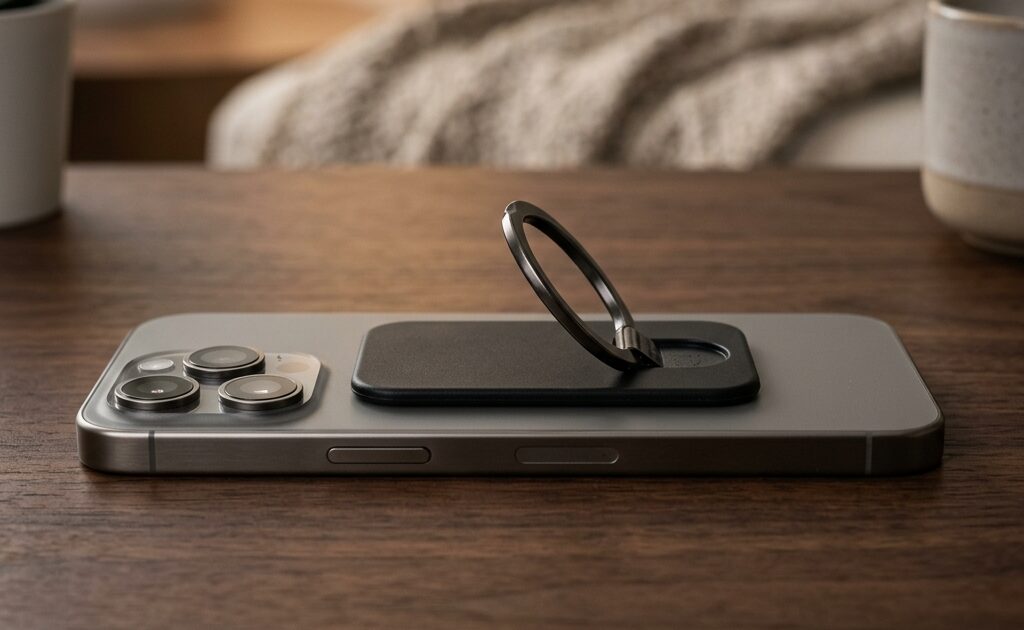
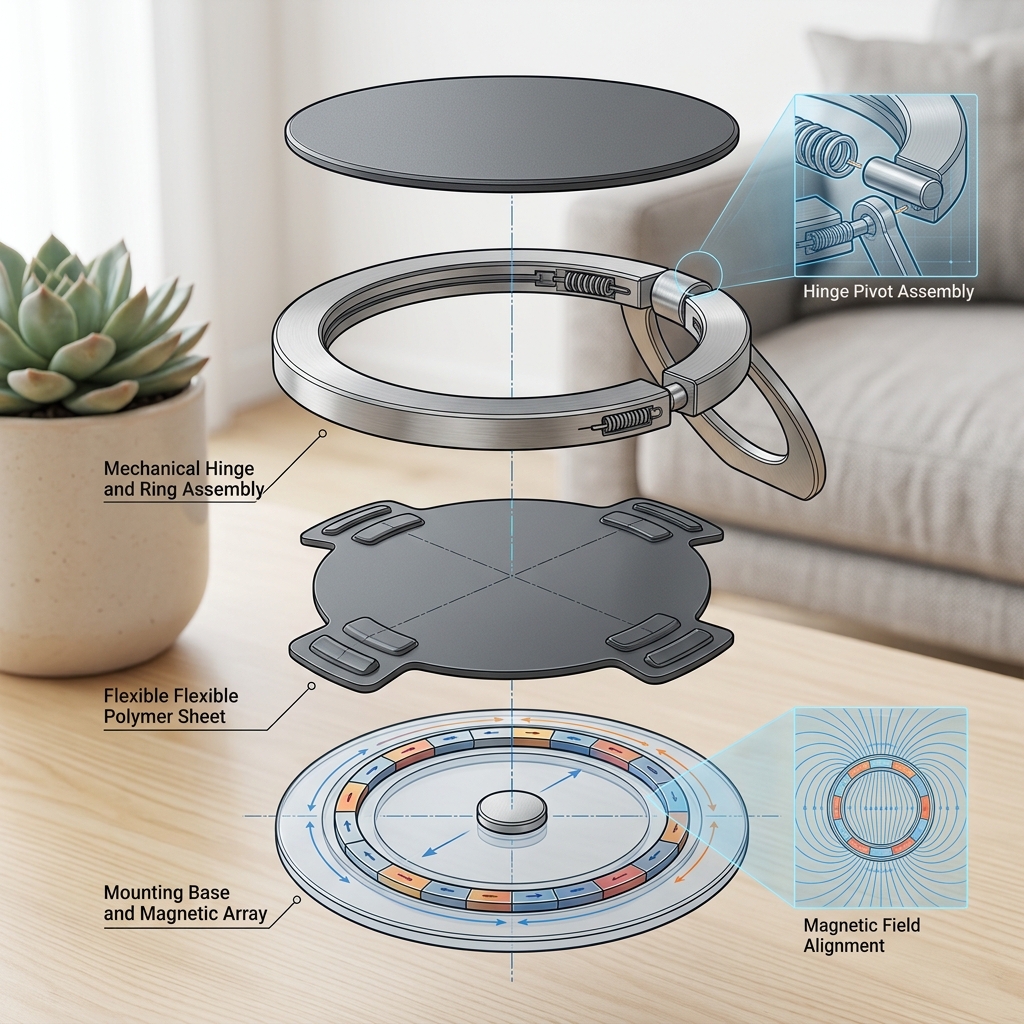
At the center of this redesign is a collapsed profile measuring approximately 2.6 mm in thickness. This ultra-low-profile chassis is specifically engineered to sit lower than the camera bump on modern flagship smartphones, such as the iPhone 17 Pro Max. By matching or staying below this camera extrusion, the grip ensures that the device can lay perfectly flat on desks or wireless charging pads, eliminating the wobbling associated with thicker accessories. Achieving this thickness required PopSockets to move away from the traditional multi-tiered accordion plastic structure. Instead, the Low-Pro Grip features a face constructed from a single piece of flexible, high-fatigue-resistant polymer. When collapsed, the polymer sheet sits flush within the outer ring; when activated by a gentle finger nudge, the slitted, concentric geometry of the polymer expands upward like a paper lantern, creating a secure loop for fingers to slide through.
The boundary of the grip is reinforced with a hinged metal ring. This ring serves a dual purpose: it provides a rigid frame that protects the flexible polymer interior when collapsed, and it swings out on a mechanical friction hinge to function as a multi-angle kickstand. Unlike previous models that only supported basic horizontal angles, this metal ring is capable of propping the phone up in both portrait and landscape orientations, accommodating modern vertical video formats and traditional media viewing. From a durability perspective, the engineering teams at PopSockets validated this design to withstand up to approximately 30 pounds of pulling force, ensuring that the ultra-thin polymer and hinge mechanisms remain structurally sound under continuous physical strain and fidgeting.
However, minimizing the thickness of the accessory introduces clear electromagnetic challenges, particularly regarding wireless charging. While the Low-Pro Grip is thin enough to allow MagSafe chargers to couple with the phone’s internal charging coils without removing the grip, the physics of induction cannot be bypassed. The introduction of a 2.6 mm physical barrier—compounded by any phone case—increases the distance between the transmitter and receiver coils. This additional spacing increases magnetic flux leakage, resulting in higher thermal output and significantly slower charging speeds. Rather than achieving the maximum MagSafe power delivery, users attempting to charge through the grip will experience a slower trickle charge, making manual removal of the magnetic grip preferable for fast-charging scenarios.
Market Impact & Deployment
The introduction of the Low-Pro Grip at a launch price of $39.99 represents a calculated repositioning of PopSockets’ product portfolio. By offering an premium, minimalist accessory, the company is actively expanding its addressable market to include demographics that previously rejected the brand. Historically, the quirky, bulky, and heavily patterned aesthetic of traditional PopSockets appealed to casual consumers and younger demographics. However, business professionals and users seeking clean device lines often opted for competitor solutions or went without a grip entirely. David Barnett, the inventor and founder of PopSockets, admitted that luring in customers who felt traditional grips caught on pockets was a primary motivator for the Low-Pro’s design. The initial retail rollout reinforces this premium positioning, launching exclusively at Apple Stores and PopSockets.com, before expanding to wider retailers at the end of July 2026.
Analyzing the competitive landscape through detailed competitor reviews highlights how PopSockets is challenging established ultra-thin grip manufacturers, most notably OhSnap. OhSnap gained a strong market presence with its Snap Grip series, which prioritized thin profiles. OhSnap’s Snap 4 Luxe model, for example, measures a mere 2.5 mm in thickness. However, it relies on a reusable nano-adhesive backing to adhere to the phone or case. While this nano-adhesive can be washed with water to reactivate its stickiness, it lacks the convenience of a pure magnetic connection. To address this, OhSnap released the Snap Grip 5, which features a 3.0 mm thickness, a glueless magnetic snap-on attachment, and a soft-touch finish. By matching the glueless magnetic attachment method while undercutting the Snap Grip 5’s thickness by 0.4 mm and offering an integrated metal ring kickstand, PopSockets is positioning the Low-Pro Grip as the superior engineering solution in the ultra-thin category.
From an Enterprise IT perspective, the adoption of thin, ergonomic grips has direct implications for corporate mobile fleet management. When organizations deploy thousands of corporate smartphones to field workers, logistics teams, or sales representatives, device damage and repetitive strain injuries (RSI) are recurring cost drivers. Traditional bulky grips are unsuitable for enterprise deployment because they prevent phones from fitting into standard vehicle mounts, multi-device charging bays, and rugged docking cradles. The Low-Pro Grip’s 2.6 mm profile resolves this operational bottleneck, allowing enterprises to provide ergonomic stabilization to workers without sacrificing compatibility with existing infrastructure. The resultant drop reduction directly correlates with lower screen replacement costs, reduced hardware turnover, and fewer IT support tickets, presenting a clear return on investment (ROI) that offsets the $39.99 initial purchase price.
The Consumer Translation
For the end-user, the architectural shift of the Low-Pro Grip translates into a vastly different tactile and daily experience. The defining characteristic of the original PopSocket was its clicky, mechanical accordion pop. This action was highly satisfying for fidgeters but came at the expense of pocket clearance. The Low-Pro Grip replaces this mechanical action with a slide-and-nudge mechanism. While it lacks the auditory click of the legacy model, the physical feedback of the expanding polymer sheet offers a different kind of tactile engagement, satisfying the urge to fidget while remaining completely silent. This is particularly advantageous in professional settings where the loud popping noise of a traditional grip would be disruptive.
Furthermore, advances in polymer chemistry and hardware engineering have enabled a material that feels premium to the touch while resisting environmental wear. The face of the Low-Pro has a soft matte finish that resists fingerprint oils and pocket lint. The choice of launch colors—Blue Aura, Electric Fuchsia, Navy, and Black—aligns with the design aesthetics of modern flagship devices, allowing consumers to match or accent their phones. The integration of the swing-out metal kickstand also improves on the utility of traditional plastic stands. Because the metal ring rotates and locks firmly via friction, it can support the weight of heavy devices, such as the iPhone 17 Pro Max, at various angles on uneven surfaces like airplane trays or soft bedding, without collapsing under the weight.
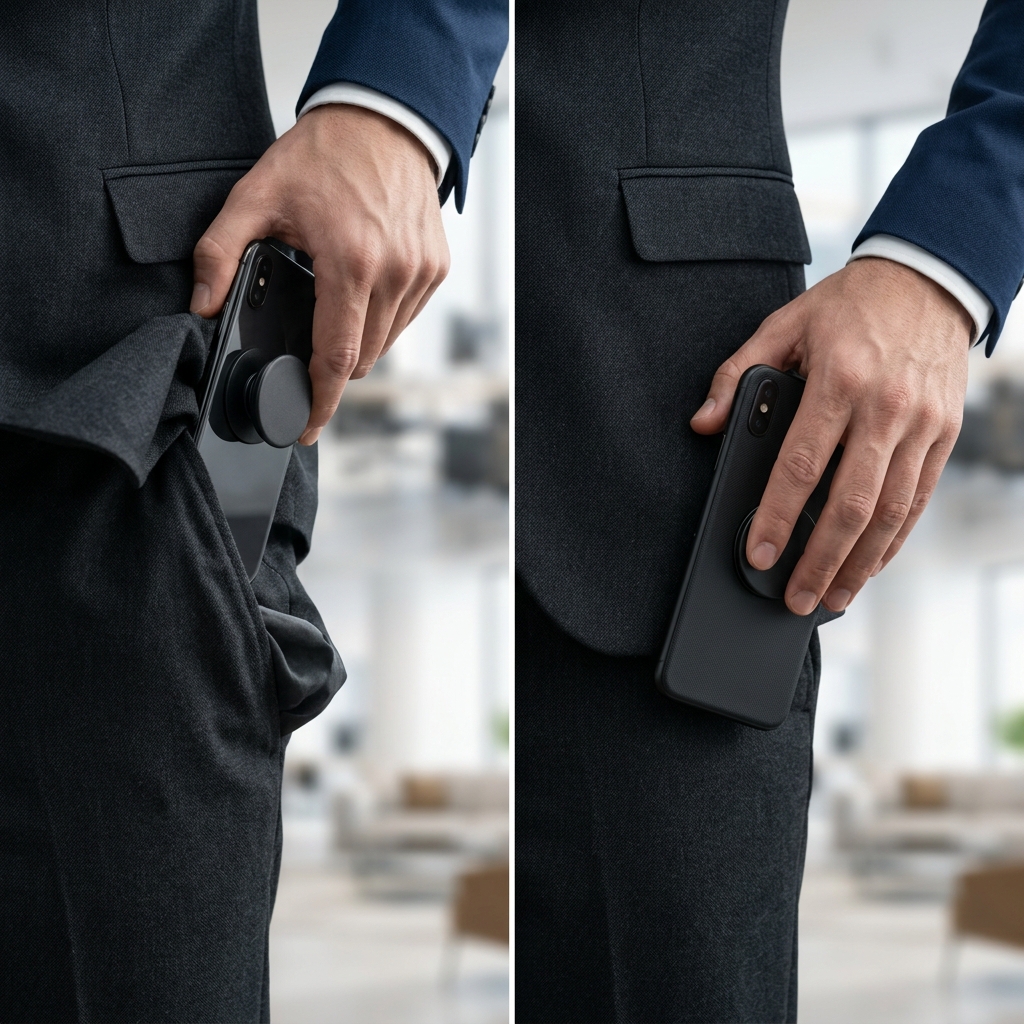
The daily utility of pocketability cannot be overstated. A common complaint with traditional grips was their tendency to snag on the seams of pants pockets, occasionally causing the grip to detach or, worse, pulling the phone out of the user’s hand during retrieval. The chamfered edges and flush profile of the Low-Pro Grip allow the device to slide smoothly into tight pockets without resistance. While the reduction in wireless charging speeds remains a minor drawback, the ease with which the MagSafe backing can be snapped off allows users to transition between using the grip and placing the phone on high-speed desktop wireless chargers or magnetic car mounts without friction.
Frequently Asked Questions
Q1: What is the exact thickness of the PopSockets Low-Pro Grip compared to competitors?
A1: The PopSockets Low-Pro Grip has a collapsed thickness of approximately 2.6 mm. In comparison, the OhSnap Snap 4 Luxe measures 2.5 mm, while the OhSnap Snap Grip 5 is slightly thicker at 3.0 mm.
Q2: How is the PopSockets Low-Pro Grip activated and attached?
A2: Unlike traditional accordion-style pop-ups, the Low-Pro Grip is activated by a gentle finger nudge to raise the disk. It attaches magnetically via MagSafe, allowing for easy removal when compared to adhesive grips.
Q3: Can the Low-Pro Grip remain on the phone during wireless charging?
A3: Yes, the thin design allows MagSafe connection without removal. However, because charging speed decreases as distance between the charger and phone increases, expect slower trickle-charging speeds if left attached.
Q4: What are the durability specifications of the Low-Pro Grip’s polymer construction?
A4: The grip is engineered using a single piece of flexible polymer capable of withstanding up to 30 pounds of pulling force. This ensures high durability for active users and fidgeting.
Q5: How does the mounting system differ from OhSnap models?
A5: While PopSockets uses purely magnetic MagSafe mounting, the OhSnap Snap 4 Luxe utilizes a reusable, washable nano-adhesive backing. The newer OhSnap Snap Grip 5 shifted to a glueless magnetic design similar to the Low-Pro.
TechNode HQ Verdict: Pros, Cons & Usability
- Pro (Engineering): The 2.6 mm polymer and metal ring construction successfully reduces collapsed thickness below modern camera bumps while supporting 30 lbs of pulling force.
- Pro (Consumer): Integrated metal ring functions as a highly stable, multi-angle kickstand supporting both portrait and landscape orientations without slide drift.
- Con: Significant wireless charging speed attenuation occurs when charging through the grip, forcing users to remove the accessory for optimal power delivery.
- Con: A premium price tag of $39.99 places it at the higher end of the mobile accessory market compared to budget competitors.
Enterprise Usability: CTOs and fleet managers should consider deploying the Low-Pro Grip for mobile workforces using corporate smartphones. The ultra-thin profile prevents compatibility conflicts with enterprise docks and vehicle cradles while providing drop-mitigating ergonomics, ultimately lowering fleet TCO by reducing physical device failures.
Everyday Usability: For consumers who have avoided traditional phone grips due to pocket snagging and desk instability, the Low-Pro Grip is a highly recommended purchase. It delivers structural grip security and kickstand utility without compromising the sleek industrial design of modern flagship smartphones.