The global construction and infrastructure sector operates on a fundamental, often unspoken assumption: the uninterrupted flow of raw materials. Cement, steel, and heavy machinery form the triad of modern urban development. But what happens when that supply chain is entirely severed, and an entire urban landscape is reduced to pulverized debris? In the Gaza Strip, a masterclass in extreme engineering and decentralized resource management is currently unfolding. Driven by absolute necessity under a stringent blockade, local engineers are upcycling the remnants of destroyed buildings into interlocking, Lego-like bricks.
According to recent United Nations Office for Project Services (UNOPS) estimates, the sheer volume of rubble in Gaza has surpassed 60 million metric tons. To put this into perspective, this is the equivalent capacity of nearly 3,000 massive container ships. Clearing it using conventional methods would take over a decade and cost billions of dollars. Yet, amidst this unprecedented infrastructure collapse, initiatives like the Green Rock project—led by Suleiman Abu Hassanin—are redefining the parameters of disaster recovery. By crushing concrete debris, mixing it with local soil, and utilizing alternative binding agents, this hyperlocal operation is bypassing the paralyzed international supply chain to manufacture structural components directly at the edge.
This is not merely a humanitarian feel-good story; it is a rigorous exercise in engineering and circular economics under the most hostile conditions imaginable. To understand the viability of this initiative, we must strip away the marketing gloss and examine the underlying mechanics, the scalability bottlenecks, and the severe occupational hazards inherent in processing war-zone debris.
The Architectural Reality
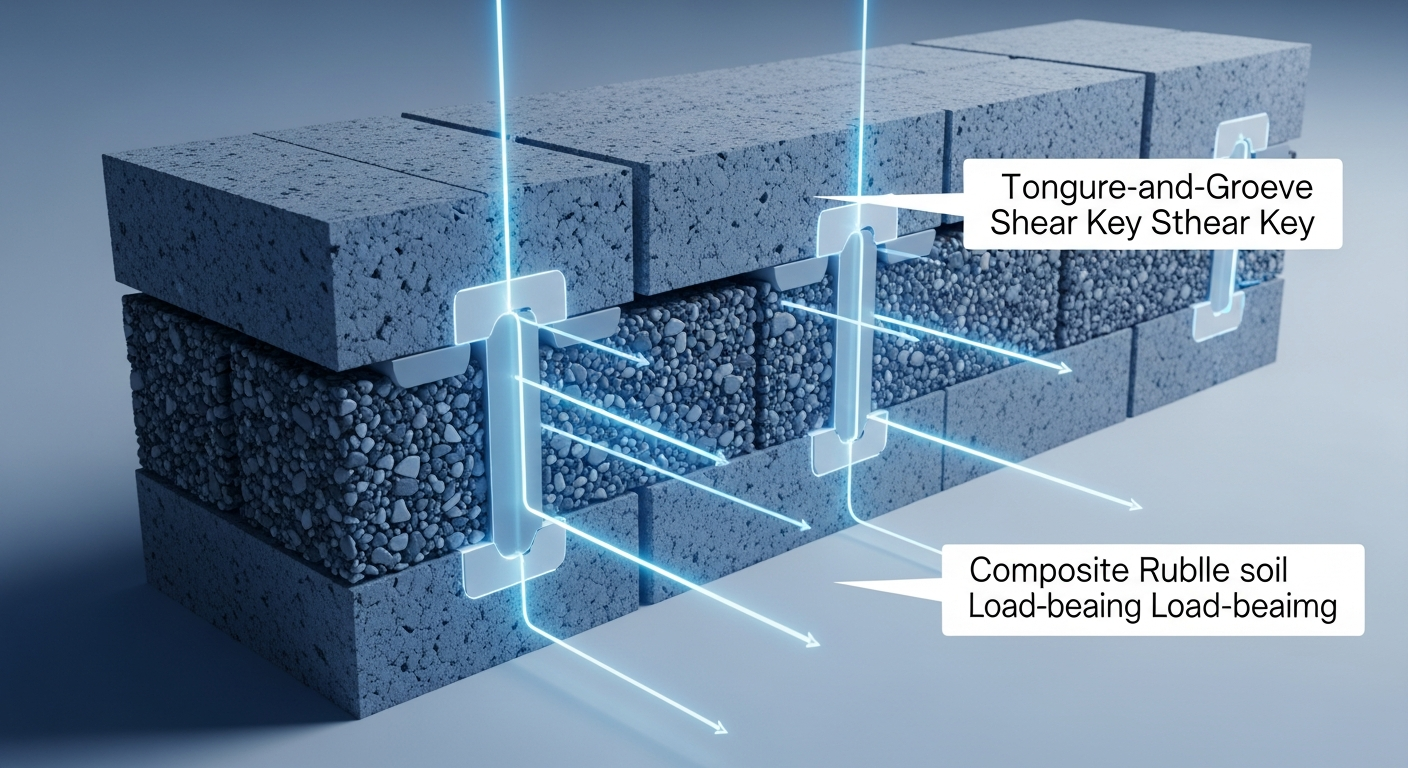
In conventional masonry, mortar acts as the chemical adhesive and load-distributing medium between bricks. It compensates for dimensional inaccuracies, seals the structure against the elements, and provides essential tensile strength. However, mortar requires Portland cement—a material heavily restricted from entering Gaza due to its classification as a dual-use commodity. To circumvent this hard limitation, the Green Rock project employs mortar-less interlocking masonry.
These “Lego-like” blocks rely on precise geometric configurations, typically featuring tongue-and-groove or shear-key designs. When stacked, the interlocking mechanisms mechanically restrict lateral movement, distributing compressive loads directly through the physical matrix of the wall rather than relying on a chemical bond. This design significantly accelerates construction time and allows unskilled labor to assemble structures, as the self-aligning nature of the blocks removes the need for expert, highly trained masons.
The true innovation, however, lies in the materials science of the block itself. A standard concrete block requires 7% to 12% cement to bind the aggregate effectively. With cement unavailable, engineer Wajdi Jouda and the Green Rock team have engineered a composite matrix using crushed rubble and local soil. When concrete is pulverized, a portion of the original cementitious material remains unhydrated. By crushing the debris to a specific aggregate gradation and mixing it with local clay or silt, the team leverages the natural pozzolanic properties of the soil.
This mixture is then subjected to immense mechanical pressure using a hand-built compression machine. This process, reminiscent of the CINVA-ram presses developed in the 1950s for compressed earth blocks (CEBs), forces the particles into a highly dense configuration. The extreme pressure expels air voids and maximizes surface-area contact between the aggregate and the soil binder. The result is a block that achieves sufficient compressive strength for single-story, load-bearing walls without a single ounce of imported cement or the need for high-temperature kiln firing.
Market Impact & Deployment
From an enterprise perspective, the Green Rock initiative represents a radical shift toward decentralized infrastructure deployment. In traditional disaster recovery models, materials are sourced globally, shipped to ports, and transported via heavy, carbon-intensive logistics networks. Gaza’s reality forces a closed-loop circular economy—often referred to as “urban mining”—where the raw material, the manufacturing facility, and the deployment site are geographically identical.
Economically, this hyperlocal model is highly efficient. The project reports a 50% to 60% reduction in overall construction costs compared to traditional rebuilding methods. By eliminating the need for imported cement, mortar, and heavy transport, the capital expenditure is drastically lowered. Furthermore, it transforms a massive liability—60 million tons of debris—into the primary asset, while simultaneously generating employment for displaced populations who are paid to collect, sort, and press the materials.
However, a rigorous red-team audit reveals severe scalability bottlenecks that cannot be ignored. The Green Rock workshop currently produces between 1,000 and 1,500 bricks per day. A standard small shelter requires approximately 3,000 to 5,000 bricks, meaning the current output can only yield one shelter every two weeks. When juxtaposed against the hundreds of thousands of displaced individuals and the 60 million tons of rubble, the production rate is a statistical rounding error.
To achieve meaningful market impact, this technology requires industrial scaling. We have seen similar interlocking rubble-brick technologies deployed in post-conflict Ukraine by organizations like Mobile Crisis Construction, which utilize containerized, automated mobile factories capable of producing 8,000 bricks a day. Without access to diesel, heavy crushers, and automated hydraulic presses, Gaza’s hand-operated model will remain a localized adaptation rather than a macro-level reconstruction solution. It is a proof of concept waiting for the geopolitical constraints to lift so that industrial automation can take over.
The Consumer Translation
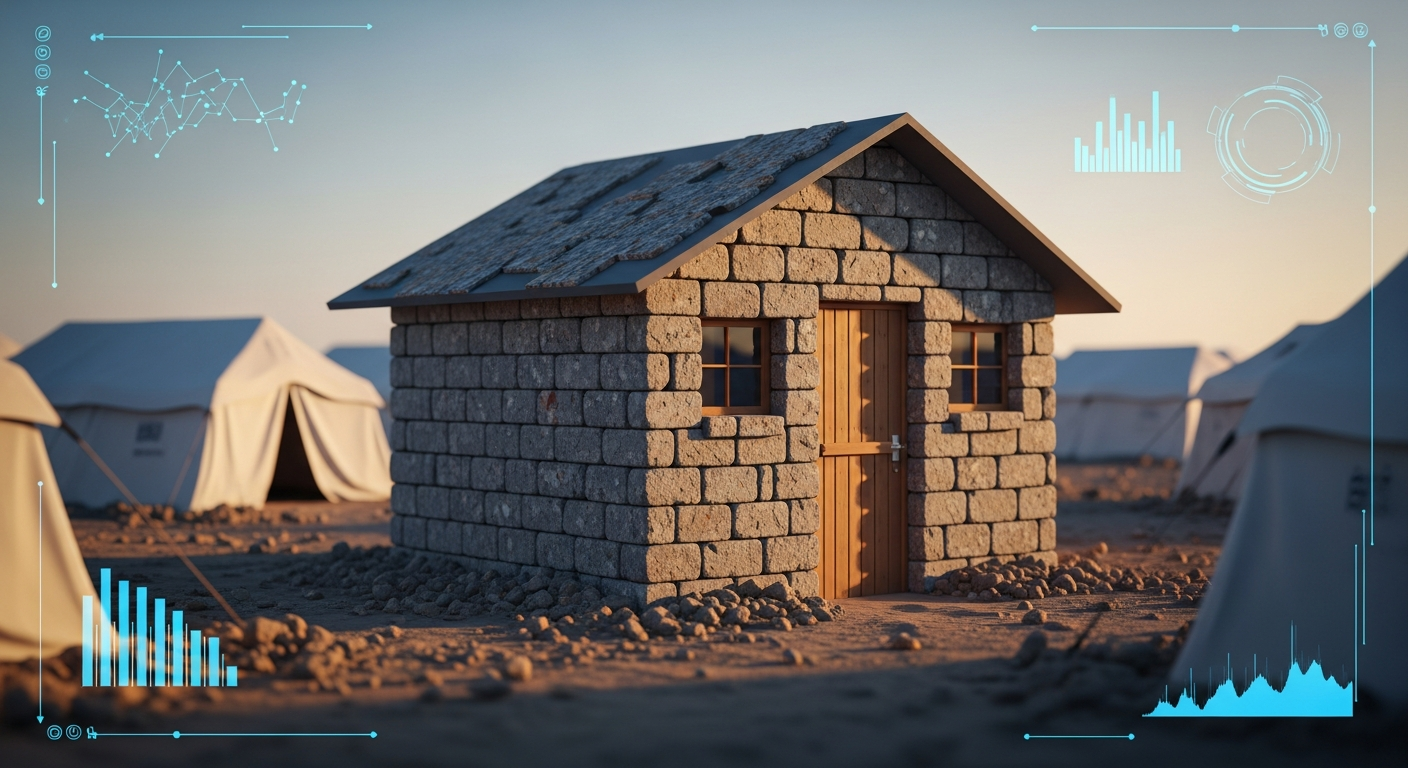
For the end-user—the displaced families currently surviving in canvas and plastic tents—the transition to an interlocking rubble-brick shelter is a monumental upgrade in quality of life. Tents offer virtually zero thermal insulation, leaving occupants entirely vulnerable to the extreme heat of the Middle Eastern summer and the freezing, flooded conditions of winter.
The recycled rubble blocks, by contrast, possess significant thermal mass. The dense composite material absorbs solar radiation during the day, delaying the transfer of heat into the interior, and slowly releases it at night as ambient temperatures drop. Additionally, the acoustic insulation provided by thick, dense walls offers a psychological barrier, a crucial element of trauma recovery and privacy in a high-conflict, densely populated zone.
Yet, this consumer translation comes with a dark, highly hazardous caveat that is often glossed over in optimistic humanitarian reports. The raw material—war-zone rubble—is inherently toxic. Environmental engineers and the UN warn that pulverized urban debris contains lethal contaminants, including asbestos fibers from older buildings, heavy metals from munitions and electronics, and the ever-present threat of unexploded ordnance (UXO).
Workers manually sorting and crushing this debris without industrial-grade personal protective equipment (PPE) or automated screening machinery are exposed to severe occupational health risks. The inhalation of silica dust and asbestos can lead to long-term, fatal respiratory diseases, including silicosis and mesothelioma. Therefore, while the bricks provide immediate physical shelter, the manual manufacturing process itself is a desperate gamble with long-term public health.
Ultimately, the significance of the Green Rock project transcends its structural output. As Abu Hassanin notes, when a man rebuilds his home with his own hands using the very debris that destroyed it, he transitions from a passive recipient of international aid to an active architect of his own survival. It is a profound psychological reclamation, engineered out of the dust of systemic collapse.
TechNode HQ Verdict: Pros, Cons & Usability
- Pro (Engineering): Eliminates the need for imported Portland cement and mortar by utilizing geometric shear-key interlocking and mechanical compression of unhydrated silicates.
- Pro (Consumer): Provides superior thermal mass and acoustic insulation compared to standard humanitarian tents, drastically improving living conditions and survivability.
- Con: Severe scalability bottlenecks; manual production of 1,500 bricks per day is mathematically insufficient to address 60 million tons of rubble in a realistic timeframe.
- Con: Extreme occupational hazards; hand-sorting war-zone debris exposes workers to asbestos, silica dust, heavy metals, and unexploded ordnance without proper PPE.
Enterprise Usability: For CTOs and infrastructure planners in disaster recovery, this model proves that decentralized, edge-based manufacturing (urban mining) is viable when global supply chains fail. However, to deploy this at an enterprise scale, organizations must invest in containerized, automated mobile block factories (similar to those used in Ukraine) to bypass the manual labor bottleneck and integrate automated hazard screening.
Everyday Usability: For the displaced public, these bricks represent an immediate, life-saving upgrade from tent living. While they are not suitable for multi-story permanent housing due to a lack of tensile reinforcement, they are the absolute best temporary shelter solution available under current geopolitical constraints.
Sources & Citations:
Original Claim via: wired
Official Handle: @wired
Topics Explored: Circular Economy, Interlocking Bricks, Construction Tech, Green Rock, Infrastructure Resilience