The Architectural Reality: Engineering the Coyl
For decades, the concept of the “gaming desk” was relegated to a highly specific, often polarizing aesthetic. It was an era defined by aggressive carbon-fiber textures, sharp angular edges, and an overwhelming saturation of RGB lighting. However, as the demographic of the enthusiast gamer has matured—blending seamlessly with the remote-working professional—the demand for high-end, architecturally sound workspace furniture has skyrocketed. Enter Herman Miller, a legacy brand synonymous with mid-century modern masterpieces and ergonomic dominance. While the company previously dipped its toes into the gaming sector with the Motia desk and its Logitech G chair partnerships, the newly released Herman Miller Coyl represents its first truly in-house, ground-up engineering effort aimed directly at the enthusiast market.
At its core, the Coyl is a masterclass in solving the physical friction points of modern sit-to-stand desks. The desk is defined by three distinct architectural pillars: The Trough, The Coil, and The Dial. Each element is designed to address a specific bottleneck in workspace usability.
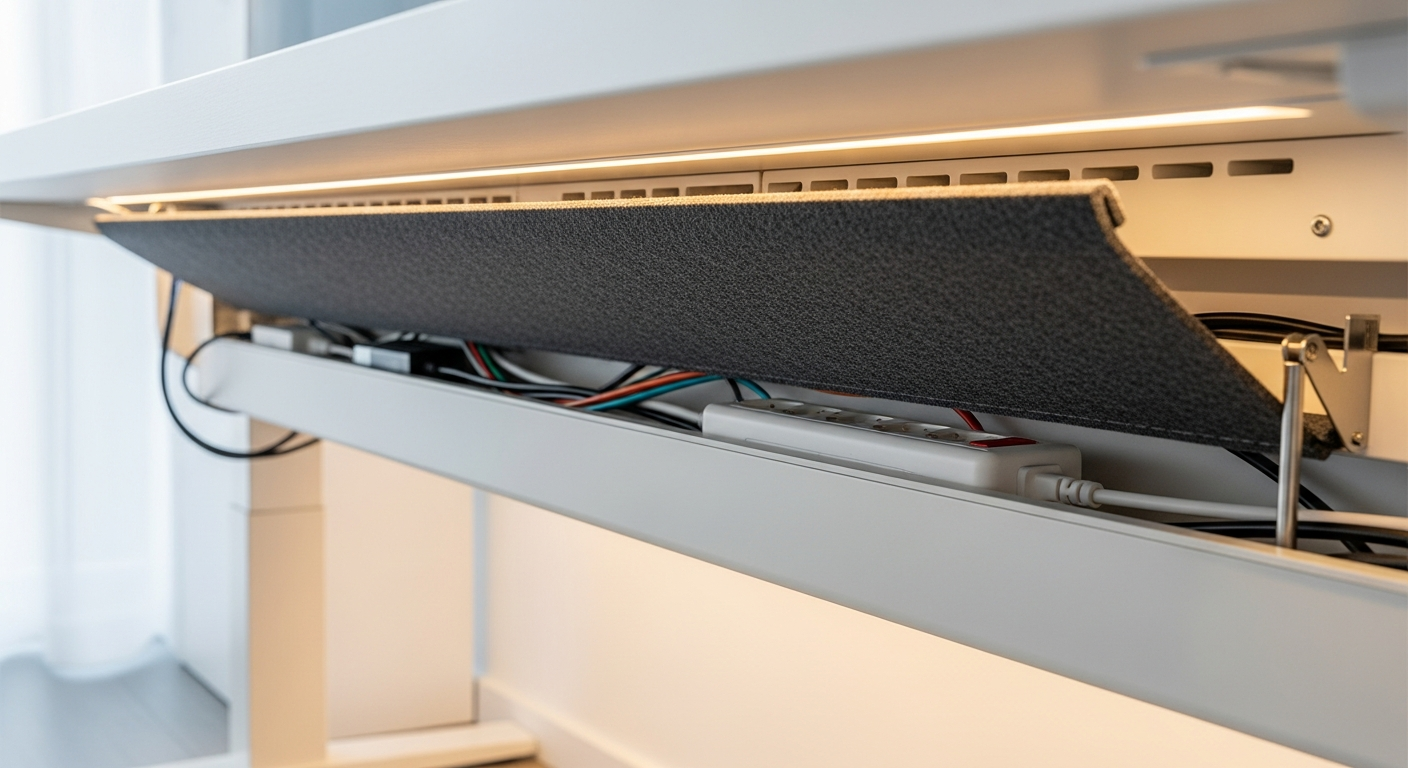
The most significant innovation is the cable management trough. Cable management is universally acknowledged as the bane of the modern workstation. Traditional standing desks attempt to solve this with flimsy wire baskets or adhesive zip-tie mounts that inevitably fail under the weight of heavy power bricks. Herman Miller’s solution is a massive, unusually wide storage space located underneath the rear of the desk. What separates the Coyl from its competitors is its front-accessibility. By raising the desk to its maximum height of 48.5 inches, users can pull down a specialized felt cover to access the trough directly from the front. This completely eliminates the “wall-gap” problem—the frustrating necessity of pulling a heavy desk away from the wall to awkwardly fish for cables from behind. It allows the user to work on their cable routing with the ease of a mechanic standing under a raised car chassis.
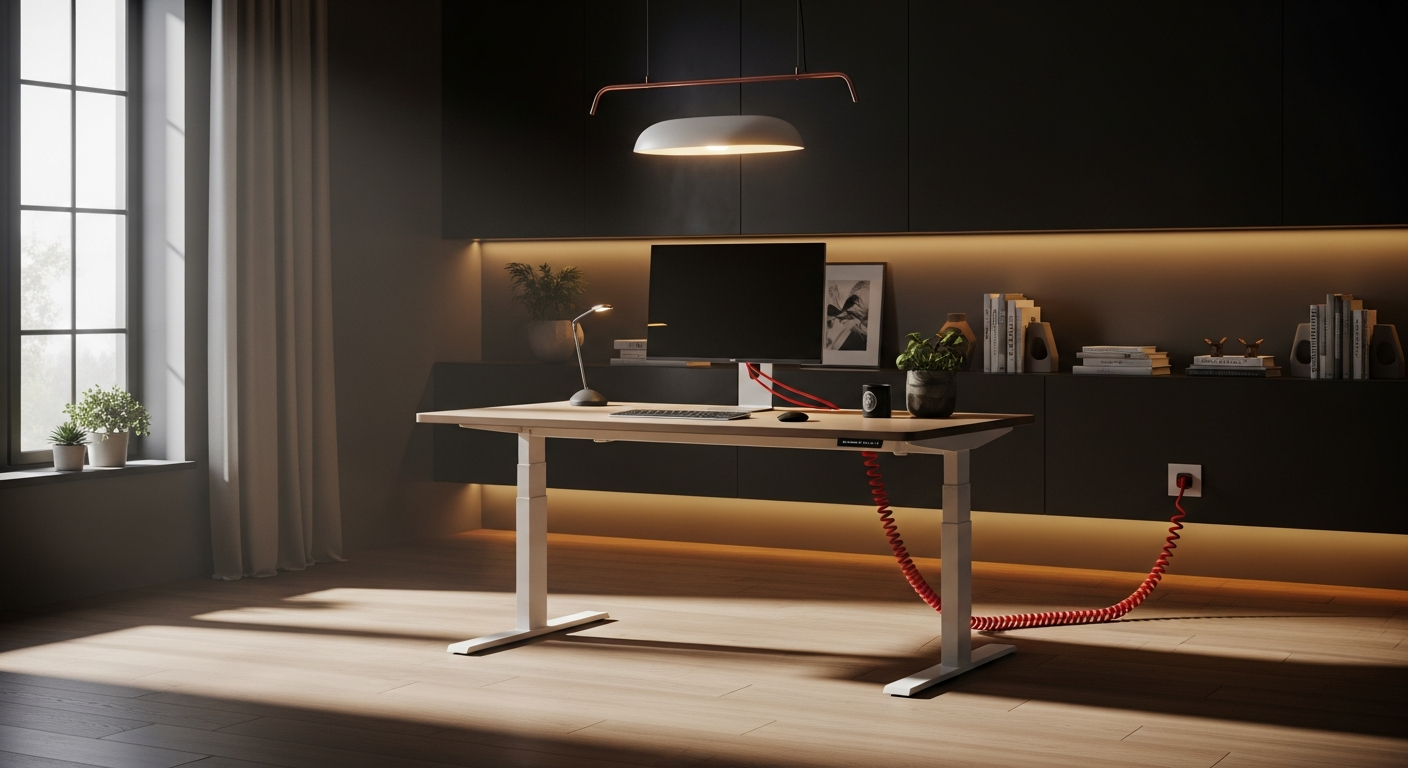
Powering this setup is the desk’s namesake: The Coil. When a desk travels vertically across a 26-inch range (from 22.5 inches to 48.5 inches), static power cables present a severe hazard. They either dangle dangerously, creating visual noise and snag risks, or they are pulled too tight, risking damage to wall outlets. Herman Miller engineered a distinctive, bright red coiled power wire that runs from the wall outlet to the desk’s integrated power strip. Inspired by the coiled cables of vintage telephone handsets and early mechanical keyboards, this design maintains dynamic tension. As the desk rises, the coil stretches; as it lowers, the coil retracts, remaining perfectly taut and visually orderly at all times.
The Mechanics of Movement: Linear Actuators and The Dial
The mechanical heart of any standing desk lies in its linear actuators—the motorized columns responsible for lifting hundreds of pounds of equipment smoothly and quietly. While Herman Miller utilizes a standard T-shaped powder-coated steel leg design (available in black or white), the user interface controlling these motors is where the Coyl truly differentiates itself.
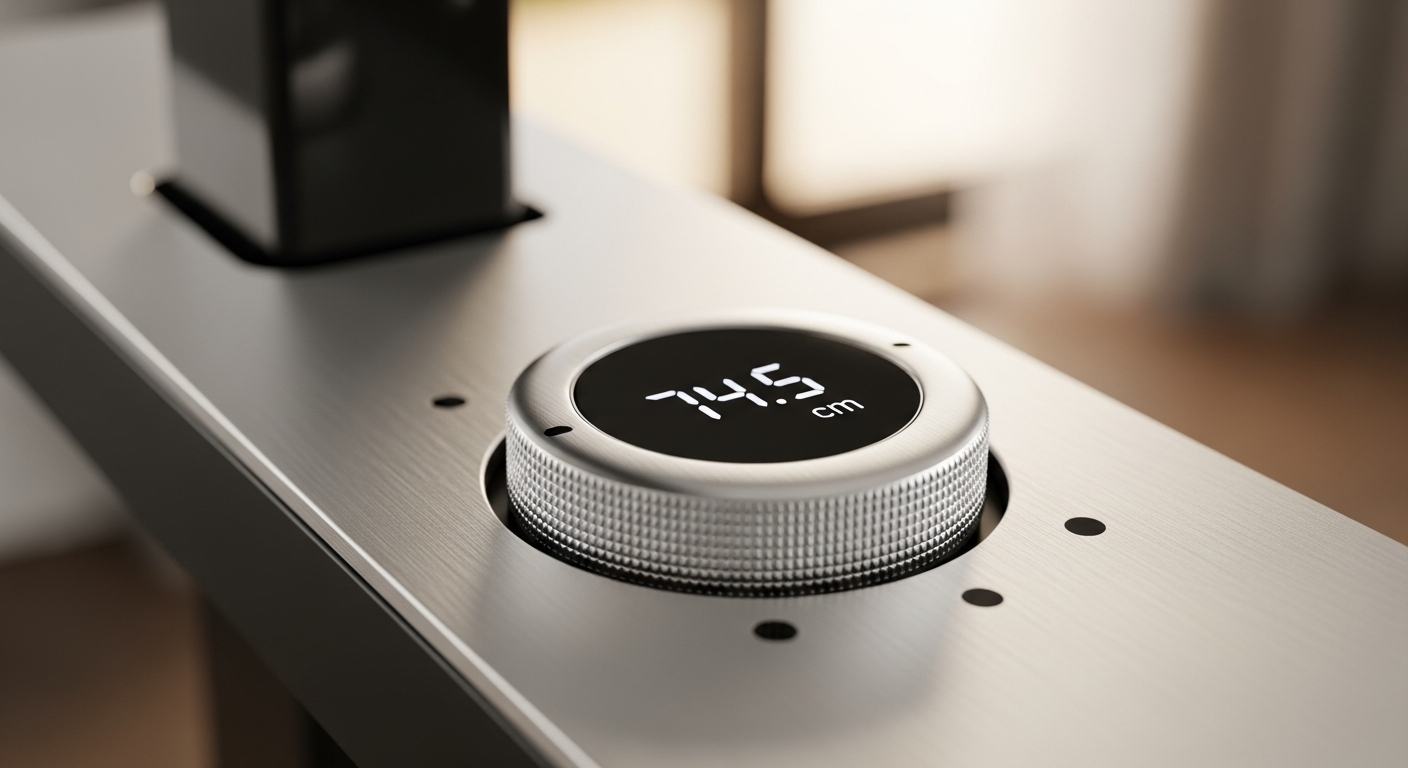
The vast majority of standing desks on the market utilize generic, mass-produced membrane switches or cheap plastic toggle paddles. These interfaces are functional but lack precision. Herman Miller has instead implemented a premium rotary dial. This dial provides haptic, tactile feedback that mimics the satisfying resistance found on high-end vintage audio receivers or enthusiast-grade gaming mice. More importantly, this dial allows users to fine-tune the desk’s height to a tenth of an inch (0.1″), with the exact measurement displayed on an integrated digital screen.
This level of micro-adjustment is not merely a luxury gimmick; it is a critical ergonomic feature. In the realm of occupational health, a discrepancy of even a half-inch in desk height can lead to severe Repetitive Strain Injury (RSI), shoulder impingement, or carpal tunnel syndrome over the course of a 10-hour work or gaming session. By allowing users to dial in their exact ergonomic sweet spot—and save it to one of four programmable height presets—the Coyl ensures strict biomechanical alignment.
The desktop itself measures 60 by 28.5 inches and is constructed from a rounded laminate, available in four sophisticated finishes: Clear on Ash, Studio White, Medium Matte Walnut, and Ultra Black. It also features integrated hooks on either side for hanging heavy gaming headsets or backpacks, alongside an optional perforated back panel (a modular pegboard) for mounting controllers, small plants, or display shelves.
Market Impact & Deployment: The Competitive Landscape
To truly understand the value proposition of the Herman Miller Coyl, it must be audited against the current heavyweights of the premium desk market. The standing desk industry is highly competitive, and the Coyl enters a battlefield dominated by brands that have spent years iterating on enthusiast-specific features.
The most formidable competitor is the Secretlab Magnus Pro. Secretlab took a radically different engineering approach. Instead of a felt trough and a coiled cable, the Magnus Pro features a world-first integrated power supply column. The power cable plugs directly into the bottom of the desk leg, routing electricity internally up to a power strip hidden within a full-length metal tray. Furthermore, the Magnus Pro is built on an all-metal chassis, allowing for a massive ecosystem of magnetic accessories—from magnetic cable anchors to magnetic headphone hangers and RGB lighting strips. The Magnus Pro supports a staggering 120 kg (265 lbs) of weight and offers a height range of 25.6 to 49.2 inches.
Another notable attempt at dominating this space was the Corsair Platform:6, a highly ambitious modular desk featuring a complex T-Channel rail system designed specifically for streamers to mount heavy camera and lighting gear. However, the Platform:6 has faced severe stock shortages and discontinuation rumors, highlighting the immense supply chain and structural complexities of manufacturing ultra-modular heavy furniture.
When placed next to the Secretlab Magnus Pro, the Herman Miller Coyl reveals a distinct performance bottleneck: its weight capacity. The Coyl is rated for only 90 kg (approx. 198 lbs). While this is sufficient for a standard dual-monitor setup and a mid-tower PC, power users with heavy ultra-wide monitors, monitor arms, heavy audio equipment, and full-tower liquid-cooled PCs may find themselves uncomfortably close to the motor’s maximum load limit.
Then there is the pricing strategy. The Herman Miller Coyl is advertised with a starting price of $1,095. However, this base model is essentially a trap. It does not include the cable management trough—the very feature that defines the desk’s utility. To acquire the trough, the price jumps to $1,495. If you want the full modular pegboard back panel, the total reaches $1,635. In contrast, the Secretlab Magnus Pro starts at around $1,099 and includes its metal cable tray and integrated leg power as standard.
However, Herman Miller counters this price disparity with its legendary Total Cost of Ownership (TCO) and warranty structure. The Coyl comes with a 12-year warranty on its main structure, 7 years on mechanical parts, and 5 years on electrical components. Secretlab, by comparison, offers a standard 5-year warranty. For an enterprise CTO outfitting a fleet of remote executives, or a consumer looking for a “buy-it-for-life” piece of furniture, Herman Miller’s SLA (Service Level Agreement) and proven track record of durability carry immense weight.
The Consumer Translation: Maturing the “Gamer” Aesthetic
Ultimately, the Herman Miller Coyl is a fascinating case study in the evolution of consumer tech aesthetics. Despite being branded under “Herman Miller Gaming,” the Coyl does not look like a gaming desk. It lacks the aggressive branding, the faux-racing-seat styling, and the integrated LED light shows that defined the previous decade of enthusiast hardware.
This is an intentional, highly calculated move. The modern gaming environment is no longer a dark basement; it is a multifunctional living space. Today’s consumer uses the same desk to compile code, edit 4K video, attend Zoom board meetings, and play competitive multiplayer games. The Coyl is designed to blend seamlessly into a meticulously curated, mid-century modern home office or a high-end downtown apartment.
The tactile joy of the rotary dial, the vintage-inspired pop of the red coiled cable, and the warm wood laminate finishes speak to a demographic that values subtle sophistication over raw, aggressive utility. It is a desk for the 30-something professional who has outgrown their RGB battle station but still demands enthusiast-grade precision and uncompromising ergonomic support.
TechNode HQ Verdict: Pros, Cons & Usability
- Pro (Engineering): The front-accessible cable management trough and the 0.1-inch precision rotary dial represent a massive leap in daily usability and ergonomic micro-adjustment.
- Pro (Consumer): A highly mature, living-room-ready aesthetic backed by Herman Miller’s industry-leading 12-year structural warranty, ensuring long-term peace of mind.
- Con (Hidden Bottleneck): The $1,095 base price is highly misleading; acquiring the essential cable trough requires a $400 upsell, pushing the true cost to $1,495.
- Con (Deployment Challenge): The 90kg (198 lb) weight capacity is surprisingly low for a $1,500 desk, potentially limiting users with heavy, multi-monitor, full-tower PC setups compared to cheaper, stronger metal alternatives.
Enterprise Usability: For CTOs and IT procurement managers outfitting remote executives or high-end creative professionals, the Coyl is an excellent deployment. The 12-year structural warranty guarantees a low Total Cost of Ownership, and the sophisticated design ensures it will meet the aesthetic standards of executive home offices.
Everyday Usability: Should the public buy this now? If you are a heavy power user with a massive, heavy PC and multiple monitors, the Secretlab Magnus Pro offers better weight capacity and superior internal power routing for less money. However, if you prioritize tactile luxury, micro-ergonomic precision, and a piece of furniture that looks like it belongs in an architectural digest rather than a Twitch stream, the Herman Miller Coyl is a premium, buy-it-for-life investment that justifies its luxury tax.
Sources & Citations:
Original Claim via: wired
Official Handle: @wired
Topics Explored: Herman Miller Coyl, Standing Desks, Secretlab Magnus Pro, Workspace Ergonomics, Cable Management