
The traditional cybersecurity model is buckling under the weight of its own fragmentation. For the past two decades, enterprise security teams have relied on a disjointed patchwork of vulnerability scanners and point-in-time manual audits to secure their perimeters. One vendor scans the web applications, another probes the internal network, and a highly specialized boutique firm is brought in once a year to red-team the artificial intelligence systems. This siloed approach has created a dangerous blind spot: modern adversaries do not respect artificial IT boundaries. They exploit the seams between them.
On May 20, 2026, Terra Security announced a major architectural expansion that aims to permanently close these gaps. The company has officially launched continuous exploitation validation for network infrastructure, bringing it into public preview. This release extends the Terra Platform beyond its existing web application and AI system coverage, effectively unifying the three most critical attack surfaces under a single, autonomous umbrella. By deploying swarms of AI agents paired with human oversight, Terra is attempting to drag the sluggish, manual world of offensive security into the real-time era.
The Architectural Reality: Moving Beyond the CVE Checklist
To understand the significance of Terra Security’s unified platform, one must first understand the fundamental failure of legacy vulnerability management. Traditional scanners operate on a signature-based model. They ping endpoints, check software versions against a database of Common Vulnerabilities and Exposures (CVEs), and generate massive spreadsheets of potential flaws ranked by raw severity scores (CVSS). A scanner might flag 50,000 “critical” vulnerabilities, leaving security teams paralyzed by alert fatigue. More importantly, these scanners lack context; they cannot tell a security engineer if a vulnerability is actually exploitable in the context of their specific network architecture.
Terra Security, co-founded by CEO Shahar Peled and CTO Gal Malachi, abandons the CVE checklist in favor of an “agentic” model. Instead of merely identifying potential flaws, Terra’s platform deploys hundreds of AI agents that actively attempt to exploit them. These agents reason about the attack surface, trace data flows to dangerous sinks, and construct multi-step exploit chains.
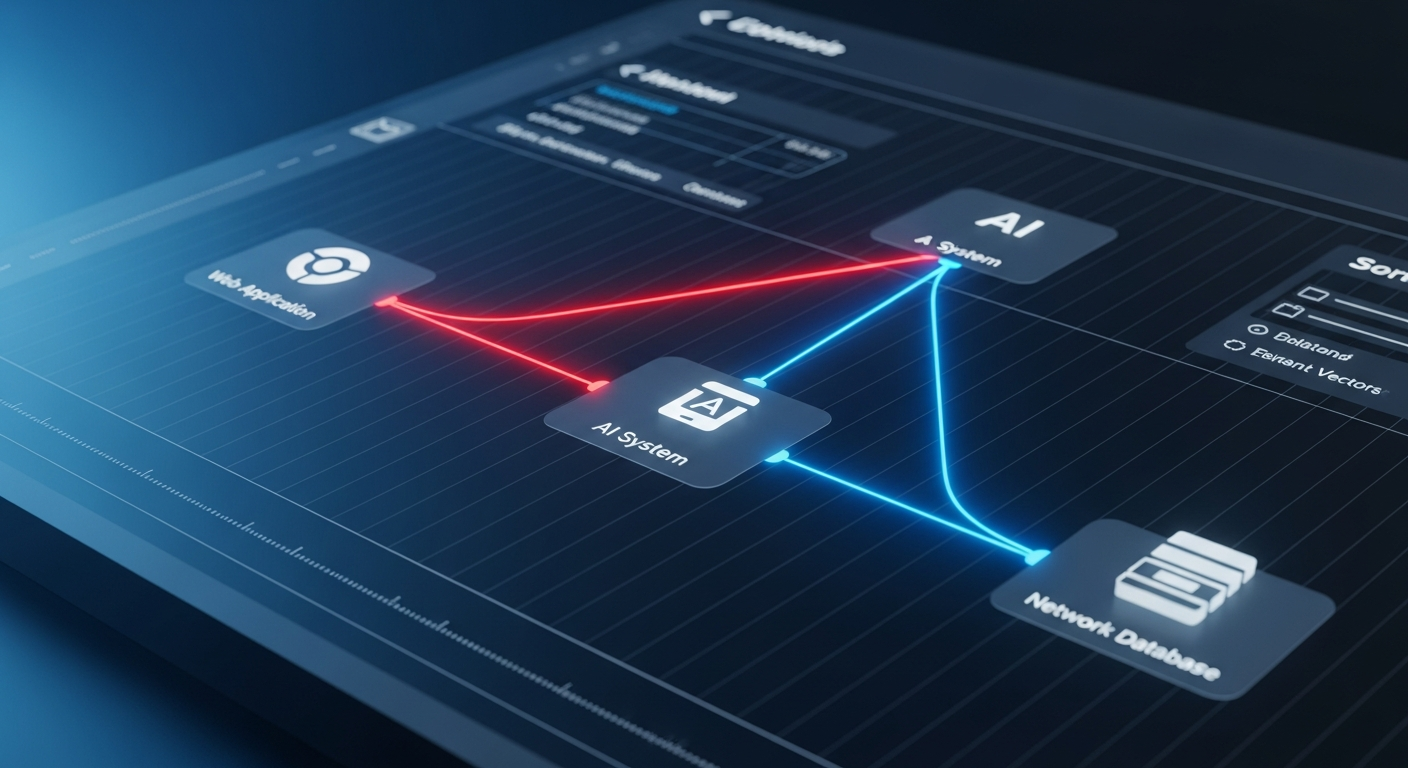
For example, a legacy scanner might flag a low-severity misconfiguration in a web application and, completely separately, flag a medium-severity overly permissive identity policy in the cloud. Because they are low and medium severity, they are ignored. Terra’s agentic AI swarm, however, recognizes that these two minor flaws can be chained together. The agent exploits the web app to gain a foothold, uses the permissive identity policy to move laterally into the internal network, and ultimately compromises a highly sensitive AI database. By proving the exploit path, Terra elevates the finding based on actual business impact rather than a theoretical severity score.
With the addition of network coverage, Terra now provides a single connected view of these multi-vector attack chains. Security teams can visualize exactly how an adversary might pivot from a public-facing generative AI chatbot (via prompt injection or retrieval-augmented generation poisoning) directly into the internal corporate network. This level of continuous, cross-domain visibility has historically been impossible to achieve without maintaining a full-time, highly expensive internal red team.
The Mechanics of Agentic Swarms and Human-in-the-Loop Oversight
The phrase “swarms of hundreds of AI agents” may sound like science fiction, but the underlying engineering is highly pragmatic. Under the hood, Terra is orchestrating parallelized Large Language Model (LLM) API calls that dynamically generate and execute offensive security scripts. These agents are trained on specific business contexts and codebases, allowing them to adapt their reconnaissance and exploitation techniques on the fly.
However, unleashing autonomous AI agents to hack a live enterprise environment presents massive operational risks. An unchecked agent could easily execute a destructive payload, corrupt a database, or trigger a denial-of-service (DoS) condition, taking down critical production systems.
To mitigate this, Terra employs a strict “Human-in-the-Loop” (or Human-ON-the-Loop) architecture. While the AI agents handle the repetitive, high-volume plumbing of reconnaissance and vulnerability identification at machine speed, human reviewers are stationed at critical decision points. Before an agent executes a potentially disruptive exploit to validate a finding, a certified human pentester must approve the action. This hybrid approach ensures production safety and provides the consistent audit trails required by compliance frameworks like ISO 27001, SOC 2, and PCI DSS.
Terra claims this methodology is up to 250 times faster than traditional penetration testing, reducing the time required for a comprehensive audit from four-to-six weeks down to just two-to-four hours. In an era where AI-powered adversaries are automating their own reconnaissance and lateral movement, this speed is not just a luxury; it is a baseline requirement for survival.
Market Impact & Deployment: The $38 Million Bet on Consolidation

Terra Security’s rapid ascent is a testament to the market’s appetite for tool consolidation. Founded in late 2024, the company hit $1 million in Annual Recurring Revenue (ARR) in just three months—a staggering pace for an enterprise cybersecurity startup. This traction recently culminated in a $30 million Series A funding round led by Felicis, bringing their total funding to $38 million, with backing from Dell Capital, SYN Ventures, and others.
Terra is selling its consolidated platform directly to Chief Information Security Officers (CISOs) who are desperate to reduce their vendor footprint. Currently, a typical enterprise might use XBOW or Penligent for AI and web application testing, while relying on legacy heavyweights like Pentera or Horizon3.ai (NodeZero) for internal network validation. By bringing network infrastructure into the fold, Terra is making a direct play to replace these entrenched incumbents.
However, the competitive landscape is unforgiving. Pentera and Horizon3.ai have spent years battle-testing their autonomous network validation engines across thousands of complex, legacy enterprise environments. Terra’s network capability is currently only in “public preview,” meaning it has not yet achieved the same level of maturity. While Terra’s AI-native architecture gives it a distinct advantage in testing modern web apps and LLM integrations, proving its efficacy in the murky depths of legacy Active Directory environments and on-premise mainframes will be its ultimate test.
The Consumer Translation: Why Agentic Security Matters to the Public
For the everyday consumer, the arcane details of enterprise penetration testing may seem irrelevant. But the reality is that the security of your personal data—your passwords, your financial records, your healthcare information—is entirely dependent on how quickly these enterprises can find and fix their vulnerabilities.
When a major corporation suffers a catastrophic data breach, it is rarely because of a sophisticated, zero-day exploit. It is almost always because a known vulnerability was left unpatched, or because a security team was too overwhelmed by false positives to notice a hacker moving laterally through their network. Traditional, point-in-time penetration testing means a company might only check its defenses once a year. If a new vulnerability is introduced the day after the audit, the company remains exposed for 364 days.
Terra Security’s shift toward continuous, agentic validation fundamentally changes this math. By testing the network 24/7, companies can identify and remediate vulnerabilities within hours of them appearing. For the public, this translates to a significantly safer digital ecosystem. As consumer applications increasingly integrate generative AI—creating entirely new attack surfaces—the need for continuous, AI-driven defense becomes the only viable way to protect consumer privacy.
TechNode HQ Verdict: Pros, Cons & Usability
- Pro (Engineering): The unification of Web, AI, and Network testing allows the platform to discover multi-vector attack chains that siloed scanners structurally cannot see, drastically reducing false positives.
- Pro (Consumer): Continuous 24/7 testing shrinks the vulnerability dwell time from months to hours, significantly reducing the likelihood of catastrophic consumer data breaches.
- Con: Terra advertises “auto-remediation built in” for certain issues. In complex enterprise environments, autonomous remediation (like altering firewall rules or patching live apps) is highly risky and can cause severe production downtime. Most CISOs will likely disable this feature.
- Con: The network infrastructure testing module is only in “public preview,” meaning it lacks the years of enterprise battle-testing enjoyed by legacy competitors like Pentera and Horizon3.ai.
Enterprise Usability: For CTOs and CISOs currently managing separate vendors for web, AI, and network red-teaming, Terra Platform represents a highly compelling consolidation play. The Human-in-the-Loop architecture makes it safe for production environments. However, enterprises with massive, legacy on-premise networks should run Terra in parallel with their existing infrastructure validation tools until the network module reaches general availability and proves its depth.
Everyday Usability: While this is strictly an enterprise B2B platform, the public should view the adoption of continuous agentic security as a major positive indicator. Consumers should increasingly demand that the digital services they trust with their data employ continuous validation rather than outdated, annual compliance checklists.
Sources & Citations:
Original Claim via: siliconangle
Official Handle: @siliconangle
Topics Explored: Agentic AI, Penetration Testing, Cybersecurity, Terra Security, Network Infrastructure