
The Architectural Reality: How CopyFail Breaks the Kernel
In the world of enterprise infrastructure, the Linux kernel is the undisputed bedrock. It orchestrates the memory, CPU, and peripheral access for over 90% of the public cloud. When a vulnerability strikes at the core of this architecture, the tremors are felt globally. On April 29, 2026, security firm Theori disclosed a catastrophic flaw dubbed “CopyFail” (officially tracked as CVE-2026-31431). The bug allows any unprivileged local user to gain absolute root control over a system in a matter of seconds. But to understand why CopyFail has triggered a scramble across global data centers, we must dissect the architectural mechanics of the exploit.
Unlike historical Local Privilege Escalation (LPE) vulnerabilities such as 2016’s infamous “Dirty COW,” CopyFail does not rely on race conditions. It is a deterministic logic flaw. The vulnerability resides deep within the Linux kernel’s cryptographic subsystem, specifically within the algif_aead module of the AF_ALG (userspace crypto API). According to Theori researcher Taeyang Lee, the flaw stems from a buggy in-place optimization introduced to the kernel in 2017 (commit 72548b093ee3) for AEAD encryption.
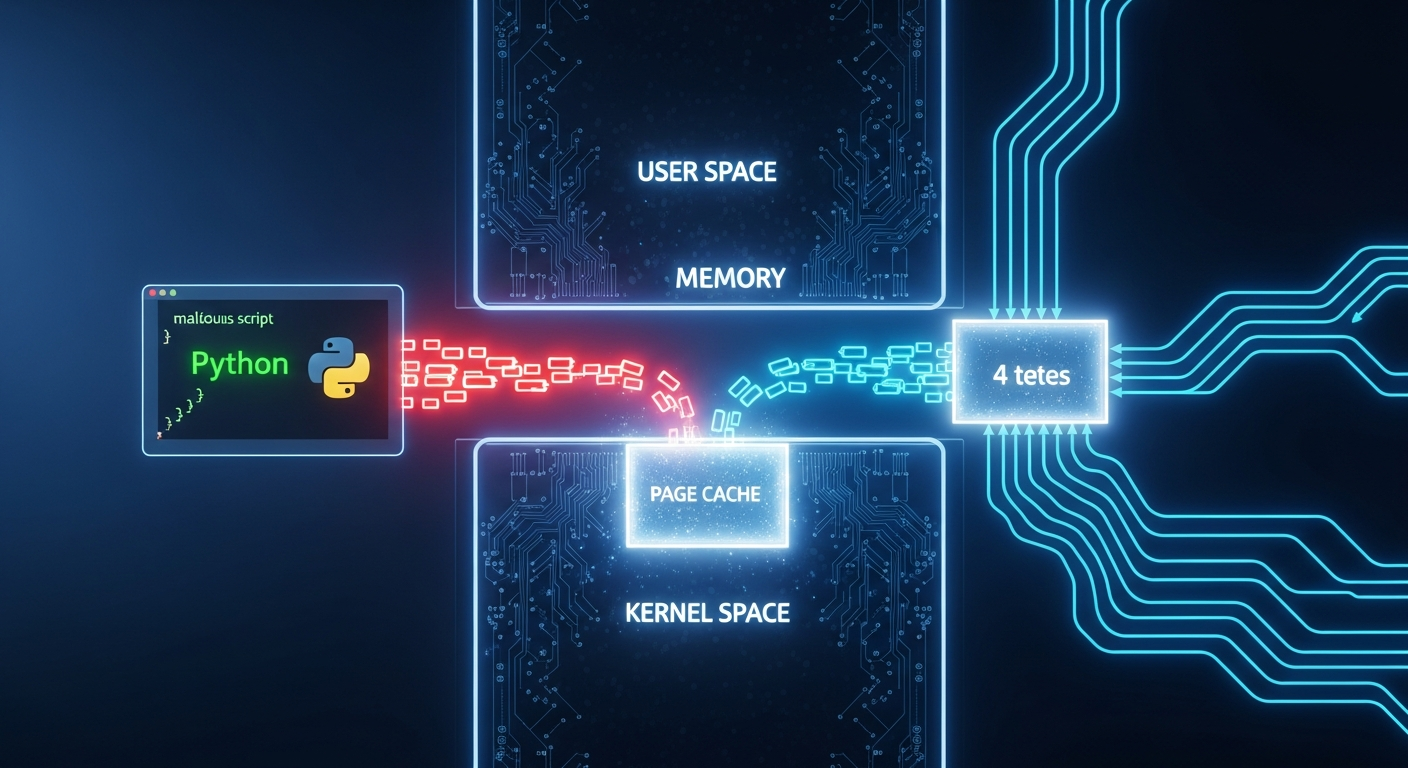
During cryptographic operations, the authencesn algorithm improperly uses the caller’s destination buffer as a scratch pad. By chaining an AF_ALG socket with the splice() system call, an attacker can force the kernel to write four controlled bytes directly into the page cache of any readable file on the system. The elegance of the exploit is terrifying: an attacker targets a privileged setuid binary—such as /usr/bin/su—and overwrites its in-memory execution instructions.
Because the physical file on the hard drive is never modified, traditional file-integrity monitoring tools like AIDE or Tripwire are entirely blind to the attack. The system’s disk checksums remain perfect, while the active memory runs malicious shellcode. A mere 732-byte Python script is all it takes to execute this attack, and it works unmodified across virtually every major Linux distribution shipped since 2017, including Red Hat Enterprise Linux 10.1, Ubuntu 24.04 LTS, Amazon Linux 2023, and SUSE 16.
The AI Discovery Paradigm
Perhaps the most profound aspect of the CopyFail disclosure is not the bug itself, but how it was found. Theori utilized their commercial AI-assisted code analysis tool, Xint Code, to surface the vulnerability. What would traditionally take a team of elite security researchers months of manual code auditing and fuzzing was accomplished by an AI agent in roughly an hour.
A human operator framed the hypothesis regarding the kernel’s crypto subsystem, and the AI scaled the analysis, identifying the exact interaction between the 2011 authencesn addition, the 2015 AF_ALG socket support, and the flawed 2017 optimization. This represents a paradigm shift in vulnerability research. As AI tools become deeply integrated into the cybersecurity lifecycle, the cost and time required to find deep kernel logic flaws are dropping by an order of magnitude. While this allows defenders to audit codebases faster, it simultaneously arms threat actors with the capability to unearth zero-days at an unprecedented cadence.
Market Impact & Deployment: The Enterprise Nightmare

The blast radius of CopyFail is unusually large. DevOps engineer Jorijn Schrijvershof noted that the exploit easily slips past default security profiles, including the RuntimeDefault seccomp profile used by Kubernetes. In modern cloud architecture, “local access” no longer means a user sitting at a physical terminal. It means a container running on a shared node, a CI/CD pipeline executing untrusted pull requests, or a multi-tenant hosting environment.
If an attacker compromises a single, low-privilege container on a shared Kubernetes node, they can use CopyFail to corrupt the shared page cache of the underlying host kernel. This instantly breaks the container boundary, granting the attacker root access to the host machine and, by extension, every other tenant’s data, secrets, and applications running on that node. Microsoft Defender’s threat intelligence team has explicitly warned that while CopyFail cannot be exploited over the internet on its own, it becomes a devastating weapon when chained with remote access vectors like SSH brute-forcing or malicious CI jobs.
The financial and operational toll of remediating CopyFail is staggering. The U.S. Cybersecurity and Infrastructure Security Agency (CISA) has added CVE-2026-31431 to its Known Exploited Vulnerabilities catalog, mandating that all federal civilian agencies patch affected systems by May 15, 2026. For enterprise CTOs, patching a kernel vulnerability across a fleet of thousands of servers requires draining nodes, applying the patch (reverting the flawed 2017 optimization via commit a664bf3d603d), and rebooting. This orchestration nightmare results in inevitable downtime and spikes in Total Cost of Ownership (TCO) for cloud operations.
For systems that cannot be immediately rebooted, administrators are forced to implement interim mitigations, such as blocking the algif_aead module via modprobe (e.g., echo "install algif_aead /bin/false" > /etc/modprobe.d/disable-algif.conf). However, disabling kernel crypto modules can break legitimate applications that rely on them, forcing IT teams to choose between security and availability.
The Consumer Translation: Edge Devices and Supply Chains
While the enterprise scramble dominates the headlines, the consumer implications of CopyFail are equally severe. The Linux kernel is the beating heart of the modern consumer ecosystem. It powers Android smartphones, smart TVs, home routers, and countless IoT devices. Because CopyFail affects kernel versions 4.14 through 7.0-rc, millions of consumer devices currently sitting in living rooms are vulnerable.
The grim reality of the consumer hardware market is that many of these devices will never receive a kernel update. A smart refrigerator or a budget Wi-Fi router purchased in 2021 is likely running a vulnerable kernel and has long since passed its end-of-life for manufacturer support. If a user is tricked into downloading a malicious app or opening a weaponized attachment, the CopyFail exploit can be triggered locally, granting the malware absolute control over the device to steal banking credentials, intercept communications, or draft the device into a botnet.
Furthermore, the threat of Supply Chain Attacks looms large. Malicious actors are actively attempting to hack into open-source developers’ accounts to plant the CopyFail payload into widely distributed software packages. If a popular NPM or PyPI package is compromised with the 732-byte Python script, any developer who installs that package on a Linux machine will instantly have their system rooted, silently and without any disk-based alarms tripping.
TechNode HQ Verdict: Pros, Cons & Usability
- Pro (Engineering): The discovery of CopyFail validates the immense power of AI-assisted code analysis (like Xint Code) to audit massive, legacy codebases and find complex logic flaws that humans missed for nearly a decade.
- Pro (Consumer): The high-profile nature of this bug is forcing major Linux distributions to streamline their live-patching capabilities, which may eventually trickle down to better update mechanisms for consumer Android and ChromeOS devices.
- Con: The vulnerability leaves zero on-disk trace, rendering traditional file-integrity monitoring (FIM) tools completely useless and creating a massive blind spot for Security Operations Centers (SOCs).
- Con: Patching requires a full kernel update and system reboot, causing severe orchestration headaches and downtime for live Kubernetes clusters and multi-tenant cloud environments.
Enterprise Usability: CTOs and Platform Engineers must treat CopyFail as a critical, drop-everything event. Immediate action is required to audit fleets for vulnerable kernels (4.14 to 7.0-rc). If live-patching or rebooting is not immediately feasible, deploy the modprobe mitigation to disable the algif_aead module, and apply custom seccomp profiles to block AF_ALG socket creation in Kubernetes environments.
Everyday Usability: For the average consumer, there is no direct action to take other than practicing extreme digital hygiene. Ensure your Android devices, Chromebooks, and home routers are updated to the latest firmware. If a device is no longer supported by the manufacturer, consider replacing it, as it will remain permanently vulnerable to local privilege escalation attacks.