Key takeaways
- Flexible data centers can deploy 3-5 years faster by reducing electricity draw during peak load.
- Throttling GPU power by 25% for short intervals preserves acceptable performance for non-urgent tasks.
- Spreading fixed grid infrastructure costs can lower ratepayer electricity costs by up to 2.8%.
- Skeptics warn that flexibility optimization cannot replace the physical need for transmission expansions.
The Architectural Reality of Power-Flexible AI Factories
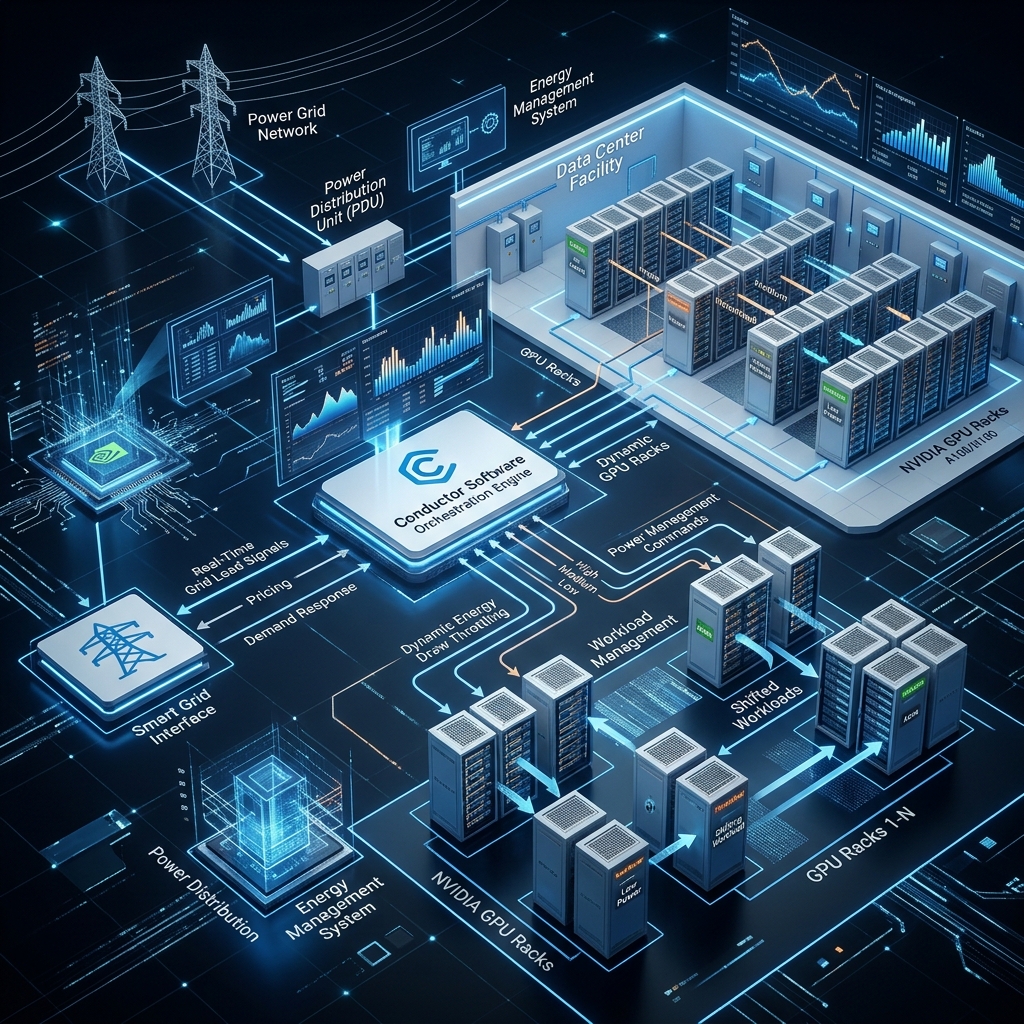
In the face of an unprecedented grid connection backlog, an emerging breed of power-flexible AI factories is redefining how enterprise infrastructure interacts with the electrical grid. For years, hyperscale data centers operated under a rigid mandate: draw maximum baseload power continuously, regardless of grid stress, fuel mix, or localized congestion. However, the explosive rise of large language models and generative AI has pushed national transmission networks to their physical limits. The old paradigm of build-and-forget is no longer sustainable. Instead of waiting years for massive grid upgrades, operators are turning to real-time software-driven flexibility, transforming data centers from passive liabilities into active, grid-interactive assets.
At the center of this paradigm shift is Emerald AI’s Conductor software, an orchestration platform designed to dynamically throttle and reschedule computational workloads based on real-time grid signals. Developed from academic research led by chief scientist Ayse Coskun at Boston University, Conductor acts as a bridge between utility operations and server rack dispatchers. The system functions by profiling AI workloads, establishing a performance-power curve for each job, and dynamically tuning hardware states. Not all AI jobs are created equal: while real-time inference (such as conversational chatbots) requires sub-second latency and consistent power, large-scale model training, batch fine-tuning, and asynchronous data ingestion are highly elastic. Conductor exploits this elasticity, temporarily scaling down clock speeds and core voltages on GPU clusters when the grid experiences sudden congestion.
The technical viability of this approach was demonstrated during a pilot program in Phoenix, Arizona, where Conductor took control of a server cluster featuring 256 Nvidia A100 GPUs. When presented with a simulated grid stress event, the software reduced the power consumption of the GPU chips by 25% for a duration of three hours. Crucially, the system maintained acceptable computing performance without interrupting the execution of the running models. This trial, published in the journal Nature Energy in December 2025, proved that software-driven power throttling could serve as a reliable tool for utility demand-side management. By adjusting operating frequencies and voltage domains, data centers can shed megawatts of load within seconds, mimicking the response time of advanced battery storage systems.
This dynamic capability represents a major evolution over traditional industrial demand response programs. For decades, grid operators relied on manual contracts, calling factories to turn off production lines during heat waves. This process was slow, imprecise, and impossible to integrate with the rapid fluctuations of modern computing. By contrast, automated AI workload orchestration operates at millisecond scale. In a landmark simulation re-creating the famous “teakettle spike” from the 2020 Euro soccer tournament, engineers proved that Conductor could instantly reduce a London facility’s power draw to accommodate the sudden rise in UK household electricity demand. Rather than relying on simple on-off switches, the software leverages fine-grained control to keep servers running at lower performance states, preserving operational continuity.
Furthermore, power flexibility extends beyond localized chip throttling to encompass spatial load shifting. In multi-region deployments, Conductor can dynamically migrate active computing jobs across physical data centers. During localized grid emergencies in Virginia, for instance, non-urgent workloads can be seamlessly routed to Chicago or Dublin, where renewable energy is abundant and grid stress is low. However, this spatial orchestration introduces significant engineering challenges. Engineers must manage latency budgets, state synchronization over long-distance fiber networks, and data sovereignty compliance. Despite these hurdles, the ability to balance loads globally makes data centers uniquely suited for grid-interactive operations.
To supplement computational throttling, data center operators are increasingly deploying behind-the-meter assets and participating in virtual power plants (VPPs). By aggregating distributed energy resources such as industrial batteries, solar arrays, and backup generators, data centers can create synthetic grid capacity. A prime example is Google’s three-year partnership with Voltus in the PJM Interconnection region, where Google bankrolls a VPP to absorb peak grid demand. Similar agreements across five major utilities have added up to one gigawatt of flexible capacity to Google’s operations. These multi-resource orchestrations enable hyperscalers to secure grid capacity while actively contributing to local grid stability and resilience.
Market Impact and Deployment
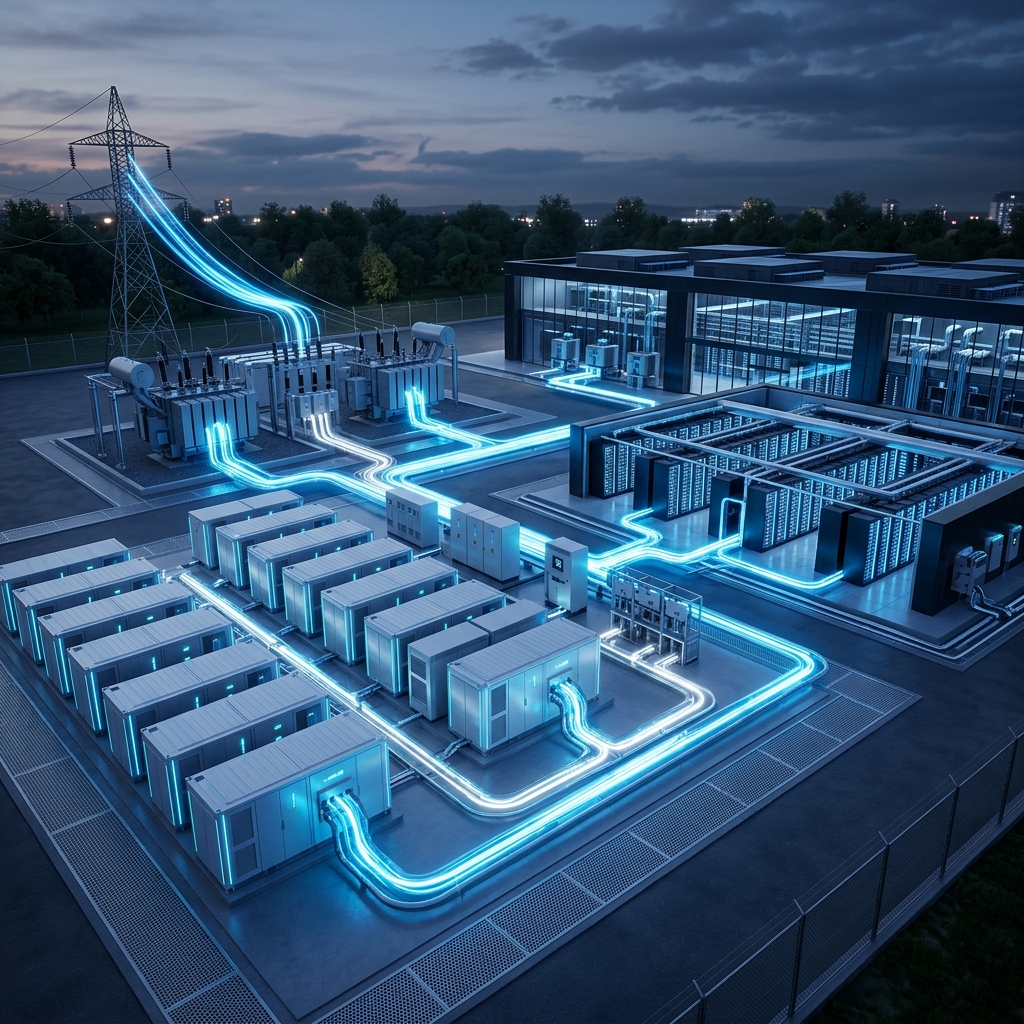
The economic driver behind grid-interactive data centers is simple: speed to power. According to research from RMI, the PJM Interconnection grid operator—which manages the electrical network across Virginia and the mid-Atlantic—requires an average of eight years to bring new power generation and transmission lines online. This administrative and construction backlog has created a critical bottleneck for tech companies racing to deploy AI hardware. Data Center Watch reports that over $150 billion worth of data center projects were stalled in 2025 due to lack of grid capacity. In this environment, a data center that demands rigid, 100% continuous baseload power must wait in queue for years, tying up billions of dollars in idle capital.
Conversely, facilities willing to embrace flexibility can secure connection approvals almost immediately. A widely cited Duke University study published in February 2026 revealed that the US electric grid could immediately offer an additional 76 gigawatts of capacity—equivalent to 5% of its total capacity and enough to accommodate all projected data center growth through 2030—if operators agree to flex their power usage just 0.25% of the time. This equates to only 22 hours of reduced operation per year. For a technology sector accustomed to running at maximum throughput, trading 22 hours of throttled compute for immediate grid access represents an extraordinary return on investment.
This trade-off is further quantified in a Princeton University study funded by Google, which examined data center siting within the PJM region. The researchers, led by Professor Jesse Jenkins of the ZERO Lab, found that a 500-megawatt facility designed to flex for less than 1% of the year could reach full operation three to five years faster than an inflexible counterpart. For a hyperscaler, accelerating a 500-megawatt AI factory’s deployment by three years translates to billions of dollars in early computational revenue. By avoiding the multi-year queue, operators can capture market share while their competitors’ hardware sits in warehouses waiting for transmission line upgrades.
Real-world deployment of this strategy is already taking shape in Hillsboro, Oregon. In 2024, Aligned Data Centers partnered with Portland General Electric (PGE) to expand its Silicon Forest operations. Rather than waiting for costly grid expansions, Aligned agreed to install a 31-megawatt industrial battery system, scheduled to go online in May 2027. During periods of high grid congestion, Aligned will throttle its draw from the grid and rely on the battery system to run its servers. This project, combined with other flexibility measures, allowed PGE to grant Aligned and neighboring facilities an additional 80 megawatts of capacity without building new power plants or upgrading transmission lines.
This flexible approach stands in stark contrast to the aggressive off-grid strategies pursued by other industry giants. Hyperscalers like Microsoft, Oracle, and xAI have proposed building massive, self-powered data centers that bypass public grids entirely by relying on on-site, gas-burning turbines. In Memphis, Tennessee, xAI quickly stood up its Colossus site by deploying gas turbines on flatbed trucks. However, this strategy has triggered intense regulatory scrutiny, noise complaints, and environmental lawsuits from local communities due to the resulting spike in carbon emissions and criteria pollutants. Furthermore, manufacturers cannot produce gas turbines fast enough to satisfy the industry’s demand, making off-grid fossil fuel generation a limited and high-risk strategy.
Despite the obvious benefits of flexibility, grid regulators and market monitors remain skeptical. Joseph Bowring, the long-standing head of PJM’s market monitor, cautions that relying on data center flexibility to justify massive load additions is “magical thinking.” Bowring argues that software-driven throttling does not replace the physical necessity of building new transmission and generation infrastructure. The critical issue is contract enforcement: during a grid emergency, a data center operator facing intense commercial pressure may choose to ignore grid requests and continue running servers at full capacity. Without legal mandates or absolute utility override controls, grid operators cannot treat voluntary data center flexibility as a guaranteed capacity reserve.
The Consumer Translation
For the general public, the debate over data center power flexibility is not just an industry concern—it directly impacts daily life, household utility bills, and grid reliability. In regions like Northern Virginia, which hosts approximately 500 data centers representing 13% of global computing capacity, residents have increasingly protested the expansion of these facilities. Neighbors criticize them for drawing massive amounts of electricity, driving up retail utility rates, producing low-frequency noise, and contributing to local carbon pollution. In response, policymakers are considering strict bans, and local moratoriums have already taken effect in Minneapolis, Minnesota, and DeKalb County, Georgia. At the federal level, the bipartisan GRID Act in the US Senate proposes to disconnect new data centers from public grids entirely to protect consumer access.
Power-flexible data centers offer a viable compromise that directly benefits residential ratepayers. According to the Duke University study, integrating flexible loads into the existing transmission system could reduce retail electricity rates for all consumers by 0.5% to 2.8%. Because data centers fund on-site energy storage, pay for local VPP participation, and contribute to grid infrastructure upgrades, they help spread the fixed costs of maintaining the grid across a larger volume of electricity sales. This prevents utilities from dumping the multi-billion-dollar cost of grid modernization onto household utility bills.
Furthermore, grid flexibility is critical for ensuring household energy security during extreme weather events. During severe winter storms or summer heat waves, when heating and air conditioning systems push grid demand to its limit, a power-flexible data center can instantly drop its usage. This rapid reduction provides grid operators with the critical margin needed to prevent rolling blackouts, protecting homes, schools, and hospitals from power loss. In this model, data centers act as a digital shock absorber, absorbing excess energy when demand is low and releasing it back to the community when the grid is stressed.
Finally, this technology accelerates the transition to a clean energy economy. The primary challenge of wind and solar power is their intermittent nature; the wind does not always blow, and the sun does not always shine. According to a January 2026 report by the International Renewable Energy Agency (IRENA), global grids will need three times as much flexibility by 2030, and ten times as much by 2050, to balance rising renewable supplies. By dynamically adjusting their demand to match the availability of renewable generation, power-flexible AI factories can help absorb surplus clean energy and prevent curtailment, paving the way for a more sustainable, decarbonized future.
Frequently Asked Questions
What are power-flexible AI factories?
These are modern data centers that use advanced workload orchestration software to adjust their electricity consumption in real-time. By throttling power to chips or shifting workloads during grid stress, they work within existing transmission capacities to avoid delays.
How does Conductor software manage data center power?
Conductor profiles AI jobs based on urgency, distinguishing real-time inference from flexible background training. It then dynamically adjusts GPU clock speeds, voltages, or redirects workloads to other facilities in less congested regions.
How much grid capacity can data center flexibility unlock?
A Duke University study shows that flexing just 0.25% of the time (22 hours a year) could free up 76 gigawatts of capacity in the US. This is roughly 5% of total capacity and enough to cover projected data center growth through 2030.
What is the primary bottleneck this technology addresses?
The primary bottleneck is the lengthy interconnection queue for new power generation and transmission lines, which takes up to eight years in PJM regions. Flexibility allows operators to plug in years faster by using existing grid headroom.
TechNode HQ Verdict: Pros, Cons & Usability
- Pro (Engineering): Millisecond-scale dynamic throttling of server racks reduces load without crashing active computation.
- Pro (Consumer): Reduces household electricity rates by up to 2.8% by spreading grid maintenance costs.
- Con: Cannot fully replace the physical necessity of building new transmission and generation infrastructure.
- Con: Requires utilities to adopt advanced software integrations and abandon conservative operational practices.
Enterprise Usability: CTOs and infrastructure directors should integrate flexibility orchestration tools like Emerald AI’s Conductor during the design phase of new AI factories. By provisioning utility-scale battery storage (e.g., Aligned’s 31 MW model) and committing to brief, scheduled throttling windows, enterprises can bypass the 8-year PJM interconnection queue and reach market up to 5 years faster.
Everyday Usability: For the general public, this technology represents a critical safeguard for grid reliability. While consumer adoption of residential VPPs (smart thermostats and home batteries) will be incentivized and funded by data center demand, the primary benefit remains passive: more stable local grids and lower monthly utility bills.