Key takeaways
- Ubuntu Core 26 provides a secure, immutable platform designed specifically for long-lifecycle edge AI workloads.
- Snaps deliver modular, cryptographically signed, and sandboxed containerized applications under a strict isolation model.
- Chisel integrations shrink the base operating system footprint down to a minimal 1.5MB size.
- TPM 2.0 on x86 platforms enables hardware-backed protection and full disk encryption for AI models.
As organizations rush to deploy generative intelligence at the edge, building a reliable and secure infrastructure remains a critical challenge. The recent release of Ubuntu Core 26 by Canonical addresses this head-on, providing a minimal, immutable, and highly optimized Linux operating system specifically tailored for edge, IoT, and embedded environments. In this deep dive, we explore how engineers can leverage Ubuntu Core 26 to build, test, and deploy a secure local AI inference appliance, shifting workloads from the resource-heavy cloud to local, hardened edge systems.
The Architectural Reality of Ubuntu Core 26
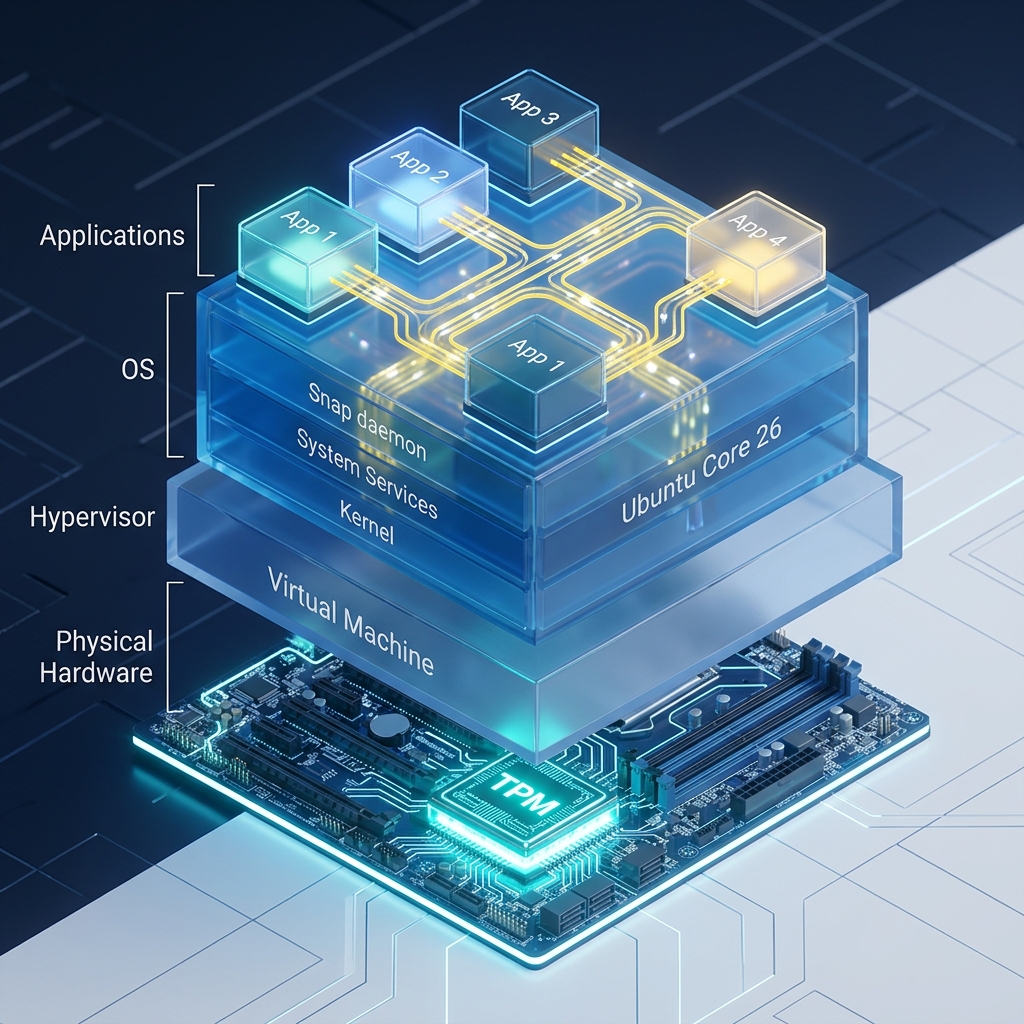
The core operating philosophy of Ubuntu Core 26 revolves around security, stability, and absolute predictability. Unlike traditional server distributions that permit ad-hoc file modifications, Ubuntu Core features an immutable, read-only root file system. Every component—from the bootloader and kernel to the base system and user applications—is packaged as a sandboxed container known as a snap. These snaps are cryptographically signed, read-only, and completely isolated from the rest of the system, preventing unauthorized modifications and ensuring that the operating system remains in a known good state.
This strict confinement model is enforced at the kernel level using AppArmor, seccomp, and control groups (cgroups). Snaps communicate with each other and the host hardware through a secure system of predefined interfaces, which connect “plugs” on the client side to “slots” on the provider side. For a local AI inference appliance, this means the inference engine can be completely isolated from the networking stack or local filesystem, accessing only the specific hardware interfaces it requires to function.
For development and local testing, Canonical’s Multipass provides a fast and lightweight virtual machine (VM) manager. Developers can query available images using the multipass find command to retrieve aliases, and instantly spin up a local environment. If the core26 image is missing from the search results, it can be unlocked by switching Multipass to its edge channel or updating the application. A typical local AI VM instance is initialized with custom resources to handle the demands of large language models:
multipass launch core26 -n aibox --cpus 4 --memory 10GB --disk 16GBWhile Multipass is ideal for initial application testing and developer onboarding, QEMU is recommended for advanced VM testing of Ubuntu Core 26. QEMU allows developers to simulate Trusted Platform Module (TPM) hardware and verify full disk encryption (FDE) before flashing images to actual hardware. On physical x86 systems, Ubuntu Core 26 utilizes TPM 2.0 to establish a hardware-backed root of trust. This cryptographic anchor ensures measured boot integrity, verifying that the bootloader, kernel, and base snaps have not been tampered with before decrypting the filesystem. If a physical device is stolen from the field, its data and proprietary AI models remain encrypted and inaccessible.
To keep the operating system as compact as possible, Ubuntu Core 26 integrates Chisel, a tool that performs precision builds. Chisel analyzes package dependencies and strips away everything except the absolute minimum files needed for execution—such as documentation, man pages, and build tools. By utilizing Chisel tool integrations, developers can reduce the base snaps footprint of Ubuntu Core 26 down to approximately 1.5MB, dramatically lowering the system’s attack surface and storage footprint.
Within this hardened OS layer, a standard inference snap architecture typically bundles the AI model, a runtime engine (such as llama.cpp or Ollama), a management CLI, and an engine manager. By deploying models like Google’s Gemma 4 locally within these snaps, enterprises can run advanced natural language processing tasks entirely on-device. However, configuring standard snaps for GPU hardware acceleration under Ubuntu Core can be challenging due to its strict snap isolation model. Snaps must be explicitly granted access to host GPU drivers through specialized interface connections, which requires careful configuration of the system’s model assertion and snap plugs.
Market Impact & Deployment

Transitioning a local AI prototype from a virtual machine to physical hardware is seamless under Ubuntu Core 26. Because snaps encapsulate all their dependencies and run-time libraries, the exact same snap packages validated locally inside an Ubuntu Core 26 VM can be deployed directly onto bare-metal hardware without any modifications. This write-once, run-anywhere capability eliminates the “works on my machine” class of bugs, saving thousands of developer hours during the QA and deployment phases of a product lifecycle.
Furthermore, Canonical has established deep partnerships with silicon vendors to optimize the OS for specific hardware targets. A prime example is the integration of the Renesas RZ/V series, featuring DRP-AI hardware acceleration. Developers can package models tailored for the DRP-AI accelerator into a custom snap, which then runs with hardware-accelerated efficiency directly on Renesas boards. This tightly coupled integration of hardware and software allows companies to ship high-performance edge AI appliances with minimal system overhead.
When deploying devices at scale, manually installing snaps and configuring endpoints is not feasible. In production, devices are flashed with custom Ubuntu Core images defined by a model assertion—a signed JSON document that lists the precise snaps, channels, and configurations that make up the device’s software stack. Once the device boots, it initializes in the desired state. Furthermore, devices powered by Ubuntu Core 26 can automatically register with cloud systems like AWS IoT Greengrass or Azure IoT Edge upon boot via its zero-touch onboarding feature. This allows the local AI box to function as an intelligent edge node, securely sending processed data back to cloud telemetry pipelines while running inference locally.
Managing these devices over time is handled by Canonical’s Landscape, a centralized fleet management platform. Because edge devices are often deployed on remote networks with limited or metered connectivity, bandwidth management is a critical concern. Ubuntu Core 26 addresses this by utilizing an enhanced snap-delta format. Instead of downloading an entire application snap during an update, the system downloads only the binary difference (the delta) between the installed version and the update. This optimization cuts down over-the-air (OTA) update bandwidth consumption by 50% to 90%, representing a massive operational cost saving for fleets connected via cellular networks.
For long-lifecycle industrial systems, stability is paramount. Canonical provides up to 15 years of security maintenance for Ubuntu Core 26. This long-term support (LTS) window means enterprises can deploy appliances in factories, utility grids, or remote infrastructure with the confidence that the base operating system will receive regular security patches and bug fixes for over a decade, significantly lowering the total cost of ownership (TCO).
The Consumer Translation
While the architectural details of Ubuntu Core 26 are of primary interest to developers and enterprise IT leaders, this shift toward local AI appliances has profound implications for everyday consumers. Today, most consumer AI interactions—such as voice assistants, document translation, and image generation—rely on sending data to centralized cloud servers. This design exposes users to privacy risks, latency, and service disruptions if cloud providers experience downtime or change their data policies.
By shifting inference workloads to local hardware, consumer devices can achieve true data sovereignty. When an AI model runs locally inside a secure snap on an appliance in a home, no voice recordings, personal images, or sensitive documents are transmitted over the internet. All processing occurs within the physical boundaries of the device. This local execution model also dramatically reduces latency, allowing for real-time interactions with smart home systems, home security cameras, and voice agents without waiting for cloud round-trips.
Security is also elevated for the consumer. In the past, smart home devices were notorious for security vulnerabilities, often joining botnets due to unpatched operating systems. Ubuntu Core 26’s transactional, automatic update mechanism ensures that consumer appliances are silently and reliably patched without user intervention. If an update fails, the system automatically rolls back to the previous working state, preventing the device from being “bricked.” Combined with hardware-backed encryption that prevents physical extraction of user data from the device, the technology ensures that the next generation of smart home appliances will be significantly safer than their predecessors.
Frequently Asked Questions
How does Ubuntu Core 26 optimize the operating system size for resource-constrained edge devices?
Ubuntu Core 26 integrates the Chisel-based build system, which strips unnecessary packages and files from the operating system. By using these Chisel tool integrations, developers can reduce the base snaps footprint down to approximately 1.5MB.
What security mechanisms protect proprietary AI models deployed on physical edge hardware?
The operating system utilizes TPM 2.0 on x86 platforms to enable hardware-backed protection, including full disk encryption. This ensures that application binaries, configuration files, and large language model weights remain secure even in the event of physical theft.
How do snaps communicate with system resources while maintaining strict confinement?
Snaps use predefined interfaces consisting of plugs and slots to securely communicate with each other and system resources under a strict confinement driver model. This architecture prevents unauthorized access to host resources and mitigates the impact of application-level vulnerabilities.
What is the benefit of the snap-delta format for OTA updates?
The enhanced snap-delta format cuts down over-the-air (OTA) update bandwidth consumption by 50% to 90%. By transmitting only the binary differences between versions, it significantly reduces cellular data costs for managing large fleets of edge devices.
TechNode HQ Verdict: Pros, Cons & Usability
- Pro (Engineering): Transactional updates with automatic rollbacks and immutable file structures guarantee zero runtime drift across large fleets.
- Pro (Consumer): Local execution ensures complete data privacy and offline functionality, freeing user data from cloud dependencies.
- Con: Strict snap isolation makes configuring GPU and hardware-accelerated drivers (such as Ollama on GPUs) complex and labor-intensive.
- Con: Multipass lacks advanced hardware emulation, forcing developers to configure more complex QEMU environments to verify cryptographic security.
Enterprise Usability: Enterprise CTOs should deploy this today. By combining the 15-year security maintenance window with Chisel-based minimal footprints, Canonical offers a production-ready base image. Enterprises should integrate Landscape for fleet updates and leverage model assertions to automate device provisioning.
Everyday Usability: Consumers should welcome this shift. While developers must handle the initial complexity of building these appliances, the final product is a highly reliable, private, and secure “set-and-forget” smart device that does not compromise user privacy.