The Threat Landscape: HNDL and Q-Day
The enterprise technology sector is currently operating under the shadow of a ticking clock. For decades, the foundational security of the global internet has relied on asymmetric cryptographic algorithms—primarily RSA and Elliptic Curve Cryptography (ECC). These algorithms protect everything from secure web browsing (TLS) and virtual private networks (IPsec) to the digital signatures that verify the integrity of operating system updates. However, the rapid advancement of Quantum Computing threatens to render these mathematical fortresses obsolete.
The inflection point, often referred to in cryptographic circles as “Q-Day,” is the hypothetical moment when a Cryptographically Relevant Quantum Computer (CRQC) comes online. Utilizing Shor’s algorithm, a CRQC will be capable of factoring the large prime numbers underlying RSA and solving the discrete logarithm problems underlying ECC in a fraction of the time it would take a classical supercomputer. While Q-Day may still be years away, the threat is immediate due to a tactic known as “Harvest Now, Decrypt Later” (HNDL).
Nation-state adversaries and advanced persistent threat (APT) groups are currently vacuuming up vast quantities of encrypted internet traffic. They know they cannot break the AES-256 or RSA-2048 encryption today, but they are storing the data in massive server farms, betting that a future quantum computer will allow them to retroactively decrypt it. For highly sensitive data with long-term intelligence value—such as military communications, proprietary corporate intellectual property, and biometric databases—this retroactive decryption represents a catastrophic, unmitigated risk.
To counter this existential threat, the National Institute of Standards and Technology (NIST) spent eight years rigorously evaluating quantum-resistant algorithms. In August 2024, NIST finalized the first three federal standards for post-quantum cryptography: FIPS 203 (ML-KEM), FIPS 204 (ML-DSA), and FIPS 205 (SLH-DSA). With the mathematics finally codified, the burden has shifted to hardware manufacturers to implement these standards at scale. At Cisco Live Amsterdam 2026, Cisco answered this call, unveiling what it claims is the industry’s first “full-stack” Post-Quantum Cryptography (PQC) architecture, embedded directly into its flagship C9000 Smart Switches running the new IOS XE 26 operating system.
The Architectural Reality: Hardware-Rooted Trust
When discussing network security, the industry often fixates on data in transit—the packets flowing between point A and point B. However, true infrastructure security must begin long before a single packet is routed. If a quantum computer can break public-key cryptography, it can also forge the digital signatures used to verify software updates and operating systems. If an attacker can forge a signature, they can load a malicious, compromised operating system onto a network switch, effectively owning the network from the inside out and bypassing all downstream security controls.
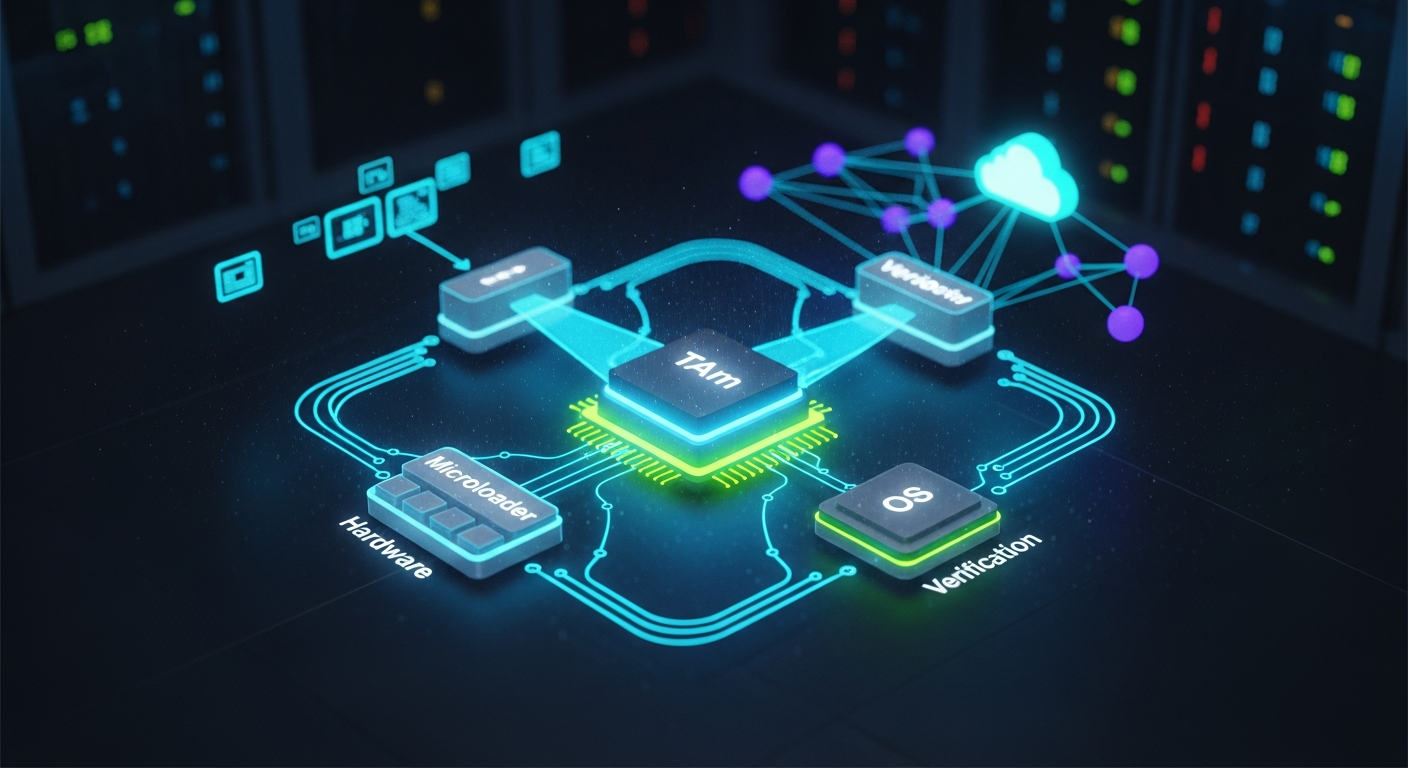
This is why Cisco’s approach to PQC is explicitly “full-stack.” It does not merely bolt quantum-resistant encryption onto the transport layer; it fundamentally re-engineers the hardware root of trust. In the Cisco C9000 Smart Switches, this security begins at the silicon level with an integrated Trust Anchor module (TAm) embedded directly into a Field Programmable Gate Array (FPGA) chip on the motherboard.
From the exact millisecond the switch is powered on, the TAm initiates a quantum-resistant Secure Boot sequence. The TAm securely stores PQC public keys in tamper-resistant hardware. The boot sequence operates as a strict, sequential chain of verification. First, the TAm verifies the microloader using AES-GCM-256 encryption and authentication. The microloader then validates and loads the BIOS/bootloader. Finally, the bootloader verifies the digital signature of the IOS XE 26 operating system image using NIST-approved PQC signature algorithms.
By anchoring this chain of trust in the FPGA and utilizing hash-based or lattice-based signatures, Cisco ensures that the boot process is mathematically immune to signature forgery by a future quantum computer. This hardware-rooted approach is a critical evolution in Zero Trust Architecture, ensuring that the device itself is uncompromised before it is allowed to participate in the network fabric.
Transport Layer Mechanics: ML-KEM and Lattice-Based Cryptography
Once the C9000 switch has securely booted and verified its own integrity, the operational focus shifts to the data plane. Here, the network must securely encapsulate and transport massive volumes of enterprise traffic. To achieve quantum resistance in transit, Cisco IOS XE 26 integrates the NIST FIPS 203 standard, known as ML-KEM (Module-Lattice-Based Key-Encapsulation Mechanism).
ML-KEM represents a radical departure from the prime factorization math of RSA. Instead, it relies on the “Learning With Errors” (LWE) problem over module lattices. In simplified terms, lattice-based cryptography involves finding the shortest vector or the closest vector in a highly complex, multi-dimensional grid. While classical computers can easily generate these lattices and hide data within them, finding the hidden data without the cryptographic key scales exponentially in difficulty. Crucially, quantum algorithms—including Shor’s algorithm—do not provide a significant shortcut for solving these specific lattice problems, making ML-KEM inherently quantum-resistant.
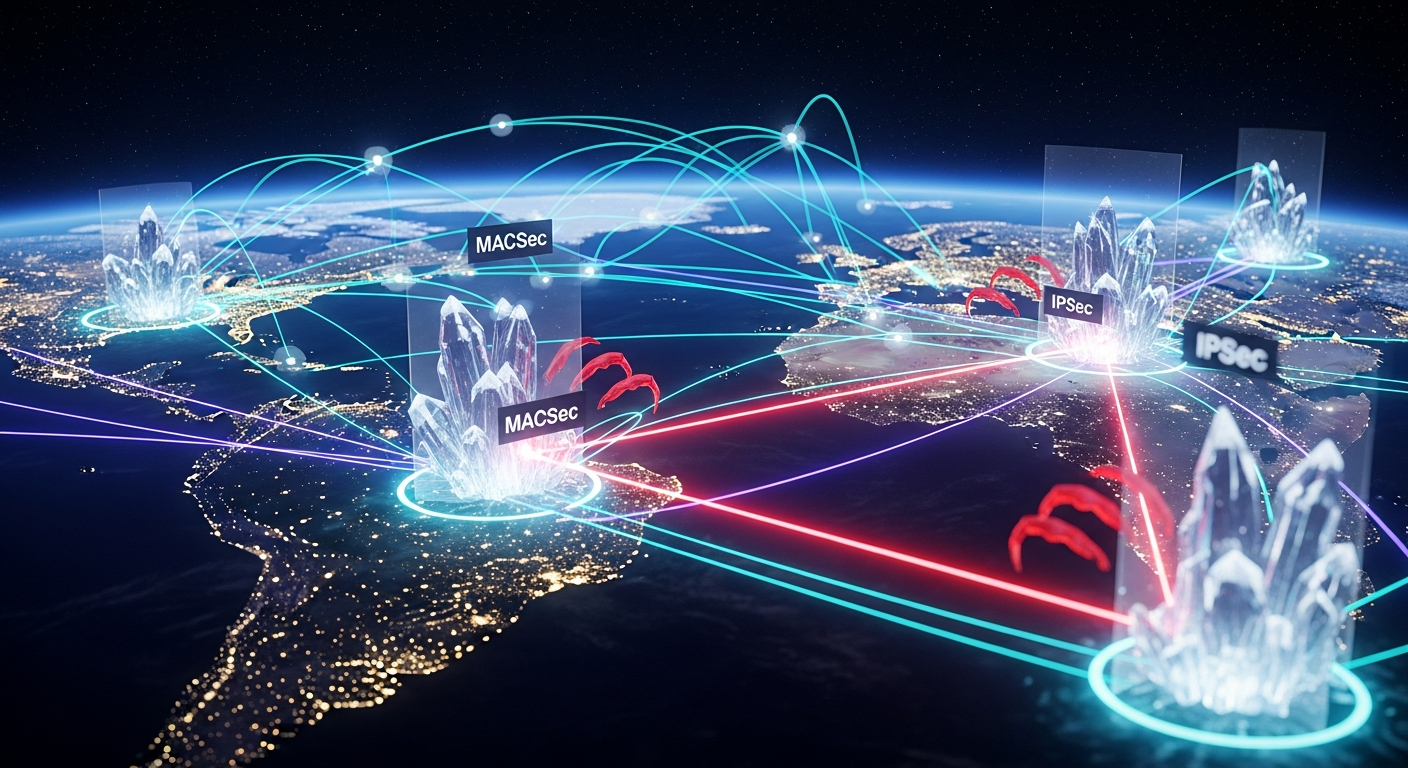
Cisco applies ML-KEM across multiple critical network layers to provide comprehensive transport plane protection. At Layer 2, PQC is integrated into MACsec (Media Access Control Security). This ensures data confidentiality for traffic moving within owned campus networks, as well as across unowned WAN links (WAN MACsec). At Layer 3, ML-KEM hardens IPsec tunnels, ensuring that routed traffic between disparate geographic locations remains secure against interception. Furthermore, management protocols such as SSH and TLS 1.3 are also upgraded to utilize quantum-safe session key setups.
However, the implementation of lattice-based cryptography introduces significant engineering challenges. PQC algorithms inherently require larger key sizes and generate heavier computational overhead compared to traditional ECC. In high-throughput enterprise environments—especially those leveraging Edge Computing and AI-driven workloads—this overhead could theoretically introduce unacceptable latency and jitter. To mitigate this, the C9000 series leverages the Cisco Silicon One architecture. By utilizing unified, programmable silicon, Cisco provides hardware-accelerated encryption that allows the switches to maintain massive throughput (up to 102.4 Tbps in top-tier modular chassis) without suffering the severe performance degradation typically associated with software-based PQC processing.
Market Impact & Deployment: The CNSA 2.0 Mandate
While the engineering behind full-stack PQC is impressive, the primary catalyst driving enterprise adoption is regulatory compliance. Specifically, the National Security Agency’s (NSA) Commercial National Security Algorithm Suite 2.0 (CNSA 2.0) is forcing the hand of IT procurement departments worldwide.
CNSA 2.0 dictates a strict, aggressive timeline for National Security Systems (NSS) and their associated vendors to transition to quantum-resistant cryptography. The mandate requires that software and firmware signing must prefer CNSA 2.0 algorithms by 2025. More critically for infrastructure vendors, traditional networking equipment—including routers, switches, and VPNs—must support CNSA 2.0 by 2026, and must use it exclusively by 2030. By December 31, 2030, any equipment that cannot support CNSA 2.0 must be phased out entirely.
This regulatory timeline effectively triggers a massive, unavoidable hardware refresh supercycle across the federal government, defense industrial base, and critical infrastructure sectors. Because true PQC requires a hardware-rooted chain of trust—such as the FPGA TAm found in the C9000—organizations cannot simply download a software patch to make their legacy switches quantum-safe. They must physically rip and replace legacy silicon.
Cisco’s announcement at Cisco Live Amsterdam 2026 is a strategic masterstroke designed to capture this impending wave of forced procurement. By being the first to market with a comprehensive, standards-based full-stack PQC enterprise switch, Cisco is setting a high benchmark. Competitors such as Arista Networks, Juniper Networks, and HPE Aruba will be forced to accelerate their own hardware-rooted PQC roadmaps or risk being locked out of lucrative federal and enterprise contracts as the 2030 deadline approaches.
The Consumer Translation: Defusing the Time Bomb
For the average consumer, the intricacies of FPGA Trust Anchor Modules and lattice-based cryptography are entirely opaque. Everyday users do not purchase Cisco C9000 switches for their homes. Yet, the deployment of this technology has a profound, direct impact on global public privacy.
Every time a consumer checks their bank balance, sends a confidential medical document to a doctor, or transmits biometric data, that information traverses enterprise campus and branch networks. Currently, that data is protected by classical encryption. If a hostile nation-state is tapping the fiber optic cables carrying that data, they are storing it in encrypted form. Without PQC, that data is a ticking time bomb, waiting for the day a quantum computer can unlock it.
By upgrading the backbone of the internet to full-stack PQC today, enterprise IT departments are effectively defusing that bomb. They are ensuring that the encryption keys protecting today’s data cannot be retroactively broken tomorrow. In essence, Cisco’s hardware shift guarantees that the digital privacy we expect today will remain mathematically intact decades into the future, long after the first quantum computers come online.
TechNode HQ Verdict: Pros, Cons & Usability
- Pro (Engineering): The integration of a hardware-anchored Trust Anchor Module (TAm) within the FPGA ensures that the Secure Boot process is mathematically immune to quantum signature forgery, securing the device before the OS even loads.
- Pro (Consumer): By applying ML-KEM to MACsec and IPsec transport layers, the architecture actively neutralizes the “Harvest Now, Decrypt Later” threat, securing long-term consumer data privacy.
- Con: Achieving true full-stack PQC compliance requires a complete hardware refresh; legacy switches cannot be retrofitted via software updates to achieve hardware-rooted quantum trust.
- Con: Despite hardware acceleration, network architects will need to carefully monitor and tune environments, as lattice-based cryptography inherently introduces larger key sizes and potential latency overhead in highly scaled deployments.
Enterprise Usability: For Chief Technology Officers and Enterprise Architects operating in defense, finance, healthcare, or critical infrastructure, deploying the C9000 series with IOS XE 26 is no longer optional—it is a regulatory necessity. The CNSA 2.0 timeline mandates support by 2026, meaning procurement cycles must begin immediately to avoid compliance failures and security gaps.
Everyday Usability: While consumers cannot buy this hardware directly, they should actively demand that the institutions handling their most sensitive data (banks, hospitals, government agencies) audit their infrastructure for quantum readiness. The security of your data in 2035 depends entirely on the hardware these institutions deploy today.