Key takeaways
- Room 641A revealed fiber-optic splitters actively mirroring global internet traffic.
- TCP/IP and BGP protocols were weaponized to convert routing into observation.
- The Narus STA 6400 enabled line-rate deep packet inspection at massive scale.
- Modern internet surveillance architecture relies on metadata, bypassing encryption entirely.
- By 2008, prefix hijacking created the foundations of the fragmented Splinternet.
The Architectural Reality
The period between 2006 and 2008 represents a defining epoch in the history of telecommunications—a systemic metamorphosis where the foundational architecture of the global internet was fundamentally rewired. It was during these crucial years that the modern internet surveillance architecture was cemented into the very fabric of connectivity. The transmission protocols originally designed for distributed network resilience and seamless data exchange were covertly and systematically repurposed into highly sophisticated instruments of observation and oversight. To fully grasp the sheer magnitude of this transition, one must dive deep into the physical hardware and mathematical realities that allowed a decentralized, open network to become the ultimate global panopticon.
The disclosure of Room 641A provided the first concrete, undeniable evidence that mass surveillance was being architected directly into the physical infrastructure of the internet. Room 641A was a highly secretive telecommunications interception facility located deep within an AT&T building at 611 Folsom Street in San Francisco. It gained significant public attention in 2006 when whistleblower Mark Klein, a former AT&T technician, courageously revealed its existence and purpose to the Electronic Frontier Foundation (EFF). Klein’s revelations exposed that this facility served as a centralized collection point for the National Security Agency (NSA) to intercept, duplicate, and analyze massive amounts of internet and telephone traffic passing through AT&T’s vast domestic and international network backbone.
The engineering deployed behind this interception was both breathtakingly simple and devastatingly effective. At the layer-one physical network level, highly specialized technicians installed passive fiber optic splitters on critical internet backbone circuits. These splitters functioned essentially as optical prisms, mirroring all incoming and outgoing traffic by diverting a microscopic fraction of the light signal pulsing through the single-mode fiber cables. By tapping the glass directly, they sent exact copies of the raw data stream into the secure, restricted-access room. Because the diversion of light was so minimal, it completely avoided triggering the automated link-state alarms or latency spikes that would have typically alerted carrier network engineers to an intrusion.
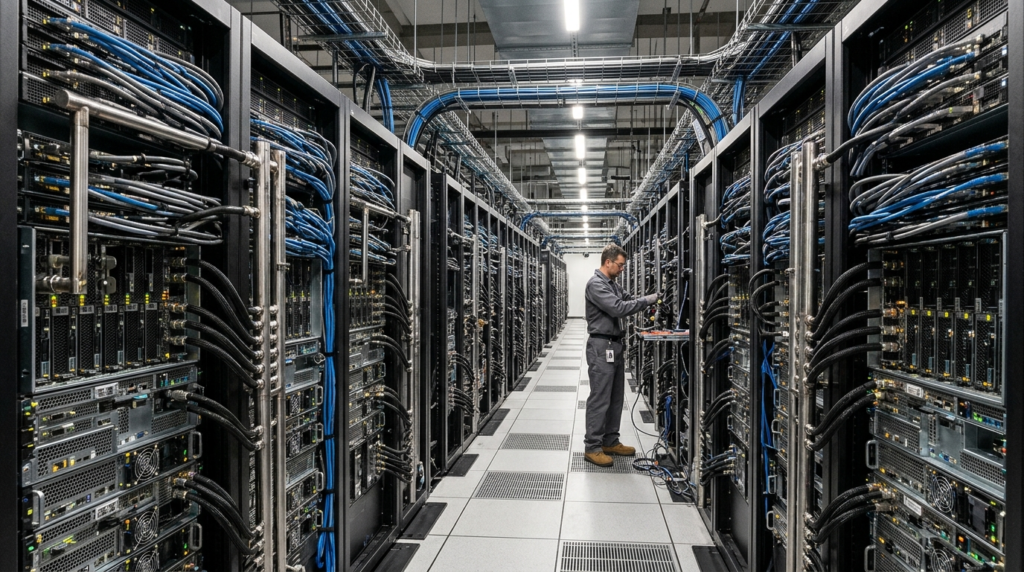
Once the raw bitstream entered Room 641A, it was instantly fed into specialized, carrier-grade technology arrays. Central to this covert operation was the Narus STA 6400, a formidable appliance capable of high-speed data capture and deep packet inspection (DPI) at unprecedented scale. The Narus system did not simply log connections or count bytes; it analyzed the entire TCP/IP stack in real-time, allowing intelligence agencies to scrutinize the metadata and routing information of billions of communications simultaneously without slowing down the primary network.
This physical infrastructure infiltration exposed a glaring mathematical vulnerability embedded in the internet’s core design since its inception. During the early days of the ARPANET, the Network Control Program (NCP) treated the underlying infrastructure—the mainframes and terminal nodes—as a closed, trusted ecosystem. However, a catastrophic “Great Schism” occurred with the 1983 transition to the Transmission Control Protocol/Internet Protocol (TCP/IP). The architects of the modern internet embraced the “end-to-end principle,” which offloaded the responsibility for data integrity, error correction, and identity verification from the core network routers directly to the terminal nodes. While this specific networking and cloud design philosophy allowed the internet to scale exponentially into a global mesh, it created a permanent architectural blind spot. The 32-bit source and destination IP address fields became essentially unauthenticated claims of identity. In a rapidly expanding world of billions of devices, these unauthenticated claims were efficiently weaponized, allowing the network’s greatest strength—its ability to find any path to any destination—to become its greatest vulnerability.
Market Impact & Deployment
As the 2006-2008 era unfolded, the fundamental paradigm of the digital economy underwent a massive, irreversible pivot. The era of optimizing wide-area networks purely for seamless data exchange was aggressively superseded by a predatory paradigm: the pivot to absolute data extraction. This systemic shift forced the global enterprise IT sector to completely reevaluate its operational security models. The traditional engineering requirement of minimizing latency and packet loss was abruptly matched by a dark new mandate for high-fidelity “interceptability.”
The forced deployment of interception-capable hardware completely changed the Total Cost of Ownership (TCO) for global internet service providers and Tier-1 carriers. Unlike early rudimentary routers that simply forwarded packets based on headers, the new generation of deep packet inspection devices relied on highly expensive, custom Application-Specific Integrated Circuits (ASICs) capable of line-rate inspection at terabits per second. The financial burden of integrating, maintaining, cooling, and physically securing these immense data capture arrays fell heavily on the telecommunications industry. The 2006–2008 period was marked by an intense national debate over the fragile balance between national security demands and constitutional privacy, creating a chaotic, highly litigious regulatory environment for corporate executives.
The legal fallout from the Room 641A revelations was monumental. Following the disclosures, the Electronic Frontier Foundation filed a landmark class-action lawsuit, Hepting v. AT&T, in 2006. The lawsuit formally alleged that the telecommunications giant had blatantly violated federal privacy laws, including the Wiretap Act and the Stored Communications Act, by willfully facilitating illegal domestic surveillance on behalf of the government. This litigation sent shockwaves through boardrooms worldwide, highlighting the severe legal, financial, and reputational risks associated with cooperating with state-sponsored interception programs. It forced infrastructure providers to rethink compliance in the age of digital oversight.
From a pure engineering perspective, the mathematics of the invisible had taken center stage. Intelligence agencies realized that the Border Gateway Protocol (BGP)—the undisputed mechanism for inter-domain routing—provided a perfect, exploitable blueprint for interception. Because BGP relies on path-vector updates to determine the absolute shortest and most efficient route for data across autonomous systems, the entire state of the global internet could be modeled as a dynamic, directed graph. An observer did not need to actively monitor every single terminal node on the planet; they only needed to tap the mathematical inevitability of the path at massive convergence points. Through highly efficient flow protocols like NetFlow and IPFIX, intelligence analysts began generating behavioral metadata—a statistical abstraction of network traffic based on the “five-tuple” attributes (source IP, destination IP, source port, destination port, and protocol).
This relentless metadata extraction allowed the surveillance state to meticulously map social, financial, and organizational hierarchies with a granularity that completely bypassed the strongest cryptographic payload protections of the era. The encrypted payload of an email or proprietary file transfer was often deemed far less valuable than the structural context of the communication itself. Who you were talking to, when you spoke, the size of the transmission, and the frequency of those interactions painted a flawless, actionable target matrix.
By the end of 2008, the severe geopolitical consequences of this new architecture were undeniable. The concept of a fragmented “Splinternet” had transitioned from theoretical academic warnings into a stark, physical reality. Global networks increasingly fragmented into isolated, highly fortified digital islands actively used for geopolitical maneuvering. National security apparatuses utilized sophisticated BGP “prefix hijacking” at the Tier-1 level to forcibly reroute global traffic through state-monitored gateways. The once-unified, egalitarian namespace of the internet was heavily stratified, ensuring that digital sovereignty was no longer merely a matter of policy, but a matter of hardcoded network physics.
The Consumer Translation
For the everyday consumer, the immense complexity of this hostile infrastructure remains deliberately and elegantly out of sight. The modern user interacts exclusively with a seamless, highly polished graphical abstraction—the modern web browser, the smartphone application, and the ubiquitous cloud storage drive. These sleek interfaces provide a comforting, albeit entirely false, sense of autonomy and privacy. The user believes that because a padlock icon appears next to a URL, their communications are impenetrable. Yet, beneath that application layer, the raw assembly language of the network is tirelessly executing the exact same extractive logic established during the Great Schism. The legacy of the 2006-2008 era is permanently embedded in the mathematical foundations of the internet.
To fully understand this abstract technological shift, consider the global internet as a massive, automated logistics and physical shipping network. When you send an encrypted message, you are placing your personal belongings into a heavy, unbreakable steel lockbox and handing it to a courier. You feel perfectly secure because you know no one can pick the lock in transit. However, the modern surveillance architecture has rendered the actual contents of the lockbox irrelevant. The surveillance apparatus functions by recording the sender’s home address, the recipient’s office address, the exact weight of the box, the precision timestamp of dispatch, and the historical frequency of your shipments. If you consistently ship a lockbox to an oncologist every Tuesday morning, and a lockbox to a bankruptcy attorney every Thursday afternoon, the state does not need the key to the box to understand the intimate details of your life. The collected metadata tells the entire story without ever breaking the encryption.
The psychological and societal impact of this absolute metadata visibility is profound, drawing eerie, documented parallels to historical attempts at mass social engineering. Technology historians and network analysts frequently compare this environment to early Soviet cybernetic dreams, specifically the Obshchesoyuznaya Gosudarstvennaya Avtomatizirovannaya Sistema (OGAS) project of the 1960s. The OGAS project was a highly ambitious, ultimately failed attempt to create a centralized, computerized nervous system capable of managing an entire socialist economy. It failed largely due to the “calculation problem”—the primitive vacuum-tube hardware of the era simply could not sustain the real-time feedback loops required for dynamic central command.
However, the high-speed fiber-optic infrastructure and extreme computational density of enterprise server racks in the mid-2000s finally solved this calculation problem. Instead of managing the physical distribution of grain or steel, modern hardware and silicon architectures enabled the flawless management of information, influence, and human attention. The 2006-2008 period was indeed the definitive beginning of the end for the open, borderless network, ushering in a dark era where high-speed infrastructure allowed for the creation of a “planned information environment.” Today, this high-fidelity behavioral mapping is not solely the domain of intelligence agencies; it forms the absolute core business model of the world’s largest advertising and social media conglomerates, conclusively proving that the tools of state surveillance are mathematically identical to the tools of surveillance capitalism.
Frequently Asked Questions
Q1: What was Room 641A?
A1: Room 641A was a secretive telecommunications interception facility located in an AT&T building in San Francisco, revealed by whistleblower Mark Klein in 2006, serving as a collection point for the NSA to intercept and analyze internet traffic.
Q2: How did fiber optic splitters enable mass surveillance?
A2: Fiber optic splitters were installed on internet backbone circuits to duplicate traffic by diverting a small fraction of the light signal, sending copies into restricted rooms without disrupting the original network transmission.
Q3: What is the Narus STA 6400?
A3: The Narus STA 6400 is a highly specialized technology appliance capable of high-speed data capture and deep packet inspection, used in facilities like Room 641A to analyze massive amounts of intercepted data.
Q4: What was the Hepting v. AT&T lawsuit?
A4: Filed in 2006 by the Electronic Frontier Foundation, the lawsuit alleged that AT&T violated federal privacy laws, including the Wiretap Act and the Stored Communications Act, by facilitating illegal domestic surveillance.
Q5: What is the “Splinternet”?
A5: The “Splinternet” refers to the fragmentation of the global internet into isolated, highly fortified digital islands used for geopolitical maneuvering, a concept that became a mathematical reality by the end of 2008.
TechNode HQ Verdict: Pros, Cons & Usability
- Pro (Engineering): Advanced Deep Packet Inspection enables robust Zero Trust network architectures and highly accurate threat detection at the carrier level.
- Pro (Consumer): The underlying hardware capabilities engineered during this era allow for unprecedented Quality of Service (QoS) and ultra-low-latency streaming for global applications.
- Con: The systemic, automated extraction of metadata completely bypasses end-to-end encryption, destroying the fundamental assumption of digital privacy.
- Con: BGP hijacking and legacy routing vulnerabilities remain an unresolved structural flaw, allowing aggressive state actors to easily partition the global namespace.
Enterprise Usability: Modern CTOs, Chief Information Security Officers, and enterprise architects must operate under the assumption that the global network core is entirely hostile. Relying solely on transport-layer encryption is a critical failure; organizations must aggressively deploy endpoint-centric zero trust architectures and rigorously audit their BGP routing paths to successfully mitigate constant metadata leakage.
Everyday Usability: For the general public, true network anonymity over the standard internet is largely a mathematical impossibility. While consumer VPNs and heavily encrypted messaging apps effectively protect the payload data of a message, everyday consumers must recognize that their structural metadata—the exact timing, volume, and routing trajectory of their communications—remains entirely visible to the underlying infrastructure.