
The Architectural Reality: Deconstructing the OYSTER Infection Chain
The landscape of state-sponsored cyber espionage is undergoing a radical transformation, shifting from brute-force intrusions to highly evasive, workflow-integrated campaigns. At the bleeding edge of this shift is the Belarus-aligned threat actor known as Ghostwriter (also tracked by intelligence agencies as UAC-0057 and UNC1151). According to recent disclosures from the Computer Emergency Response Team of Ukraine (CERT-UA), Ghostwriter has deployed a highly sophisticated, modular malware toolkit dubbed the “OYSTER” family, specifically targeting Ukrainian government entities.
The infection architecture of the OYSTER campaign is a masterclass in evading traditional endpoint detection and response (EDR) systems. The attack vector abandons broad, generic spam in favor of hyper-targeted spear-phishing. Attackers compromise legitimate email accounts of government employees and distribute lures disguised as administrative updates for “Prometheus,” a widely used Ukrainian online learning platform. This workflow-aligned social engineering drastically lowers the recipient’s skepticism.
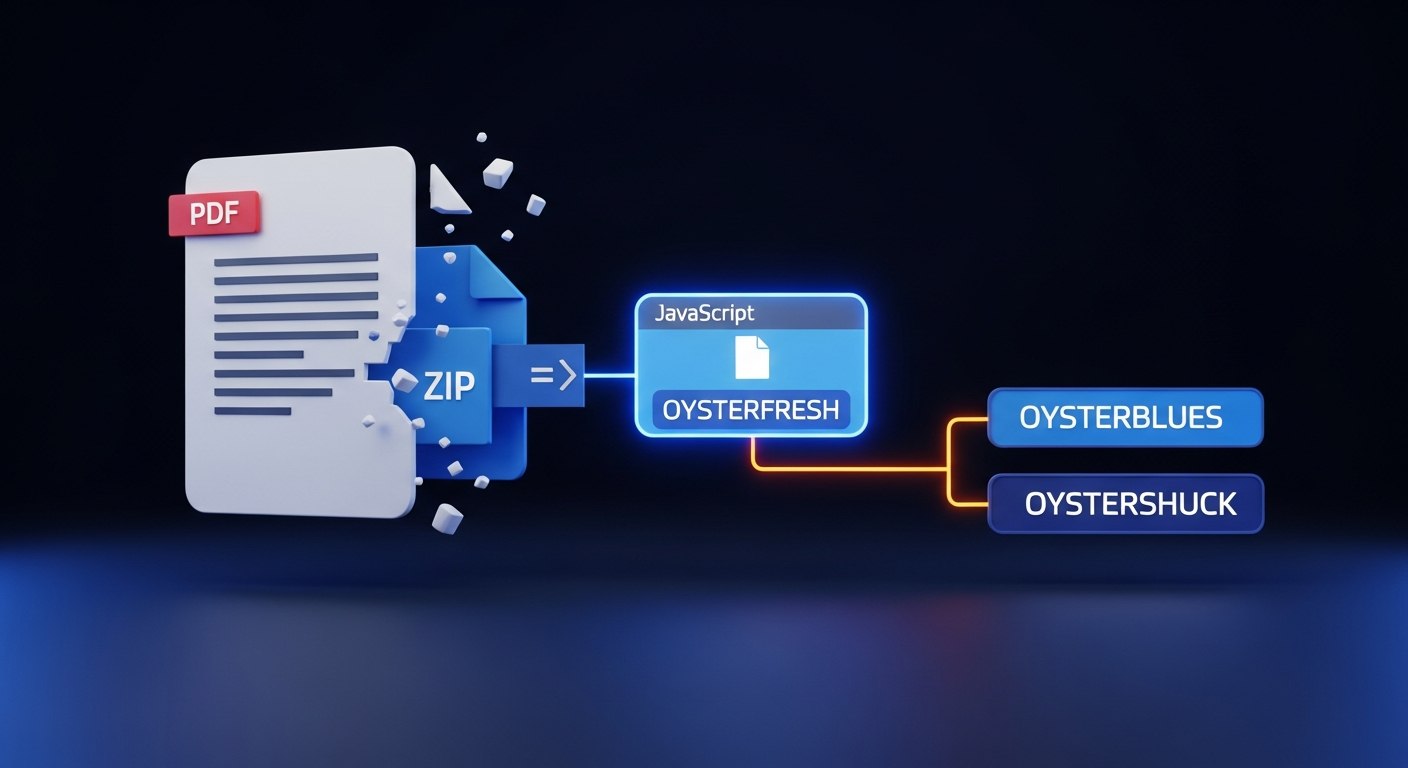
The technical execution begins when a victim clicks a link embedded within a seemingly benign PDF attachment. This action triggers the download of a ZIP archive containing a malicious JavaScript file classified as OYSTERFRESH. Upon execution, OYSTERFRESH operates as a dual-purpose dropper. To maintain the illusion of legitimacy, it immediately displays a decoy document to the user. Simultaneously, in the background, it initiates a complex Fileless Malware routine.
Instead of writing executable binaries to the disk—which would easily be flagged by heuristic scanners—OYSTERFRESH writes an obfuscated and encrypted payload, known as OYSTERBLUES, directly into the Windows Registry. To achieve execution, the malware downloads a secondary component called OYSTERSHUCK. This component acts as a dedicated decoder, utilizing techniques such as string reversal, ROT13, and URL decoding to unpack the registry-resident OYSTERBLUES payload.
Once active, OYSTERBLUES functions as a comprehensive reconnaissance and staging tool. It fingerprints the compromised host, harvesting critical telemetry including the computer name, active user account, precise operating system version, last boot time, and a complete list of running processes. This data is exfiltrated via HTTP POST requests to a Command-and-Control (C2) infrastructure that investigators have noted is heavily reliant on Cloudflare-protected .icu domains. The C2 server then responds with arbitrary, next-stage JavaScript code that is executed dynamically using the eval() function. The ultimate objective of this intricate chain is the deployment of a Cobalt Strike beacon (specifically the CSBEACON DLL), granting the threat actors persistent, post-exploitation access for lateral movement and deep network espionage.
AI Weaponization and Runtime Command Generation
While the OYSTER malware family demonstrates advanced evasion techniques, the broader strategic context reveals a terrifying evolution in cyber warfare: the integration of Large Language Models (LLMs) into the attack lifecycle. Concurrent with the CERT-UA disclosures, Ukraine’s National Security and Defense Council (NSDC) released a stark warning regarding the weaponization of artificial intelligence by Kremlin-backed hacking groups.
According to the NSDC, Russian intelligence apparatuses are actively utilizing commercial AI tools, specifically OpenAI’s ChatGPT and Google’s Gemini, to augment their offensive capabilities. The application of these models extends far beyond generating convincing phishing copy. Threat actors are reportedly using AI to scout targets, analyze network topologies, and, most alarmingly, embed LLM technology directly into malware to generate malicious commands at runtime.
This represents a paradigm shift in malware design. Traditional malware relies on static, pre-programmed instructions or hardcoded C2 communication protocols. By integrating AI for runtime command generation, malware can theoretically become infinitely polymorphic. An AI-driven payload could analyze the specific defensive posture of a compromised endpoint in real-time and dynamically generate obfuscated scripts or API calls designed to bypass the exact security software installed on that machine. While the NSDC did not explicitly state that the OYSTERBLUES payload utilizes this specific AI capability, the convergence of Ghostwriter’s highly modular JavaScript execution (via the eval() function) and Russia’s broader AI doctrine suggests that dynamic, AI-generated payloads are the immediate future of state-sponsored intrusions.
Market Impact & Deployment: Securing the Enterprise Perimeter

For Enterprise IT leaders and Chief Information Security Officers (CISOs), the Ghostwriter campaign serves as a critical case study in the necessity of a strict Zero Trust Architecture. The initial penetration vectors observed throughout 2025 and early 2026—social engineering, exploitation of edge vulnerabilities, compromised RDP/VPN accounts, and supply chain attacks—highlight the fragility of perimeter-based defense models.
The reliance of the OYSTER family on native Windows scripting engines exposes a massive vulnerability in default enterprise configurations. CERT-UA’s primary mitigation directive is the immediate restriction of wscript.exe and mshta.exe execution for standard user accounts. Furthermore, organizations must implement aggressive policies limiting PowerShell and JavaScript execution environments.
From a network defense perspective, the use of Cloudflare to mask C2 infrastructure complicates IP-based blocking. Security Operations Centers (SOCs) must pivot toward behavioral analytics, monitoring specific registry Run keys for suspicious modifications, and establishing strict web filtering policies that scrutinize or outright block high-risk top-level domains (TLDs) like .icu. The deployment of Cobalt Strike as the final payload means that defenders must also ensure their EDR solutions are finely tuned to detect in-memory execution and anomalous scheduled tasks, such as the creation of fake update services (e.g., MicrosoftEdgeUpdateTaskMachine) used for persistence.
The Consumer Translation: Matryoshka and the Hijacking of Bluesky
The geopolitical cyber conflict is not confined to government networks and enterprise IT; it has aggressively spilled over into the consumer internet, manifesting as highly coordinated disinformation campaigns. In a parallel development to the Ghostwriter network intrusions, researchers have uncovered a massive pro-Kremlin propaganda operation targeting the decentralized social network, Bluesky.
Attributed to a Moscow-based entity known as the Social Design Agency (SDA), this campaign—dubbed “Matryoshka” (after the Russian nesting dolls)—represents a sophisticated evolution in information warfare. Unlike traditional troll farms that rely on easily identifiable bot networks, the Matryoshka campaign actively hijacked the accounts of real, credible Bluesky users. According to research from Clemson University and the Institute for Strategic Dialogue (ISD), the compromised accounts belonged to influential figures, including journalists, university professors, a Texas pollster, and a Hollywood filmmaker.
By laundering their disinformation through the established reputations of these individuals, the SDA bypassed standard inauthentic behavior detection algorithms. The hijacked accounts were used to disseminate highly produced fake news articles designed to mimic legitimate outlets like Reuters and France 24, as well as AI-doctored deepfake videos. In one notable instance, a compromised account posted an AI-generated video impersonating a Canadian police official criticizing French President Emmanuel Macron.
The goal of the Matryoshka campaign is clear: to erode public support for Ukraine, fuel domestic division within Western democracies, and fundamentally degrade the public’s trust in digital media. For the everyday consumer, this signifies the end of the “bot” era and the beginning of the “synthetic identity” era. When a trusted academic or journalist’s account can be seamlessly hijacked to broadcast AI-generated geopolitical propaganda, the burden of verification shifts entirely to the end-user, creating a deeply fractured and paranoid digital ecosystem.
TechNode HQ Verdict: Pros, Cons & Usability
- Pro (Engineering): The OYSTER malware family demonstrates exceptional operational security by utilizing registry-based fileless execution and dynamic decoding, severely limiting forensic artifacts on the disk.
- Pro (Consumer): The exposure of the Matryoshka campaign by academic researchers has forced platforms like Bluesky to implement more aggressive account suspension and reset protocols, temporarily halting the spread of high-tier disinformation.
- Con: The integration of LLMs for runtime command generation renders traditional, signature-based threat intelligence nearly obsolete, requiring a massive overhaul of enterprise behavioral detection systems.
- Con: The hijacking of credible, verified accounts for disinformation bypasses standard media literacy filters, making it nearly impossible for the average consumer to distinguish between authentic commentary and state-sponsored psychological operations.
Enterprise Usability: CTOs and security architects must immediately audit their endpoint configurations. The principle of least privilege must be ruthlessly enforced, specifically targeting the execution capabilities of native scripting engines (wscript.exe, mshta.exe). Furthermore, organizations must transition from static IOC (Indicator of Compromise) blocking to dynamic, behavioral-based EDR solutions capable of detecting in-memory anomalies and unauthorized registry modifications.
Everyday Usability: For the general public, the Matryoshka campaign is a stark reminder of the fragility of digital identity. Users must enable hardware-backed Multi-Factor Authentication (MFA) on all social and professional accounts to prevent hijacking. Furthermore, consumers must adopt a “zero trust” mindset toward digital media, independently verifying sensational claims or videos, even if they appear to originate from a trusted connection or verified journalist.