For decades, the architecture of live sports broadcasting has remained largely unchallenged. It is an industry defined by massive, multi-million-dollar production trucks, miles of heavy triax and fiber optic cabling, and optical behemoths—broadcast cameras that cost upwards of $100,000 a piece when paired with specialized box lenses. But on Saturday, May 23, 2026, the paradigm shifts entirely. Apple TV, in partnership with Major League Soccer (MLS), is broadcasting the LA Galaxy vs. Houston Dynamo FC match live from Dignity Health Sports Park in Carson, California. The catch? The entire production is being shot exclusively on the iPhone 17 Pro.
This is not a marketing gimmick relegated to a single sideline shot. According to Apple’s latest engineering mandates, 15 units of the iPhone 17 Pro are being deployed across the 84,000-square-foot pitch to capture every second of the action—from player introductions and team warmups to dynamic in-net goal angles and sweeping stadium atmosphere shots. This marks the first time in television history that a major professional live sporting event broadcast has been captured end-to-end using a smartphone.
To the casual observer, this is a fun technological novelty. But to enterprise IT architects, broadcast engineers, and silicon designers, this is a watershed moment. It represents the ultimate triumph of computational photography over traditional optical physics, and it signals a radical restructuring of how live video data is captured, processed, and distributed at scale.
The Architectural Reality: Silicon Over Optics
To understand how a 7-ounce piece of consumer electronics can replace a 50-pound Sony HDC-5500 broadcast camera, we must look at the silicon and the sensor architecture. The iPhone 17 Pro is equipped with a triple 48MP Fusion camera system. In a traditional broadcast lens, zooming and focal length adjustments are achieved by physically moving heavy glass elements. Apple, however, is utilizing the massive 48-megapixel sensor to achieve the equivalent of eight distinct lenses through a combination of optical design and aggressive sensor cropping (pixel binning).
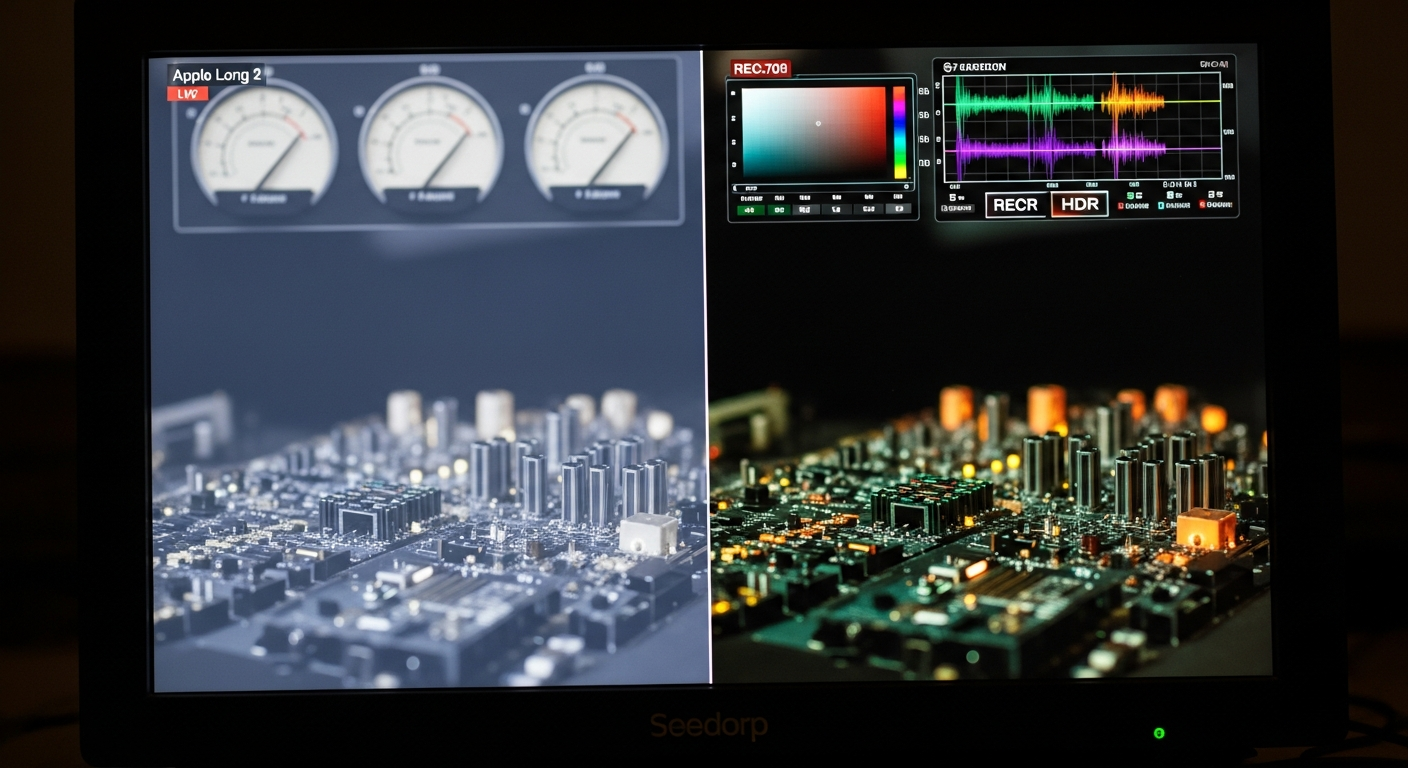
But the true hero of this broadcast is not just the megapixel count; it is the color science. The May 23 MLS broadcast relies heavily on Apple Log 2. In professional video production, a logarithmic (Log) color profile is a mathematical curve used to encode video data. Unlike standard Rec.709 video, which bakes in contrast and saturation, Apple Log 2 captures a flat, desaturated image that preserves an immense amount of dynamic range—specifically in the highlights and shadows.
In a live sports environment, dynamic range is the difference between a usable shot and a ruined broadcast. A soccer stadium at 7:30 p.m. presents a nightmare scenario for camera sensors: half the pitch may be bathed in harsh, direct stadium floodlights, while the other half falls into deep, crushing shadows. Traditional broadcast cameras handle this via massive 2/3-inch or Super 35 sensors. The iPhone 17 Pro handles it via Apple Log 2 and the brute force of its A-series Image Signal Processor (ISP).
The ISP performs trillions of operations per second, analyzing the exposure, applying real-time noise reduction, and encoding the massive data stream into ProRes. In the broadcast truck, engineers take this flat Apple Log 2 feed and apply real-time LUTs (Look-Up Tables) to instantly color-grade the footage into the vibrant, high-contrast HDR video that Apple TV subscribers expect. It is a seamless marriage of edge processing and centralized broadcast control.
The Red Team Audit: Unmasking the “Shot on iPhone” Illusion
As veteran technology analysts, it is our job to look past the polished press releases. When Apple claims this match is “captured exclusively on iPhone 17 Pro,” it is technically true regarding the image sensor. However, it heavily obscures the massive enterprise-grade infrastructure required to make that sensor viable for a two-hour live television broadcast.
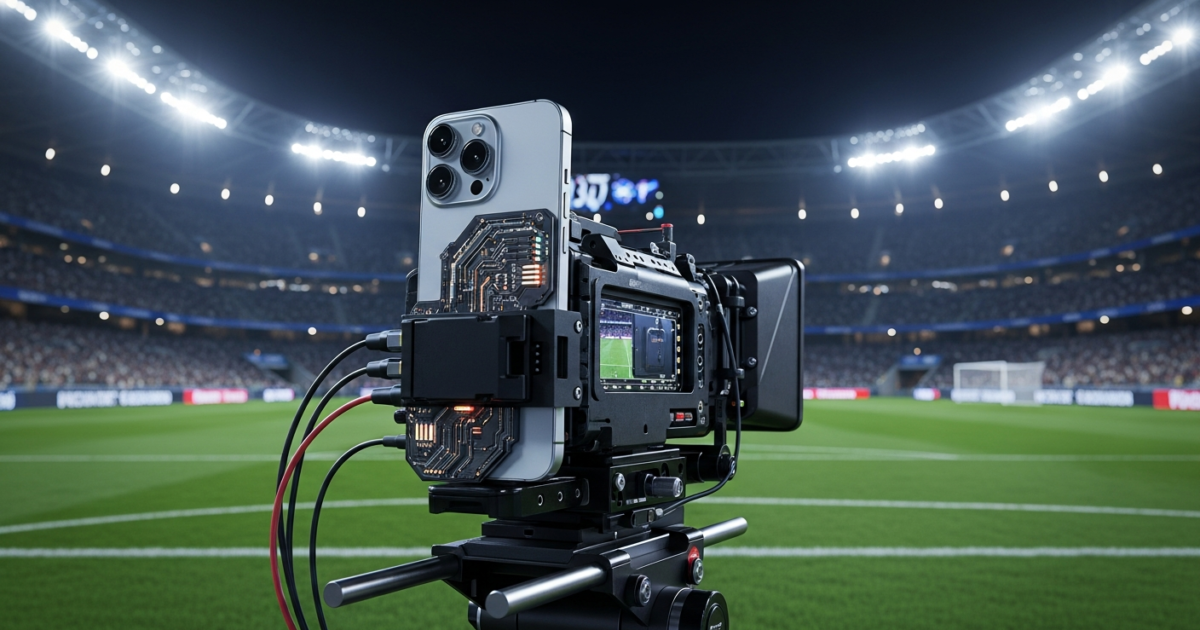
If you were to walk the sidelines at Dignity Health Sports Park, you would not see camera operators casually holding iPhones in their hands. You would see complex, heavy-duty broadcast rigs. Here is the hidden reality of the “Shot on iPhone” infrastructure:
- The Rigging & Cages: Each iPhone 17 Pro is housed in a machined aluminum cage, likely manufactured by companies like Tilta or SmallRig. These cages provide the necessary mounting points for tripods, gimbals, and fluid heads, allowing operators to pan and tilt with the smooth precision required for sports tracking.
- Thermal Management: Recording 4K60fps ProRes Log video continuously for over two hours generates an immense amount of heat. Left to its own devices in the California sun, an iPhone would thermally throttle, dropping frames or shutting down entirely to protect its battery. These broadcast rigs are equipped with active cooling systems—Peltier coolers and high-RPM fans attached directly to the MagSafe port to draw heat away from the chassis.
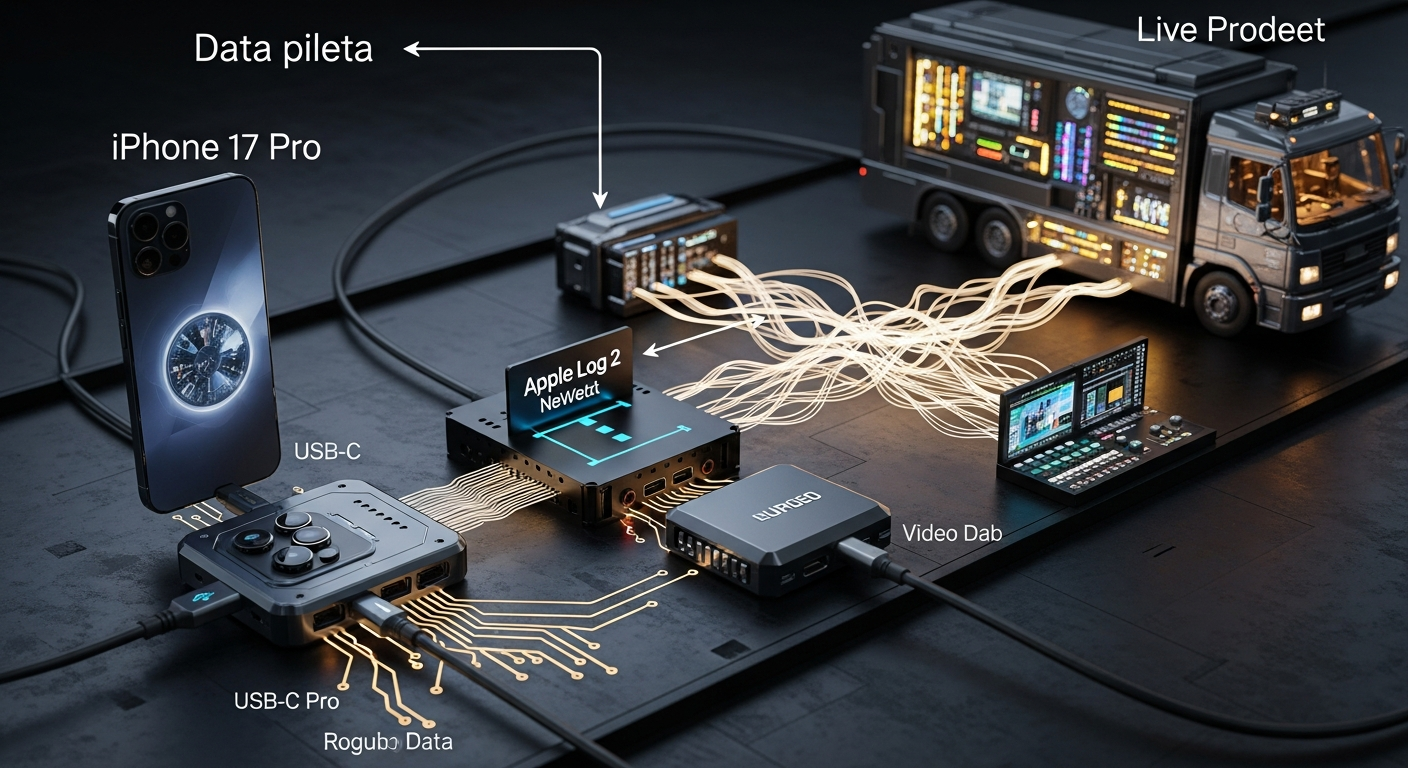
- Enterprise Networking: A live broadcast cannot rely on Wi-Fi or 5G, no matter how robust the stadium’s network is. The latency and packet loss would be catastrophic. Instead, the iPhone’s USB-C port is the lifeline. The phones are connected to ruggedized USB-C hubs, which split the signal. One path provides continuous Power Delivery (PD) so the phone doesn’t die in 30 minutes. The other path converts the video signal to SDI (Serial Digital Interface) or utilizes NDI HX (Network Device Interface) over hardwired Ethernet. This allows the iPhone to plug directly into the stadium’s existing SMPTE 2110 IP video routing infrastructure.
In short, the iPhone is acting purely as a sensor head and an encoder. The glass and the silicon are Apple’s, but the nervous system supporting it is pure, unadulterated enterprise broadcast IT.
Market Impact & Deployment: The Economics of Smartphone Broadcasting
Why go through the trouble of rigging an iPhone to act like a broadcast camera? The answer, as always in enterprise IT, comes down to Total Cost of Ownership (TCO) and deployment scalability.
A standard live sports camera chain—comprising the camera body, the box lens, the fiber base station, and the CCU (Camera Control Unit)—can easily exceed $100,000. To outfit a stadium with 15 of these cameras requires a capital expenditure of $1.5 million just for the optics.
Conversely, an iPhone 17 Pro retails for roughly $1,199. Even when you add $3,000 worth of professional rigging, cooling, and SDI converters, the total cost per camera position is under $5,000. You can deploy twenty iPhone 17 Pro rigs for the cost of a single traditional broadcast camera. This economic reality is sending shockwaves through legacy broadcast manufacturers like Sony, Grass Valley, and Panasonic.
Apple has been quietly testing this pipeline for over a year. In September 2025, Apple TV incorporated the iPhone 17 Pro into a live “Friday Night Baseball” matchup between the Boston Red Sox and the Detroit Tigers. That proof-of-concept was so successful that the National Baseball Hall of Fame added one of the broadcast iPhones to its permanent collection. Following that, Apple scaled the technology across the 2025 MLS Cup before committing to this weekend’s fully iPhone-powered broadcast.
By leveraging edge computing, where the heavy lifting of image processing and encoding is done on the device itself rather than in the truck, Apple is proving that high-end live production is no longer constrained by the cost of optical glass. This allows directors to place cameras in previously impossible locations—inside the goal netting, strapped to the referee, or tucked into the tight corners of the player tunnels—without risking a $100,000 piece of equipment.
The Consumer Translation: Democratizing the ESPN Look
For the millions of fans tuning into Apple TV in over 100 countries this Saturday, the technical backend is irrelevant. What matters is the visual output. Because of the iPhone’s small form factor, viewers will experience dynamic new perspectives that bring them closer to the pitch. The pristine video quality, powered by Apple Log 2 and real-time LUT grading, will ensure that the grass looks vibrant, the jerseys pop, and the action remains fluid without motion blur.
But the broader consumer translation extends far beyond the MLS. By proving that the iPhone 17 Pro can anchor a Tier-1 professional sports broadcast, Apple is democratizing the “ESPN look.”
If a smartphone can broadcast the LA Galaxy, it can broadcast a high school football game, a local minor league baseball match, or a collegiate wrestling tournament with the exact same visual fidelity. Independent creators, local sports networks, and digital-first broadcasters no longer need to secure millions of dollars in funding to produce network-quality live television. With a few iPhones, a software switcher like Blackmagic Design’s ATEM, and a basic understanding of IP networking, anyone can spin up a global broadcast.
The line between consumer technology and professional enterprise infrastructure has not just been blurred; it has been entirely erased.
TechNode HQ Verdict: Pros, Cons & Usability
- Pro (Engineering): The A-series ISP combined with Apple Log 2 delivers unprecedented dynamic range and real-time ProRes encoding, drastically reducing the need for massive broadcast CCUs.
- Pro (Consumer): The ultra-compact form factor allows for highly immersive, intimate camera angles (like in-net cameras) that traditional broadcast lenses physically cannot achieve.
- Con: Severe thermal limitations. Continuous 4K60fps ProRes recording requires bulky, active third-party cooling solutions to prevent the silicon from throttling during a live event.
- Con: Optical physics cannot be entirely faked. While the 48MP sensor is incredible, digital cropping and pixel binning still struggle with low-light noise compared to a true 2/3-inch broadcast sensor.
Enterprise Usability: For CTOs and broadcast engineers, the iPhone 17 Pro is now a legitimate, highly scalable tool for Tier-2 and Tier-3 live productions. While it may not entirely replace the main play-by-play cameras at the Super Bowl just yet, it is the ultimate solution for B-roll, specialty angles, and cost-effective multi-cam deployments. It should be integrated into your IP video workflows immediately.
Everyday Usability: For the everyday consumer and independent creator, the iPhone 17 Pro is the most powerful pocket-sized production studio ever built. If you are a streamer, podcaster, or local sports videographer, this device completely eliminates the need to purchase dedicated DSLR or mirrorless cameras for live video production.