The $150M Catalyst: Nvidia’s Strategic Healthcare Play
The intersection of artificial intelligence and clinical healthcare has officially moved from experimental pilot programs to enterprise-grade infrastructure. Aidoc Medical Ltd., a pioneer in clinical AI, has secured a massive $150 million funding round led by Goldman Sachs, with heavy-hitting participation from General Catalyst, SoftBank Investment Advisors, and Nvidia’s venture capital arm, NVentures. This latest capital injection pushes the software maker’s total outside funding past the half-billion-dollar mark, cementing its status as a dominant force in the medical imaging sector.
While the sheer volume of the raise is notable, the strategic composition of the cap table tells a much deeper story about the future of medical IT. Nvidia’s involvement is not merely a financial bet; it is a calculated infrastructure play. In 2026 alone, Nvidia has committed tens of billions to AI equity investments, aggressively expanding its footprint beyond traditional data centers and into “physical AI” and edge computing environments. By backing Aidoc—alongside other healthcare AI innovators like Hippocratic AI and Abridge—Nvidia is ensuring that the next generation of clinical diagnostics runs on its silicon. Hospitals are rapidly becoming localized data centers, requiring immense GPU Compute power to process complex, multimodal AI workloads securely on-premises or in hybrid cloud environments to maintain strict patient data privacy compliance.
Aidoc’s mandate is clear: eradicate the lethal bottlenecks inherent in hospital triage. When a patient undergoes a medical scan, the traditional workflow dictates a “first-in, first-out” queue. A routine scan for a minor fracture sits in the same backlog as a scan containing a hidden, ticking time bomb—like a pulmonary embolism or an intracranial hemorrhage. Aidoc’s platform flips this linear model on its head, utilizing advanced AI to instantly analyze scans, cross-reference patient data, and push urgent anomalies to the top of the radiologist’s queue.
The Architectural Reality: Decoding CARE and aiOS
To understand why Aidoc is commanding such a premium valuation, one must look under the hood at its proprietary architecture. Historically, clinical-grade AI models were narrow and fragmented. A hospital would have to purchase and integrate one algorithm to detect lung nodules, another to spot brain bleeds, and a third to analyze bone fractures. This fragmented approach led to IT nightmares, siloed data, and severe alert fatigue among clinicians.
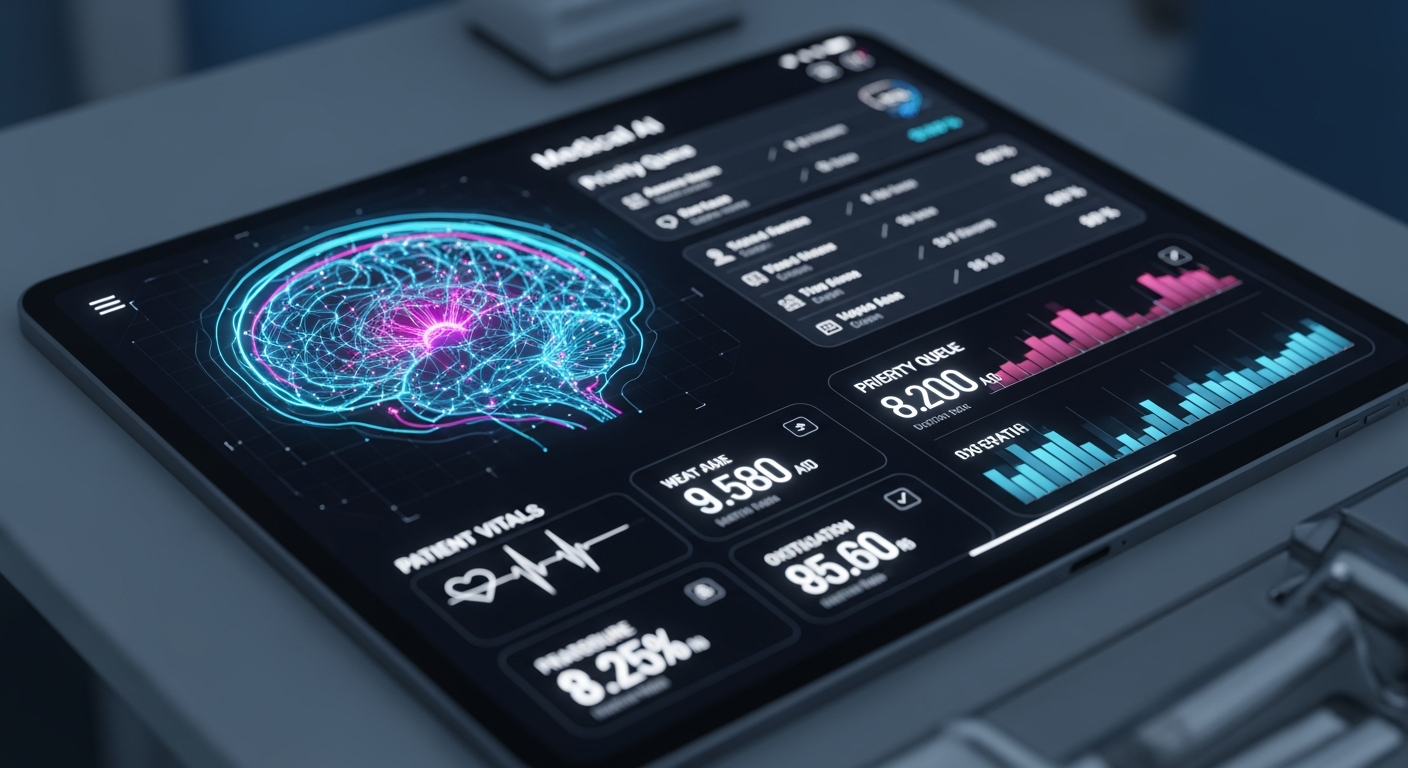
Aidoc has bypassed this fragmentation by developing a custom Foundation Model known as the Clinical AI Reasoning Engine, or CARE. Unlike legacy models trained on a single type of medical data, CARE is intrinsically multimodal. It possesses the capability to simultaneously ingest and analyze high-resolution medical images (pixel data), Electronic Health Records (EHR), real-time patient vitals, and laboratory results. This holistic data fusion allows the AI to contextualize an anomaly rather than just flagging a suspicious cluster of pixels.
In January 2026, this architectural leap was validated when the U.S. Food and Drug Administration (FDA) cleared the CARE model for diagnostic tasks across 11 new disease indicators, bringing Aidoc’s total cleared indicators to 14. This marked a watershed regulatory milestone: the first FDA clearance of a double-digit suite of acute indications powered by a single foundation model. The performance metrics are staggering. In FDA-reviewed pivotal studies, the 11 newly cleared indications achieved a mean sensitivity of 97% and a mean specificity of 98%. For certain critical pathologies, the model’s specificity scales up to 99.7%, corresponding to a less than 1% chance of a false positive. According to Aidoc, this represents an order-of-magnitude improvement over competing single-condition models.
However, a powerful foundation model is useless if it cannot be deployed seamlessly into the chaotic IT environment of a modern hospital. This is where Aidoc’s aiOS platform comes into play. Acting as the enterprise orchestration layer, aiOS handles the heavy lifting of data normalization, continuous performance monitoring, and built-in governance. When CARE identifies a severe anomaly, aiOS prioritizes it based on estimated severity and instantly routes the alert to the appropriate medical professionals via a secure mobile app. Furthermore, the platform automates peripheral administrative burdens, such as automatically identifying patients who may qualify for specific clinical trials based on their real-time diagnostic data.
Market Impact & Deployment: The Economics of Clinical AI

The deployment scale of Aidoc’s technology is already vast. The aiOS platform is currently installed in nearly 2,000 hospitals worldwide, processing data for more than 60 million patients annually. This level of market penetration is driven by a stark economic and operational reality: healthcare systems are buckling under the weight of rising imaging volumes and severe workforce shortages.
Diagnostic errors and delays contribute to an estimated 400,000 deaths annually in the United States alone. As imaging volumes continue to outpace the availability of skilled radiologists, the time-to-diagnosis for critical conditions has stretched to dangerous lengths. Aidoc’s platform acts as an automated triage layer, providing the most readily available operational lever for improving patient outcomes and reducing institutional risk. By surfacing urgent findings the moment a scan is completed, hospitals can drastically reduce the length of stay for emergency department patients, optimize operating room scheduling, and mitigate the massive liability costs associated with missed or delayed diagnoses.
With its fresh $150 million in capital, Aidoc is aggressively pursuing international expansion and deepening its product roadmap. The company is currently developing a feature that will automatically draft clinical reports based on the data extracted from medical images. This “pixel-to-draft-report” capability aims to eliminate hours of manual dictation and data entry for radiologists, allowing them to function as editors of AI-generated reports rather than authors starting from a blank page. For hospital CIOs and CTOs, the Total Cost of Ownership (TCO) equation is shifting. The initial capital expenditure required to deploy aiOS and the necessary on-premise compute infrastructure is rapidly offset by the hard ROI of increased throughput, reduced administrative overhead, and optimized billing capture from incidental findings.
The Consumer Translation: Rewiring the Patient Experience
While the underlying technology is a marvel of enterprise IT and silicon engineering, the consumer impact is deeply personal. For the average patient, Aidoc’s technology fundamentally alters the safety net of the healthcare system.
Imagine walking into a crowded emergency room with severe abdominal pain. You are sent for a CT scan, but because it is a Friday night and the ER is overflowing, your scan is placed at the bottom of a digital stack of 50 other routine images waiting for the on-call radiologist. In a traditional hospital, if that scan reveals a ruptured appendix or an aortic aneurysm, you are entirely dependent on the speed at which the radiologist can burn through the queue. With Aidoc deployed, the CARE model analyzes your scan within seconds of you leaving the CT machine. It immediately detects the critical anomaly, bypasses the queue, and triggers a high-priority alert on the attending physician’s mobile device. Minutes, rather than hours, dictate your path to the operating room.
Equally transformative is the AI’s ability to spot “incidentals”—potential disease indicators that doctors were not actively looking for. A patient might receive a chest X-ray to check for pneumonia, only for the AI to detect an early-stage, asymptomatic lung nodule in the corner of the image. By catching these incidental findings early, the AI shifts the paradigm of care from reactive treatment to proactive intervention, potentially saving lives and drastically reducing the long-term cost of care for the patient.
Red Team Audit: The Hidden Bottlenecks of AI Triage
Despite the impressive metrics and massive funding, a critical audit of Aidoc’s claims reveals several friction points that enterprise buyers must navigate. First is the inescapable reality of alert fatigue. While a 98% mean specificity is a triumph of machine learning, applying that 2% false positive rate across 60 million annual patients yields over 1.2 million false alerts globally per year. In a high-stress emergency department, even a small volume of false alarms can lead to clinicians ignoring the system entirely—a phenomenon well-documented in legacy EHR implementations.
Furthermore, Aidoc’s own literature notes the inclusion of a “spreadsheet-based data management interface” used to track the current status of patients. For a platform boasting a state-of-the-art multimodal foundation model, a spreadsheet-based UI feels remarkably archaic. It highlights the persistent, grueling challenge of achieving deep, native integration with monolithic EHR systems like Epic and Cerner. Often, cutting-edge AI platforms are forced to run in parallel to the main hospital system, requiring doctors to toggle between screens or rely on third-party mobile apps rather than having the insights injected directly into their primary workflow.
TechNode HQ Verdict: Pros, Cons & Usability
- Pro (Engineering): The CARE model’s ability to fuse pixel data with structured EHR and vitals into a single foundation model eliminates the need for hospitals to manage dozens of siloed, single-condition algorithms.
- Pro (Consumer): Acts as an automated safety net in crowded ERs, instantly prioritizing life-threatening conditions and catching early-stage incidental diseases that human eyes might miss during routine scans.
- Con: A 98% mean specificity still guarantees a non-trivial number of false positives at scale, requiring strict governance to prevent clinical alert fatigue.
- Con: Reliance on parallel interfaces (like spreadsheet-based trackers and standalone mobile apps) indicates that seamless, native integration into legacy EHR monoliths remains a significant deployment hurdle.
Enterprise Usability: For hospital CTOs and radiology directors, Aidoc is rapidly becoming a mandatory infrastructure upgrade rather than an experimental luxury. The FDA clearance of 11 simultaneous indications proves the viability of the foundation model approach. Deployment should be prioritized in high-volume trauma centers and emergency departments where acuity-based triage yields the highest immediate ROI.
Everyday Usability: While patients cannot “buy” this technology directly, its presence should become a key differentiator when choosing a healthcare provider. Hospitals utilizing comprehensive AI triage offer a mathematically proven safety net against diagnostic delays, making them the superior choice for emergency and complex care.