The Architectural Reality: Reimagining the Agentic Stack
For the past two years, the artificial intelligence industry has been locked in a monolithic arms race. The prevailing orthodoxy dictated that capable Agentic AI—systems that can plan, execute, and recover from errors autonomously—required frontier-scale models. These trillion-parameter behemoths, housed in hyperscale data centers, have driven the narrative of modern automation. However, Microsoft Research AI Frontiers has just fundamentally challenged this consensus with the release of MagenticLite, MagenticBrain, and Fara1.5. This release is not merely a software update; it is a comprehensive, end-to-end agentic stack optimized entirely for Small Language Models (SLMs), proving that orchestration and action can trump sheer parametric knowledge.
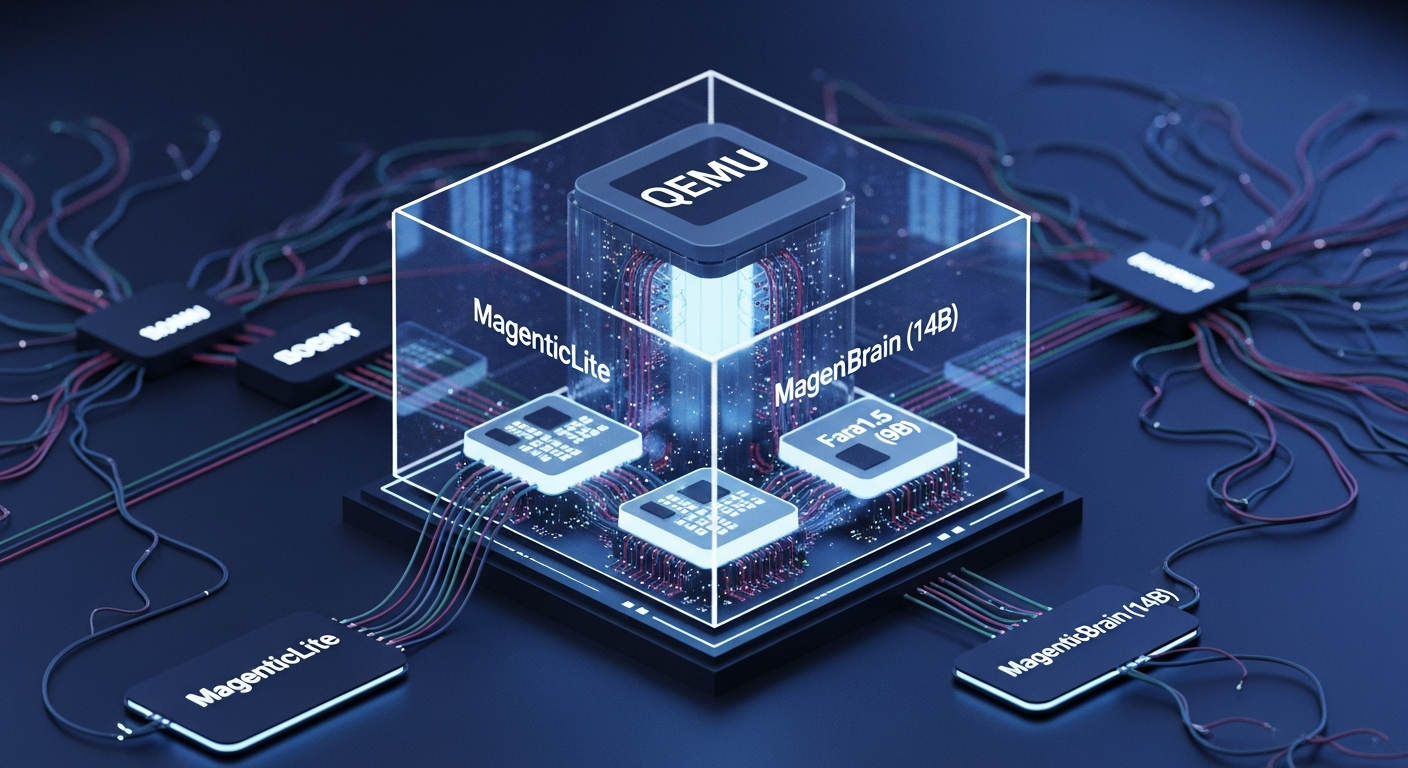
At the core of this localized revolution lies a tripartite architecture designed to operate seamlessly across both web browsers and local file systems. The application layer, MagenticLite, serves as the next-generation successor to the experimental Magentic-UI. It provides the interface and the execution harness. But the true engineering marvels are the models powering the logic beneath the surface.
MagenticBrain acts as the system’s central orchestrator. Fine-tuned from the open-weight Qwen 3 14B base model, this 14-billion-parameter engine is a hybrid planner, coder, and delegator. In traditional agentic frameworks, orchestration is the most reasoning-intensive task, typically reserved for massive models like GPT-4o or Claude 3.5 Sonnet. Microsoft’s research bet is that orchestration does not require exhaustive world knowledge (like knowing the capital of every country or the intricacies of 18th-century literature). Instead, it requires precise tool-calling trajectories and the ability to write localized code—often just a few lines of Python—to bridge execution gaps. Crucially, MagenticBrain was trained end-to-end within the MagenticLite harness, utilizing the exact tool schemas it encounters at inference. This tight coupling eliminates the translation gap between training environments and real-world execution, allowing a 14B model to punch significantly above its weight class.
When MagenticBrain determines that a task requires navigating a graphical user interface or scraping a dynamic webpage, it does not attempt to do so itself. Instead, it delegates the workload to Fara1.5. Fara1.5 is Microsoft’s next-generation computer-use model family, built on the robust Qwen 3.5 architecture. Available in 4B, 9B, and 27B parameter sizes—with the 9B variant positioned as the flagship for most use cases—Fara1.5 is a vision-capable decoder-only model. It perceives the browser exclusively through UI screenshots and emits structured tool calls (such as click, type, and scroll) to execute multi-step web tasks. By separating the “brain” (orchestration) from the “hands” (computer use), Microsoft has created a highly modular, efficient system.
The glue holding these models together is a highly optimized execution harness. Small models are notoriously susceptible to degradation when their Context Window is flooded with irrelevant data or long histories of past actions. The MagenticLite harness employs active context management, dynamically curating the prompt at each step. It surfaces only necessary information, condenses earlier interactions into concise summaries, and offloads the rest. This active curation allows the 14B and 9B models to maintain strict coherence over long-running tasks that span hundreds of steps and many minutes of real-world work.
Furthermore, security and isolation are paramount when granting an AI access to local file systems and live web browsers. Microsoft addresses this critical enterprise requirement by executing the entire system inside Quicksand, an open-source wrapper for a QEMU-based sandbox. This ensures that browser sessions and code execution are strictly isolated from the host operating system. If the agent is instructed to download a file that turns out to be malware, or if it hallucinates a destructive bash command, the damage is contained entirely within the ephemeral QEMU instance. The host OS remains completely untouched.
Market Impact & Deployment: The Economics of Local Automation
The deployment of MagenticLite and its underlying models sends a shockwave through the enterprise IT landscape, primarily due to its profound implications for Total Cost of Ownership (TCO) and data sovereignty. To understand the true market impact, one must look closely at the benchmark data, specifically the Online-Mind2Web benchmark.
Published at the COLM 2025 conference by researchers at Ohio State University, Online-Mind2Web was introduced specifically to expose the over-optimism in previously reported web agent results. The paper, aptly titled “An Illusion of Progress?”, revealed that agents scoring highly on static, cached benchmarks performed dramatically worse on live websites. Online-Mind2Web tests agents against 300 diverse tasks across 136 live, dynamic websites spanning finance, travel, and government domains. Live websites feature pop-ups, A/B tested layouts, and complex cookie consent banners that easily break fragile agents. On this grueling live benchmark, the Fara1.5-9B model nearly doubles the performance of its predecessor, Fara-7B, setting a new state-of-the-art for its size class. The larger Fara1.5-27B variant achieves an astonishing 90+% success rate.
This level of performance from sub-30B parameter models fundamentally alters the economics of AI automation. Currently, enterprises deploying agentic workflows rely heavily on API calls to cloud-based frontier models. This approach is expensive, introduces network latency, and raises severe data privacy concerns when handling proprietary local files, healthcare records, or sensitive customer data. By shifting the compute to local hardware or private, cost-effective edge servers, organizations can run fleets of parallel agents without burning through a massive cloud budget. The work shifts from renting intelligence by the token to owning the automation infrastructure outright.
Competitively, Microsoft is positioning MagenticLite against Anthropic’s Computer Use capabilities and OpenAI’s Operator. While Anthropic and OpenAI rely on their massive cloud infrastructure, Microsoft is carving out a highly lucrative niche for decentralized, privacy-first automation. The training pipeline for Fara1.5, dubbed FaraGen1.5, utilizes highly realistic synthetic environments to simulate complex scenarios like credentialed logins and irreversible actions. This synthetic data engine allows Microsoft to rapidly iterate and improve the model’s reliability without relying solely on human-annotated web scraping, giving them a scalable moat in the open-source and local AI ecosystem.
However, a rigorous red-team audit of Microsoft’s claims reveals a hidden bottleneck: hardware requirements. While Microsoft touts these as “small” models, the reality of local deployment is demanding. Running a 14B parameter orchestrator alongside a 9B parameter vision-language model concurrently requires significant local compute. Even with aggressive quantization techniques (such as 4-bit or 8-bit precision), this dual-model stack demands a minimum of 16GB to 32GB of unified memory or VRAM. Therefore, while the software is optimized for “modest hardware” relative to a hyperscale data center, it still necessitates high-end AI PCs, Apple Silicon Macs (M2/M3/M4 Max), or dedicated local workstations equipped with modern GPUs. The promise of running this seamlessly on a standard 8GB corporate laptop remains an illusion for now. This hardware floor will likely drive the next major upgrade cycle in enterprise hardware procurement.
The Consumer Translation: Privacy, Trust, and the Active Desktop
For the everyday consumer and the modern knowledge worker, the highly technical architecture of MagenticLite translates into a profound shift in how we interact with our personal computers. We are moving away from the paradigm of the computer as a passive tool that requires manual input for every action, and toward the computer as an active, collaborative partner.
Imagine returning from a week-long industry conference. Your local hard drive is littered with scattered PDF notes, audio transcripts, and downloaded presentation decks. Instead of spending hours manually sorting and synthesizing this data, you grant MagenticLite access to that specific folder. The MagenticBrain orchestrator reads the local files, identifies the key themes, and realizes it needs more context about a specific product announced at the event. It seamlessly delegates a task to Fara1.5, which spins up a sandboxed browser, searches the live web for the latest product specs, and returns the data. The orchestrator then writes a comprehensive update document and saves it directly to your desktop. All of this happens locally. Your proprietary company notes were never uploaded to a third-party cloud server to be used as training data for a future global model.
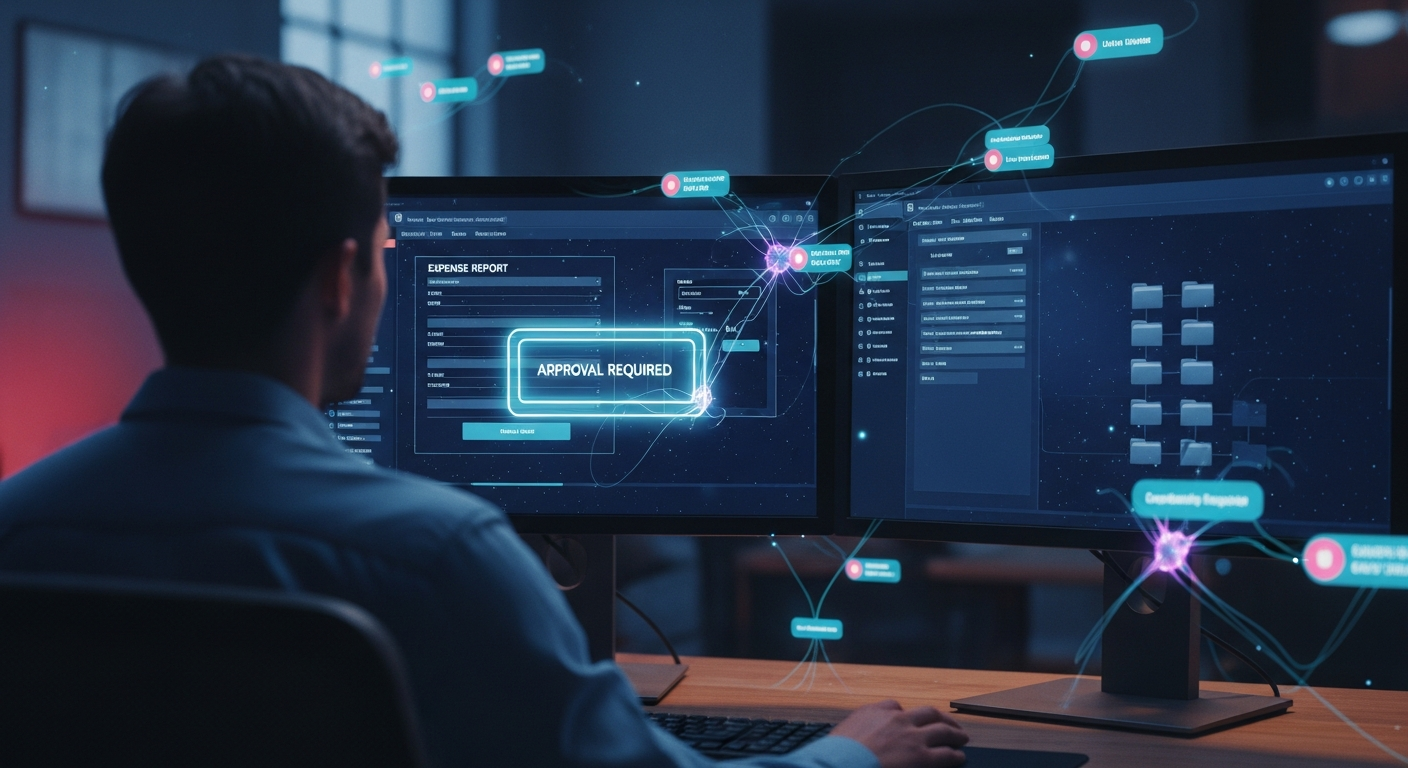
One of the most critical consumer-facing features of this release is the recalibration of “Critical Points.” A major fear surrounding AI agents is their potential to take irreversible, damaging actions—such as accidentally booking a non-refundable $5,000 flight, sending an inappropriate email to a supervisor, or deleting a crucial directory. Microsoft has trained Fara1.5 and MagenticBrain to inherently recognize these critical points. When the agent encounters a transaction, a login flow requiring credentials, or an ambiguous instruction, it automatically pauses the workflow. The Magentic-UI flashes a prompt, explicitly asking the human user for approval or clarification before proceeding.
This human-in-the-loop design is not just a safety feature; it is a usability triumph. It builds essential trust. Users can watch the agent’s reasoning process in real-time through the updated chat and browser views. If the agent begins to stray off course, the user can intervene, take direct control of the browser, correct the action, and hand control back to the AI. This collaborative friction ensures that the AI acts as a powerful exoskeleton for the user’s productivity, rather than an unpredictable, autonomous black box.
By keeping the data on the user’s machine and requiring explicit consent for high-stakes actions, Microsoft is addressing the two largest hurdles to mainstream agentic AI adoption: privacy and trust. While the hardware requirements mean that not everyone will be able to run this stack today, MagenticLite provides a clear, tangible preview of the AI PC era that is rapidly approaching.
TechNode HQ Verdict: Pros, Cons & Usability
- Pro (Engineering): The active context management and QEMU-based Quicksand isolation provide a highly secure, coherent environment for long-running, multi-step tasks without context degradation.
- Pro (Consumer): Absolute data privacy. By running locally, users can automate tasks involving sensitive local files and personal accounts without transmitting data to cloud providers.
- Con: The “small model” moniker is slightly misleading for consumer hardware; running a combined 23B parameters (14B + 9B) locally still requires 16GB-32GB of unified memory, alienating users on older or entry-level machines.
- Con: Live web environments are constantly changing. Despite the FaraGen1.5 synthetic training, aggressive anti-bot measures (like advanced CAPTCHAs) on credentialed sites will still require frequent human intervention.
Enterprise Usability: CTOs and Enterprise IT leaders should begin piloting MagenticLite immediately for internal automation workflows. The ability to run capable agents on private edge servers or high-end local workstations bypasses the severe compliance and data sovereignty hurdles associated with cloud-based API agents. It is a highly viable solution for automating internal HR forms, local data synthesis, and secure web research.
Everyday Usability: For the general public, this is a glimpse into the future rather than an immediate download. Unless you own a high-end AI PC or a top-tier Apple Silicon Mac, the hardware requirements will bottleneck the experience. However, for power users, developers, and researchers with the requisite hardware, MagenticLite offers the most robust, privacy-first local agent experience currently available on the market.
Sources & Citations:
Original Claim via: microsoft
Official Handle: @Azure
Topics Explored: Local AI, Small Language Models, MagenticLite, AI Agents, Enterprise Automation