Key takeaways
- Xreal Project Aura introduces a tethered split-compute architecture to solve AR thermal constraints.
- It is the first global AR headset to natively run Google’s new Android XR operating system.
- The device boasts a class-leading 70°+ FOV using OLED displays and birdbath optics.
- Xreal targets a late 2026 IPO and claims it will reach profitability by 2027.
- Google’s ecosystem integration (Gemini, Maps, WebXR) aims to solve the historic AR software drought.
For over a decade, the smartglasses industry has been Silicon Valley’s most notorious financial black hole—a graveyard of bulky hardware, thermal throttling, and software ecosystems that shipped into total silence. However, a seismic shift occurred at Google I/O in May 2026. Xreal (formerly Nreal), backed by a massive new strategic partnership with Google, unveiled Xreal Project Aura. This isn’t just another iterative hardware bump; it is a fundamental reimagining of how spatial computing is processed, powered, and delivered to both enterprise users and everyday consumers.
By abandoning the impossible physics of packing a supercomputer into a lightweight frame, Xreal and Google have embraced a tethered, edge-compute philosophy. Coupled with the native integration of Google’s highly anticipated Android XR operating system, Xreal Project Aura is pivoting the narrative from gimmicky, low-resolution holograms to legitimate, multi-monitor productivity. With an IPO slated for late 2026 and a staggering target to break even by 2027, Xreal is making the boldest financial and engineering commitments this notoriously unprofitable sector has ever seen.
Xreal Project Aura: The Architectural Reality
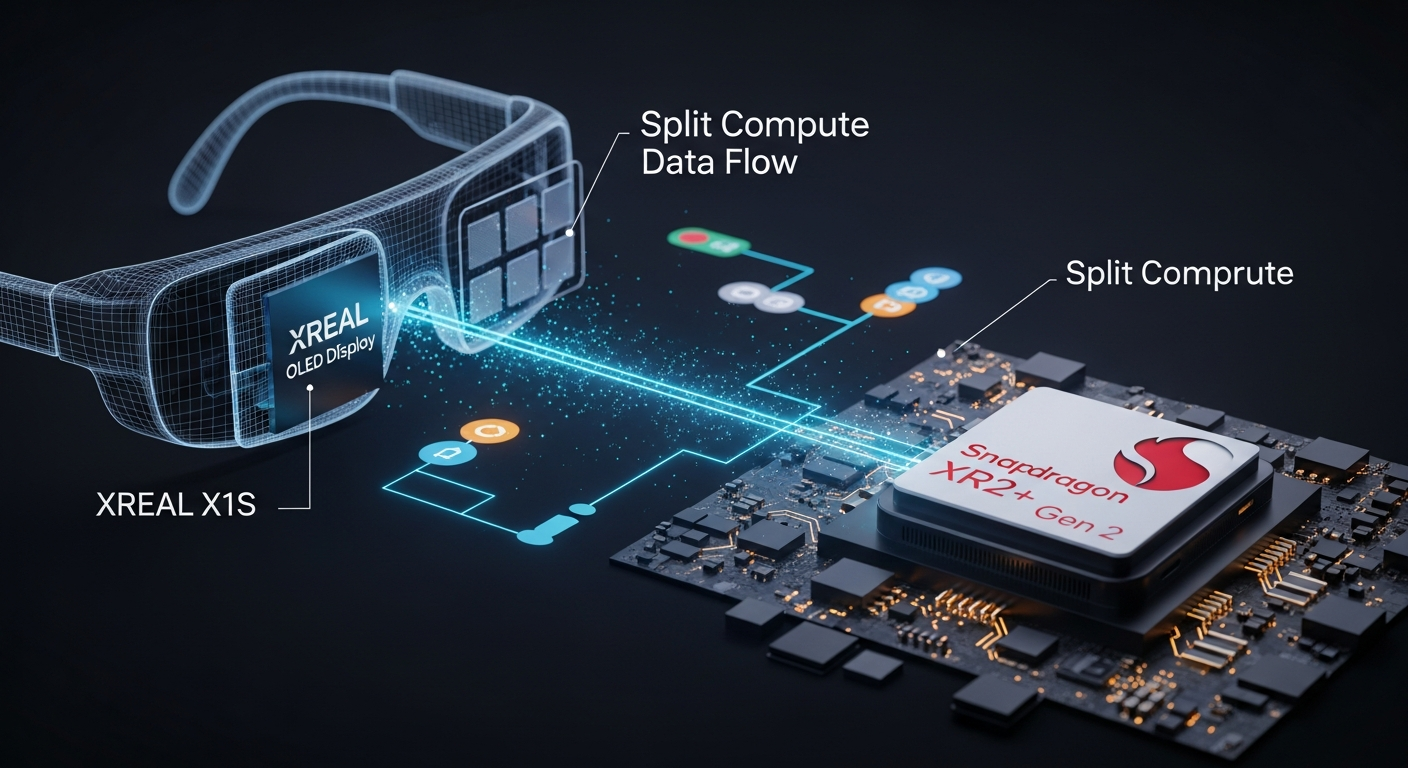
The core failure of early augmented reality (AR) devices, from the original Google Glass to modern standalone headsets, lies in a brutal battle against physics. You cannot put a high-performance CPU, a high-capacity battery, and bright displays on the bridge of a human nose without exceeding the thermal limits of human skin (typically capped at around 1 to 2 watts of heat dissipation) or creating a device so heavy it causes cervical strain. Xreal’s solution is a highly refined split-compute architecture.
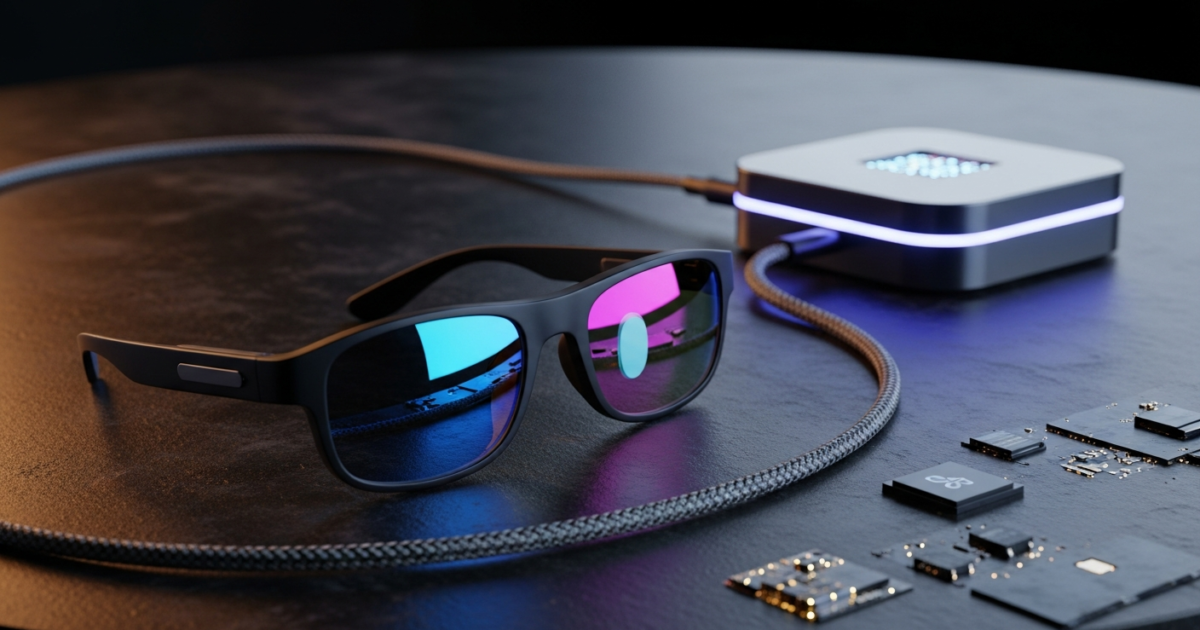
Instead of forcing all components into the frames, Xreal Project Aura offloads the heavy lifting to a tethered “puck”—a dedicated, phone-shaped mini-computer that slips into the user’s pocket. This puck is powered by a Qualcomm Snapdragon XR platform, specifically in the XR2+ Gen 2 class. This allows the system to draw 10 to 15 watts of power, enabling desktop-class rendering and complex spatial mapping without burning the user’s face.
The glasses themselves are far from dumb terminals, however. They house the proprietary XREAL X1S spatial computing chip. This dedicated silicon handles local 3DoF (Three Degrees of Freedom) tracking, sensor fusion, and image stabilization. By processing head movements locally on the glasses rather than sending the data down the wire to the puck and back, Xreal achieves a motion-to-photon latency of well under 20 milliseconds. This is the critical threshold required to prevent user nausea during extended wear.
Optically, Project Aura is a marvel of miniaturization. Xreal has deployed next-generation, compact birdbath-style optics paired with high-resolution OLED displays. These displays are built directly into electrochromically dimmed lenses, allowing the user to dynamically adjust the opacity of the glasses based on their environment—fading to black for immersive movie watching, or remaining transparent for walking down the street. Most impressively, the system boasts a class-leading 70°+ Field of View (FOV). In the realm of consumer AR, where 40° to 50° has long been the restrictive norm, a 70° FOV provides a massive canvas, allowing for true multi-window spatial computing without the user feeling like they are looking through a narrow mail slot.
Market Impact & Deployment: The 2026 IPO
The engineering triumphs of Project Aura are matched only by the aggressive financial posturing of Xreal’s executive team. CEO Chi Xu has gone on record stating that the company is aggressively gearing up for an Initial Public Offering (IPO) before the end of 2026. Furthermore, he claims Xreal aims to break even in 2027. In an industry where competitors routinely post multi-billion-dollar annual losses—Meta’s Reality Labs being the most prominent example—this claim requires deep scrutiny.
How does a hardware startup plan to achieve profitability in a sector famous for burning cash? The answer lies in the Google partnership. Historically, AR companies like Magic Leap and Microsoft (with HoloLens) had to build their hardware, design their own custom operating systems, and spend billions trying to woo developers to build apps for a microscopic user base. It was a vertically integrated nightmare.
Xreal is taking a horizontally integrated approach. By partnering with Google to natively run Android XR, Xreal is effectively outsourcing the most expensive part of the spatial computing stack: the operating system and the developer ecosystem. Google provides the OS, the app store infrastructure, the APIs, and the native apps (Maps, YouTube, Workspace). Xreal only has to focus on what it does best: manufacturing high-margin optical hardware.
This strategy drastically lowers Xreal’s Research & Development (R&D) burden and Customer Acquisition Cost (CAC). Developer kits are currently shipping early under the “Catalyst Program” to ensure a robust app ecosystem is ready on Day 1. When the global consumer launch occurs in Fall 2026, Xreal won’t be selling a piece of hardware with three tech demos; they will be selling a fully functional Android computer for your face. If they can maintain strict supply chain discipline and leverage Google’s marketing muscle, the 2027 break-even target, while highly ambitious, moves from the realm of fantasy into the realm of mathematical possibility.
The Software Savior: Android XR and Google
Hardware without software is just an expensive paperweight. Xreal is explicitly avoiding the 2013 Google Glass “failure mode”—launching innovative hardware without a compelling daily use case. The integration of Android XR is the true differentiator for Project Aura.
Android XR is not just a ported version of mobile Android; it is a ground-up spatial operating system designed to understand 3D environments. It brings native support for WebXR, allowing users to access immersive web experiences without downloading dedicated apps. Furthermore, it integrates deeply with Google’s ecosystem. Users can experience an immersive, 3D version of Google Maps for pedestrian navigation, or watch VR YouTube videos on a massive virtual screen.
Perhaps the most critical software integration is Gemini Live AI. The glasses serve as the ultimate multimodal input device for Google’s flagship artificial intelligence. Because the glasses have outward-facing cameras and microphones, Gemini can “see” and “hear” exactly what the user is experiencing in real-time. Whether it’s translating a physical menu in a foreign country, identifying components on a complex motherboard for an IT technician, or providing real-time conversational assistance, the AI layer transforms the glasses from a passive display into an active, intelligent assistant.
Input and user interface (UI) have also been vastly improved. Project Aura utilizes advanced optical hand-tracking, allowing users to navigate the Android XR interface using intuitive pinch and scroll gestures, similar to the interaction model popularized by the Apple Vision Pro. For more precise inputs, the tethered compute puck doubles as a physical trackpad, giving users tactile feedback when navigating complex spreadsheets or dense text documents.
The Consumer Translation: Wearability vs. The Puck
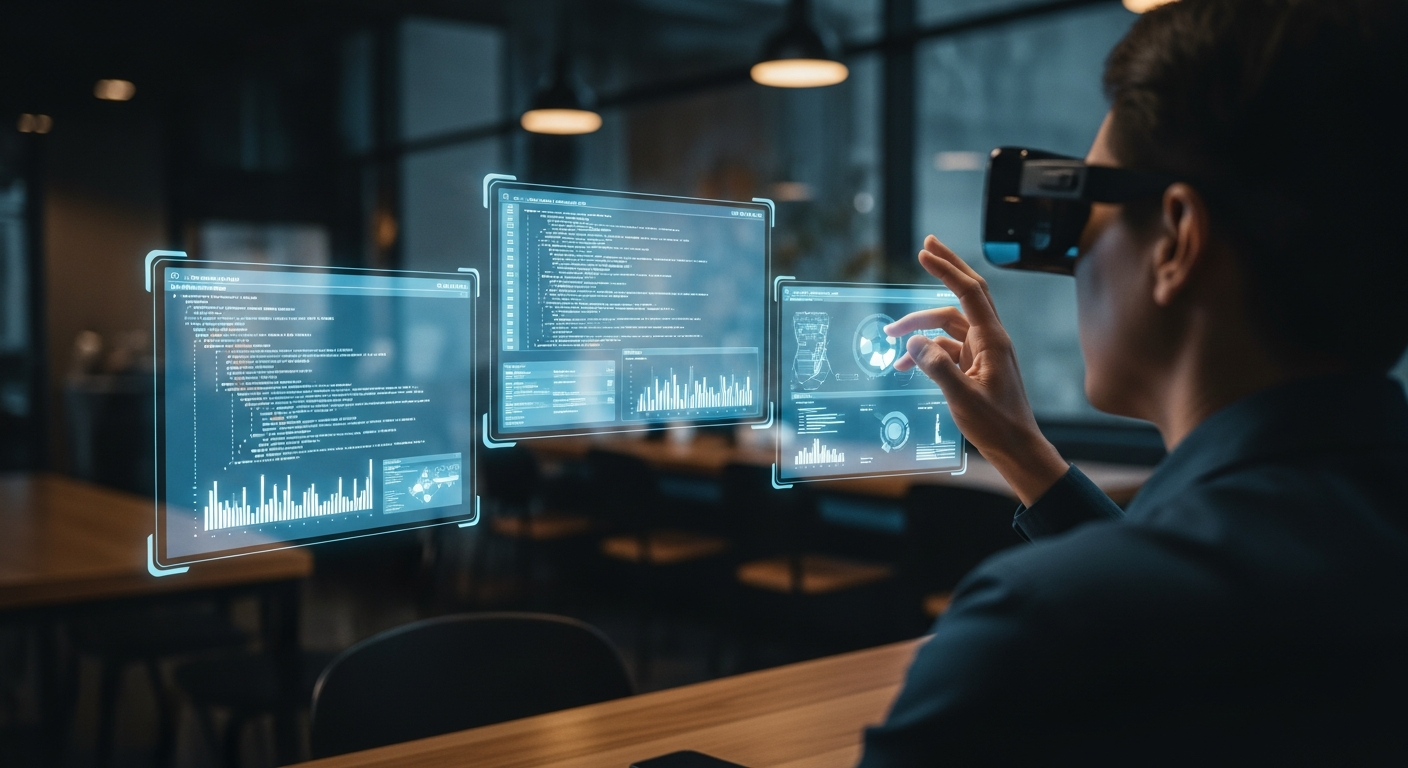
For the enterprise CTO and the everyday consumer, the highly technical shift toward split-compute architecture translates into a very specific lifestyle change. The promise is alluring: edge-compute productivity anywhere you go. You can sit in a crowded coffee shop, on a cramped airplane, or in a minimalist hotel room, plug your glasses into the puck, and instantly deploy three massive, private virtual monitors. You can review confidential financial models, write code, or watch an NBA game in a holographic format, all while maintaining situational awareness of your physical surroundings.
However, this utopian vision comes with a distinct physical compromise: the wire. The tethered puck is the undeniable friction point of Xreal Project Aura. In an era where consumers have been trained by Apple AirPods and wireless charging to despise cables, introducing a wire that runs from the user’s face down to their pocket is a significant UX hurdle. Wires snag on doorknobs, they tangle in bags, and the puck represents yet another device that must be charged every night.
Yet, industry insiders argue that this is a necessary transitional phase. Until solid-state batteries and micro-LED displays achieve a generational leap in efficiency—likely not until the 2030s—the puck is the only way to deliver the compute power required for true spatial computing in a form factor that doesn’t look socially awkward. Xreal is betting that the immense utility of having a 70° FOV wearable workstation will outweigh the minor inconvenience of managing a cable.
TechNode HQ Verdict: Pros, Cons & Usability
- Pro (Engineering): The split-compute architecture successfully bypasses the thermal limits of face-worn wearables, allowing for a desktop-class Snapdragon XR2+ Gen 2 processor to drive a massive 70°+ FOV without overheating.
- Pro (Consumer): Native Android XR and Gemini Live AI integration means the device will launch with a massive, immediately useful software ecosystem, avoiding the “empty app store” curse of previous AR headsets.
- Con: The tethered puck introduces physical friction. The wire is prone to snagging, and managing a separate battery/compute module detracts from the seamless “put it on and go” dream of smartglasses.
- Con: Achieving profitability by 2027 relies heavily on flawless supply chain execution and massive consumer adoption, which is historically unprecedented in the AR hardware space.
Enterprise Usability: For CTOs managing remote or highly mobile workforces, Project Aura represents a viable alternative to issuing multiple physical monitors. The privacy aspect—where only the user can see their screens—makes it an excellent tool for executives working with sensitive data in public spaces like airplanes or lounges. Pilot programs should be initiated as soon as the Catalyst Program developer kits arrive.
Everyday Usability: For the general public, Project Aura is the most compelling AR proposition to date, provided the user is willing to tolerate the wired puck. If your primary goal is mobile productivity, immersive media consumption, and hands-free AI assistance, the Fall 2026 consumer launch is worth waiting for. However, if you demand a completely wireless, frictionless experience, the technology simply isn’t there yet.