
The Architectural Reality
For the past two decades, the internet has relied on a fundamentally broken paradigm for trust: to prove a single fact about yourself, you must surrender the entirety of your underlying credential. Whether verifying age for a restricted service or proving professional accreditation to a platform, users are routinely forced to upload high-resolution images of government-issued IDs. These documents are processed, stored in centralized databases, and inevitably targeted by threat actors, transforming routine compliance into a toxic liability for enterprises.
Enter Vega, a breakthrough cryptographic proof system developed by Microsoft Research in collaboration with UC Berkeley. Set to be presented at the IEEE Symposium on Security and Privacy (S&P) in San Francisco this May 2026, Vega operationalizes Zero-Knowledge Proofs (ZKPs) for digital identity at an unprecedented scale and speed. By allowing a user to cryptographically prove a specific claim—such as “I am over 21″—without revealing the credential itself, Vega ensures the underlying data never leaves the user’s device.
Historically, the concept of ZKPs is not new. The barrier to enterprise adoption has always been computational practicality. Prior systems either required a cumbersome “trusted setup” every time the verification logic changed, or they sacrificed performance, resulting in massive proof sizes and latency that crippled mobile user experiences. Vega shatters this bottleneck, generating a zero-knowledge proof from a standard mobile driver’s license (mDL) in just 92 milliseconds on a commodity smartphone, with a proof size of only 108 KB and a verification time of 23 ms.
To achieve this sub-100ms latency, Vega’s architecture relies on a highly optimized Rust implementation—soon to be fully open-sourced under Microsoft’s spartan2 repository. The system is an elegant composition of several cutting-edge cryptographic building blocks:
- Spartan: A high-speed zkSNARK that efficiently proves Rank-1 Constraint Systems (R1CS) without requiring a trusted setup.
- Nova & HyperNova: Frameworks that introduce folding schemes, allowing the prover to compress multiple instances of a computation into one. HyperNova specifically enables “NovaBlindFold,” a technique that achieves zero-knowledge by folding a real instance with a random instance to hide the underlying secret data.
- NeutronNova: The most efficient folding scheme for handling a batch of uniform computational instances simultaneously.
The true engineering marvel of Vega lies in how it handles the most computationally expensive part of credential verification: hashing. To verify an issuer’s digital signature, the system must hash the credential bytes using SHA-256. A typical mobile driver’s license requires 30 blocks of SHA-256 compression. A naive ZKP circuit would unroll all 30 iterations, resulting in a monolithic, bloated circuit that scales poorly with credential length.
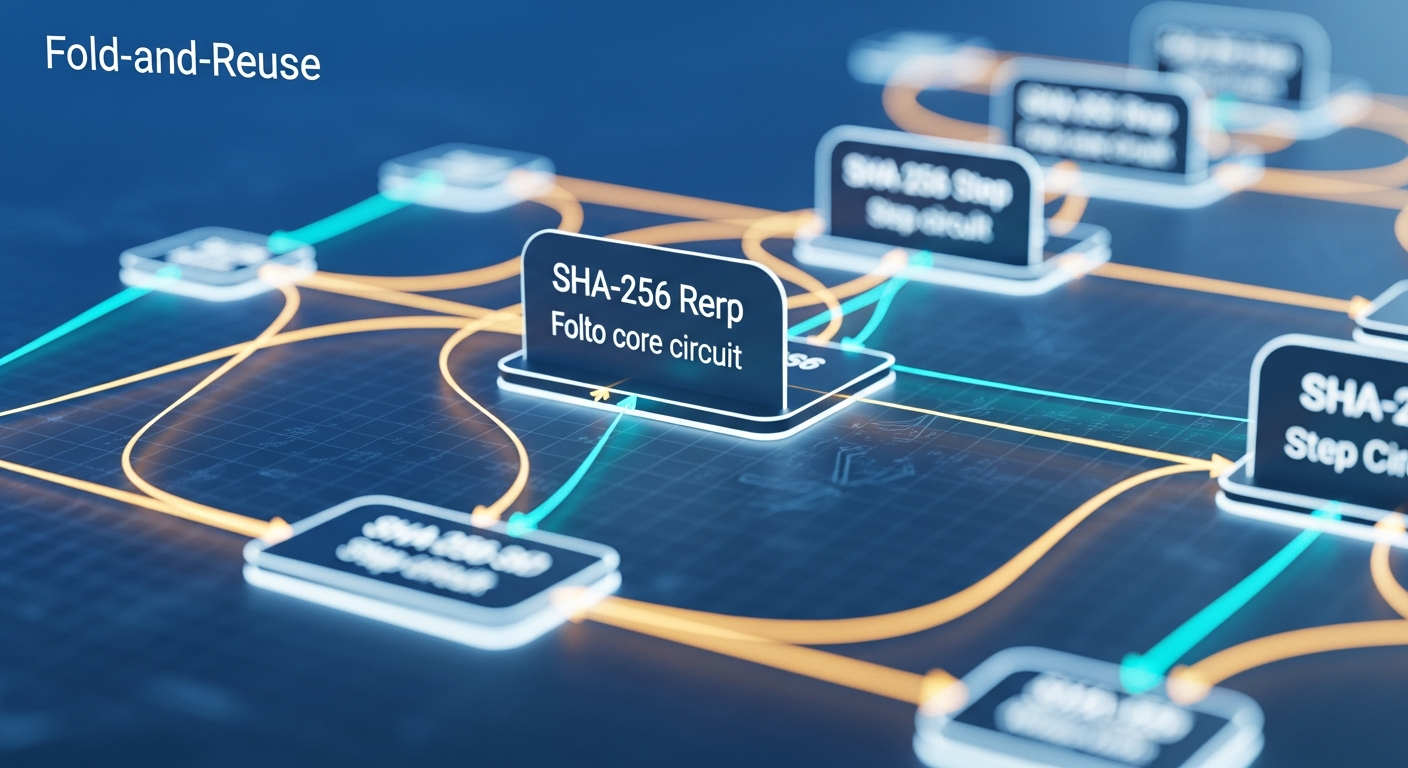
Vega bypasses this by utilizing a fold-and-reuse proving pipeline. Instead of unrolling the hash, Vega defines one small “step” circuit for a single SHA-256 compression step. Using NeutronNova, it folds all 30 structurally identical step instances into a single instance. Spartan then only needs to prove this single step-sized circuit alongside a “core” circuit that handles signature verification and age predicates. The prover key remains a lightweight 464 KB, fitting comfortably on any modern smartphone.
Furthermore, Vega completely eliminates the need for a complex parser. Mobile driver’s licenses are encoded in Concise Binary Object Representation (CBOR). Building a full CBOR parser inside a cryptographic circuit would be computationally disastrous. Instead, Vega treats the credential as a byte-addressable lookup table. The prover simply points the circuit to a specific byte offset (e.g., “the public key starts at byte 847”). The circuit then verifies three lightweight conditions: that the bytes match the authenticated credential, that the correct CBOR prefix is present, and that the addresses are contiguous. This lookup-centric design replaces an entire parser with a handful of highly efficient constraints.
Market Impact & Deployment

The timing of Vega’s release is not coincidental; it arrives at a critical inflection point for global digital identity regulation. The European Union’s eIDAS 2.0 framework mandates that by 2026, all Member States must provide a European Digital Identity (EUDI) Wallet. Recital 14 of the European Digital Identity Regulation explicitly calls for the integration of privacy-preserving technologies, specifically naming zero-knowledge proofs as the standard for selective disclosure. Simultaneously, legislation like the UK’s Online Safety Act is forcing platforms to implement rigorous age verification.
For Chief Technology Officers and Enterprise IT architects, Vega represents a massive reduction in Total Cost of Ownership (TCO) and legal liability. Currently, application providers face a lose-lose scenario: deploy inaccurate AI-based age estimation tools, or absorb the immense risk of storing Personally Identifiable Information (PII). By integrating Vega, an enterprise acts only as a verifier. The server receives a 108 KB cryptographic proof, verifies it in 23 milliseconds, and logs the boolean result. No PII is ever transmitted, processed, or stored. The honeypot is eliminated.
Beyond regulatory compliance, Vega is poised to bridge the gap between off-chain identity and decentralized systems. In Web3 and decentralized finance (DeFi), protocols increasingly require real-world identity signals for KYC compliance or accredited investor status. Currently, this requires a centralized intermediary to view the documents and issue an on-chain attestation—compromising privacy twice. Vega allows a user to generate a proof directly from their government-issued credential and submit it on-chain. Because Vega re-randomizes cached commitments for each presentation, repeated proofs are entirely unlinkable, preventing on-chain tracking.
The Consumer Translation
For the everyday consumer, the underlying mathematics of folding schemes and R1CS circuits will be entirely invisible. The user experience is frictionless: you tap a button on your phone to prove your age to a digital storefront, and 92 milliseconds later, the transaction is approved. The merchant learns that you are over 21, but they never see your name, your exact date of birth, your address, or your driver’s license number.
Crucially, Vega is designed for the impending era of autonomous AI agents. As AI assistants evolve from passive chatbots to active agents that book travel, sign contracts, and interact with services on our behalf, they will need to prove facts about the humans they represent. However, handing over your raw passport file to an AI agent is a massive security risk.
Vega solves this through strict device binding. The zero-knowledge proof is cryptographically tied to the user’s physical device. When a proof is generated, the device’s secure hardware enclave (where the private key is stored) signs a fresh session nonce. The Vega circuit extracts the device’s public key from the credential and verifies this signature. This means an AI agent can carry and present a valid identity proof to a third-party service, but because the proof is bound to a specific session and hardware signature, a compromised agent cannot steal the credential or generate new proofs for unauthorized actions.
We are moving from a paradigm where proving who you are requires giving up your identity, to a world where cryptography allows you to keep it entirely on your device.
TechNode HQ Verdict: Pros, Cons & Usability
- Pro (Engineering): The fold-and-reuse architecture combined with a lookup-centric circuit design bypasses the need for a heavy CBOR parser, achieving sub-100ms latency and a 108 KB proof size without a trusted setup.
- Pro (Consumer): Eliminates the need to upload sensitive ID photos to third-party servers, protecting users from inevitable corporate data breaches while enabling seamless AI agent delegation.
- Con: The byte-addressable lookup approach relies on stable byte encodings. If a government issuer uses highly variable or non-standard credential formatting, the offset logic could become brittle and require frequent updates.
- Con: Strict device binding means that if a user loses their smartphone, the credential cannot simply be restored from a cloud backup; it must be formally re-provisioned by the issuing authority to the new device’s secure element.
Enterprise Usability: CTOs and security architects should immediately begin evaluating the spartan2 Rust repository. With EUDI Wallet mandates taking effect in 2026, integrating Vega’s verifier logic into your authentication pipeline is the most effective way to achieve compliance while entirely offloading the liability of storing toxic PII.
Everyday Usability: While consumers cannot “buy” Vega directly, they should actively opt-in to digital identity wallets (like the upcoming EUDI wallets or Apple/Google mobile driver’s licenses) that leverage this technology. As platforms roll out ZKP-based verification, users should refuse legacy services that still demand raw photo uploads of physical IDs.
Sources & Citations:
Original Claim via: Microsoft Research
Official Handle: @Azure
Topics Explored: Zero-Knowledge Proofs, Microsoft Research, Digital Identity, Cryptography, AI Agents