The Architectural Reality
The artificial intelligence industry has been hurtling toward a physical barrier known in engineering circles as the “memory wall.” As large language models scale into the trillions of parameters, the compute units—namely GPUs and custom AI accelerators—have vastly outpaced the ability of memory modules to feed them data. The processors spend critical clock cycles idling, waiting for data to arrive. Today, Samsung Electronics has fundamentally altered the trajectory of this bottleneck. In a watershed moment for enterprise infrastructure, the South Korean semiconductor titan announced the shipment of the industry’s first 12-layer HBM4E (High Bandwidth Memory 4 Extended) samples to global hyperscale customers.
The specifications of Samsung’s new silicon are nothing short of staggering. The 12-layer HBM4E stack delivers a stable pin speed of 14 gigabits-per-second (Gbps), with the architectural headroom to scale up to 16 Gbps. To put this into perspective, this represents a 20 percent speed increase over the HBM4 modules that Samsung just began mass-producing in February 2026. At maximum throughput, a single stack of this memory delivers a mind-bending 3.6 terabytes per second (TB/s) of bandwidth. When deployed in an eight-stack configuration alongside a next-generation AI accelerator, the aggregate memory bandwidth approaches 28.8 TB/s, allowing massive datasets to be ingested and processed with near-zero latency.
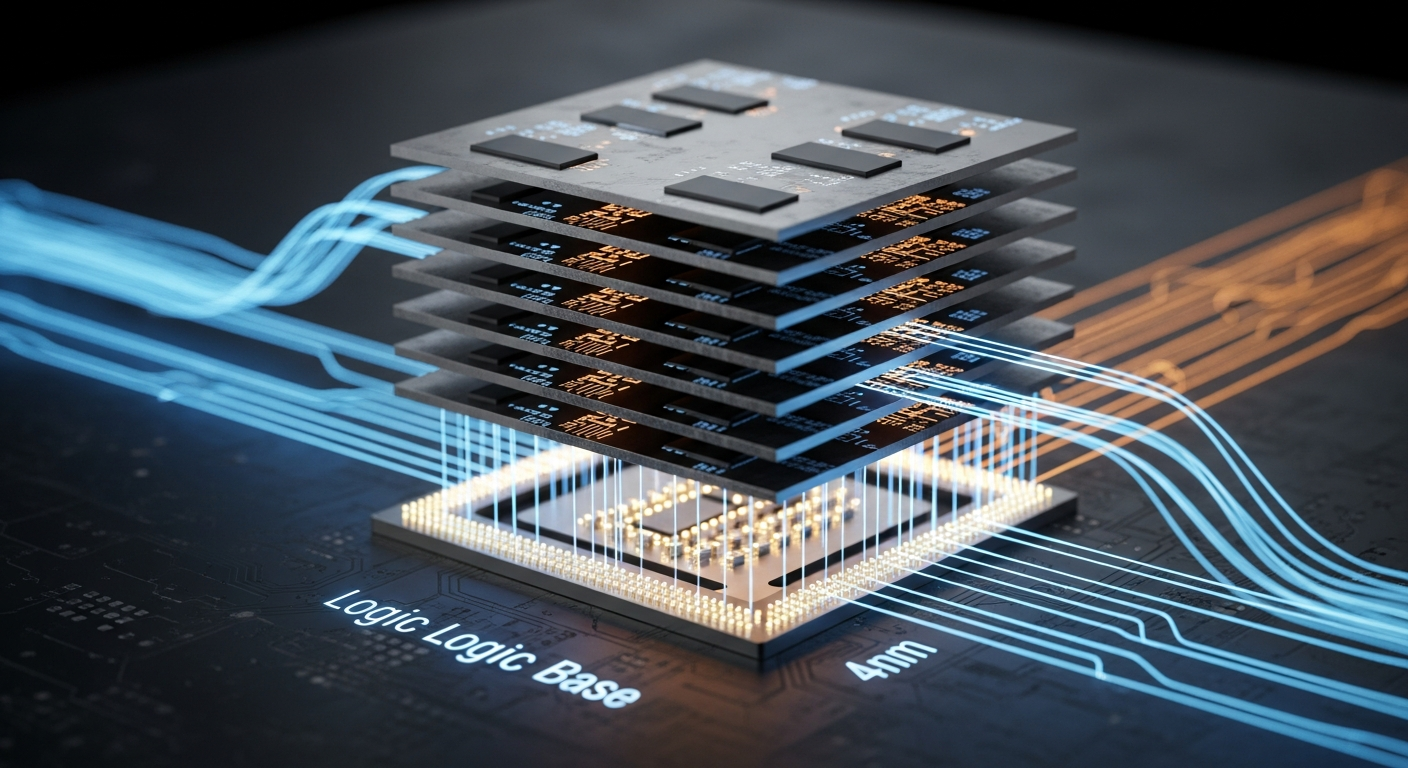
But the raw speed is only half the story. The true engineering marvel lies in the integration of Samsung’s proprietary 1c DRAM (its sixth-generation 10-nanometer-class dynamic random-access memory) with a cutting-edge 4-nanometer logic base die. Historically, the logic controller for memory resided on the GPU itself. By moving complex logic functions directly onto the 4nm base die of the memory stack, Samsung has drastically reduced the physical distance data must travel. This tight integration of memory and logic is a unique advantage for Samsung, as it is the only company in the world that possesses both top-tier memory fabrication and leading-edge logic foundry capabilities under one roof.
Furthermore, the capacity of the 12-layer HBM4E has been expanded to 48 gigabytes (GB) per stack, a 30 percent increase over the previous generation. For enterprise IT leaders, this means a standard 8-GPU server node can now house vastly more memory, enabling the inference of significantly larger AI models without the need to split the workload across multiple server nodes—a process that introduces crippling network latency.
Thermal Dynamics and Packaging Innovations
In the realm of hyperscale data centers, heat is the ultimate enemy. As semiconductor manufacturers stack memory dies higher to increase capacity, the thermal density of the chip rises exponentially. A 12-layer stack generates immense heat, and if that heat cannot be dissipated efficiently, the chip will thermally throttle, negating any theoretical speed advantages. Samsung’s engineering teams have addressed this physical limitation head-on with the HBM4E architecture.
According to the company’s technical disclosures, the new HBM4E module boasts a 16 percent improvement in energy efficiency and a 14 percent improvement in thermal resistance compared to its predecessor. Achieving these metrics required a complete overhaul of the chip’s low-power design and packaging structure. While Samsung has kept the exact proprietary packaging techniques closely guarded, industry analysts point to the utilization of advanced Hybrid Copper Bonding (HCB). Unlike traditional thermal compression bonding, HCB allows for direct copper-to-copper connections between the stacked dies, eliminating the need for microbumps. This not only reduces the physical height of the 12-layer stack—ensuring it fits within standard packaging constraints—but also creates a highly efficient thermal pathway for heat to escape the silicon.
For cloud providers and hyperscalers, a 16 percent reduction in energy consumption is a massive financial lever. AI data centers are currently constrained by the limits of the local power grid. By lowering the power draw of the memory subsystem, operators can pack more compute density into a single server rack without tripping power limits or requiring prohibitively expensive liquid cooling upgrades. As AI clusters grow in scale, these efficiency gains will translate into hundreds of millions of dollars in operational cost savings.
Market Impact & Deployment

The timing of Samsung’s HBM4E shipment is a calculated strike in the ongoing silicon cold war. During the previous HBM3E cycle, Samsung stumbled, struggling with manufacturing yields and ceding the crucial first-mover advantage to its crosstown rival, SK Hynix. SK Hynix capitalized on this by becoming the primary memory supplier for Nvidia’s dominant Hopper GPUs. However, with HBM4 and now HBM4E, Samsung has aggressively accelerated its roadmap to reclaim the crown.
By shipping 12-layer HBM4E samples in May 2026—months ahead of its original mid-year forecast—Samsung has effectively broken SK Hynix’s monopoly on the narrative. Industry sources indicate that SK Hynix is not expected to supply its own HBM4E samples until the second half of 2026. This early delivery allows Samsung to begin the rigorous qualification process with key customers like Nvidia, AMD, and Google, positioning itself as the primary supplier for the next generation of AI accelerators, such as the Nvidia Vera Rubin platform.
The financial stakes of this rivalry are astronomical. Foxconn Chairman Young Liu recently noted that cloud provider capital expenditures have already hit $700 billion this year and are on track to reach a staggering $1 trillion by 2027. The gating factor for this trillion-dollar buildout is not demand, but the supply of high-bandwidth memory and advanced packaging capacity. By proving it can execute on a 4nm logic die and 12-layer 1c DRAM stack, Samsung is positioning itself to capture a massive slice of this unprecedented infrastructure spending. The market reacted swiftly to the news, with Samsung Electronics shares surging nearly 6 percent intraday following the announcement.
The Consumer Translation
While 12-layer HBM4E is strictly an enterprise data center product, its impact will be felt intimately by everyday consumers and software developers. The capabilities of consumer-facing AI tools—from voice assistants to complex video generation models—are directly tethered to the hardware they run on in the cloud.
Currently, when a user asks an AI to analyze a massive PDF, write a complex codebase, or generate a high-definition video, the model must hold vast amounts of context in its active memory. If the memory bandwidth is too slow, the user experiences long wait times, timeouts, or degraded output quality. The 3.6 TB/s bandwidth and 48GB capacity of Samsung’s HBM4E mean that the next generation of AI models (such as GPT-5 or Claude 4) will be able to process multimodal inputs—simultaneously analyzing live video, audio streams, and text—in real-time. The latency between asking a complex question and receiving a comprehensive answer will drop to near-instantaneous levels.
Furthermore, the 16 percent energy efficiency improvement has a democratizing effect on the software ecosystem. As the Total Cost of Ownership (TCO) for running AI inference drops for hyperscalers like AWS and Google Cloud, those savings are eventually passed down to developers in the form of cheaper API calls. Lower API costs mean that independent developers and startups can afford to integrate powerful AI features into everyday applications, accelerating the proliferation of AI across the consumer software landscape.
TechNode HQ Verdict: Pros, Cons & Usability
- Pro (Engineering): The integration of a 4nm logic base die with 1c DRAM fundamentally reduces latency and power draw, pushing bandwidth to an unprecedented 3.6 TB/s per stack.
- Pro (Consumer): Enables real-time, zero-latency processing for next-generation multimodal AI agents, allowing for seamless video and audio analysis.
- Con: The heavily marketed 16 Gbps speed is a “scalable maximum.” The stable, guaranteed pin speed is 14 Gbps, which requires careful thermal management to maintain.
- Con: Samsung is currently only shipping samples. Mass production is vaguely tied to “customer schedules,” meaning volume availability remains a bottleneck for immediate deployment.
Enterprise Usability: CTOs and infrastructure architects should immediately begin factoring 48GB HBM4E configurations into their 2027 hardware procurement cycles. If you are building custom silicon or planning deployments of next-gen accelerators, engaging with Samsung now for sample qualification is critical to avoiding the supply chain bottlenecks that plagued the HBM3E generation.
Everyday Usability: Consumers cannot buy this hardware directly. However, if you are an enterprise software buyer or developer, you should anticipate a significant drop in AI inference latency and API costs over the next 12 to 18 months as these chips light up in hyperscale data centers.