
On May 27, 2026, GitLab issued a highly critical patch release spanning versions 19.0.1, 18.11.4, and 18.10.7 for both its Community Edition (CE) and Enterprise Edition (EE). While routine patch notes often blend into the background noise of enterprise IT, this specific release highlights a terrifying new frontier in software supply chain security: the weaponization of artificial intelligence assistants.
Addressing seven distinct security vulnerabilities—ranging from GraphQL enumeration to token revocation failures—the undeniable centerpiece of this release is CVE-2026-4868. Carrying a severe CVSS score of 8.2, this vulnerability exposes a fundamental flaw in how GitLab’s Duo AI workflow runners handle user identity resolution. In an era where DevSecOps relies heavily on autonomous agents to write, review, and deploy code, the ability to spoof an AI’s identity is not just a bug; it is a catastrophic architectural compromise.
TechNode HQ has conducted a comprehensive teardown of the 19.0.1 patch release, analyzing the underlying mechanics of these vulnerabilities, the hidden risks buried in the release notes, and what this means for the future of enterprise software deployment.
The Architectural Reality: AI as the Confused Deputy
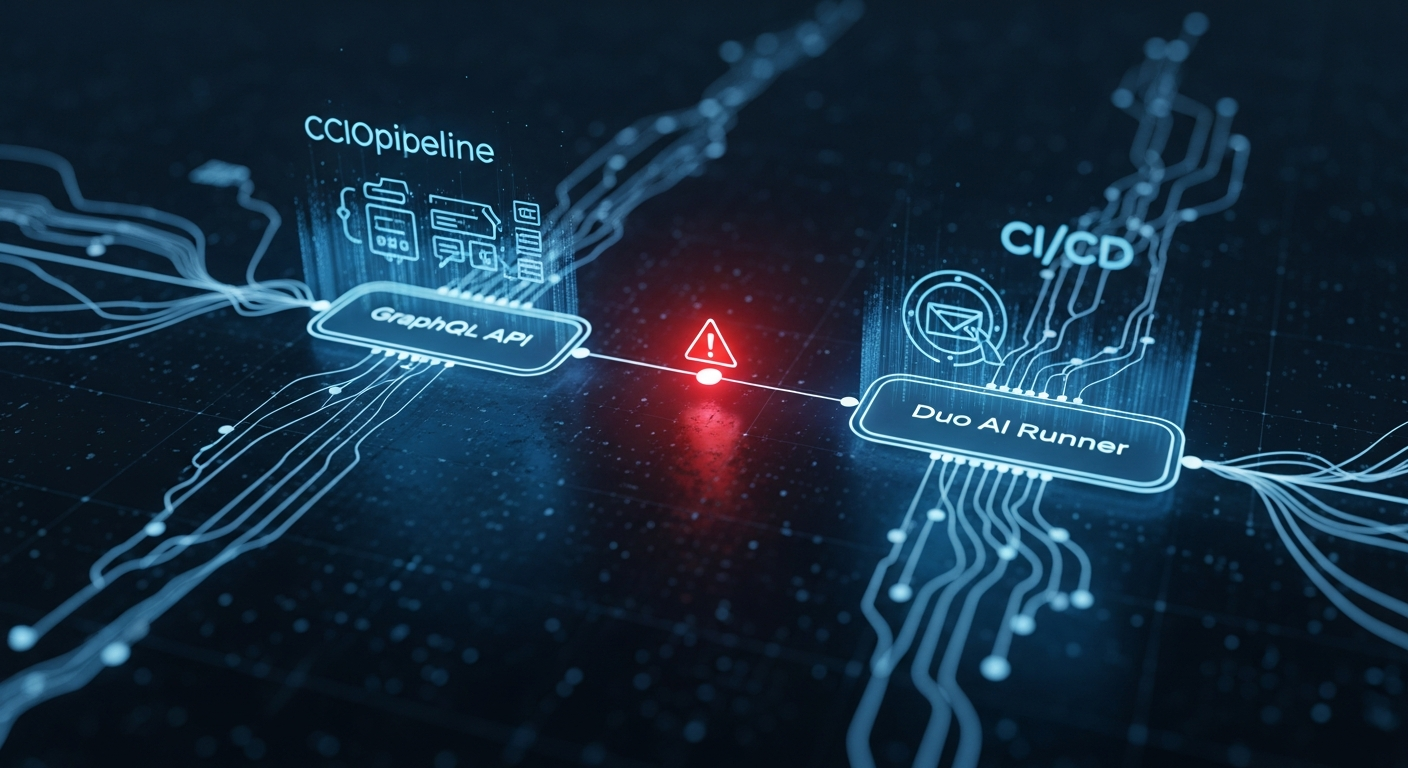
To understand the gravity of CVE-2026-4868, one must first understand the role of GitLab Duo in the 2026 development lifecycle. GitLab Duo is not merely a passive chatbot; it is deeply integrated into the CI/CD pipeline through AI workflow runners. These runners act as autonomous agents, executing complex tasks such as code generation, vulnerability remediation, and pipeline orchestration.
According to the official disclosure, CVE-2026-4868 involves an “Improper Access Control issue” that allows an authenticated user to “cause specific Duo AI workflows to run under another user’s identity due to improper user identity resolution.”
In cybersecurity engineering, this is known as the Confused Deputy Problem, but elevated to the age of Agentic AI. When a developer triggers a Duo AI workflow, the system must resolve the identity of the requester to ensure the AI only accesses repositories, secrets, and environments that the specific developer is authorized to see. Due to a failure in this identity resolution mechanism, a low-privileged attacker could manipulate the workflow trigger, forcing the AI runner to execute its tasks using the permissions of a highly privileged user—such as a Lead DevOps Engineer or a Repository Maintainer.
The implications are staggering. An attacker could theoretically use the AI to silently inject malicious code into a protected branch, approve their own malicious merge requests, or exfiltrate sensitive environment variables, all while the audit logs point the finger at an innocent senior developer. The CVSS 3.1 vector (AV:N/AC:H/PR:L/UI:N/S:C/C:H/I:H/A:N) confirms that while the attack complexity is high, it requires only low privileges, requires zero user interaction, and results in a high impact on both confidentiality and integrity.
Expanding the Attack Surface: GraphQL and Pipeline Failures
While the Duo AI vulnerability dominates the headlines, the 19.0.1 release patches several other systemic authorization failures that expose the fragility of modern CI/CD architectures.
CVE-2026-6713 (CVSS 5.3): This vulnerability in the GraphQL WorkItem API allows unauthorized users to enumerate private projects. GraphQL is notoriously difficult to secure due to its flexible querying nature. In this instance, incorrect authorization checks allowed attackers to map out an organization’s internal project structure. While it does not grant direct access to source code, project enumeration is the critical first step in any targeted reconnaissance campaign, allowing attackers to identify high-value targets (e.g., repositories named “billing-api” or “auth-service”).
CVE-2026-2601 (CVSS 4.3): This flaw in the Operations module allowed authenticated users with mere developer-role permissions to access sensitive deployment data. In a mature deployment environment, developers should not have unfettered access to production deployment secrets or infrastructure states. This missing authorization check breaks the principle of least privilege, potentially exposing production environments to internal threats.
CVE-2026-8716 (CVSS 4.3): Discovered internally by GitLab, this incorrect name resolution issue in Pipelines allowed authenticated users to access CI data from a different ref type than intended. In complex branching strategies, isolating CI data between feature branches, release branches, and tags is critical. Leaking this data across refs can expose proprietary build processes or temporary secrets used during specific testing phases.
The Token Revocation Failure: A Zero Trust Nightmare
Buried at the bottom of the security fixes is CVE-2026-2710 (CVSS 4.3), described as an “Incorrect Authorization issue in certain authentication endpoints.” The reality of this bug is far more severe than its medium-severity score suggests.
Under certain conditions, this vulnerability allowed a blocked Project Access Token (PAT) to continue accessing private resources. Token revocation is the absolute bedrock of Zero Trust Architecture. When an employee is offboarded, or a service account is compromised, administrators rely on token blocking to instantly sever access.
The fact that a blocked token could bypass authorization enforcement and continue pulling private resources is a catastrophic architectural failure. It means that automated offboarding scripts and security incident response playbooks that relied on GitLab’s token blocking API were effectively firing blanks. Organizations that believed they had contained a breach by revoking tokens may have remained exposed for months. The low CVSS score likely reflects the specific “certain conditions” required for exploitation, but from an enterprise risk perspective, a failure in token revocation is a critical red flag.
Under the Hood: Infrastructure and Dependency Upgrades
Beyond the security patches, versions 19.0.1, 18.11.4, and 18.10.7 bring a host of critical backend dependency bumps and performance optimizations designed to stabilize self-managed instances.
- Python 3.14.4 & Nginx 1.30.1: The backporting of these core dependencies ensures that self-managed instances are protected against upstream vulnerabilities in the web server and scripting environments.
- Zlib 3.2.3: Updating the compression library is crucial for mitigating potential denial-of-service vectors related to decompression bombs during repository cloning or artifact extraction.
- Elasticsearch Indexer 5.14.7: This bump, combined with the backport to “Use primary DB connection for advanced search bulk indexer,” addresses significant performance bottlenecks in large-scale enterprise environments where advanced code search was previously causing database timeouts.
- Ruby Thread Scheduler Priority Patch: Backported to 18.11, this patch optimizes how GitLab’s underlying Ruby on Rails architecture handles concurrent background jobs, specifically targeting the flaky CI Catalog Resource filters and SyncPolicyWorker timeouts that have plagued recent releases.
Market Impact & Deployment

The release of GitLab 19.0.1 arrives at a pivotal moment for enterprise IT. In 2026, the DevSecOps landscape has fully embraced AI. According to recent industry data, over 75% of enterprise development teams have integrated AI into their CI/CD pipelines. However, as this patch release proves, the rush to deploy AI has outpaced the implementation of adequate security guardrails.
For Chief Information Security Officers (CISOs) and CTOs, this patch is a wake-up call. The threat model has fundamentally changed. Security teams can no longer just scan code for vulnerabilities; they must now secure the AI agents that are writing and deploying that code. The Duo AI identity spoofing vulnerability demonstrates that AI assistants inherit not just the context of the codebase, but the inherent risks of the platform’s access control mechanisms.
GitLab has stated that GitLab.com is already running the patched version and Dedicated customers require no action. However, for the thousands of enterprises running self-managed GitLab instances—often air-gapped or hosted on-premise for compliance reasons—immediate deployment of 19.0.1 (or the respective 18.x backports) is non-negotiable. The lack of required downtime for multi-node deployments removes any operational excuse for delaying this patch.
The Consumer Translation
For the everyday consumer, the intricacies of CI/CD pipelines and GraphQL APIs are invisible, but the consequences of these vulnerabilities are deeply personal. The software that powers modern life—from mobile banking applications to the firmware in smart vehicles—is built, tested, and deployed using platforms like GitLab.
When a vulnerability like CVE-2026-4868 exists, it means a malicious actor could theoretically compromise the AI tools used by developers at a major bank. By spoofing a senior developer’s identity, the hacker could instruct the AI to silently insert a backdoor into the bank’s login portal. Because the code was generated by an approved AI and committed under a trusted user’s name, it could easily bypass standard security reviews and make its way to the consumer’s smartphone.
In short, vulnerabilities in enterprise development platforms are the root cause of the supply chain attacks that eventually lead to massive consumer data breaches. Securing the factory is the only way to ensure the safety of the final product.
TechNode HQ Verdict: Pros, Cons & Usability
- Pro (Engineering): The patch introduces zero-downtime upgrades for multi-node deployments, allowing enterprise IT teams to rapidly close critical security gaps without disrupting global engineering workflows.
- Pro (Consumer): Rapid remediation of the Duo AI vulnerability prevents potential large-scale software supply chain attacks that could compromise end-user data.
- Con: The discovery of CVE-2026-2710 (blocked tokens retaining access) reveals a deeply concerning architectural fragility in GitLab’s core token lifecycle management.
- Con: The sheer volume of authorization bypasses (GraphQL, Operations, Pipelines) suggests that GitLab’s RBAC implementation is struggling to scale securely alongside its rapidly expanding feature set.
Enterprise Usability: CTOs and DevSecOps leads managing self-hosted GitLab instances must deploy 19.0.1, 18.11.4, or 18.10.7 immediately. The presence of an identity spoofing flaw in an AI workflow runner constitutes a critical, active threat to intellectual property and production environments. Ensure that /etc/gitlab/skip-auto-reconfigure is properly managed if custom migration behaviors are required.
Everyday Usability: While consumers cannot directly interact with this patch, they should view this as a reminder of the fragility of the software supply chain. The integration of AI into software development is accelerating innovation, but it is simultaneously creating complex, invisible attack vectors that the industry is still learning how to defend against.