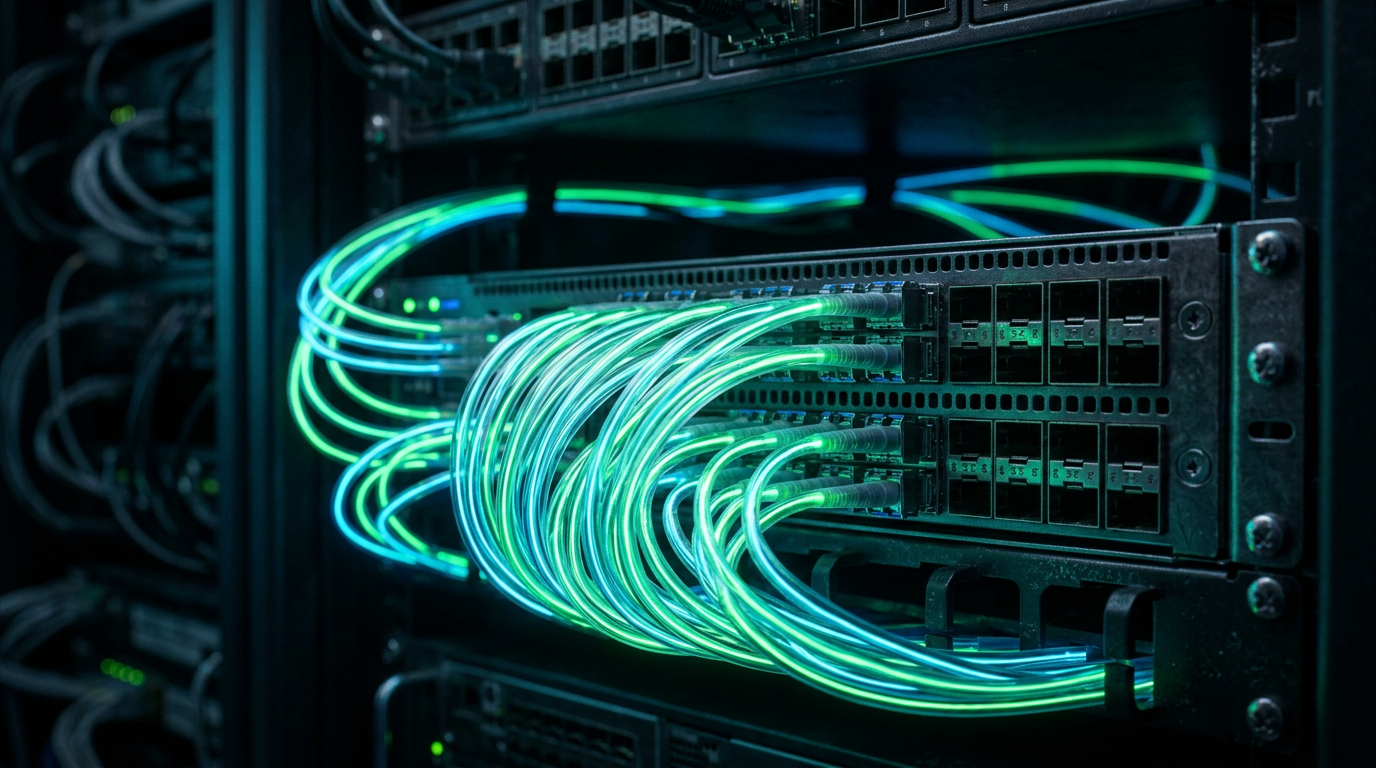
The artificial intelligence industry has reached a critical inflection point where the sheer computational power of GPUs is no longer the primary bottleneck. Instead, the existential crisis of modern AI development lies in the connective tissue between these processors: the network. As frontier Large Language Models (LLMs) scale to trillions of parameters, training clusters have exploded from thousands to hundreds of thousands of GPUs. At this gigascale level, we are no longer building computers; we are constructing synthetic brains the size of massive data centers. In these environments, a GPU is only as fast as the data it can ingest. If the network stutters, the world’s most expensive silicon sits idle.
Enter NVIDIA’s latest strategic masterstroke. In a move that fundamentally alters the landscape of AI infrastructure, NVIDIA is taking its Multipath Reliable Connection (MRC)—a next-generation RDMA transport protocol proven at scale on its Spectrum-X Ethernet hardware—and making it available to the broader industry through the Open Compute Project (OCP). This is not merely a technical update; it is a tectonic shift in how gigascale AI fabrics will be architected, deployed, and monetized over the next decade. By open-sourcing a protocol already powering the largest AI factories on earth, NVIDIA is aggressively positioning Spectrum-X Ethernet as the undisputed, production-ready standard for the future of AI networking.
The Architectural Shift

To understand the magnitude of MRC, one must first understand the catastrophic failure of traditional networking protocols in AI environments. For decades, the Transmission Control Protocol (TCP) over Internet Protocol (IP) has been the bedrock of global networking. However, TCP/IP is heavily software-dependent, requiring the host CPU to process network traffic. In an AI cluster, relying on the CPU to handle data transfer introduces intolerable latency. This led to the rise of Remote Direct Memory Access (RDMA), which allows GPUs to bypass the CPU and operating system entirely, reading and writing data directly to the memory of other GPUs across the network.
While InfiniBand has historically been the gold standard for RDMA in high-performance computing, the industry’s desire for the ubiquity and cost-effectiveness of Ethernet led to the creation of RoCEv2 (RDMA over Converged Ethernet). RoCEv2 brought RDMA to Ethernet, but it inherited a fatal flaw from traditional Ethernet routing: Equal-Cost Multi-Path (ECMP). ECMP routes traffic by hashing entire data flows to a single network path. In a massive AI training job, where thousands of GPUs are simultaneously executing synchronous operations like Ring All-Reduce, ECMP inevitably causes “hash collisions.” Multiple massive data flows are forced onto the same physical link, causing severe incast congestion, dropped packets, and catastrophic tail latency, while other network links sit completely empty.
NVIDIA’s Multipath Reliable Connection (MRC) completely dismantles this limitation. Instead of binding an entire flow to a single path, MRC utilizes advanced hardware-accelerated packet spraying. It takes a massive data flow, breaks it down into individual packets, and distributes them dynamically across every available path in the network simultaneously. The receiving SuperNIC then reorders the packets at hardware speed before delivering them to the GPU. This ensures 100% network utilization and perfectly balanced loads, effectively eliminating the stranded bandwidth that plagues traditional RoCEv2 deployments.
Furthermore, MRC introduces microsecond-level failure bypass. In a gigascale cluster containing tens of thousands of optical transceivers and miles of fiber optic cabling, link degradation and hardware failures are not anomalies; they are mathematical certainties occurring daily. Traditional networks rely on software-based routing protocols like BGP to detect failures, a process that can take milliseconds or even seconds—an eternity in AI training, causing the entire cluster to halt and wait. MRC detects path failures and congestion at the hardware level in mere microseconds, dynamically rerouting packets in real-time without the GPU ever knowing a disruption occurred.
This capability is intrinsically tied to Spectrum-X’s support for multiplanar network architectures. A multiplane network physically separates the cluster’s connectivity into multiple, independent network fabrics, or “planes.” Each GPU is connected to multiple planes simultaneously. MRC’s intelligent load balancing spans across these independent planes. If an entire network switch in Plane A catches fire, MRC instantly shifts the traffic to Planes B, C, and D. This multiplane resiliency, combined with packet spraying, allows AI factories to scale to hundreds of thousands of GPUs while maintaining predictably low, flat latency profiles—a feat previously thought impossible on standard Ethernet.
Enterprise Market Impact & TCO
The introduction of MRC as an open standard carries profound implications for Enterprise IT, particularly regarding the Total Cost of Ownership (TCO) of AI infrastructure. To grasp the economics at play, one must look at the capital expenditure (CapEx) required for modern AI factories. A cluster of 100,000 next-generation GPUs represents an investment of several billion dollars. However, the true cost of this infrastructure is not just the purchase price; it is the operational efficiency.
In a synchronous AI training workload, the entire cluster operates at the speed of the slowest link. If network congestion causes a 5% delay in data delivery, 100,000 GPUs sit idle for that 5% of the time. This phenomenon, often referred to as the “GPU Tax,” is financially devastating. A 5% idle time on a $3 billion cluster equates to $150 million in stranded CapEx, not to mention the massive amounts of electricity (often measured in tens of megawatts) wasted powering idle silicon. By implementing MRC, enterprises can reclaim this lost compute. The dynamic congestion avoidance and packet spraying ensure that GPUs are constantly fed with data, pushing cluster utilization rates from the low 70s to the high 90s.
This economic reality is exactly why MRC is not a theoretical whitepaper concept, but a battle-tested protocol already deployed at the highest echelons of the tech industry. NVIDIA has confirmed that Spectrum-X Ethernet and MRC are currently operating at scale with OpenAI, and are deployed across major hyperscalers including Oracle and Microsoft. For a Chief Technology Officer (CTO) or VP of Infrastructure, this drastically de-risks the adoption of Spectrum-X. When building a multi-hundred-million-dollar data center, enterprise leaders require proven reliability. The fact that MRC is actively managing the network traffic for the world’s most advanced LLM training runs provides an unparalleled stamp of enterprise validation.
Moreover, the open-sourcing of MRC via the Open Compute Project addresses a critical enterprise anxiety: vendor lock-in. Historically, achieving this level of lossless, high-performance networking required purchasing proprietary InfiniBand fabrics. While InfiniBand remains a powerhouse, many hyperscalers and large enterprises demand the flexibility, multi-vendor interoperability, and familiar management tools of Ethernet. By pushing MRC into the open ecosystem, NVIDIA allows operators who own their infrastructure to utilize custom protocols, shape routing behavior, and deploy granular telemetry that matches their specific multi-rack architectures. It transforms the network from a leased, opaque black box into a highly tunable, transparent engine for AI acceleration.
The Consumer Reality: What This Means for You
For the everyday consumer, the intricacies of RDMA transport protocols, packet spraying, and multiplane architectures sound like an alien language. It is invisible plumbing buried deep within windowless, hyper-secure data centers. However, this highly technical shift has a direct, profound, and immediate impact on the worldwide public. The network architecture of AI factories dictates the speed, cost, and capability of every AI product you use on your smartphone, laptop, and smart home devices.
First, consider the pace of AI innovation. The training of frontier models like OpenAI’s GPT-4 or Anthropic’s Claude 3 takes months of continuous, uninterrupted computation across tens of thousands of GPUs. If the network is inefficient, training takes longer, delaying the release of next-generation models. By utilizing MRC to eliminate network bottlenecks and hardware-failure interruptions, AI companies can compress training times significantly. For the consumer, this means faster access to smarter, more capable AI assistants. The leap to GPT-5, featuring true multimodal reasoning and autonomous agent capabilities, is directly accelerated by the efficiency of protocols like MRC.
Second, there is the reality of consumer cost. Running generative AI is incredibly expensive. Every time you ask a chatbot to write an email, generate an image, or summarize a document, a GPU in a remote data center performs massive calculations. If the infrastructure powering these queries is inefficient, the cost per query remains high. This is why many advanced AI tools are locked behind $20/month subscription paywalls or strict usage limits. As MRC drives up the utilization efficiency of AI clusters, the cost of compute drops. This trickle-down effect will eventually lead to cheaper AI subscriptions, higher usage limits, and the integration of powerful, free AI features into everyday applications that previously couldn’t afford the compute overhead.
Finally, there is the aspect of reliability and real-time performance. As we move toward real-time voice AI and live video generation, latency becomes the enemy of user experience. A delay of 200 milliseconds in a voice conversation with an AI feels unnatural and robotic. The microsecond-level telemetry and congestion avoidance provided by MRC on the backend ensure that data moves through the cloud with absolute minimal delay. This backend efficiency is what will make real-time, conversational AI tutors, therapists, and customer service agents feel indistinguishable from human interaction.
The Industry Ripple Effect
While the technical and consumer benefits of MRC are vast, the strategic brilliance of NVIDIA’s decision to open-source the protocol cannot be overstated. This move is a calculated, aggressive strike in a massive geopolitical-level corporate war for the future of AI infrastructure. To understand the ripple effect, one must look at NVIDIA’s competitors and the formation of the Ultra Ethernet Consortium (UEC).
Over the past year, the UEC—backed by industry heavyweights like AMD, Broadcom, Intel, Meta, and Microsoft—has generated massive industry buzz. The consortium’s explicit goal is to develop a new, open Ethernet standard specifically designed to handle AI workloads, effectively aiming to break NVIDIA’s dominant grip on AI networking (historically held through its Mellanox InfiniBand acquisition). The UEC promised to deliver a standard that would solve the exact problems of RoCEv2: packet spraying, congestion control, and multi-pathing.
By releasing MRC through the Open Compute Project, NVIDIA has effectively front-run the entire Ultra Ethernet Consortium. NVIDIA is telling the industry, “Why wait years for a consortium to agree on a new standard, build the silicon, and test it, when MRC is already here, already open, and already powering OpenAI today?” It is a devastatingly effective maneuver. NVIDIA collaborated with AMD, Broadcom, and Intel on the development of MRC, essentially co-opting its rivals into supporting its protocol before the UEC could finalize its own.
This forces competitors into a difficult position. They must now react to a standard that NVIDIA has already established in the wild. While MRC is an open specification allowing anyone to build interoperable networking stacks, the reality of the hardware market is that NVIDIA’s Spectrum-X switches and BlueField SuperNICs are already perfectly optimized at the silicon level to run it natively. Competitors can use the open standard, but they will be playing catch-up to match the hardware-software co-design efficiencies NVIDIA has already achieved. NVIDIA is making Spectrum-X Ethernet feel less like a proprietary alternative to standard Ethernet, and more like the de facto, production-ready path for all Ethernet-based AI fabrics. It is a masterclass in using open-source as a weapon to maintain ecosystem dominance.
TechNode HQ Verdict: Pros, Cons & Usability
- Pro (Engineering): Hardware-accelerated packet spraying and microsecond failure bypass completely eliminate the incast congestion and tail latency issues that have historically plagued RoCEv2 in gigascale AI topologies.
- Pro (Consumer): Drastically improves the efficiency of AI training clusters, leading to faster deployment of next-generation LLMs and driving down the compute costs associated with consumer AI subscriptions.
- Con: Despite being an open specification, achieving the absolute maximum performance and lowest latency still heavily incentivizes purchasing NVIDIA’s proprietary Spectrum-X switches and BlueField SuperNICs, maintaining a soft vendor lock-in.
- Con: Deploying multiplane network architectures with MRC requires immense physical infrastructure complexity, demanding highly specialized network engineering talent to design, cable, and maintain the parallel fabrics.
Enterprise Usability: For CTOs and Infrastructure VPs building AI clusters exceeding 10,000 GPUs, adopting Spectrum-X with MRC is highly recommended today. It provides the familiar management paradigm of Ethernet while delivering the lossless, high-utilization performance previously reserved for InfiniBand. The fact that it is proven at scale by Microsoft and Oracle de-risks the CapEx investment. Enterprises should immediately evaluate their current RoCEv2 deployments for stranded bandwidth and consider MRC as the upgrade path.
Everyday Usability: While consumers cannot buy or interact with MRC directly, they should view this development as a leading indicator of the AI market’s trajectory. The deployment of these hyper-efficient networks means that the hardware bottlenecks slowing down the release of multimodal, real-time AI agents are being solved. Consumers can expect a rapid acceleration in AI capabilities and a stabilization of AI service costs over the next 12 to 18 months as these gigascale networks come online.
Sources & Citations:
Original Technical Breakdown via: servethehome
Official Handle: @servethehome
Topics Explored: NVIDIA Spectrum-X, RDMA Transport Protocol, Gigascale AI, Multipath Reliable Connection, Open Compute Project