The Architectural Reality
The era of the robotic, latency-plagued Interactive Voice Response (IVR) system is officially drawing to a close. Vapi, a San Francisco-based AI voice startup, has just secured a $50 million Series B funding round led by Peak XV Partners, catapulting its valuation to a staggering $500 million. But the financial milestone is merely a symptom of a much larger engineering victory: Amazon Ring, a subsidiary of the world’s largest cloud and AI conglomerate, has migrated 100% of its inbound customer support calls to Vapi’s platform after aggressively evaluating more than 40 competing vendors.
To understand why an operationally sophisticated giant like Amazon Ring bet its entire customer service pipeline on a startup founded in 2023, one must look past the generative AI hype and examine the raw LLM Infrastructure. Vapi is not simply an LLM wrapper; it is a highly optimized orchestration layer designed to solve the most notoriously difficult problem in voice AI: latency.
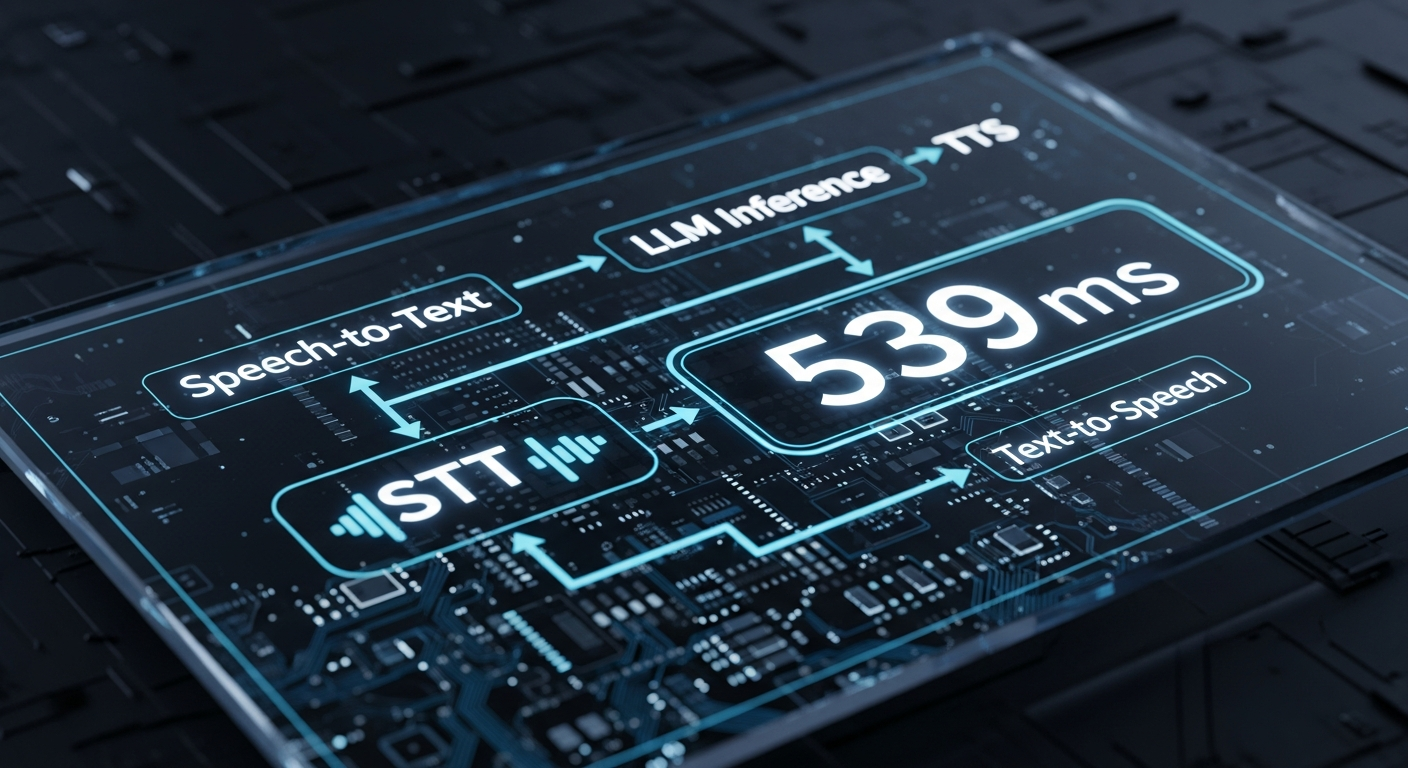
Human conversation relies on natural turn-taking, with average response gaps hovering between 200 and 400 milliseconds. Research indicates that when AI latency exceeds 800 to 1,200 milliseconds, callers perceive the system as unresponsive, leading to awkward pauses and user frustration. Vapi has engineered a pipeline that consistently achieves end-to-end latency as low as 539 to 700 milliseconds. This requires the seamless, real-time synchronization of three distinct compute-heavy layers: Speech-to-Text (STT) transcription, Large Language Model (LLM) inference, and Text-to-Speech (TTS) generation.
By optimizing LLM processing times down to roughly 161 milliseconds and utilizing streaming token generation (often pairing models like GPT-4o with edge-deployed TTS providers like ElevenLabs or Cartesia), Vapi effectively eliminates the “satellite delay” that has plagued legacy AI agents. Furthermore, Vapi natively handles “barge-in”—the complex engineering feat of allowing a human to interrupt the AI mid-sentence, forcing the system to instantly halt its audio output, re-process the new context, and respond accordingly. For Amazon Ring, which deals with emotionally charged calls regarding broken security cameras and offline doorbells, this sub-second responsiveness is not a luxury; it is a strict operational requirement.
Market Impact & Deployment

The deployment of Vapi at Amazon Ring is a watershed moment for Enterprise AI. It signals that voice AI has crossed the chasm from experimental pilot programs to mission-critical, tier-1 business infrastructure. Ring reportedly went from zero to production in just two weeks, a timeline virtually unheard of in legacy contact center deployments.
The financial mathematics driving this adoption are undeniable. Traditional human contact center agents cost enterprises between $7 and $12 per call. In contrast, an AI-driven interaction costs approximately $0.40 per call. Vapi’s specific pricing model charges a base platform fee of $0.05 per minute, passing the third-party LLM and TTS compute costs directly to the customer. While a complex, 10-minute troubleshooting call might reach $2.75, it still represents a 70% to 90% cost reduction compared to human labor.
However, Vapi is not operating in a vacuum. The startup, which currently processes between 1 million and 5 million calls daily and has handled over 1 billion calls to date, faces fierce competition from a crowded field of Voice Agents including Retell, Bland, Sierra, and PolyAI. Retell, for instance, boasts raw infrastructure latency as low as 600ms, while Bland aggressively targets high-volume outbound calling.
What differentiated Vapi in the eyes of Amazon Ring’s engineering team was granular control. Rather than delivering a “black box” application, Vapi provides a dashboard with precise knobs for tuning model behavior, temporal awareness, and telephony integration (such as SIP trunking and warm transfers). Jason Mitura, Vice President of Software Development at Amazon Ring, noted that this architecture allowed Ring’s customer experience teams to tune the AI agent’s behavior without constantly relying on backend software engineers, ultimately driving up Customer Satisfaction (CSAT) scores.
The Consumer Translation
For the everyday consumer, this technological shift fundamentally alters the reality of seeking customer support. If you purchase an Amazon Ring doorbell and it fails to connect to your Wi-Fi network on Christmas morning, your resulting phone call will no longer begin with a labyrinthine menu demanding you “Press 1 for Technical Support, Press 2 for Billing.”
Instead, the call is immediately answered by a highly articulate, conversational AI that sounds virtually indistinguishable from a human operator. Because the system is tied directly into backend APIs, the AI already knows what device you own, can run remote diagnostics on your hardware in real-time, and can guide you through troubleshooting steps without placing you on hold. If you get frustrated and interrupt the AI to say, “No, the light is flashing red, not blue,” the AI will instantly stop talking, process your correction, and pivot its troubleshooting strategy.
This deployment was specifically stress-tested during the notorious holiday surge—a period when call volumes traditionally overwhelm human call centers, resulting in hour-long wait times and abandoned calls. By routing 100% of inbound traffic through Vapi, Amazon Ring effectively achieved infinite, instant scalability. The consumer gets their problem solved in three minutes instead of thirty, entirely unaware of the complex STT-to-LLM-to-TTS pipeline executing in milliseconds behind the scenes.
TechNode HQ Verdict: Pros, Cons & Usability
- Pro (Engineering): Achieves sub-600ms end-to-end latency with native “barge-in” interruption handling, abstracting the immense complexity of synchronizing STT, LLM, and TTS pipelines.
- Pro (Consumer): Eliminates hold times and rigid IVR menus, providing instant, context-aware troubleshooting that adapts to natural human speech patterns.
- Con: The decentralized pricing model ($0.05/min platform fee + external LLM/TTS costs) forces enterprise IT to manage billing and API limits across 4 to 6 different vendor relationships simultaneously.
- Con: While the AI handles 100% of inbound routing and tier-1 triage, edge-case hardware failures or complex RMAs still require seamless “warm transfers” to human agents, which can introduce friction if telephony integrations are not perfectly configured.
Enterprise Usability: For CTOs and IT Directors managing high-volume contact centers (500+ calls/day), Vapi is currently the gold standard for inbound voice infrastructure. The ability to deploy a production-ready system in weeks rather than months, combined with granular behavioral controls, makes it an immediate buy. However, teams must be prepared to architect robust backend webhooks (under 2-second response times) to feed the AI real-time customer data.
Everyday Usability: Consumers cannot “buy” Vapi directly, but they will increasingly interact with it. If you are calling a major enterprise for support in 2026, you should expect to speak naturally. Do not treat the system like a legacy keyword-bot; speak to it in full sentences, and do not hesitate to interrupt it if it misunderstands your issue.