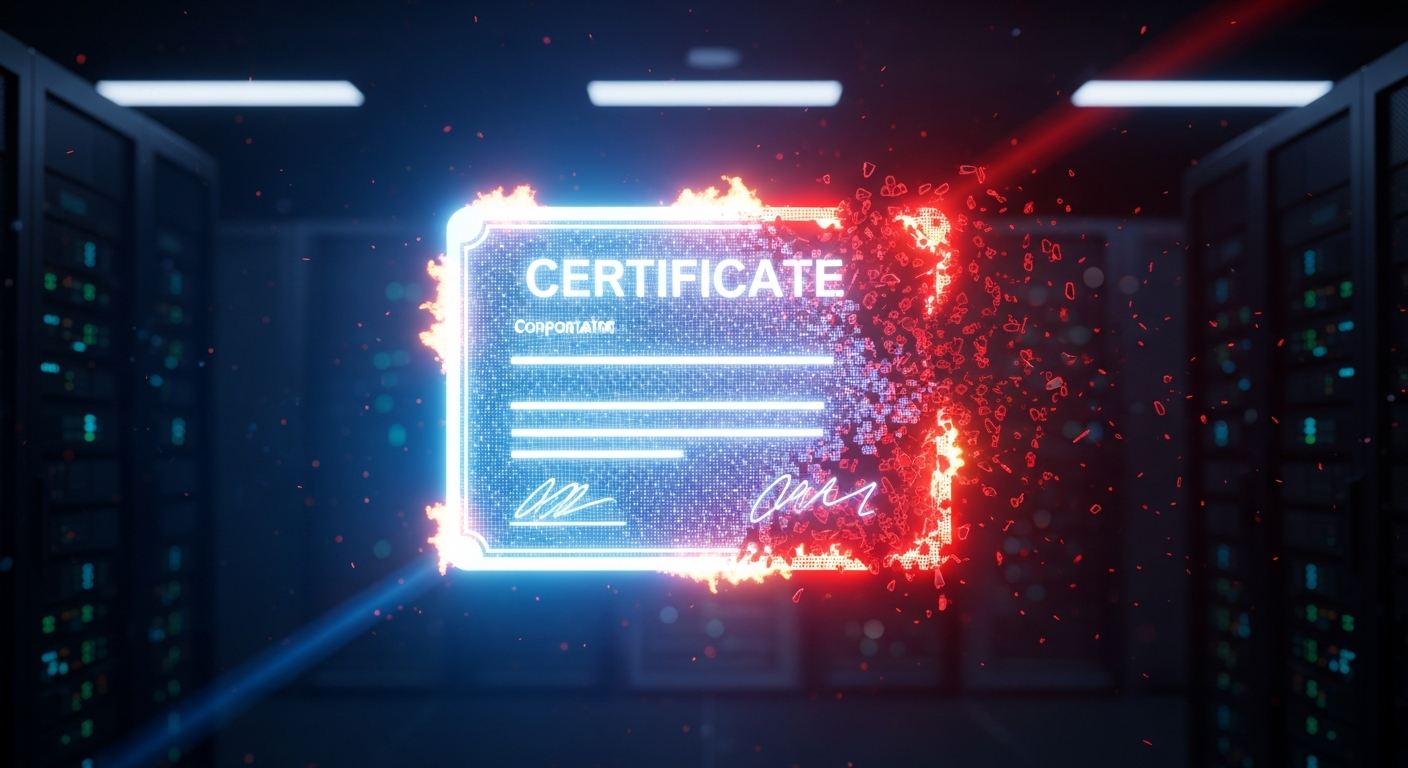
The Architectural Reality: Weaponizing Digital Trust

In the foundational architecture of modern computing, trust is not an abstract concept; it is a cryptographic mathematical certainty. Operating systems, enterprise firewalls, and endpoint security agents rely on Public Key Infrastructure (PKI) to determine whether a software binary is a legitimate application or a malicious payload. If a file carries a valid digital signature from a trusted certificate authority, it is granted the keys to the kingdom. In May 2026, Microsoft’s Digital Crimes Unit (DCU), in coordination with the FBI and Europol, executed “OpFauxSign”—a massive takedown of a cybercriminal syndicate that successfully commoditized and weaponized this very foundation of trust.
The threat actor, tracked by Microsoft as Fox Tempest, operated a highly sophisticated Malware-Signing-as-a-Service (MSaaS) platform. Active since May 2025, Fox Tempest did not rely on exploiting zero-day vulnerabilities in Windows or brute-forcing enterprise networks. Instead, they exploited Microsoft’s own Artifact Signing service (formerly known as Azure Trusted Signing). Artifact Signing is a fully managed, end-to-end cloud solution designed to allow legitimate developers to seamlessly build, sign, and distribute applications. Fox Tempest turned this developer convenience into a weapon of mass compromise.
To obtain a legitimate code-signing certificate, a requestor must pass stringent identity validation processes based on industry-standard Verifiable Credentials (VC). Fox Tempest bypassed this Know Your Customer (KYC) gateway by utilizing a vast repository of stolen identities originating from the United States and Canada. By masquerading as legitimate corporate entities, the syndicate successfully established hundreds of fraudulent Azure tenants and subscriptions. This allowed them to generate over 1,000 short-lived, fully valid code-signing certificates. Because these certificates were issued directly by Microsoft’s infrastructure, the resulting malware bypassed Windows SmartScreen, evaded traditional antivirus heuristics, and slipped silently past enterprise network defenses.
The engineering sophistication of Fox Tempest evolved rapidly. Initially, the group operated a web portal, signspace[.]cloud, featuring an admin panel and a structured database for managing cybercriminal clients and malicious files. However, by February 2026, the syndicate shifted to a more resilient, low-friction deployment model. They began providing their clients with pre-configured Virtual Machines (VMs) hosted on Cloudzy, a cloud infrastructure provider. This allowed ransomware operators to directly upload raw, malicious artifacts to attacker-controlled infrastructure and receive cryptographically signed, trusted binaries in return via an automated pipeline. This infrastructure evolution not only improved Fox Tempest’s operational security but enabled the delivery of signed malware at an unprecedented, industrialized scale.
Market Impact & Deployment: The $9,500 MSaaS Economy

The takedown of Fox Tempest exposes the staggering financial scale of the modern cybercrime ecosystem. The MSaaS platform was not a cheap, dark-web novelty; it was a premium, enterprise-grade service catering to the upper echelon of ransomware syndicates. Court documents unsealed in the U.S. District Court for the Southern District of New York reveal that Fox Tempest charged its clients between $5,000 and $9,500 per signed certificate. The pricing tiered based on priority processing, with premium clients receiving expedited access to the automated signing pipeline.
Why would a threat actor pay nearly $10,000 for a certificate that is only valid for 72 hours? The answer lies in the Total Cost of Ownership (TCO) of a successful ransomware deployment. A single successful breach of a healthcare provider, financial institution, or government agency can yield ransom payouts in the millions of dollars. The 72-hour validity window of the Fox Tempest certificates was a calculated feature, not a bug. It provided a tight, highly effective operational window for threat actors to launch targeted campaigns, minimizing the time security researchers had to detect and revoke the specific certificate serial numbers.
The market impact of this service was devastating. Microsoft’s telemetry, alongside blockchain analysis of Fox Tempest’s cryptocurrency wallets, linked the MSaaS platform to some of the most prolific Ransomware-as-a-Service (RaaS) operations in the world. A primary co-conspirator named in the legal filings is Vanilla Tempest (an affiliate of the INC Ransomware group). Vanilla Tempest utilized Fox Tempest’s services as early as June 2025 to sign the Oyster modular implant (also known as CleanUpLoader). Once the signed Oyster loader bypassed enterprise defenses, it was used to deploy the devastating Rhysida ransomware.
The ripple effects extended far beyond a single ransomware strain. The signed certificates were utilized by affiliates of Qilin, BlackByte, Akira, and various Storm-designated threat actors to deploy Lumma Stealer and Vidar malware. These campaigns successfully compromised thousands of machines across the United States, France, India, and China, targeting critical infrastructure, educational institutions, and healthcare networks. By commoditizing the bypass of endpoint security, Fox Tempest effectively acted as the logistics provider for the global ransomware economy.
The Consumer Translation: When Trust Becomes a Liability
While the architectural mechanics of PKI and Azure tenant abuse are highly technical, the real-world impact on the everyday consumer and office worker is terrifyingly simple. For decades, the cybersecurity industry has trained users to look for visual indicators of trust. We are taught to check for the “lock” icon, to only download software from “Verified Publishers,” and to trust the operating system when it says a file is safe to execute. Fox Tempest weaponized this exact psychological conditioning.
Threat actors like Vanilla Tempest did not rely on complex email phishing lures to distribute their signed malware. Instead, they utilized legitimately purchased search engine advertisements, Malvertising, and SEO poisoning. An everyday user, perhaps an employee working remotely, would search Google or Bing for standard corporate tools like “Download Microsoft Teams,” “AnyDesk,” “PuTTY,” or “Cisco Webex.” The top result would be a sponsored advertisement directing them to a flawless replica of the official download page.
When the user downloaded the installer, their local security software—and the Windows operating system itself—would inspect the file. Because the file was signed by a certificate generated through Microsoft’s Artifact Signing service, the OS would validate the cryptographic signature. The prompt presented to the user would literally state that the file was published by a verified, legitimate entity. The moment the user clicked “Run,” the illusion of trust evaporated. The signed binary would silently unpack the Oyster loader in the background, establish command-and-control communication, and eventually lock the user’s entire hard drive with Rhysida ransomware.
This represents a fundamental breakdown in the consumer security contract. When attackers can make malicious software mathematically indistinguishable from legitimate software, it undermines the very fabric of how people and systems decide what is safe. The consumer is left entirely defenseless, punished for following the exact security best practices they were taught to obey.
The Red Team Audit: Microsoft’s KYC Catastrophe
Microsoft’s public relations apparatus has framed OpFauxSign as a heroic, proactive victory against global cybercrime. Steven Masada, assistant general counsel at Microsoft’s Digital Crimes Unit, highlighted the seizure of signspace[.]cloud and the disruption of the Cloudzy VMs as a testament to Microsoft’s commitment to raising the cost of cybercrime. However, a rigorous Red Team audit of the incident reveals a much more uncomfortable truth: Microsoft is taking a victory lap for cleaning up a catastrophic failure of its own infrastructure.
Fox Tempest did not hack Microsoft. They simply walked through the front door. The fact that a single cybercriminal syndicate could use stolen U.S. and Canadian identities to pass the Verifiable Credentials (VC) validation process over 1,000 times indicates a systemic, glaring flaw in Microsoft’s Know Your Customer (KYC) protocols. Artifact Signing was designed to be a frictionless, cloud-native solution for developers, but in its pursuit of seamless user experience, Microsoft clearly degraded the friction required to prevent synthetic identity fraud.
Furthermore, the reliance on signature-based detection by modern Endpoint Detection and Response (EDR) platforms has been exposed as a critical vulnerability. Security vendors have long treated Microsoft-signed binaries as inherently trustworthy, often whitelisting them by default to prevent false positives and reduce CPU overhead. Fox Tempest proved that this implicit trust model is obsolete. While Microsoft worked with a “cooperative source” in a sting operation between February and March 2026 to finally map and dismantle the infrastructure, the damage had already been done. For nearly a year, the gatekeeper of digital trust was actively handing out the keys to the barbarians.
TechNode HQ Verdict: Pros, Cons & Usability
- Pro (Engineering): The takedown of the Cloudzy VM infrastructure and the revocation of over 1,000 fraudulent certificates immediately neutralizes a massive, automated pipeline that was actively bypassing global EDR solutions.
- Pro (Consumer): The disruption of Fox Tempest directly reduces the volume of highly deceptive Malvertising campaigns disguising ransomware as everyday applications like Microsoft Teams and AnyDesk.
- Con: Microsoft’s Verifiable Credentials (VC) identity validation process has been proven fundamentally vulnerable to stolen and synthetic identities, raising serious questions about the future integrity of cloud-based code signing.
- Con: The MSaaS model is highly resilient. As noted in court documents, Fox Tempest was already attempting to migrate its clients to alternative code-signing services before the final takedown, indicating this is a hydra that will regrow its heads.
Enterprise Usability: For the modern CTO and CISO, the Fox Tempest incident is a blaring siren signaling the absolute necessity of a strict Zero-Trust Architecture. You can no longer rely on digital signatures and publisher verification as the sole arbiters of safety. Enterprise security stacks must pivot aggressively toward behavioral analytics, memory scanning, and anomaly detection. If a “Microsoft Teams” installer attempts to inject code into lsass.exe or initiate unauthorized outbound connections, the EDR must kill the process immediately, regardless of whose cryptographic signature is on the binary.
Everyday Usability: For the general public, the concept of “downloading software safely” has fundamentally changed. You can no longer trust search engine advertisements, even if the resulting download has a verified lock icon. Consumers must bypass search engines entirely when downloading software, navigating directly to the official URL (e.g., typing microsoft.com directly into the browser) or utilizing locked-down, curated environments like the Microsoft Store or Apple App Store, where secondary behavioral checks are enforced.
Sources & Citations:
Original Claim via: thehackernews
Official Handle: @thehackernews
Topics Explored: Malware-Signing-as-a-Service, Fox Tempest, Microsoft Artifact Signing, Ransomware, Cybersecurity