The Architectural Reality

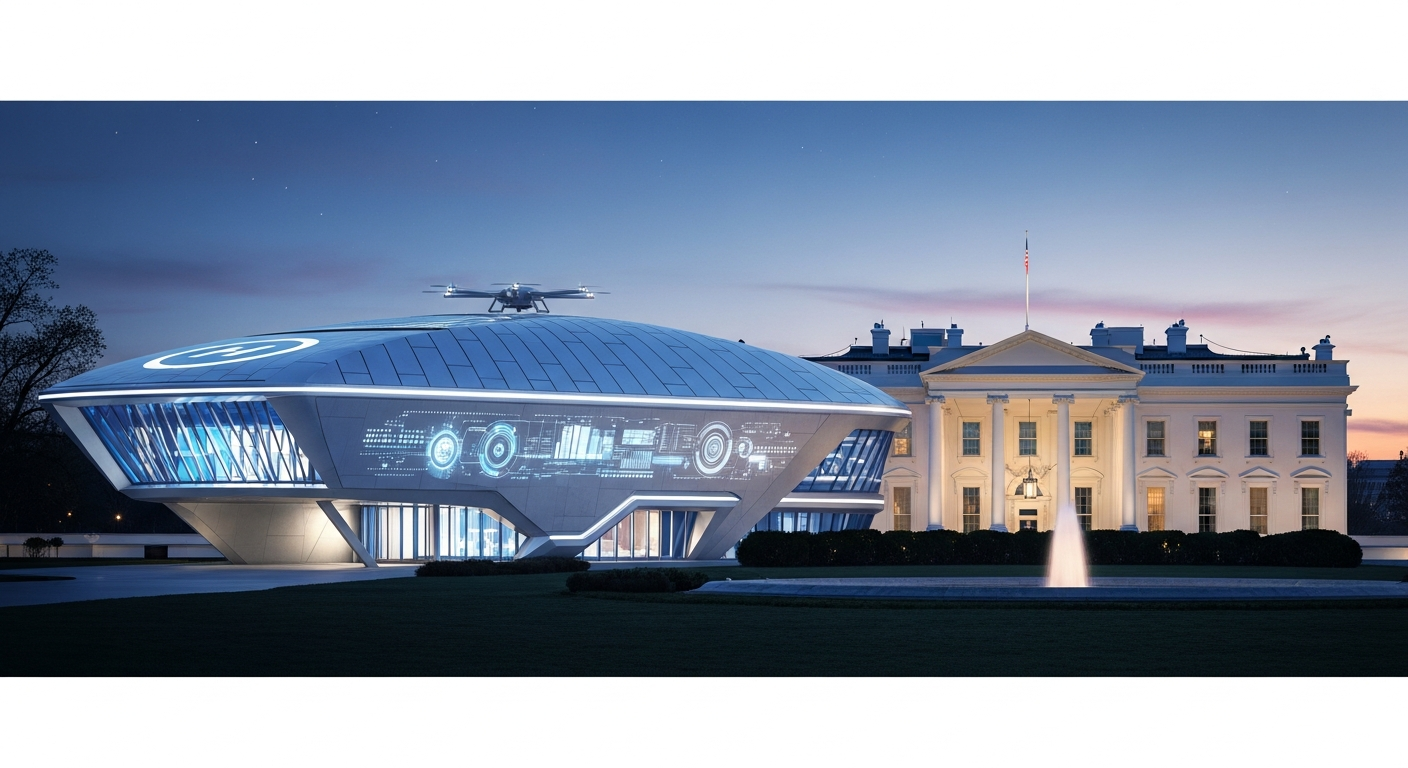
The era of open skies over civilian architecture has officially ended. President Donald Trump’s recent proposal to secure a newly constructed White House ballroom with a $1 billion taxpayer-funded defense package is not merely a political flashpoint; it is a glaring indicator of a fundamental shift in global infrastructure security. The project, which controversially involved the demolition of the historic East Wing, is being touted as a militarized fortress. Its proposed features—a rooftop “drone port” designed to house military interceptors and a roof forged from “impenetrable steel”—represent a radical departure from traditional executive protection. To understand the gravity of this development, we must strip away the political rhetoric and examine the hard engineering and materials science driving this architectural evolution.
First, we must address the physics of the “impenetrable steel” claim. In the realm of modern kinetic warfare and loitering munitions, there is no such thing as an impenetrable material. The primary aerial threats today are one-way attack munitions, such as the Iranian-designed Shahed-136, which have been utilized with devastating effect in both the Russo-Ukrainian war and the recent conflicts in the Middle East. These drones often carry shaped-charge warheads or high-explosive fragmentation payloads designed to penetrate hardened structures before detonating. Solid steel, regardless of its thickness, is highly susceptible to the focused kinetic energy of a shaped charge. Therefore, the engineering reality of a “drone-proof” roof relies not on sheer density, but on the principles of spaced armor and passive disruption.
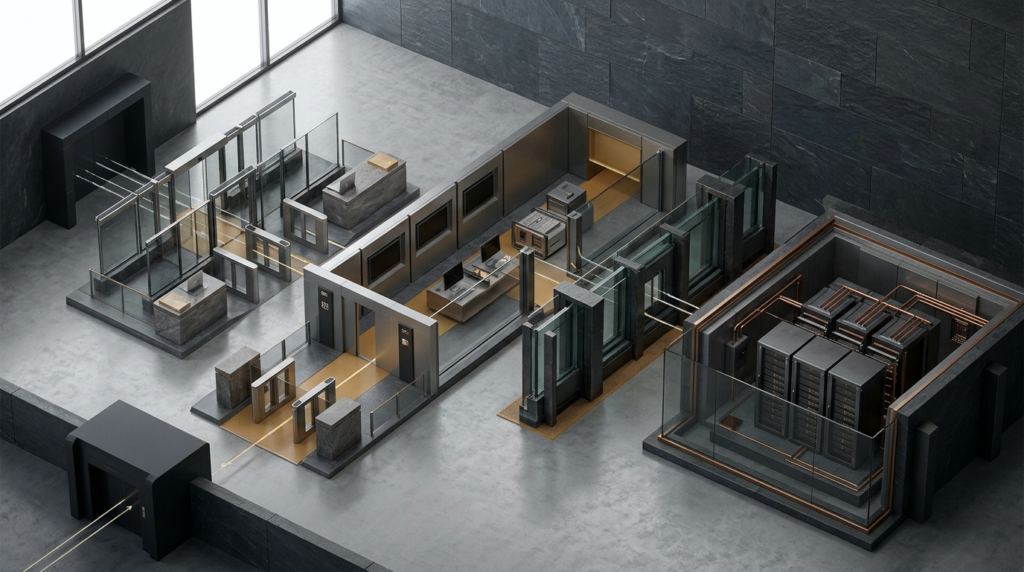
This doctrinal shift is explicitly outlined in the Pentagon’s January 2026 Guide for Physical Protection of Critical Infrastructure. The Department of Defense has recognized that active defense measures—such as Electronic Warfare (EW) jamming, directed energy weapons, or kinetic interceptor missiles—are insufficient on their own. Active systems have failure rates, can be overwhelmed by swarm tactics, and, crucially, cause significant collateral damage when intercepted debris falls onto dense urban environments. Consequently, the Pentagon now mandates passive “hardening” measures: concrete enclosures, overhead netting, and metal mesh structures.
We are already seeing this implemented on a massive scale globally. As of May 2026, satellite imagery and field reports confirm that the United Arab Emirates has begun constructing massive metal “cope cages” around highly volatile fuel storage tanks at Dubai International Airport. This desperate architectural adaptation was forced by a barrage of over 2,200 Iranian drone and missile attacks that overwhelmed the UAE’s advanced active missile shields. These steel mesh frames are designed to create a physical standoff distance, forcing a suicide drone’s warhead to detonate prematurely, thereby dissipating its destructive force before it breaches the primary structure. While Trump may eschew the unsightly aesthetic of a chain-link “cope cage” atop a White House ballroom, the underlying engineering principle remains identical: the roof must feature layered, spaced metallurgy to defeat kinetic impacts.
Equally ambitious is the proposal for a rooftop “drone port” intended to house “unlimited numbers” of US military drones to protect the entirety of Washington, D.C. From a systems engineering perspective, the claim of “unlimited numbers” is pure marketing fluff. Operating a continuous Combat Air Patrol (CAP) of interceptor drones from a civilian-government hybrid building requires a staggering amount of C4ISR (Command, Control, Communications, Computers, Intelligence, Surveillance, and Reconnaissance) infrastructure. A functional drone port necessitates Automated Launch and Recovery Systems (ALRS), robotic battery-swapping logistics, highly volatile munitions storage, and localized RF datalinks that are hardened against the very EW jamming systems used to protect the White House. The physical footprint of the roof strictly limits the sortie generation rate. However, as a localized node in a broader distributed air defense network, a rooftop drone base is a highly viable, albeit complex, engineering reality.
Market Impact & Deployment

The financial architecture of this ballroom project is just as unprecedented as its physical engineering, signaling a profound blurring of the lines between consumer technology, defense contracting, and executive power. The base construction cost of the ballroom—$400 million—has been entirely funded by a syndicate of private corporate donors. This list reads like a roster of the modern military-industrial-technology complex: Amazon, Apple, Coinbase, Comcast, Google, HP Inc., Lockheed Martin, Meta, Micron Technology, Microsoft, Palantir, Ripple, and T-Mobile.
The involvement of these tech titans is not an act of mere philanthropy; it is a strategic positioning play. Companies like Palantir, Google, and Microsoft are deeply entrenched in providing the AI and cloud infrastructure that powers modern Unmanned Aircraft Systems and defense networks. Crypto firms like Coinbase and Ripple are actively lobbying for favorable regulatory frameworks. By privately funding a White House structure, these corporations are physically cementing their influence at the nexus of executive power.
However, the true market impact lies in the $1 billion taxpayer request for “security adjustments and upgrades.” A $1 billion budget for securing a single $400 million building is vastly disproportionate if viewed in isolation. In reality, this funding likely obscures a much broader, classified upgrade to the National Capital Region’s integrated air defense system. A billion dollars buys a comprehensive system-of-systems: phased-array radar networks, optical and thermal tracking sensors, localized GPS-spoofing arrays, and the integration of the aforementioned drone port into the broader NORAD command structure.
But the implications of this project extend far beyond Pennsylvania Avenue. On May 6, 2026, the Federal Aviation Administration (FAA) published a highly anticipated Notice of Proposed Rulemaking (NPRM) regarding Section 2209 of the FAA Extension, Safety, and Security Act. This proposed rule establishes a formal process for designating Unmanned Aircraft Flight Restrictions (UAFRs) over Critical Infrastructure. The rule defines 16 critical sectors—including energy production, chemical facilities, and crucially, communications and data centers.
For Enterprise IT leaders, this FAA ruling is a watershed moment. Hyperscale data centers, which house the compute power for the global economy, are incredibly vulnerable to kinetic drone attacks. Their massive HVAC systems, cooling towers, and backup generators are typically exposed on rooftops. Under the new FAA framework, facility operators can apply for a “Standard UAFR” to create a virtual no-fly zone, or a “Special UAFR” for highly sensitive sites facing credible threats, which carries severe criminal penalties for airspace violators. CTOs and infrastructure managers must now pivot from purely focusing on cybersecurity to actively managing their physical airspace sovereignty. The market for counter-UAS (Unmanned Aircraft Systems) technology, passive hardening materials, and legal compliance consulting for UAFR applications is poised for explosive growth.
The Consumer Translation
For the everyday consumer, the militarization of the White House ballroom and the subsequent FAA regulations represent the end of the “wild west” era of consumer drones and the beginning of a highly restricted, visually altered urban landscape. The trickle-down effect of infrastructure hardening will fundamentally change how we interact with the sky and our cities.
First, the visual aesthetic of our urban environments is about to change. If the White House, Dubai International Airport, and hyperscale data centers require passive physical defenses to survive the modern threat landscape, it is only a matter of time before local power plants, water treatment facilities, corporate headquarters, and even large amusement parks adopt similar measures. The public should prepare for the normalization of “cope cages”—heavy metal netting and spaced architectural facades—becoming a standard feature of modern building design. The sleek, glass-heavy architecture of the 21st century will increasingly be shrouded in protective mesh, a stark visual reminder of the persistent aerial threats that define the late 2020s.
Secondly, the operational reality for consumer and commercial drones will be severely curtailed. The FAA’s proposed UAFR rules mean that the airspace over American cities will soon resemble a complex, invisible patchwork of restricted zones. For companies banking on drone delivery logistics—such as Amazon Prime Air or Alphabet’s Wing—navigating this fragmented airspace will require flawless, real-time Geofencing capabilities. A delivery drone dynamically rerouting to avoid a newly designated Special UAFR over a local chemical plant or a VIP event will become a daily logistical hurdle.
For the hobbyist drone pilot, the implications are even more restrictive. The integration of mandatory Remote ID broadcasting means that any consumer drone breaching a UAFR boundary will instantly transmit the operator’s exact location to local law enforcement. The days of casually flying a DJI drone over a local bridge, dam, or corporate campus for aerial photography are effectively over. Violators will face immediate license revocations, civil fines, and potential criminal charges under the guise of homeland security. The White House ballroom project is not an isolated fortress; it is the blueprint for the future of civilian airspace, where security absolute takes precedence over public transit and recreational freedom.
TechNode HQ Verdict: Pros, Cons & Usability
- Pro (Engineering): Passive physical defenses (like spaced steel roofs and mesh netting) provide a fail-safe, mathematically reliable layer of security that cannot be bypassed by electronic warfare spoofing or software zero-days.
- Pro (Consumer): The FAA’s new UAFR framework provides a much-needed, standardized legal mechanism for local communities and businesses to protect their physical privacy and safety from unauthorized aerial surveillance and rogue drones.
- Con: The aerodynamic and thermal impact of installing dense “cope cage” mesh over enterprise data center cooling systems or building HVACs drastically reduces energy efficiency, leading to massive spikes in operational cooling costs.
- Con: The bureaucratic bottleneck of the FAA’s UAFR application process will likely heavily favor massive tech corporations and government entities, leaving smaller businesses unprotected while simultaneously crippling the commercial drone delivery sector with fragmented routing.
Enterprise Usability: CTOs and Enterprise Infrastructure Managers must act immediately. You must conduct a physical aerial vulnerability audit of your data centers and critical facilities today. With the FAA’s Section 2209 NPRM comment period closing on July 6, 2026, enterprises must begin the legal groundwork to apply for UAFR protections while simultaneously budgeting for passive physical roof hardening (netting/mesh) to protect exposed cooling infrastructure from low-cost kinetic threats.
Everyday Usability: The general public should hold off on investing heavily in prosumer camera drones unless they are prepared to navigate a legal minefield. The airspace above your city is about to be heavily geofenced and aggressively policed. Expect significant delays and route alterations in any drone-based delivery services as logistics companies struggle to adapt to the new, militarized reality of urban airspace.
Sources & Citations:
Original Claim via: arstechnica
Official Handle: @arstechnica
Topics Explored: Drone Defense, Critical Infrastructure, FAA Regulations, Physical Security, Tech Policy