The Architectural Shift: Building a $10 Billion Edge-Computing Panopticon

At the 2020 Consumer Electronics Show, Toyota CEO Akio Toyoda made a sweeping declaration: the world’s largest automaker would build a “city of the future” from scratch. Fast forward to today, and that vision has materialized atop a disused factory site in Japan. Dubbed “Woven City,” this $10 billion, 175-acre urban laboratory is currently operating with its first 100 handpicked residents, known as “Weavers.” But beneath the lush, stylized gardens and sweeping brutalist architecture lies one of the most aggressive, dense, and complex edge-computing deployments ever attempted by a private enterprise.
To understand Woven City is to understand a fundamental pivot in autonomous infrastructure. While Silicon Valley giants like Tesla and Waymo have spent the last decade trying to pack infinite intelligence into the vehicle itself—relying on onboard neural networks, lidar, and vision systems to navigate a chaotic world—Toyota is taking the opposite approach. Woven City is built on the premise of Vehicle-to-Everything (V2X) communication. The company’s Chief Technology Officer for Woven City, John Absmeier, argues that onboard systems alone will never achieve Toyota’s ultimate goal: a society with zero accidents. To spot a child darting from behind a truck, the environment itself must be sentient.
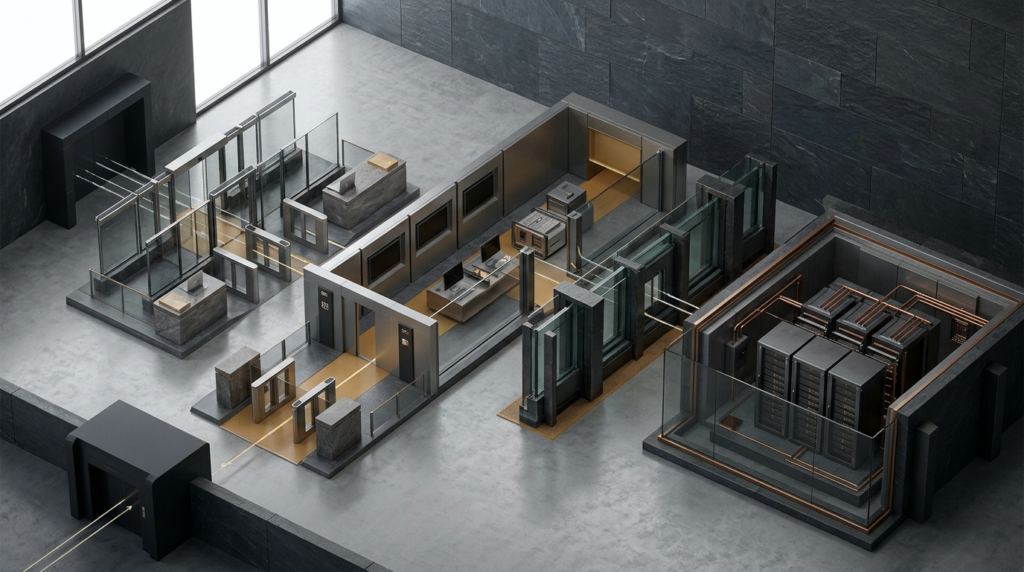
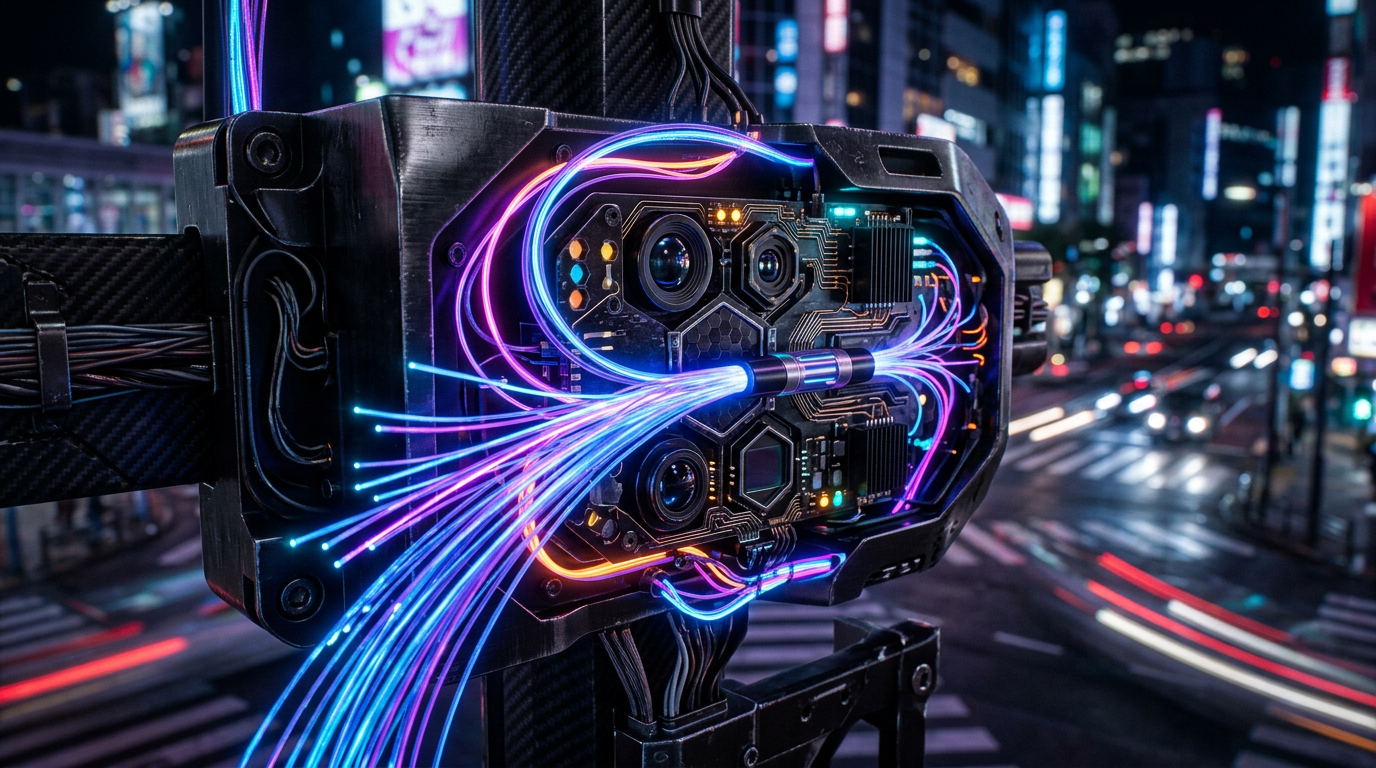
This environmental sentience is powered by the “Woven City AI Vision Engine,” an agentic artificial intelligence system that acts as the omniscient brain of the metropolis. The hardware density required to facilitate this is staggering. A single intersection in Woven City features no less than eight high-definition cameras, supplemented by countless others mounted on building ceilings, retail spaces, and even inside the local coffee shop. From an enterprise IT perspective, the bandwidth and compute overhead to ingest, process, and analyze this volume of high-resolution video telemetry in real-time is monumental.
To prevent network latency from causing fatal delays in autonomous vehicle routing, Toyota cannot rely on traditional cloud architecture. Instead, Woven City operates as a massive edge-computing mesh. The AI Vision Engine doesn’t just record; it is an agentic system designed to monitor, catalog, and report activity dynamically. While Toyota claims the system does not utilize facial recognition, it employs advanced computer vision to track individuals based on clothing and gait, seamlessly handing off tracking data from one camera node to the next as a resident moves through the city. This requires a highly sophisticated localized data pipeline, where inferencing happens at the edge to instantly alert oncoming traffic of pedestrian hazards.
Managing the ethical and technical routing of this data is a proprietary system Toyota calls the “Data Fabric.” In enterprise architecture, a data fabric is typically a decentralized architecture that provides unified access to data across multiple endpoints. In Woven City, it acts as a physical-world Identity and Access Management (IAM) platform. Engineer Saipang Chan explains that the Data Fabric handles consent management, allowing residents to opt into or out of specific surveillance and robotic services. Currently, 98 percent of the highly curated Weaver population has opted into having a camera-equipped robot operate inside their homes. However, scaling this microservices-based consent architecture from a controlled cohort of 100 employees to a global municipal deployment presents an unprecedented cryptographic and governance challenge.
Enterprise Market Impact & TCO: The Economics of Infrastructure-Assisted Autonomy
From a Total Cost of Ownership (TCO) and enterprise strategy perspective, Woven City is not merely a $10 billion R&D sinkhole; it is a proving ground for commercial technologies that Toyota intends to license and sell to global municipalities and corporate campuses. Operating under the corporate umbrella of Woven by Toyota, Inc., the city is mandated to become a long-term sustainable business. The most lucrative enterprise play hidden within Woven City’s walls is its approach to energy management and fleet logistics.
Beneath the city lies a massive parking structure that doubles as a Virtual Power Plant (VPP). The facility houses a fleet of Toyota bZ4X electric vehicles connected to bidirectional chargers. In a standard grid, EVs are merely a drain on municipal power. In Woven City, they act as a distributed energy resource (DER). By utilizing Vehicle-to-Grid (V2G) technology, the collective battery packs of the parked EVs can be tapped to offset the city’s peak power demand by up to 10 percent. For enterprise businesses managing large EV fleets, this technology represents a massive reduction in operational expenditure (OpEx). By shaving peak demand charges—often the most expensive component of commercial electricity bills—Toyota’s VPP architecture could revolutionize corporate energy procurement.
However, the automation of this system reveals a glaring bottleneck in current robotics. While the grid is smart, the physical connection is dumb. The bidirectional chargers utilize standard, human-operated plugs. This means that despite the billions spent on AI and autonomy, a human worker must still physically walk through the garage to plug and unplug the vehicles before they can be autonomously dispatched. This “last-inch” automation failure highlights the immense difficulty of bridging digital orchestration with physical hardware.
Furthermore, Toyota’s approach to vehicle dispatching challenges the current industry consensus on autonomous hardware. Instead of equipping every bZ4X with tens of thousands of dollars worth of lidar and imaging sensors, Toyota utilizes a robot called the “Guide Mobi.” Acting like a digital tugboat, the Guide Mobi is heavily outfitted with lidar and sensor arrays. It autonomously navigates to a parked EV, digitally tethers to it, and guides the sensor-light vehicle out of the garage to the resident waiting at the curb.
This is a fascinating TCO calculation. Tesla attempts to solve this exact problem with its “Summon” feature, relying entirely on the car’s onboard cameras and software—a notoriously unreliable system to date. Toyota’s thesis is that it is more cost-effective and infinitely safer to build a fleet of highly intelligent, localized infrastructure robots (the Guide Mobi) to manage “dumb” cars within a geofenced area, rather than forcing every consumer vehicle to carry the cost and compute burden of full autonomy. If proven successful, this model could drastically lower the manufacturing cost of consumer EVs while creating a new enterprise market for municipal fleet-management robots.
The Consumer Reality: What This Means for You
While the enterprise architecture of Woven City is a marvel of modern engineering, the consumer reality of living inside a $10 billion corporate utopia is far more complex. For the general public, Toyota’s vision of the future presents a stark, uncompromising ultimatum: you can have absolute physical safety, zero traffic accidents, and seamless convenience, but you must surrender the concept of public anonymity.
The sheer density of the AI Vision Engine creates a physical panopticon. Walking down the street, ordering a coffee, or sitting in a public park means being continuously cataloged by an agentic AI. Kota Oishi, General Manager at Woven City, notes that while Southeast Asian populations may be relaxed about data privacy, Japanese and European citizens are highly cautious. The “Data Fabric” consent app is Toyota’s olive branch to privacy advocates, allowing residents to toggle their visibility. But in a city where the infrastructure relies on ubiquitous tracking to prevent a car from hitting you, opting out of the surveillance mesh might inherently mean opting out of the city’s safety guarantees. The psychological toll of living in an environment where every movement is tracked, analyzed, and categorized—even without facial recognition—is a reality the broader public will have to grapple with as smart city tech proliferates.
Beyond the privacy paradox, the current state of Woven City highlights the fragility of early-stage utopian tech. During a recent press tour, the reality of the city was less “cyberpunk future” and more “sterile ghost town.” With only 100 residents occupying a space the size of three New York City blocks, the environment feels eerily empty. Automated e-Palette buses run their routes meticulously, stopping at empty stations, waiting, and departing without a single passenger. The brutalist residential buildings, while featuring beautiful, sweeping ridges of wood and lush gardens, show no signs of human life—no laundry on balconies, no bicycles, no children playing.
More critically, the utopian vision is entirely at the mercy of the weather. Woven City is heavily reliant on micro-mobility solutions, such as the “Swake”—a three-wheeled, leaning scooter with a top speed of 12 mph designed as a safer alternative to Lime or Bird scooters. Yet, in the rain, the Swake fleet is grounded. The scooter-sharing stations sit empty, and many of the delivery robots are forced to stay indoors to keep their delicate sensor arrays dry. A city of the future that ceases to function during a mild rainstorm is a stark reminder of the gap between controlled R&D environments and the chaotic reality of global consumer deployment.
There are, however, tangible consumer benefits being beta-tested behind these walls. Residents act as alpha testers for quality-of-life technologies that could soon hit the global market. A prime example is the next-generation HVAC system deployed in Woven City apartments, which is engineered to eliminate 95 percent of airborne pollen—a massive lifestyle upgrade for the roughly 50 percent of the Japanese population that suffers from severe hay fever. It is these localized, highly practical innovations that may ultimately win over consumers, rather than the grand promises of autonomous tugboats.
The Industry Ripple Effect
Toyota’s $10 billion gamble is sending shockwaves through the automotive, tech, and urban planning sectors. By proving out the V2X model at scale, Toyota is directly challenging the “vehicle-centric” autonomy models championed by Elon Musk and Silicon Valley. If Woven City successfully demonstrates that the only mathematically viable way to achieve “zero accidents” is through infrastructure-assisted autonomy, it forces a massive pivot in how governments approach urban design.
Competitors like Ford, General Motors, and Waymo will be forced to decide whether to continue pouring billions into onboard neural networks or to begin partnering with municipalities to build out smart-grid infrastructure. The Woven City model suggests that the future of the automotive industry is not just selling cars, but selling the operating system for the city itself. Toyota is positioning itself to become a primary vendor for municipal AI Vision Engines, Data Fabric consent platforms, and Virtual Power Plant orchestration software.
However, this ripple effect places an enormous financial burden on city planners. If the cars of the future require intersections equipped with eight edge-computing cameras and lidar-guided tugboats to function safely, the cost of upgrading public infrastructure will be astronomical. Toyota is betting that by refining these systems in its private utopia, it can drive down the cost of deployment and offer a turnkey “Smart City as a Service” to governments worldwide. As the broader Toyota Group enters its next century, Woven City is less of a residential neighborhood and more of a $10 billion showroom for the future of enterprise mobility.
TechNode HQ Verdict: Pros, Cons & Usability
- Pro (Engineering): The Virtual Power Plant (VPP) architecture successfully utilizes bidirectional EV charging to offset peak grid demand by 10%, offering a massive OpEx reduction model for enterprise fleet management.
- Pro (Consumer): Next-generation environmental controls, such as the advanced HVAC systems eliminating 95% of pollen, offer immediate, tangible health and lifestyle benefits for residents.
- Con: The “last-inch” automation gap remains a critical bottleneck; sophisticated V2G energy grids still require human intervention to physically plug and unplug autonomous vehicles.
- Con: The entire micro-mobility and robotics infrastructure is highly susceptible to weather, with scooters and delivery drones failing to operate safely in standard rain conditions.
Enterprise Usability: For CTOs and urban planners, Woven City’s Data Fabric and VPP models are the gold standard for future deployments. Enterprises managing large logistics hubs or corporate campuses should immediately begin evaluating V2G bidirectional charging infrastructure to offset peak energy costs. However, reliance on localized AI Vision Engines for safety requires massive edge-compute investments that most current IT budgets cannot support.
Everyday Usability: For the general public, the technologies tested in Woven City are still years away from municipal deployment. While the prospect of zero-accident intersections is appealing, consumers should be highly critical of the privacy trade-offs required. Until the robotics can function reliably in adverse weather and the consent management systems are proven secure against state-level actors, living in a fully integrated smart city remains a utopian concept with dystopian vulnerabilities.
Sources & Citations:
Original Technical Breakdown via: arstechnica
Official Handle: @arstechnica
Topics Explored: Smart Cities, Edge Computing, AI Surveillance, Virtual Power Plants, Vehicle-to-Everything