The Architectural Shift

In a move that feels both inevitable and revolutionary, Amazon Web Services has unveiled a new preview feature for its Amazon WorkSpaces service that promises to solve one of the most persistent and costly problems in enterprise IT: the “last-mile challenge.” The announcement is deceptively simple: AI agents can now securely access and operate desktop applications within a managed WorkSpaces environment. But the implications of this architectural fusion—blending cutting-edge AI with the established world of Desktop-as-a-Service (DaaS)—are profound. This isn’t merely an upgrade; it’s the formalization of a new paradigm for enterprise automation, one that could finally bridge the chasm between modern AI and the legacy systems that, for better or worse, still run the global economy.
To understand the magnitude of this shift, one must first appreciate the limitations of its predecessors. For decades, large organizations have been hamstrung by critical business processes locked inside desktop applications with no modern APIs. Think of the AS/400 mainframe terminals used in logistics, the Windows 95-era proprietary accounting software in a regional bank, or the complex, multi-window ERP systems that require months of training for a human to master. Automating workflows on these systems has been the domain of Robotic Process Automation (RPA). Traditional RPA solutions from vendors like UiPath and Automation Anywhere provided a crucial, if brittle, solution. They deployed “bots”—essentially complex scripts—onto virtual machines to mimic human mouse clicks and keystrokes. While effective, this model carried significant overhead: high licensing fees, the need to manage and patch fleets of on-premises VMs, and scripts that would break at the slightest change to the user interface. It was a duct-tape solution for a multi-trillion-dollar problem.
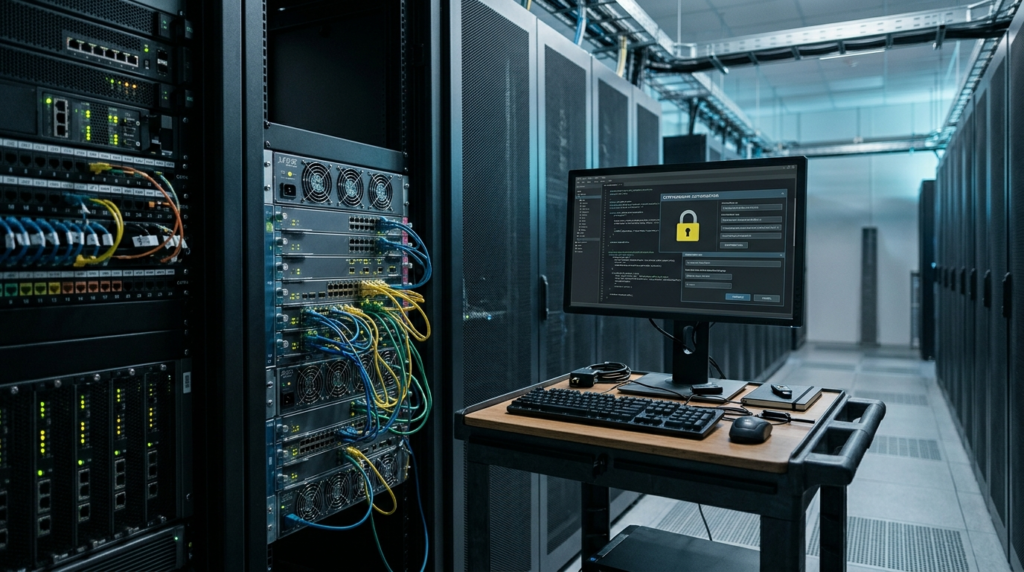
The new AWS offering fundamentally re-architects this process. Instead of a brittle script on a self-managed VM, the “bot” is now a sophisticated AI agent, and its “computer” is a fully managed, secure, and ephemeral Amazon WorkSpace. This is RPA 2.0. The AI agent is not a simple macro recorder; it’s a cognitive system. It likely combines a computer vision (CV) model to see and interpret the screen—identifying icons, buttons, and text fields just as a human does—with a large language model (LLM) to understand instructions and make decisions. A high-level command like “Process the attached invoice and approve if the total is under $5,000” is no longer a rigid, step-by-step script. The AI agent can now dynamically navigate the application, locate the relevant fields, perform the calculation, and execute the correct action, even if the window layout has changed slightly.
The linchpin of this entire architecture is a new component AWS calls the “Model Context Protocol (MCP).” While AWS frames this as an “industry-standard,” it’s more accurately an AWS-defined abstraction layer that serves as the universal translator between the AI’s “brain” and the WorkSpace’s “hands.” The AI agent, regardless of whether it’s built on technology from OpenAI, Anthropic, or a company’s own proprietary model, doesn’t need to know how to control a mouse or keyboard directly. It simply outputs its intentions in the MCP format—a structured set of commands like `{“action”: “click”, “target”: {“label”: “Submit”}}` or `{“action”: “type”, “target”: {“id”: “user_id_field”}, “value”: “agent_007”}`. The AWS infrastructure receives these MCP commands and translates them into the low-level inputs within the secure WorkSpace session. This brilliant decoupling allows enterprises to use the best AI model for the job without being locked into a single vendor’s cognitive engine, while AWS controls the critical—and billable—infrastructure layer.
Enterprise Market Impact & TCO

For Chief Technology Officers and IT budget holders, the announcement of AI agents in WorkSpaces triggers an immediate and complex series of calculations around Total Cost of Ownership (TCO), security, and strategic vendor management. This isn’t just a new tool; it’s a potential catalyst for rethinking entire operational departments and IT strategies. The market impact will be felt across three primary domains: cost structure, security posture, and the competitive landscape of enterprise software.
From a TCO perspective, the AWS model presents a compelling, if complex, alternative to traditional RPA and human labor. The old RPA model involved significant upfront capital expenditure (CapEx) on software licenses and on-premises server infrastructure, followed by ongoing operational expenditure (OpEx) for maintenance, support, and the specialized developers needed to write and fix the brittle scripts. The AWS model shifts this entirely to OpEx. The cost components are now: the per-hour or per-month cost of the Amazon WorkSpace instance, the inference cost for the AI model (billed per token or per API call), and the data transfer and storage costs within AWS. While “pay-as-you-go” sounds appealing, the true TCO will hinge on efficiency. An agent that can process a claim in 30 seconds is vastly cheaper than one that takes 5 minutes. This places an enormous emphasis on the quality of the AI model and the workflow design. However, the potential for savings is immense. A single human claims processor costs a company tens of thousands of dollars per year in salary, benefits, and overhead, and can work roughly 2,000 hours. An AI agent, once developed, can run on a WorkSpace for a few dollars per hour, 24/7/365, effectively creating a “digital workforce” with near-perfect attendance and superhuman productivity for specific, repetitive tasks.
The security and compliance implications are perhaps the most significant selling point for enterprises in regulated industries like finance and healthcare. Traditional RPA bots often ran on shared servers with highly privileged accounts, creating a massive security risk and an auditor’s nightmare. The WorkSpaces model offers a “zero trust” architecture by default. Each AI agent is provisioned its own dedicated, isolated desktop environment. Its “blast radius” is contained. Access to network resources is controlled via VPC security groups, and access to other AWS services (like S3 for reading documents or DynamoDB for writing results) is governed by granular IAM roles, eliminating the need for hardcoded credentials. Furthermore, the promise of “screenshots and metrics” for observability is a game-changer for compliance. Every action the AI takes can be visually recorded and logged, creating a non-repudiable audit trail that can be used to prove compliance with regulations like SOX, HIPAA, or PCI-DSS. This transforms the AI agent from a mysterious “black box” into one of the most heavily monitored and auditable “employees” in the organization.
Finally, this move sends a seismic shockwave through the enterprise software market. It positions AWS not just as an infrastructure provider, but as a core platform for business process transformation. Pure-play RPA vendors now face an existential threat. Their core business model of selling licenses and running bots on generic VMs is being directly challenged by a deeply integrated, scalable, and secure cloud-native solution. They will be forced to either compete by integrating more deeply with cloud providers or pivot to specializing in the highest-value part of the stack: the AI models and workflow design tools. For Microsoft, this is a direct shot across the bow. They have their own ecosystem with Azure Virtual Desktop (AVD) and the Power Automate platform. We can now expect an accelerated race to integrate more powerful AI agents directly into AVD, turning this into a two-horse race between the world’s largest cloud providers for control of the future of enterprise automation.
The Consumer Reality: What This Means for You
While the technical jargon of AI agents and cloud desktops may seem distant, the impact of this technology will be felt in the daily lives of nearly everyone, often in invisible but significant ways. This innovation is the missing piece of plumbing needed to connect the lightning-fast world of modern AI to the creaky, decades-old infrastructure that powers many of the services we use every day. The result will be a subtle but powerful acceleration of the business world, smoothing out friction points that we’ve long accepted as normal.
Consider the process of filing a medical insurance claim. Today, you submit your paperwork, and it enters a queue. A human processor eventually opens your file, then launches a clunky, text-based application on their computer. They manually key in your policy number, the diagnostic codes, and the billing amounts, cross-referencing multiple screens and documents. This process is slow, prone to typos, and limited to business hours. With AWS’s new capability, the process is transformed. The moment you submit your claim, an AI agent is spun up in a secure WorkSpace. It reads your documents, launches the same clunky application, and, in a matter of seconds, navigates the arcane menus to enter all the information flawlessly. It can cross-reference the company’s entire policy database instantly to verify coverage. If the claim is straightforward, it can be approved and processed for payment in minutes, not weeks. You, the consumer, don’t see the AI; you just get your reimbursement faster and with fewer errors.
This pattern will replicate across countless industries. Applying for a mortgage, a process notorious for its mountains of paperwork and weeks of waiting, can be dramatically streamlined. An AI agent can ingest your financial statements, log into the bank’s legacy loan origination system, fill out the hundreds of required fields, and flag the application for final human review in a fraction of the time. When you call customer service to change your address, the agent you speak with might no longer need to put you on hold while they navigate four different systems. They could simply state the request, and an AI agent in the background could perform the tedious data entry across all relevant platforms simultaneously. The “3-5 business days” we so often hear for transactions to clear could begin to shrink as back-office processes that relied on manual batch processing are replaced by 24/7 AI agents.
Of course, this efficiency comes with a societal trade-off that cannot be ignored. This technology is purpose-built to automate a specific class of white-collar, administrative jobs centered around data entry and process execution. While it will undoubtedly create new, higher-skilled jobs in AI management, workflow design, and automation auditing, it will also displace a significant number of workers whose current roles are a direct match for the capabilities of these new AI agents. The consumer reality is a double-edged sword: we will benefit from faster, cheaper, and more reliable services, but we must also grapple with the economic and social consequences of this powerful new wave of automation. It represents a fundamental shift in the nature of “office work,” moving from human execution of repetitive tasks to human supervision of automated systems.
The Industry Ripple Effect
Amazon’s announcement is not happening in a vacuum. It is a calculated, strategic move that will force a response from every major player in the cloud and enterprise automation space, creating a ripple effect that will reshape the competitive landscape for years to come.
The most immediate and direct pressure falls on Microsoft. The battle for cloud supremacy has always been a two-horse race, and this move opens a new, critical front. Microsoft has all the necessary components: Azure as the infrastructure, Azure Virtual Desktop (AVD) as the DaaS platform, and Power Automate as the RPA/automation engine, all increasingly infused with OpenAI’s technology. However, AWS has now presented a deeply integrated, elegant solution specifically for legacy GUI automation. The pressure is now on Microsoft to move beyond simple API-based automation in Power Automate and deliver a similarly seamless, secure, and scalable solution for AI agents to control AVD instances. Expect a flurry of announcements from Redmond in the coming months, likely centered on “AI-driven UI flows” in AVD, as they cannot afford to cede this lucrative market to AWS.
For the established giants of Robotic Process Automation—UiPath and Automation Anywhere—this is an existential moment. Their entire business model has been built on being the third-party software layer that automates processes on top of generic infrastructure, whether on-premises or in the cloud. AWS is now effectively cutting out the middleman, integrating the automation capability directly into the infrastructure platform itself. These RPA vendors must now make a critical choice: do they try to compete with AWS on infrastructure, a losing battle, or do they pivot? The most likely path forward is to move “up the stack.” They must de-emphasize the “bot” and the “VM” and focus on providing the most advanced AI models, the most intuitive workflow design studios, and the most comprehensive governance dashboards. Their new value proposition cannot be “we run the bots”; it must be “we provide the smartest brains for the bots that run on AWS and Azure.” This will lead to a frenzy of M&A activity as they look to acquire smaller AI and computer vision companies to bolster their cognitive capabilities.
Google Cloud Platform (GCP) is the third major player watching this development closely. While traditionally stronger in data analytics and Kubernetes, GCP has been making inroads into the enterprise. This move by AWS highlights a potential gap in their portfolio. They will likely accelerate their own efforts to build or partner for a similar capability, perhaps leveraging their strengths in AI with models like Gemini to control virtualized Android or ChromeOS environments for automation. The race is on to prove that they too can solve the legacy automation problem.
Finally, this will spawn a new ecosystem of startups and consulting firms. The “minimal code” promise from AWS only applies to the connection; building the agent itself is a monumental task. A new generation of specialized development shops will emerge, focusing on building and training “Certified AI Agents” for specific legacy applications like SAP, Oracle Financials, or industry-specific mainframe systems. System integrators like Deloitte, Accenture, and Capgemini will rapidly build “AI Agent Deployment” practices, helping large enterprises manage the organizational change and strategic implementation of these new digital workforces. The ripple from this single AWS feature will not just be a wave, but a tsunami of innovation, competition, and market realignment.
TechNode HQ Verdict: Pros, Cons & Usability
- Pro (Engineering): The architecture provides unparalleled security and auditability for UI-based automation. By isolating each agent in a dedicated, IAM-governed WorkSpace and providing a full visual audit trail, AWS has solved the core governance problem that plagued traditional RPA.
- Pro (Consumer): This technology will lead to a tangible increase in the speed and reliability of services from large institutions. It’s the engine that will finally process your insurance claim in minutes instead of weeks.
- Con: The solution is fundamentally brittle. It still relies on computer vision to interpret a GUI. A minor application update (e.g., changing a button’s color) could break the automation, requiring costly and time-consuming retraining of the AI model.
- Con: The “minimal code” claim is misleading. The cost and complexity of developing, training, and maintaining the sophisticated AI agent “brain” will be immense, representing a significant hidden TCO component that is not immediately obvious from the announcement.
Enterprise Usability: For a CTO, this “Preview” is a flashing green light for experimentation. The immediate action is to task a small, innovative R&D team to begin a pilot project. Choose a high-volume, low-complexity, and non-critical back-office workflow. The goal is not full production deployment but to build internal expertise and understand the true TCO and development lifecycle of an AI agent. Focus on building the governance and monitoring framework in CloudWatch from day one. This is not a technology to be bought, but a capability to be built.
Everyday Usability: The public will not “buy” or “use” this service directly. It is deep enterprise infrastructure. However, you should be aware of its impending impact. This is the technology that will power the next generation of corporate efficiency. When you notice that a previously slow bureaucratic process suddenly becomes remarkably fast and efficient, it’s likely that a service like this is the invisible engine working behind the scenes.
Sources & Citations:
Original Technical Breakdown via: aws
Official Handle: @aws
Topics Explored: AWS, AI Agents, Robotic Process Automation, Cloud Computing, Digital Transformation