
Key takeaways
- Sub-32B parameter models currently fail at zero-shot autonomous 3D game generation.
- Forcing RAG and complex Skill Cards into restricted context windows causes catastrophic logic collapse.
- Nemotron 30b successfully generates basic 2D HTML widgets but fails at complex state management like Tetris.
- Hackathon winners succeeded by strictly limiting AI scope, proving edge AI requires narrow focus.
The Architectural Reality of Small-Parameter AI Limits

In the rapidly accelerating world of artificial intelligence, the narrative has largely been dominated by the pursuit of efficiency. The industry mandate is clear: shrink the models, reduce the compute, and push inference to the edge. However, a recent, highly publicized failure within the developer community has exposed the severe Small-Parameter AI Limits that currently govern the landscape of autonomous coding. The project, known as “Amazing Digital Dentures,” serves as a critical, real-world stress test for sub-32-billion parameter models, revealing exactly where the boundaries of logic and spatial reasoning break down.
Published on June 7, 2026, by a developer operating under the handle “VirusDumb,” the project was submitted to the Hugging Face Build Small Hackathon. The hackathon’s constraints were strict but reflective of modern deployment goals: all submissions had to run on models with 32 billion parameters or fewer, utilize Gradio for the user interface, and be hosted entirely on Hugging Face Spaces. The developer’s original vision was wildly ambitious—a digital pet inspired by the animated show The Amazing Digital Circus that would autonomously generate fully playable 3D adventure games to gamify real-world productivity.
To achieve this, the developer selected Nemotron 30b, part of Nvidia’s open-weight architecture, specifically to qualify for the hackathon’s “NVIDIA Nemotron Quest,” which dangled the lucrative prize of RTX 5080 GPUs. The target output was complex: fully functional 3D environments rendered in Three.js. What followed was a cascading series of technical failures that perfectly illustrate why small models cannot simply be brute-forced into acting as full-stack game developers.
The core issue lies in the architectural reality of parameter density. While a 30B model possesses a robust understanding of syntax and basic programming structures, it lacks the deep, multi-layered spatial reasoning required for zero-shot 3D generation. When tasked with writing Three.js code from scratch, the model consistently hallucinated API calls, mismanaged camera vectors, and failed to properly instantiate rendering loops, resulting in the developer’s most persistent enemy: the blank screen.
Context Window Collapse: The Anatomy of a RAG Failure
When initial long-form prompt engineering failed, the developer attempted to augment the model’s capabilities using advanced techniques that are standard practice in enterprise environments. This is where the project transitioned from a simple coding failure to a fascinating case study in system architecture breakdown.
The developer introduced GitHub Copilot “Skill Cards” (specifically targeting game-engine/SKILL.md) to teach the Nemotron 30b model the specific logic required for game development. However, to save on compute costs—a common reality in both hackathons and enterprise edge deployments—the developer had artificially restricted the model’s context window. The sudden influx of dense, instructional tokens from the Skill Cards blew up the short context window, leading to immediate KV (Key-Value) cache pressure and catastrophic forgetting. The model simply could not hold the instructions, the game state, and the output syntax in its active memory simultaneously.
Attempting to pivot, the developer increased the context window, but the logic still failed. Finally, they employed OpenAI Codex to distill the necessary skills into a single text file and implemented a Retrieval-Augmented Generation (RAG) pipeline over it. While this approach successfully fed the right information to the model, the fundamental reasoning bottleneck remained. The model could retrieve the correct Three.js snippets, but it lacked the parameter depth to synthesize them into a cohesive, functional application. The games continued to render as blank screens, proving that RAG is not a magic bullet for models that lack the inherent reasoning capacity to process the retrieved data.
Market Impact & Deployment: The Economics of Sub-32B Models
The failure of Amazing Digital Dentures must be viewed through the lens of the broader market economics driving the AI industry in 2026. The Hugging Face Build Small Hackathon is not just a playground for hobbyists; it is a proving ground backed by serious capital, boasting a $15,000+ cash prize pool, $10,000 in backing from OpenAI Codex, and heavy compute credits from Modal. The industry is desperately trying to prove that small models can handle complex tasks to justify the massive investments in edge computing infrastructure.
For Enterprise IT leaders and CTOs, this case study provides invaluable telemetry. The current market push suggests that companies can drastically reduce their Total Cost of Ownership (TCO) by swapping out expensive frontier models (like GPT-4 or Claude 3.5 Sonnet) for localized, open-weight 30B models. However, the Dentures project proves that this substitution is only viable if the scope of the task is radically reduced.
When we look at the competitors who actually succeeded in the hackathon, a clear pattern emerges. The highly praised project “Her (हेर)” did not attempt to build a sprawling, generative 3D universe. Instead, it succeeded by strictly limiting the AI’s scope to a highly specific, manageable domain. The market reality is that sub-32B models are incredibly powerful, but they are specialists, not generalists. Deploying them for open-ended, multi-step autonomous generation is a guaranteed path to system failure and wasted compute.
The Consumer Translation: From 3D Dreams to 2D Realities
Realizing that Nemotron 30b could not handle 3D spatial generation or complex game logic, the developer of Amazing Digital Dentures made a pragmatic pivot. The project was downgraded from a 3D adventure generator to a simple HTML 2D toy maker. This pivot perfectly encapsulates the current consumer reality of edge AI.
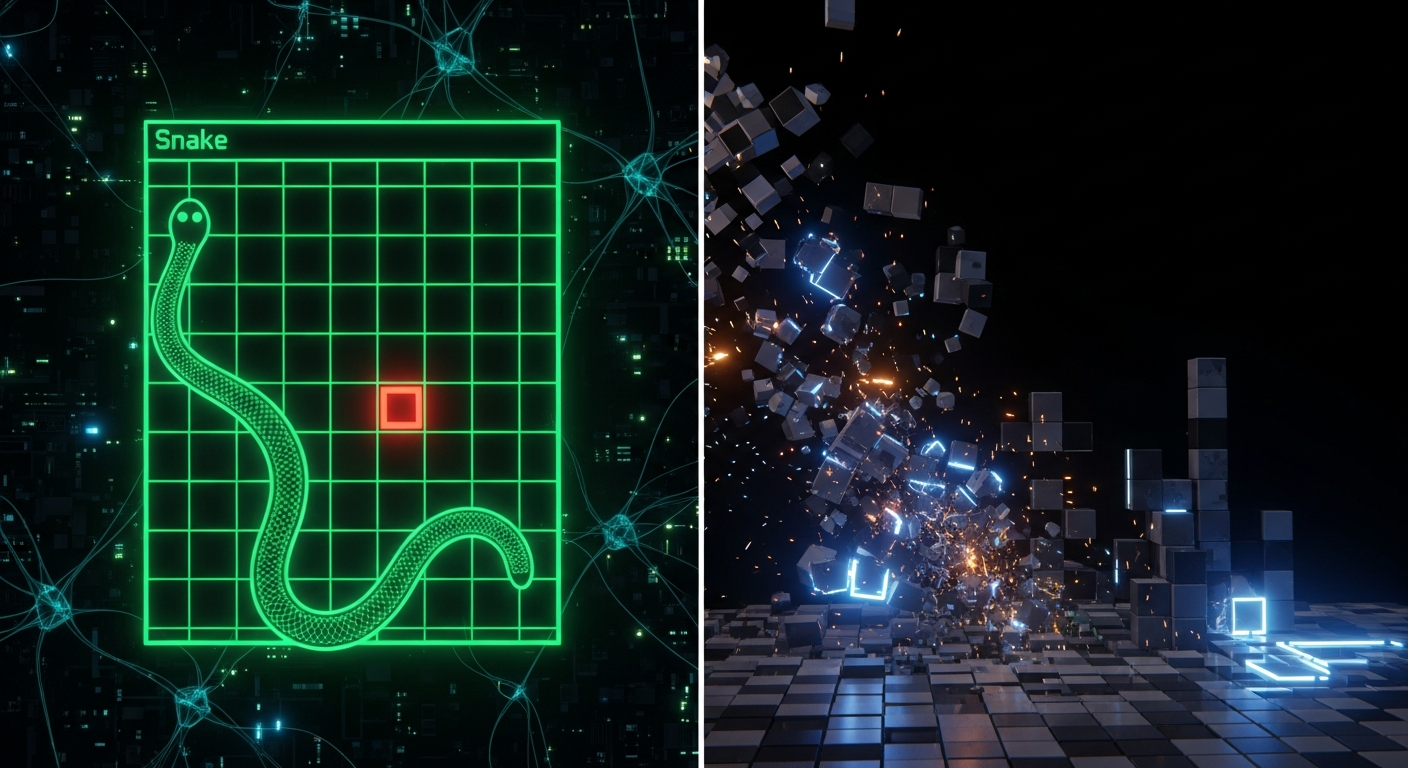
When constrained to simple, single-prompt HTML and JavaScript generation, the 30B model excelled. The developer successfully used it to create functional, everyday web utilities: a working clock, a basic to-do list, and classic arcade clones like Snake and Breakout. For the average consumer, this is the current sweet spot for local AI. You can ask your local machine to build you a custom widget or a simple distraction, and it will deliver functional code in seconds.
However, there is a hard ceiling to this capability. The developer noted that while Snake and Breakout worked perfectly, attempting to generate Tetris completely broke the model. Why? Because Tetris requires a significantly higher level of state management. The model must track a grid, manage collision detection across multiple rotating shapes, handle row-clearing logic, and update the score simultaneously. This multi-step matrix manipulation exceeds the logic threshold of a 30B model operating zero-shot. It highlights a crucial consumer takeaway: local AI can build your tools, but it cannot yet build your complex systems.
TechNode HQ Verdict: Pros, Cons & Usability
- Pro (Engineering): Sub-32B models like Nemotron 30b demonstrate exceptional speed and reliability when generating highly scoped, single-file HTML/JS applications, making them ideal for micro-tooling.
- Pro (Consumer): The ability to generate custom, functional 2D widgets (clocks, to-do lists, simple games) locally without relying on cloud subscriptions empowers everyday users to customize their digital environments.
- Con: Severe context window limitations and KV cache pressure make these models highly susceptible to catastrophic forgetting when augmented with complex RAG pipelines or dense Skill Cards.
- Con: The models completely lack the spatial reasoning and multi-step state management required for zero-shot 3D generation (Three.js) or complex logic games (Tetris), resulting in application crashes.
Enterprise Usability: For CTOs and Enterprise IT architects, sub-32B models should be deployed strictly as single-function microservices or localized data extractors. Do not attempt to use them as autonomous, full-stack coding agents for complex applications. If you are building internal tools, restrict the model’s output to basic scripting and UI generation, and ensure human-in-the-loop verification for any state-dependent logic.
Everyday Usability: For the general public and hobbyist developers, models in this weight class are fantastic “toy makers.” If you want to generate a quick script, a custom calculator, or a simple game of Snake, these models will perform brilliantly on local hardware. However, if your goal is to build the next indie game hit or a complex 3D environment, you will still need to rely on frontier cloud models or learn to code it yourself.