The AI Illusion and the Mid-Market Mandate
In the frantic, multi-billion-dollar race to deploy generative artificial intelligence across the corporate world, a quiet but catastrophic bottleneck has emerged. It is not a lack of compute power, nor is it a deficiency in large language model reasoning. The true enemy of enterprise AI is Data Fragmentation. At the 2026 Freshworks Refresh conference in New York City, Chief Executive Officer Dennis Woodside delivered a sobering reality check to the industry: mid-size enterprises cannot punch above their weight and compete with Fortune 100 giants using AI until they fundamentally consolidate their underlying data architecture.
Woodside’s thesis targets what he calls the “agile enterprise”—mid-market organizations with roughly 500 to 5,000 employees. These are companies like New Balance squaring off against Nike, or Seagate Technology competing with Samsung. These organizations require the stringent security, governance, and robust capabilities of a massive enterprise, but they completely lack the unlimited IT budgets and armies of implementation consultants required to deploy legacy systems. For these agile enterprises, the promise of AI has often been a mirage. They purchase advanced AI tools, only to realize that their internal data is scattered across dozens of disconnected SaaS applications, rendering the AI effectively blind and useless.
“Every customer that I talk to is looking to AI to help them transform their service operations,” Woodside explained during an exclusive broadcast with SiliconANGLE’s theCUBE. “A lot of companies are challenged in that their data is fragmented, their tech stack is fragmented, so the first thing they have to do is they have to consolidate—especially on the IT side—into a system of record that is robust, is broad, is enterprise-grade. That’s what we offer.” This mandate sets the stage for a radical rethinking of how IT departments operate, shifting the focus from merely adopting AI to actively preparing the digital foundation required to sustain it.
The Architectural Reality: Fixing the Data Foundation
For the past decade, the standard operating procedure for IT Service Management (ITSM) involved duct-taping disparate systems together. Human Resources data lived in Workday or Rippling; engineering tickets lived in Jira or Linear; institutional knowledge was buried in Notion or Google Drive; and IT Asset Management (ITAM) was often relegated to a separate, siloed database. When human agents manage these workflows, they act as the biological API, manually context-switching between tabs to piece together the narrative of a single employee request.
However, when you introduce an autonomous AI agent into this environment, the illusion of integration shatters. An AI model cannot autonomously resolve a hardware provisioning ticket if it cannot simultaneously verify the employee’s identity in the HR system and check laptop inventory in the ITAM database. The AI simply hits a wall of permission errors and missing context, forcing the ticket back into the human queue and defeating the purpose of automation entirely.
Freshworks’ strategic pivot is rooted in solving this exact architectural dilemma. Over the last 14 years, the company has built toward a unified “ServiceOps” foundation. By natively integrating IT asset management and operations management—including the sophisticated incident management capabilities acquired through their FireHydrant integration—into a single environment, Freshworks has created a pristine, unified data lake. This is not merely a backend cleanup; it is a strict prerequisite for agentic AI. This consolidation transforms the ITSM platform from a passive ticketing system into an active, enterprise-grade system of record where incidents, assets, and service history all live in the same environment.
The urgency of this architectural shift is validated by the speed at which agile enterprises are migrating. Seagate Technology, a massive player in the data storage sector, managed to migrate off a legacy competitor platform and onto Freshservice in just three months. In the realm of enterprise software transitions, which typically take quarters if not years, this deployment velocity is practically unheard of. This speed is only possible when the underlying architecture is designed for rapid ingestion and unified data mapping, bypassing the months of data cleansing usually required before AI tools can even be turned on.
The Engineering Mechanics: MCP Gateway and Agentic Workflows
The most technically significant announcement from the 2026 Refresh event is the introduction of the Model Context Protocol (MCP) Gateway. To understand the gravity of this release, one must look at how AI models traditionally interact with enterprise data. Historically, connecting an LLM to a proprietary database required bespoke API integrations, custom middleware, and constant maintenance by developers to handle authentication and data formatting. The Model Context Protocol is an open standard designed to securely and uniformly bring external data into AI workflows without custom coding.
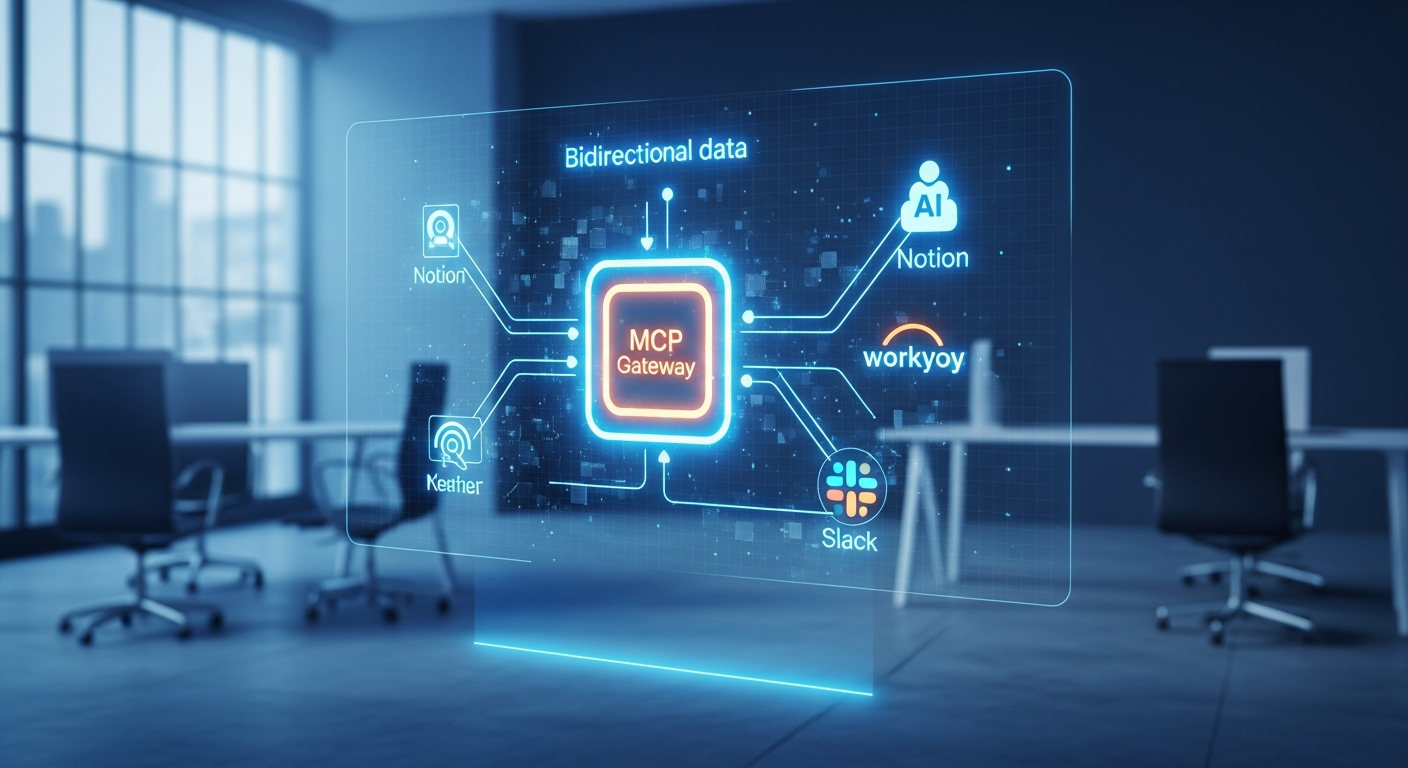
Freshworks has engineered the MCP Gateway to operate bidirectionally, solving two distinct engineering headaches. First is the “Inbound MCP.” This allows developers and IT professionals working inside external AI environments—such as Cursor, Anthropic’s Claude, or Microsoft Copilot—to query live Freshservice data directly. A developer writing code in Cursor who needs to check the status of a specific incident ticket, review a configuration protocol, or check an asset tag no longer needs to break their flow, open a browser, and log into Freshservice. They can query the ITSM database directly from their IDE via a secure OAuth 2.0 or API key connection. The AI assistant inside the IDE instantly gains the exact same context as a human support agent looking at the Freshservice dashboard.
Conversely, the “Outbound MCP” empowers Freshworks’ proprietary AI, Freddy AI, to reach outside its own ecosystem. Without requiring custom connectors, Freddy AI Agents can pull context from third-party applications like Notion, ClickUp, Linear, and Atlassian. If an employee submits a ticket asking for clarification on a new engineering protocol, the Freddy AI Agent can autonomously search the company’s Notion workspace, synthesize the relevant documentation, and deliver the answer directly in Slack or Microsoft Teams. It bridges the gap between the system of record and the systems of engagement.
Sitting on top of this protocol layer is the newly launched Freddy AI Agent Studio. Billed as a no-code environment, the Studio allows IT teams to build custom agentic AI applications or deploy over 20 prebuilt, domain-specific workflows. While “no-code” is often a marketing buzzword that masks rigid limitations, Freshworks has embedded strict governance controls and domain templates directly into the Studio. This allows business users to prototype complex workflows—such as automated employee onboarding, payroll inquiries, or software license provisioning—while giving developers the architectural agility to refine and scale these agents securely. To assist developers, Freshworks also included a Freddy AI Developer Copilot built into the IDE that surfaces platform docs, fixes validation errors, and speeds execution from idea to working app.
Market Impact & Deployment: The Financial Realities of the “SaaSpocalypse”

To fully grasp the impact of Freshworks’ AI strategy, one must examine the broader financial and competitive landscape of the SaaS industry in 2026. The market is currently navigating what analysts have dubbed the “SaaSpocalypse”—a period where enterprise buyers are ruthlessly cutting bloated software subscriptions, consolidating vendors, and demanding immediate, measurable Return on Investment (ROI) from AI features. In this climate, Freshworks finds itself in a fascinating, highly leveraged position.
Despite boasting an impressive 85% gross profit margin, generating $238 million in free cash flow over the last twelve months, and seeing its Freshservice revenue grow by 27% in the most recent quarter, Freshworks’ stock (NASDAQ: FRSH) experienced a 48% decline over the past year. The broader market has been highly skeptical of mid-tier SaaS companies’ ability to defend their moats against behemoths like ServiceNow, Salesforce, and Atlassian, all of which have launched competing AI agent platforms in the same quarter.
However, Woodside’s strategy is a direct counter-offensive to this skepticism. By targeting the agile enterprise, Freshworks is exploiting a massive gap in the market. These mid-size organizations cannot afford the multi-million-dollar budgets and extended implementation timelines required to deploy legacy systems like ServiceNow. Freshworks is offering a unified, AI-native platform that delivers rapid time-to-value out of the box. As Srini Raghavan, Chief Product Officer at Freshworks, stated: “It delivers immediate, controlled orchestration and the architectural agility to deploy AI in weeks, not quarters, allowing our customers to transform service at the speed their business demands.”
Furthermore, the unit economics of SaaS are fundamentally changing. Woodside noted that Freshworks is using AI internally across engineering, recruiting, and marketing, with over 70 applications in use. “Most of the code that we’re shipping out originated from AI,” Woodside revealed, pointing towards drastically shortened software development cycles. This internal efficiency allows Freshworks to iterate faster than legacy competitors burdened by decades of technical debt.
The Consumer Translation: Defeating the Ghost Shift and Pioneering xLAs
While the architectural and financial mechanics are complex, the impact of AI service management on the everyday workforce is deeply human. The modern enterprise is no longer confined to a single time zone or a traditional 9-to-5 schedule. Distributed teams, remote workers, and global operations have fundamentally changed how and when employees need support.
During the Refresh event, Freshworks revealed startling telemetry data derived from millions of service interactions: 47% of all IT tickets are now submitted outside standard business hours. Freshworks refers to this phenomenon as the “ghost shift.” When an employee in Tokyo encounters a critical software failure at 2:00 AM New York time, they are typically met with an automated email promising a response during normal business hours. The data shows that after-hours response times lag by more than an hour, and Service Level Agreement (SLA) compliance drops by as much as 5%. For the employee, this results in lost productivity, frustration, and a feeling of being disconnected from the organization’s support structure.
Agentic AI, powered by unified data, completely eliminates the ghost shift. Because Freddy AI Agents have real-time access to the ITAM database and HR systems via the MCP Gateway, they can autonomously resolve complex requests at any hour of the day. If a remote worker needs a password reset, a software license upgrade, or troubleshooting for a peripheral device, the AI agent can verify their identity, check the asset registry, execute the workflow, and close the ticket in seconds. It provides zero-contact resolution in over 60 languages, transforming a frustrating multi-hour wait into an instantaneous, consumer-grade experience.
But Freshworks is pushing the envelope further by redefining how success is measured. Traditional SLAs measure operational metrics: How fast was the ticket answered? How long until it was closed? Woodside argues that in an era where AI can respond instantaneously, these metrics are obsolete. Instead, Freshworks has introduced Experience Level Agreements (xLAs) and an AI Insights analytics layer. xLAs move beyond response times to measure actual business outcomes and employee sentiment. The core question shifts from “Did we close the ticket fast?” to “Did this AI interaction actually make the employee more productive?” By analyzing what the employee does immediately after the interaction, the system generates an xLA score, ensuring that the AI is actually facilitating meaningful work rather than just deflecting complaints.
The Governance Challenge: Managing Agent Sprawl
Looking ahead, the enterprise faces a new, unprecedented challenge: agent sprawl. Woodside predicts that within the next two years, IT teams will inherit the governance responsibility for thousands of AI agents deployed across multiple vendors and departments. A marketing team might deploy an agent for campaign analytics, while HR deploys one for onboarding, and finance deploys another for expense approvals. If these agents operate in silos without centralized oversight, the resulting chaos will dwarf the shadow IT problems of the early cloud era.
This impending challenge plays directly into Freshworks’ consolidation-first pitch. By providing a single ServiceOps foundation where incidents, assets, and AI agents are managed under one roof, Freshworks is positioning itself not just as an ITSM tool, but as the central nervous system for mid-market enterprise operations. The embedded governance controls within the Freddy AI Agent Studio ensure that as organizations scale their autonomous workflows, IT retains total visibility and control over what data the agents can access and what actions they are authorized to take.
Ultimately, the promise of AI in service management is not about eliminating human IT jobs. As Woodside aptly pointed out, there is not a single IT team on the planet that doesn’t have a backlog of strategic projects vastly exceeding their actual capacity. By offloading the repetitive, mundane tasks to autonomous agents, highly skilled IT professionals are freed from the ticketing trenches. They can finally focus on the creative, high-value architectural work that drives the business forward. In this light, fixing fragmented data isn’t just about making AI work; it’s about making work better for humans.
TechNode HQ Verdict: Pros, Cons & Usability
- Pro (Engineering): The implementation of the bidirectional MCP Gateway is a masterstroke, allowing developers to query live ITSM data directly from IDEs like Cursor without writing custom API connectors.
- Pro (Consumer): The eradication of the “ghost shift.” Global employees receive instant, zero-contact resolution for IT and HR requests regardless of their time zone, drastically reducing downtime.
- Con: Despite the “no-code” marketing of the Freddy AI Agent Studio, deploying complex, cross-departmental workflows still requires significant data mapping and technical oversight to ensure strict governance.
- Con: Freshworks faces an uphill battle convincing larger enterprises to migrate away from deeply entrenched legacy systems like ServiceNow, despite offering faster deployment times.
Enterprise Usability: For CTOs and IT leaders at mid-market organizations (500-5,000 employees), Freshworks offers a highly compelling, rapid-deployment alternative to bloated legacy platforms. If your organization is suffering from data silos and lagging after-hours support, consolidating onto the ServiceOps foundation should be a priority for Q3 2026.
Everyday Usability: For the everyday employee, the shift to agentic AI means the end of the “ticket black hole.” The integration of xLAs ensures that the technology is measured by how much it actually helps you get back to work, making internal corporate support feel as seamless as consumer tech.
Sources & Citations:
Original Claim via: siliconangle
Official Handle: @siliconangle
Topics Explored: AI Service Management, Freshworks, IT Service Management, Model Context Protocol, Enterprise AI