
The Architectural Reality: Aeromedical Evacuation and Bio-Containment

The intersection of global health security, enterprise logistics, and geopolitical maneuvering is rarely as visible—or as politically charged—as it is this week. In a highly controversial mandate, the Trump administration has effectively blocked the medical repatriation of American citizens exposed to the deadly Bundibugyo ebolavirus in the Democratic Republic of the Congo (DRC). Instead of utilizing the United States’ multi-billion-dollar domestic Bio-Containment Infrastructure, the White House forced a rapid, high-stakes logistical pivot. Infected 39-year-old surgeon Dr. Peter Stafford was rerouted to Berlin’s Charité University Hospital, while his exposed colleague, 46-year-old Dr. Patrick LaRochelle, was sent to Bulovka Hospital in Prague.
To understand the sheer scale of this logistical pivot, one must examine the engineering required to transport a Level 4 pathogen across international airspace. This is not a standard medical evacuation; it is an aerospace engineering marvel. The evacuation of Dr. Stafford relied on specialized aviation contractors, specifically utilizing a Phoenix Air Gulfstream III aircraft (flight PH 83). These aircraft are retrofitted with an Aeromedical Biological Containment System (ABCS).
The ABCS is a modular, negative-pressure tent system erected directly inside the fuselage of the aircraft. Because an airplane cabin is essentially a pressurized tube recycling its own air, introducing a hemorrhagic fever virus into that environment without containment would be catastrophic. The ABCS operates on its own independent power grid and utilizes a dedicated ventilation system. It maintains negative pressure—meaning air can flow into the tent, but cannot flow out without passing through a rigorous scrubbing process. The exhaust is forced through High-Efficiency Particulate Air (HEPA) and Ultra-Low Penetration Air (ULPA) filters, which capture particles as small as 0.12 microns through a process of interception, impaction, and diffusion. Only after this scrubbing is the air released into the main cabin and eventually vented outside the aircraft at 40,000 feet.
Once the Gulfstream III touched down at Berlin Brandenburg Airport (BER) after a refueling stop in Chania, Crete, the logistical chain shifted from aviation to terrestrial bio-secure transport. Dr. Stafford was moved via a heavily guarded convoy to the Charité Virchow-Klinikum campus, a facility specifically engineered for High-Level Isolation.
The engineering of a High-Level Isolation Unit (HLIU) like the one at Charité goes far beyond standard hospital negative pressure rooms. The most critical infrastructure challenge in an HLIU is not the air, but the liquid. Ebola is transmitted through bodily fluids, meaning every drop of water used in the patient’s room—from the sink, the shower, and the toilet—is highly infectious. Charité utilizes a closed-loop Effluent Decontamination System (EDS). All wastewater is routed into subterranean holding tanks where it is essentially pressure-cooked (autoclaved) at extreme temperatures and treated with heavy chemical agents before it is deemed safe enough to be released into Berlin’s municipal sewer system. The facility also features dedicated airlock systems (Schleusensysteme) and independent ventilation grids to ensure zero cross-contamination with the rest of the hospital.
Market Impact & Deployment: Supply Chains and Data Surveillance
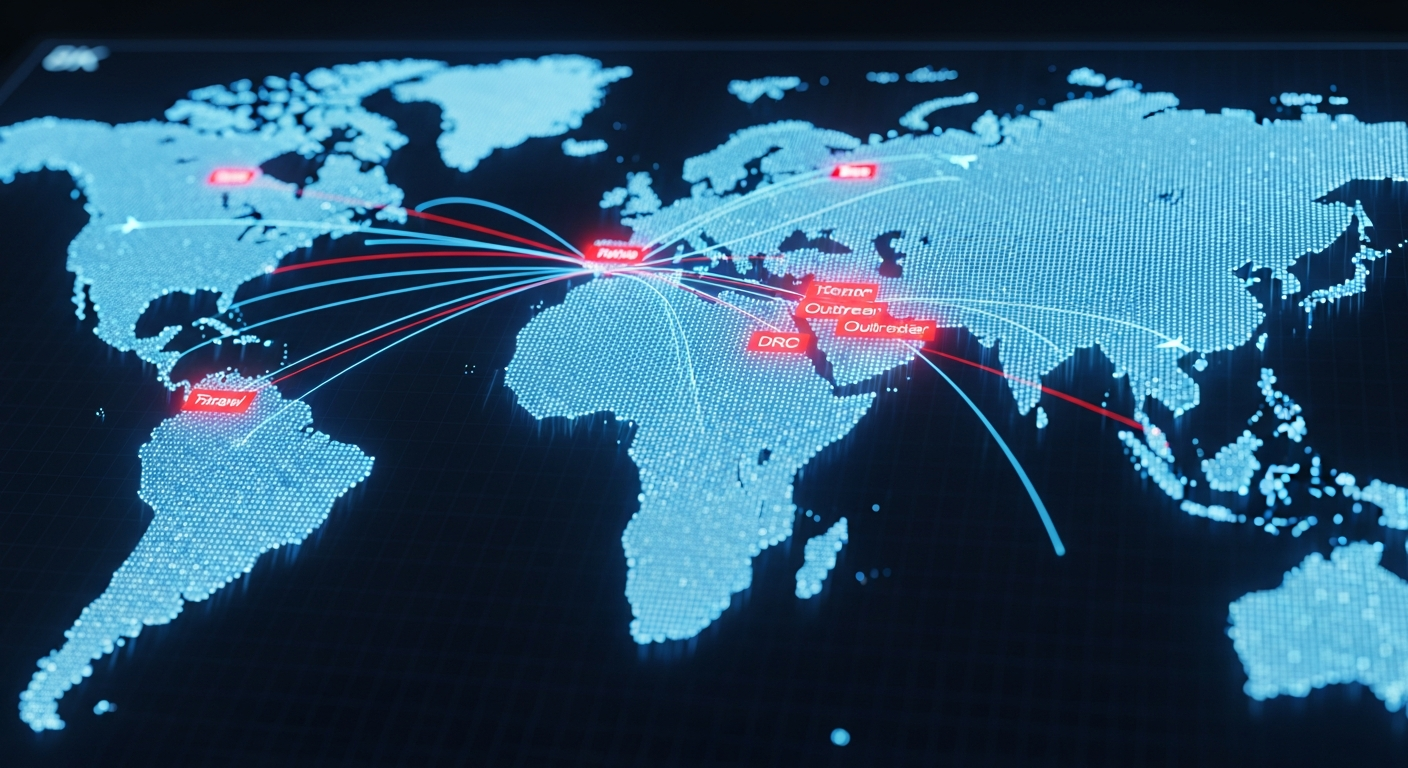
While the evacuation of American personnel dominates the headlines, the broader market and enterprise impact is unfolding on the ground in the DRC. The outbreak in the Ituri Province has rapidly escalated, with the World Health Organization (WHO) and the CDC tracking over 600 suspected cases and 139 deaths as of late May 2026. The pathogen responsible is the Bundibugyo ebolavirus, a rare strain for which there is currently no FDA-approved vaccine or specific therapeutic treatment.
In response, the UK and the US are rushing an experimental vaccine developed by Oxford University to the front lines. This triggers a massive deployment of Cold-Chain Logistics. mRNA and advanced viral vector vaccines require strict temperature controls, often necessitating ultra-low temperature (ULT) storage. Moving these assets into the conflict-ridden, infrastructure-poor regions of eastern DRC requires enterprise-grade IoT hardware. Logistics teams are deploying active cooling containers for air freight and phase-change material (PCM) portable freezers for the “last mile” delivery. These coolers are equipped with IoT data loggers utilizing satellite uplinks and LoRaWAN networks to transmit real-time temperature telemetry, ensuring the vaccines do not suffer temperature excursions that would render them inert.
Simultaneously, the WHO and the Africa Centres for Disease Control and Prevention (Africa CDC) are deploying advanced Epidemiological Data Modeling to track the spread of the virus. Software platforms like Go.Data are being used for field data collection, contact tracing, and the visualization of disease chains. In a region plagued by geopolitical instability, military rule, and porous borders, maintaining an accurate digital twin of the outbreak is the only way to allocate scarce medical resources effectively.
The Consumer Translation: Border Tech and Title 42
For the everyday consumer and the enterprise traveler, the most immediate impact of this outbreak is the sudden resurgence of pandemic-era border security technology. The Trump administration has invoked the Title 42 regulation, effectively barring entry to the United States for any non-US passport holders who have traveled through the DRC, Uganda, or South Sudan in the past 21 days.
At major US ports of entry, this policy translates into a rapid spin-up of health screening infrastructure. Thermal imaging arrays are being recalibrated to detect low-grade fevers in crowds, while biometric cross-referencing systems are pulling flight manifests to trace passenger origins through complex, multi-leg international itineraries. Digital health questionnaires and secondary screening protocols are creating friction in global travel networks.
However, the efficacy of these technological border walls is highly debated. Africa CDC Director General Jean Kaseya issued a stark warning regarding the US travel restrictions, stating that generalized border closures “can create fear, damage economies, discourage transparency, complicate humanitarian and health operations, and divert movement toward informal and unmonitored routes.” From a data perspective, Kaseya is entirely correct. When legal, monitored travel routes are closed, individuals utilize unmonitored routes, effectively breaking the data chain and blinding epidemiological surveillance networks. Global health security is achieved through data transparency and rapid response capacity at the source, not through the deployment of thermal cameras at JFK International Airport.
Red Team Audit: Deconstructing the “Rapid Mobilization” Narrative
When pressed on the decision to refuse entry to Ebola-exposed Americans, White House spokesperson Kush Desai attacked the media, while CDC incident response manager Satish Pillai dodged direct questions. Pillai eventually claimed that the European reroute was based on “the conditions on the ground” and the “need to rapidly mobilize.”
As an enterprise infrastructure analyst, this claim fails a basic Red Team audit. The United States government has spent the last decade—and hundreds of millions of taxpayer dollars—building and maintaining the National Ebola Training and Education Center (NETEC). The US possesses a robust network of Regional Emerging Special Pathogen Treatment Centers (RESPTCs). Facilities like Emory University Hospital in Atlanta and Nebraska Medicine in Omaha were specifically engineered, funded, and kept on permanent standby for this exact scenario. They possess the exact same, if not superior, biocontainment infrastructure as Charité in Berlin.
The logistical pivot to Europe was not a necessity born of infrastructure limitations or the need for “rapid mobilization.” In fact, coordinating with foreign governments to secure airspace and hospital beds in Germany and the Czech Republic likely introduced more logistical friction than flying the Gulfstream III directly to Atlanta. The decision was a top-down political firewall. The administration prioritized political optics and an isolationist border posture over utilizing its own highly capable, purpose-built domestic health infrastructure.
TechNode HQ Verdict: Pros, Cons & Usability
- Pro (Engineering): The successful deployment of the Aeromedical Biological Containment System (ABCS) at 40,000 feet proves that aerospace engineering can safely transport Level 4 pathogens without compromising the flight crew or the aircraft.
- Pro (Consumer): The rapid deployment of the experimental Oxford vaccine demonstrates that global health supply chains have learned from past pandemics, utilizing IoT cold-chain tracking to deliver therapeutics to the most remote regions on Earth.
- Con: The invocation of Title 42 travel restrictions creates a false sense of security, driving travelers to unmonitored routes and blinding the data models required for effective contact tracing.
- Con: The political refusal to utilize the US domestic biocontainment network sets a dangerous precedent, stranding enterprise and humanitarian workers abroad and wasting the billions invested in domestic health security infrastructure.
Enterprise Usability: For CTOs and logistics directors managing global supply chains or international personnel, this event is a stark reminder to audit your emergency extraction protocols. Do not assume your home country will allow medical repatriation during a bio-event. Enterprises must secure secondary medical evacuation insurance and establish contingency contracts with European or Asian biocontainment facilities.
Everyday Usability: Should the public panic about an Ebola outbreak in the US? Absolutely not. The Bundibugyo virus is not airborne; it requires direct contact with bodily fluids. The risk to the everyday consumer remains statistically near zero. However, international travelers should prepare for increased friction, thermal screenings, and potential delays at major border crossings as health surveillance tech is spun back up.
Sources & Citations:
Original Claim via: arstechnica
Official Handle: @arstechnica
Topics Explored: Bio-Surveillance, Cold-Chain Logistics, Aeromedical Evacuation, Health Tech, Border Security