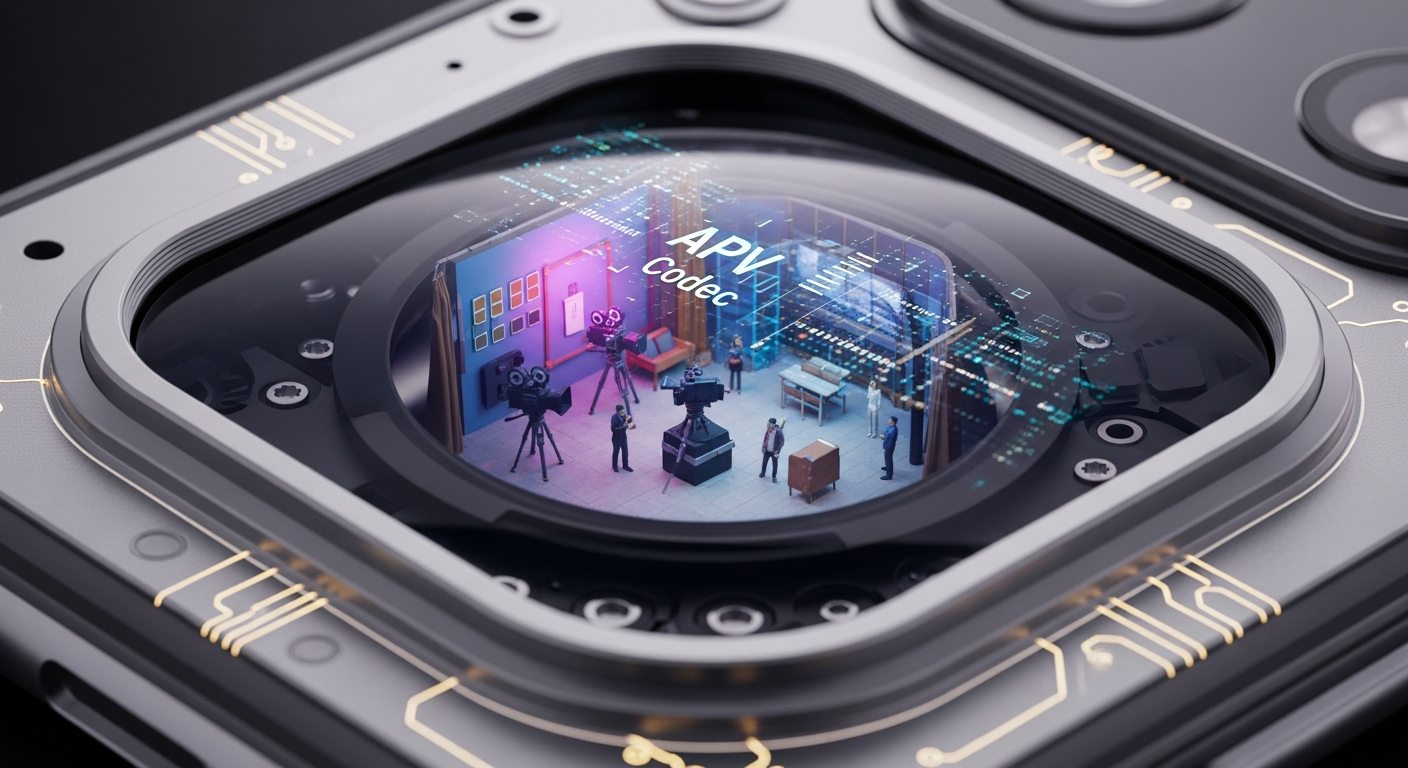
The mobile smartphone industry has spent the last decade locked in a relentless, often myopic specifications war. Manufacturers have chased higher megapixel counts and larger resolutions, pushing 4K, then 8K, onto sensors smaller than a postage stamp. Yet, despite these staggering numbers, mobile video has frequently retained a distinctly “digital” and clinical aesthetic—lacking the organic depth, dynamic range, and emotional resonance of true cinema. With the release of the Samsung Galaxy S26 Ultra, the paradigm is fundamentally shifting. The industry is pivoting from the pursuit of “high resolution” to the mastery of “high emotion.” At the core of this transformation is not a new lens or a larger sensor, but a radical overhaul of the underlying software architecture: the Advanced Professional Video (APV) codec and the integration of Cinematic Look-Up Tables (Cine LUTs).
This is not merely a consumer-facing software update; it is a foundational restructuring of how mobile devices process, compress, and render moving images. Developed independently by Samsung in collaboration with Qualcomm Technologies, Inc. and proposed as an open standard to the Internet Engineering Task Force (IETF), the APV codec represents a direct assault on the dominance of proprietary intermediate codecs like Apple ProRes. By prioritizing visually lossless, intra-frame compression and pairing it with real-time, professional-grade color grading developed alongside industry veterans U5K Imageworks, Samsung is democratizing the Hollywood aesthetic. In this comprehensive TechNode HQ deep-dive, we will dissect the engineering mechanics of the APV codec, analyze the silicon requirements that make it possible, and evaluate the broader market impact for both enterprise creators and everyday consumers.
The Architectural Reality: The Death of Inter-Frame Compromise
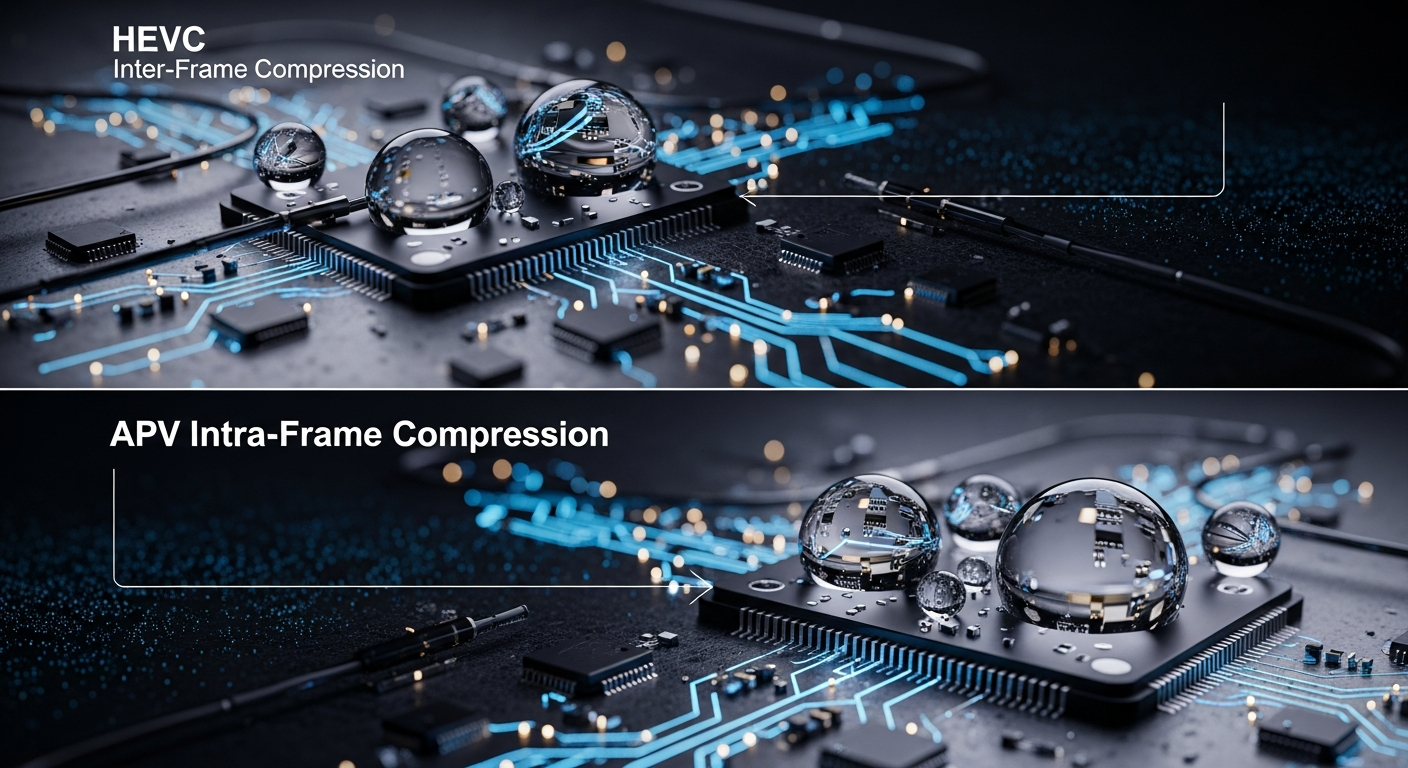
To understand the magnitude of the APV codec, one must first understand the compromises inherent in traditional mobile video compression. For years, the industry standard has been High-Efficiency Video Coding (HEVC), also known as H.265. HEVC is an engineering marvel designed for one primary purpose: distribution. It achieves remarkably small file sizes by utilizing inter-frame (or temporal) compression. Instead of saving every single frame as a complete image, HEVC saves a “keyframe” and then only records the pixels that change in the subsequent frames. While this is highly efficient for streaming a static talking-head video on YouTube, it catastrophically fails when confronted with complex, chaotic motion.
Consider a video of a water splash, falling snow, or a burst of confetti. Because almost every pixel is changing from frame to frame, the HEVC motion estimation algorithms become overwhelmed. To maintain the target bitrate, the codec is forced to aggressively discard high-frequency visual data. The result is macroblocking—the ugly, pixelated artifacts and blurred textures that instantly betray the footage as “shot on a smartphone”. Furthermore, because HEVC relies on predicting frames based on past and future data, it is a nightmare for Non-Linear Editors (NLEs) like Adobe Premiere Pro or DaVinci Resolve. The computer must constantly decode multiple frames just to display a single frame during timeline scrubbing, leading to sluggish performance and dropped frames.
The Advanced Professional Video (APV) codec fundamentally abandons this temporal compromise. APV is an intra-frame codec. This means that every single frame of the video is compressed and stored independently, as a complete, standalone image. There is no pixel domain prediction between frames. If you shoot a video at 60 frames per second, the APV codec is essentially capturing 60 high-resolution, visually lossless photographs every single second.
The technical specifications of APV are staggering. It utilizes block-based transforms and a highly optimized, lightweight entropy coding scheme to manage the immense data throughput required for intra-frame compression. The design emphasizes perceptual fidelity that is virtually indistinguishable from uncompressed RAW video. It supports resolutions up to 8K at 30 frames per second, and 4K at up to 120 frames per second,. More importantly, it supports advanced chroma subsampling formats ranging from 4:2:2 up to 4:4:4:4 (including alpha channel support), and bit depths from 10-bit to 16-bit per component.
For the professional editor, this intra-only design is a revelation. It allows for multiple re-encoding cycles—often referred to as “generation loss” in traditional codecs—with minimal cumulative degradation. Localized coding boundaries provide resilience against error propagation. When an editor drops an APV file onto a timeline, the CPU or GPU only needs to decode the specific frame being viewed, ensuring buttery-smooth scrubbing and predictable, low-latency performance. APV is not designed for uploading directly to social media; it is an “intermediate” or “mezzanine” codec, built specifically for the rigors of post-production.
Silicon Deep Dive: Hardware Acceleration on the Edge
The sheer mathematical complexity of encoding intra-frame, 10-bit 4:2:2 video at 8K resolution in real-time cannot be overstated. If a device were to attempt this using software-based encoding on a standard mobile CPU, the processor would instantly thermal throttle, the battery would drain in minutes, and the frame rate would plummet to single digits. The realization of the APV codec on a mobile device is entirely dependent on dedicated, purpose-built silicon.
Enter the Snapdragon 8 Elite Gen 5 for Galaxy. The integration of APV into the Galaxy S26 Ultra is the culmination of years of deep, silicon-level collaboration between Samsung and Qualcomm. To make APV a reality, Qualcomm had to design specific hardware encoding and decoding blocks within the System-on-Chip (SoC).
The architecture relies on a highly synchronized dance between the Image Signal Processor (ISP), the Neural Processing Unit (NPU), and the dedicated video encoding hardware. When light hits the Galaxy S26 Ultra’s sensor, the raw data is immediately ingested by the ISP. The ISP performs the initial demosaicing, noise reduction, and exposure adjustments. Simultaneously, the NPU analyzes the scene, applying advanced computational photography algorithms to optimize dynamic range and preserve highlight retention.
This pristine, uncompressed data stream is then handed off to the APV hardware encoder. Because APV utilizes a tile-based frame structure, the encoding process can be heavily parallelized. The Snapdragon 8 Elite Gen 5 distributes the workload across multiple cores, processing different spatial tiles of the same frame simultaneously. This parallel processing architecture is what allows the device to maintain real-time encoding at bitrates that can reach several gigabits per second.
However, this massive data throughput introduces a new bottleneck: storage bandwidth and thermal management. The Galaxy S26 Ultra supports two primary APV profiles: APV 422 HQ (High Quality) and APV 422 LQ (Low Quality). Even at the LQ setting, a 1080p video at 30 frames per second consumes approximately 0.75 gigabytes per minute. At 8K resolution, the data rates are astronomical. To mitigate this, Samsung has engineered the device to support direct recording to external USB-C Solid State Drives (SSDs). By bypassing the internal UFS storage, the device can sustain the necessary write speeds for prolonged professional shoots. Furthermore, offloading the thermal load of the storage medium to an external drive helps the Galaxy S26 Ultra’s internal vapor chamber cooling system focus entirely on dissipating the heat generated by the SoC.
Color Science: The Mathematics of Cinematic LUTs
While the APV codec provides the mathematically lossless foundation, the emotional resonance of a video is dictated by its color science. For decades, mobile video has been constrained by the Rec.709 color space and standard 8-bit color depth, which allows for roughly 16.7 million colors. While this sounds like a lot, it frequently results in harsh highlight clipping, crushed shadows, and unnatural skin tones—the hallmarks of the “smartphone look.”
The Galaxy S26 Ultra shatters this limitation by recording APV in 10-bit color depth, expanding the palette to over 1 billion colors. This exponential increase in data allows for incredibly smooth tonal transitions, eliminating the ugly color banding often seen in gradients like a clear blue sky. Furthermore, the move from 4:2:0 to 4:2:2 chroma subsampling means the device is capturing twice as much color information horizontally. This is a critical requirement for professional post-production, particularly for green screen keying and aggressive color grading, where edge artifacts can ruin a shot.
To harness this massive color data, Samsung introduced Samsung Log. A Log (logarithmic) gamma curve is a flat, desaturated color profile designed to maximize the dynamic range captured by the sensor. By intentionally flattening the image, Samsung Log preserves the maximum amount of detail in both the brightest highlights and the darkest shadows. However, Log footage looks terrible straight out of the camera—it requires a Look-Up Table (LUT) to translate the flat data into a final, cinematic image.
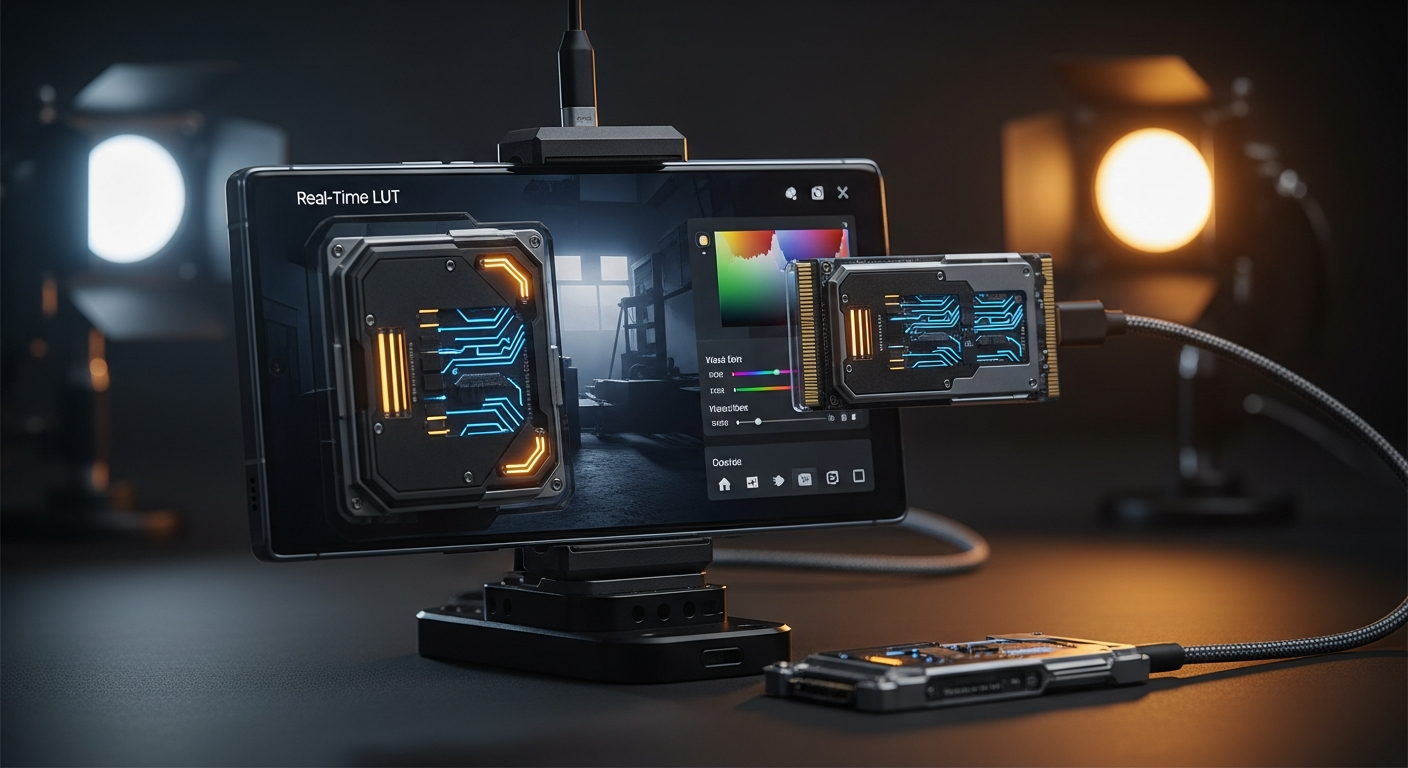
A LUT is essentially a complex mathematical matrix. It maps one set of input colors to a specific set of output colors, allowing creators to apply highly specific, stylized color grades. In the past, applying a LUT was strictly a post-production task. With the Galaxy S26 Ultra, Samsung has introduced the Cinematic LUT (Cine LUT) feature, allowing users to apply and preview professional color grades in real-time while recording.
This is a monumental feat of engineering. The device is taking the raw, 10-bit Log sensor data, running it through a complex 3D LUT matrix, and displaying the fully graded image on the viewfinder at 60 frames per second, all while simultaneously encoding the underlying flat Log data into the APV codec. To ensure the aesthetic quality of these LUTs, Samsung partnered with U5K Imageworks, a globally recognized colorist studio responsible for major motion picture grades. Unlike standard social media filters that simply overlay a translucent color tint, these Cine LUTs fundamentally reinterpret the Log data, reconstructing color and brightness to deliver the authentic depth, contrast, and tonal roll-off of professional analog film stocks.
Market Impact & Deployment: The Economics of Open Standards
The introduction of the APV codec is not merely a technical milestone; it is a calculated strategic maneuver designed to disrupt the professional video ecosystem. For over a decade, Apple’s ProRes has been the undisputed king of intermediate codecs. While ProRes is exceptional, it is a proprietary format tightly controlled by Apple. Camera manufacturers and software developers must pay licensing fees to implement it, and the files are notoriously massive.
Samsung’s APV codec is a direct challenge to this hegemony. By developing APV as an open-source, royalty-free standard and proposing it to the Internet Engineering Task Force (IETF), Samsung is inviting the entire industry to adopt it without financial penalty. This open-standard approach ensures compatibility across major multimedia frameworks, including FFmpeg, and guarantees that NLEs like Premiere Pro, Final Cut Pro, and DaVinci Resolve can integrate native support rapidly.
From an enterprise perspective, the Total Cost of Ownership (TCO) for media organizations and production houses is a critical factor. Storage is one of the most significant recurring expenses in video production. Samsung claims that the APV codec delivers roughly 10% to 20% more efficient compression compared to Apple ProRes at the exact same objective visual quality. When dealing with petabytes of archival footage, a 20% reduction in storage requirements translates to massive financial savings in server costs, cloud storage fees, and data transfer bandwidth.
Furthermore, the ability to record directly to external USB-C drives transforms the Galaxy S26 Ultra from a consumer smartphone into a legitimate B-camera for professional productions. A Director of Photography can rig the phone to a gimbal, plug in a 2TB portable SSD, shoot an entire scene in APV Log, and immediately hand the drive to an editor. There is no need to wait for agonizingly slow wireless transfers or proprietary cable offloads. This frictionless workflow drastically reduces on-set downtime and accelerates the post-production pipeline.
The Consumer Translation: High Emotion Over High Resolution
While the underlying mathematics of the APV codec and 10-bit Log gamma curves are highly technical, the consumer translation is remarkably simple: the democratization of the Hollywood aesthetic. For the average user, the specifications war has reached a point of diminishing returns. A consumer cannot easily distinguish between a 4K and an 8K video on a 6-inch smartphone screen. However, every human being can instantly recognize the emotional difference between a harsh, over-sharpened digital video and a soft, beautifully graded cinematic film.
The Galaxy S26 Ultra shifts the focus from capturing pixels to capturing mood. The integration of Cine LUTs directly into the native camera app, and subsequently into the Gallery app for post-capture editing, removes the intimidation factor of professional color grading. An indie filmmaker, a wedding videographer, or a travel vlogger no longer needs to spend hours tweaking color wheels and tracking nodes in complex desktop software. They can select a U5K Imageworks-designed LUT, see the cinematic result in real-time on their screen, and capture the emotion of the moment instantly,.
This represents a fundamental shift in user experience. By handling the immense computational heavy lifting in the background—compressing visually lossless intra-frame data, applying complex 3D color matrices, and managing thermal loads—Samsung has allowed the user to focus entirely on composition, lighting, and storytelling. The technology becomes invisible, leaving only the art. The era of the clinical, hyper-sharp smartphone video is ending; the era of mobile cinematography has truly arrived.
TechNode HQ Verdict: Pros, Cons & Usability
- Pro (Engineering): The APV codec’s intra-frame, visually lossless compression eliminates temporal macroblocking, providing a 10-20% storage efficiency advantage over Apple ProRes while maintaining pristine 10-bit 4:2:2 color data,.
- Pro (Consumer): Real-time Cinematic LUTs, developed with U5K Imageworks, allow everyday users to capture Hollywood-grade color science instantly, bypassing the steep learning curve of desktop post-production software,.
- Con: Despite efficiency gains, APV file sizes remain astronomically large (up to 1GB per minute at 1080p HQ), necessitating the purchase of external USB-C SSDs for any meaningful prolonged recording.
- Con: Playback and editing currently rely heavily on the hardware decoding capabilities of the Snapdragon 8 Elite Gen 5; sharing raw APV files with older devices will result in severe software-decoding stutter and missing thumbnails.
Enterprise Usability: For CTOs of media organizations and production houses, the Galaxy S26 Ultra is a highly viable, cost-effective B-camera. The open-source nature of APV reduces licensing friction, while the 20% storage efficiency over ProRes significantly lowers long-term data archiving costs. Deploy immediately for agile, on-location shoots.
Everyday Usability: For the general public, the APV codec is overkill and will rapidly deplete internal storage. However, prosumers, vloggers, and indie filmmakers should absolutely invest in this ecosystem. The ability to shoot Log and apply real-time Cine LUTs fundamentally elevates the aesthetic quality of mobile content.
Sources & Citations:
Original Claim via: news
Official Handle: @news
Topics Explored: APV Codec, Galaxy S26 Ultra, Mobile Cinematography, Snapdragon 8 Elite Gen 5, Apple ProRes