The Architectural Shift: From Mobile Liabilities to Stationary Assets

The automotive industry is currently executing one of the most aggressive, high-stakes pivots in the history of modern manufacturing. For the better part of a decade, the narrative out of Detroit, Stuttgart, and Tokyo was singular: the future is electric, and the internal combustion engine is dead. Billions of dollars in capital expenditure were deployed to construct sprawling gigafactories, secure rare-earth mineral supply chains, and retool century-old assembly lines. Yet, as consumer demand for Electric Vehicles (EVs) plateaued—stifled by high interest rates, range anxiety, and inadequate public charging infrastructure—automakers found themselves staring down the barrel of catastrophic financial losses. Ford alone took a staggering $19.5 billion write-down on its EV programs late last year. But salvation has arrived from an unlikely savior: the artificial intelligence boom.
To understand the magnitude of this pivot, one must look past the marketing veneer of “synergy” and examine the underlying electrochemical and architectural realities. Automakers are transitioning from manufacturing mobile energy assets (cars) to stationary energy assets—specifically, Battery Energy Storage Systems (BESS). Ford’s recent announcement of “Ford Energy,” a subsidiary dedicated to selling BESS to utilities, industrial clients, and data centers, is the canary in the coal mine. By repurposing a Glendale, Kentucky plant originally slated for EV batteries, Ford is fundamentally altering its identity. They are no longer just building vehicles; they are building the critical power infrastructure required to sustain the AI revolution.
From an engineering perspective, the shift from EV batteries to BESS requires a complete recalibration of battery chemistry and pack architecture. Electric vehicles demand high energy density by weight and volume; every extra pound reduces the vehicle’s range. Consequently, automakers have historically relied on Nickel Manganese Cobalt (NMC) or Nickel Cobalt Aluminum (NCA) chemistries. These cells are highly volatile, expensive, and reliant on fraught geopolitical supply chains, but they deliver the necessary punch to accelerate a 5,000-pound truck to 60 mph in four seconds. Stationary storage, however, operates under entirely different physical constraints. A BESS installation sitting outside a hyperscale data center does not care about weight. It cares about thermal stability, cycle life, and cost per kilowatt-hour. This allows automakers to pivot their retooled factories toward Lithium Iron Phosphate (LFP) chemistry. LFP is heavier and less energy-dense, but it is vastly cheaper, degrades much slower over thousands of charge-discharge cycles, and is virtually immune to the thermal runaway (fires) that plague NMC batteries.
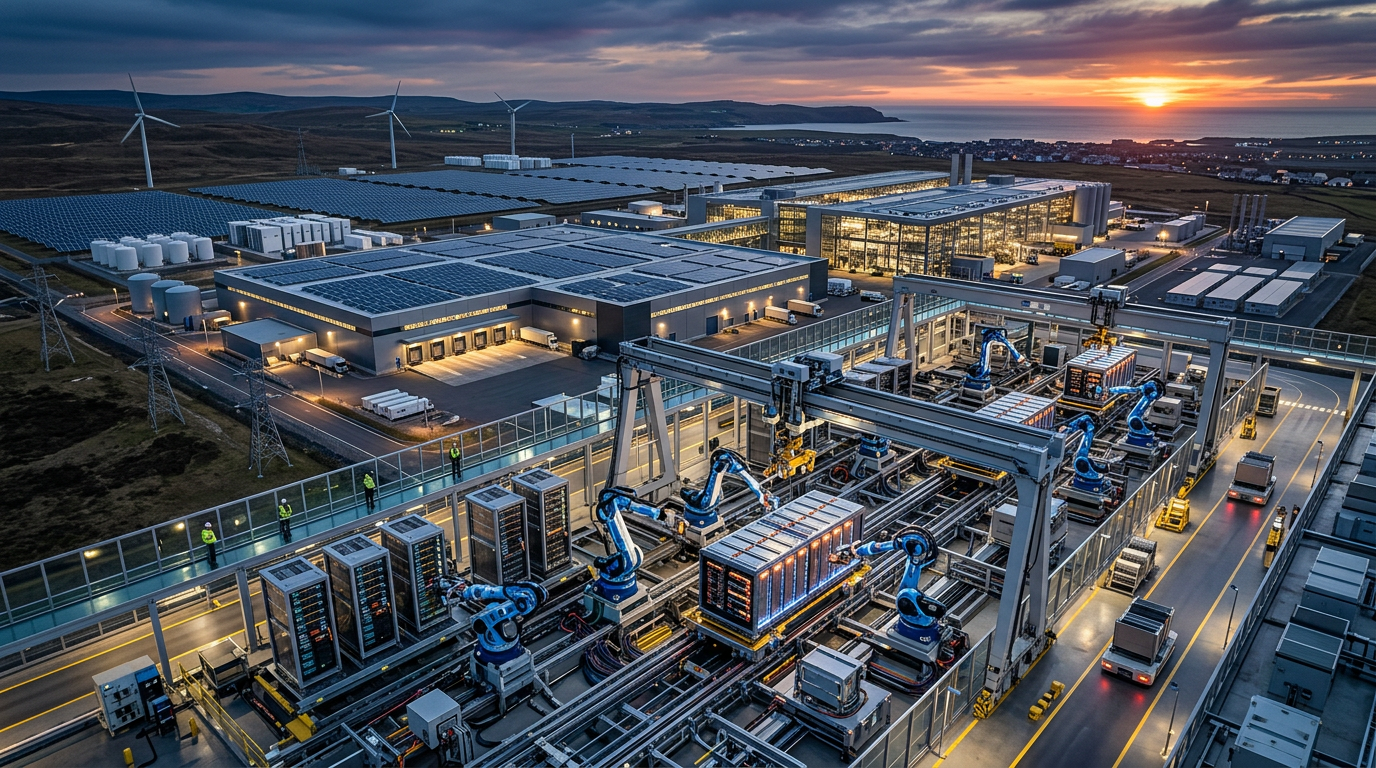
The scale of this architectural shift is staggering. According to BloombergNEF, 11 battery cell manufacturing plants globally are currently being retooled for energy storage, with eight of those located in the United States. General Motors is partnering with Redwood Materials and LG Energy Solution to repurpose a massive Tennessee facility. Stellantis, in collaboration with Samsung SDI, has already begun pivoting production lines in Kokomo, Indiana. Tesla, the undisputed elder statesman of this space, is expanding its Megapack production with a new dedicated facility in Houston. These are not minor adjustments to product lines; these are multi-billion-dollar architectural overhauls designed to transform stranded EV manufacturing assets into highly profitable, enterprise-grade energy foundries.
Enterprise Market Impact & TCO: Powering the AI Hyperscalers
The enterprise IT landscape is currently facing an existential crisis, and it has nothing to do with software. It is a crisis of physics and thermodynamics. The proliferation of Generative AI and Large Language Models (LLMs) has triggered an unprecedented arms race in data center construction. A single NVIDIA H100 GPU consumes roughly 700 watts of power under peak load. When hyperscalers like Microsoft, Meta, Amazon, and Google deploy clusters of 100,000 GPUs to train next-generation models, the power draw is astronomical. We are no longer talking about megawatts; we are talking about gigawatts. Traditional power grids, reliant on aging infrastructure and slow-to-deploy natural gas peaker plants, simply cannot handle the localized, massive power spikes generated by AI training workloads.
This is where the automakers’ pivot to BESS becomes a masterstroke of enterprise market timing. Data centers require absolute, uninterrupted power. A millisecond drop in voltage can corrupt petabytes of training data and cost millions of dollars in lost compute time. Historically, data centers relied on diesel generators and traditional lead-acid Uninterruptible Power Supplies (UPS) for backup. Today, the sheer scale of AI workloads renders these legacy solutions obsolete. Automaker-produced BESS units—massive, containerized lithium-ion arrays—serve as the ultimate enterprise power buffer. They sit between the volatile public grid and the hyper-sensitive server racks, providing instantaneous frequency regulation, voltage smoothing, and seamless failover power.
But the Total Cost of Ownership (TCO) benefits for enterprise IT extend far beyond mere backup power. The true financial magic of BESS lies in “peak shaving” and “load shifting.” Utility companies charge commercial and industrial customers based on their peak demand—the maximum amount of power drawn at any single moment during a billing cycle. Because AI data centers have highly variable power draws depending on the intensity of the compute workload, their peak demand charges can be astronomical. By deploying a massive BESS installation, a data center can draw power from the grid during off-peak hours (when electricity is cheap) to charge the batteries. When the AI cluster spins up to maximum capacity during peak hours, the facility draws power from the BESS rather than the grid, effectively “shaving” the peak and saving millions of dollars annually in utility penalties.
Furthermore, the financial viability of this pivot is heavily subsidized by the federal government. While recent GOP-led legislation has aggressively targeted and reduced tax credits for consumer EV purchases, the Inflation Reduction Act (IRA) continues to offer massive, uncapped Investment Tax Credits (ITC) for commercial battery storage projects. Automakers are reading the regulatory tea leaves. Why fight a grueling, low-margin battle to convince skeptical consumers to buy $60,000 electric SUVs when you can sell $2 million BESS installations to desperate hyperscalers, all while the federal government subsidizes a massive percentage of the capital expenditure? For Ford, GM, and Stellantis, the enterprise BESS market offers high margins, predictable B2B sales cycles, and a captive audience of tech giants who literally cannot build data centers fast enough.
The Consumer Reality: What This Means for You
While the enterprise IT sector celebrates the arrival of massive new battery supply chains, the everyday consumer is left navigating a deeply altered automotive landscape. The most immediate impact of this pivot is the quiet death of the “affordable EV revolution.” For years, consumers were promised that economies of scale would eventually drive the price of electric vehicles down to parity with internal combustion engine (ICE) cars. That timeline has now been indefinitely delayed. As automakers divert their battery manufacturing capacity away from vehicles and toward enterprise BESS, the supply of EVs will remain constrained, keeping prices artificially high. Instead of a rapid transition to full electrification, consumers will see a massive resurgence in hybrid vehicles—a compromise that allows automakers to meet emissions regulations while utilizing significantly smaller battery packs.
However, the consumer reality is not entirely bleak; the benefits are simply shifting from the driveway to the fuse box. The most profound impact of the automakers’ pivot to energy storage will be felt in the stability of the public power grid. In regions like California and Texas, where aging grid infrastructure routinely buckles under the strain of extreme weather and high demand, rolling blackouts have become a grim reality of modern life. As utilities purchase massive BESS installations from Ford Energy and GM to stabilize their networks, the average consumer will experience fewer brownouts and a more resilient local grid. These battery systems can store excess solar and wind energy generated during the day and discharge it during the evening peak, effectively smoothing out the volatile nature of renewable energy.
Moreover, the industrialization of BESS manufacturing by automotive giants will inevitably democratize residential energy storage. Currently, home battery systems like the Tesla Powerwall are luxury items, costing upwards of $10,000 fully installed. They are status symbols for affluent homeowners looking to maximize their rooftop solar panels. But as Ford, GM, and Stellantis achieve massive economies of scale in their retooled gigafactories, the cost per kilowatt-hour of LFP battery cells will plummet. Within the next five to seven years, we can expect to see a flood of affordable, automaker-branded home energy storage solutions hitting the consumer market. Imagine a future where a Ford-branded home battery system comes standard with the purchase of a new home, seamlessly integrating with the local grid to lower monthly utility bills and provide days of backup power during a storm. The EV revolution may be stalling, but the home energy revolution is just beginning.
There is also a deeply cynical, yet highly logical, consumer dynamic at play here. As Gil Tal, director of the EV Research Center at UC Davis, astutely points out, automakers prefer the BESS market because it does not cannibalize their core business. Selling an EV means *not* selling a highly profitable, gas-powered F-150 or Chevy Silverado. Selling a battery storage system to a data center, however, is purely additive revenue. It allows Detroit to continue churning out the high-margin, gas-guzzling trucks and SUVs that American consumers still overwhelmingly prefer, without having to write off the billions they invested in battery technology. For the consumer who still wants a V8 engine, this pivot ensures those vehicles aren’t going anywhere anytime soon.
The Industry Ripple Effect: Geopolitics and Grid Monopolies
The decision by US automakers to pivot toward enterprise energy storage sends massive shockwaves through the global supply chain, altering the geopolitical balance of power and threatening legacy utility monopolies. At the center of this ripple effect is the complex, often contentious relationship between American manufacturing and Chinese intellectual property. Despite the political rhetoric surrounding “all-American” supply chains, the reality is that China currently holds a near-monopoly on the refining of battery minerals and the manufacturing of LFP battery cells. Ford’s BESS ambitions are heavily reliant on a controversial licensing agreement with CATL (Contemporary Amperex Technology Co. Limited), the Chinese battery behemoth. By licensing CATL’s technology rather than forming a traditional joint venture, Ford is attempting to thread a delicate geopolitical needle—utilizing superior Chinese battery chemistry while still qualifying for US federal tax subsidies and avoiding the ire of hawkish lawmakers.
This reliance on foreign technology underscores a critical vulnerability in the US enterprise infrastructure strategy. If the AI revolution is entirely dependent on data centers, and those data centers are entirely dependent on BESS to function, and those BESS units are reliant on Chinese intellectual property, the national security implications are profound. The US government is pouring billions into domestic semiconductor manufacturing via the CHIPS Act to secure the AI hardware supply chain, but the *power* supply chain remains deeply tethered to foreign adversaries. Automakers entering the BESS space will be under immense pressure from the Department of Defense and the Department of Energy to rapidly domesticate the entire lifecycle of these batteries, from lithium extraction to final cell assembly.
Beyond geopolitics, the entry of Big Auto into the energy sector poses a massive existential threat to pure-play energy companies and traditional utility monopolies. For a century, utility companies have operated as unchallenged regional monopolies, dictating the terms of power generation and distribution. Now, companies like Ford and Tesla are essentially becoming decentralized power brokers. By deploying gigawatt-hours of storage across data centers, industrial parks, and residential neighborhoods, these automakers are creating “Virtual Power Plants” (VPPs). A VPP aggregates thousands of distributed battery systems and orchestrates them via software to act as a single, massive power plant. When the grid is stressed, Tesla or Ford can command their network of batteries to discharge power back into the grid, effectively competing directly with traditional natural gas peaker plants.
This forces traditional energy companies into a defensive posture. They must now decide whether to partner with the automakers—purchasing their BESS units to modernize their own aging grids—or attempt to compete with them by developing proprietary storage solutions. Given the massive manufacturing head start and capital resources of the automotive industry, most utilities will be forced into submission, becoming mere distribution pipes for energy that is stored, managed, and monetized by Detroit and Silicon Valley. The lines between the automotive sector, the enterprise IT sector, and the energy sector have been permanently erased. We are witnessing the birth of the “Energy-Compute-Mobility” complex, a new industrial paradigm where the company that controls the battery controls the future of the economy.
TechNode HQ Verdict: Pros, Cons & Usability
- Pro (Engineering): The shift to LFP chemistry for stationary BESS eliminates the thermal runaway risks associated with NMC EV batteries, providing enterprise data centers with highly stable, ultra-long-cycle-life power buffering capable of handling massive AI compute spikes.
- Pro (Consumer): The industrialization of battery manufacturing for the enterprise sector will rapidly drive down the cost per kWh, eventually democratizing residential energy storage and protecting homeowners from grid instability and rolling blackouts.
- Con: The pivot is heavily reliant on licensing intellectual property from Chinese battery giants like CATL, creating a severe geopolitical bottleneck and potential national security vulnerability for critical US AI infrastructure.
- Con: Repurposing gigafactories from mobile to stationary storage indefinitely delays the promised price parity of EVs, forcing consumers to rely on legacy internal combustion engines and hybrid stopgaps for the foreseeable future.
Enterprise Usability: For CTOs and Data Center Architects, integrating automaker-supplied BESS is no longer optional; it is a critical requirement for survival in the AI era. Hyperscale deployments should immediately factor BESS into their Total Cost of Ownership (TCO) models to leverage peak shaving, load shifting, and IRA tax credits. Relying solely on the public grid or legacy diesel UPS for 100+ megawatt GPU clusters is a recipe for catastrophic downtime and exorbitant utility penalties.
Everyday Usability: For the general public, this pivot signals a time to recalibrate expectations. If you are in the market for a vehicle, the “cheap EV” is a mirage; pivot your purchasing strategy toward high-efficiency hybrids. However, if you are a homeowner, hold off on purchasing premium residential battery storage for the next 24-36 months. As Ford, GM, and Stellantis flood the market with retooled BESS capacity, the cost of home energy storage will plummet, making whole-home backup a standard, affordable utility rather than a luxury add-on.
Sources & Citations:
Original Technical Breakdown via: wired
Official Handle: @wired
Topics Explored: Battery Energy Storage Systems, AI Data Centers, Enterprise Infrastructure, Grid Modernization, EV Market Pivot