The Architectural Shift: Silicon, Pixels, and the Sub-50-Inch Renaissance
For the better part of a decade, the technology industry has treated the sub-50-inch television market as an afterthought—a dumping ground for aging LCD panels, underpowered silicon, and stripped-down operating systems. However, as we analyze the hardware landscape of 2026, a profound architectural shift has occurred. The 40-inch to 43-inch display category is no longer just a budget-friendly consumer compromise; it has evolved into a highly dense, technologically sophisticated endpoint that bridges the gap between traditional home entertainment, high-end PC monitors, and enterprise digital signage.
To understand this shift, we must examine the underlying silicon and panel architecture. In the 42-inch and 43-inch form factors, pushing a 4K resolution (3840 x 2160) results in a pixel density of approximately 105 Pixels Per Inch (PPI). This specific density is the critical threshold where a television ceases to be a mere “living room screen” and becomes viable as a near-field monitor for complex data visualization, coding, and enterprise dashboarding. The LG C5 OLED 42-inch is the vanguard of this movement. By shrinking its self-lit pixel technology down to 42 inches, LG has created a display that offers infinite contrast ratios and a native 120Hz refresh rate. The thermal management required to drive a high-brightness OLED panel at this density without catastrophic burn-in is a marvel of modern engineering, utilizing advanced algorithmic pixel-shifting and localized dimming zones controlled by a dedicated AI processor.
But the architectural revolution isn’t limited to premium OLEDs. The commoditization of Quantum Dot technology (QLED) has fundamentally altered the baseline of display hardware. The Hisense QD6 43-inch, retailing at a staggering $200, utilizes a QLED panel that would have cost over $1,500 just five years ago. By placing a layer of quantum dots—nanocrystals that emit specific spectrums of light when excited by a backlight—between the LED array and the LCD matrix, manufacturers are achieving color volumes and peak brightness levels that satisfy stringent Dolby Vision HDR standards. Furthermore, the System-on-Chip (SoC) integration in these devices has reached a point of maturity where real-time AI upscaling, Dolby Atmos decoding, and seamless AirPlay casting are handled natively, without thermal throttling or interface lag.
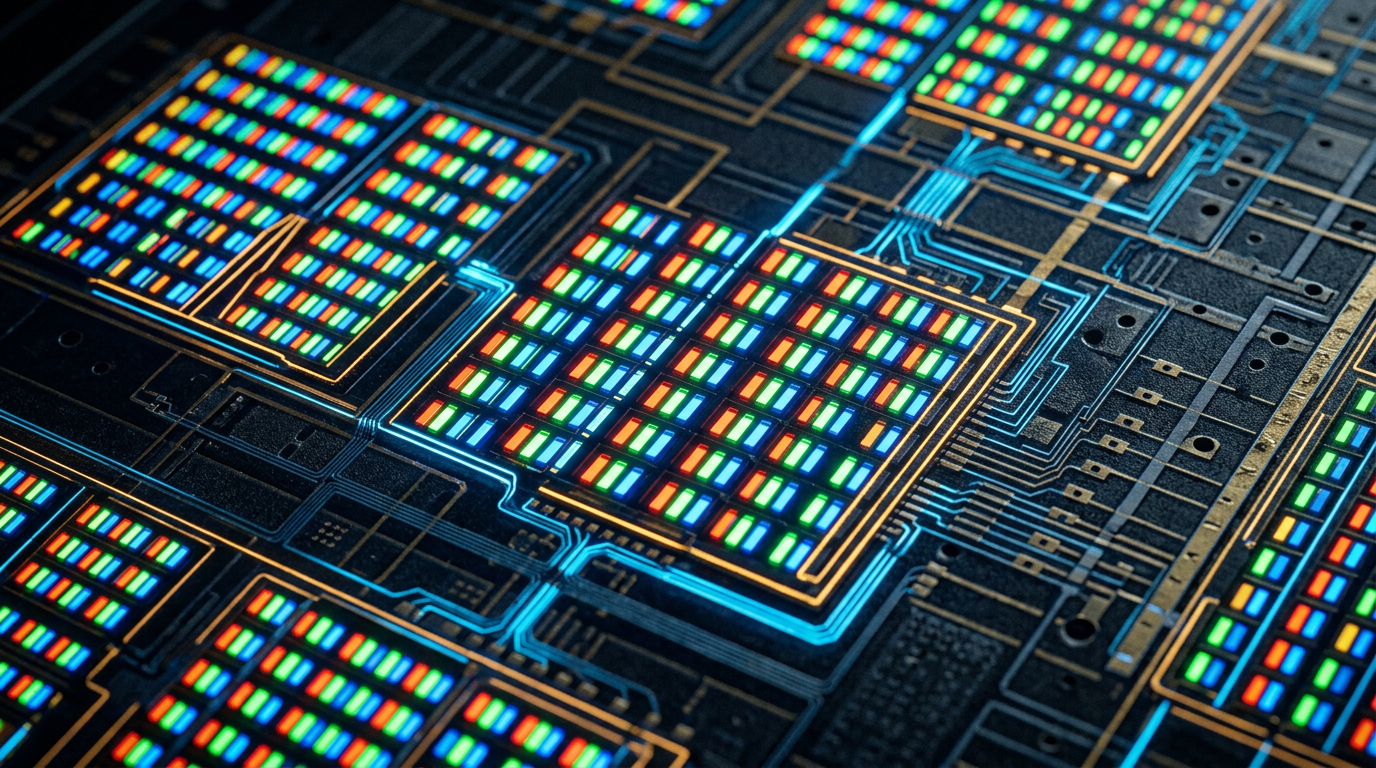
Looking ahead, the underlying physics of display backlighting are undergoing a seismic change. As revealed at CES 2026, the industry is rapidly pivoting away from traditional white LED backlights (which rely on inefficient color filters) toward true RGB backlighting. This transition will effectively eliminate the color filter bottleneck, resulting in displays that are significantly thinner, drastically more energy-efficient, and capable of rendering the full Rec. 2020 color space. When this technology trickles down to the 40-inch class, it will redefine the boundaries of micro-display capabilities.
Enterprise Market Impact & TCO (Total Cost of Ownership)
While consumer tech publications focus on how these screens fit into dorm rooms and bedrooms, the true paradigm shift is happening in the enterprise sector. Chief Technology Officers (CTOs) and IT procurement managers are increasingly looking at the 40-inch consumer television market as a highly lucrative alternative to traditional, overpriced commercial displays. The Total Cost of Ownership (TCO) calculations have shifted dramatically in favor of consumer-grade hardware.
Consider a standard enterprise deployment: a corporate campus requiring 300 displays for huddle rooms, digital signage, cafeteria menus, and edge computing data dashboards. Historically, an enterprise would purchase commercial-grade monitors costing anywhere from $800 to $1,200 per unit, citing the need for 24/7 reliability and RS-232 serial control. Today, a model like the Samsung U7900 43-inch ($228) or the Sony Bravia 2 II 43-inch ($400) offers 4K resolution, HDR10+ support, and robust Wi-Fi 6 connectivity at a fraction of the CapEx (Capital Expenditure).
The math is undeniable. Deploying 300 Hisense QD6 units at $200 each results in a hardware CapEx of $60,000. Deploying 300 traditional commercial displays at $1,000 each results in a CapEx of $300,000. The $240,000 savings can be reallocated to core infrastructure, cloud compute, or cybersecurity. Even if the consumer-grade panels have a slightly higher failure rate under 24/7 operation, the replacement cost is so negligible that the enterprise still comes out massively ahead.
However, this hardware arbitrage introduces complex OpEx (Operational Expenditure) and deployment challenges. Consumer TVs are bundled with consumer operating systems—Google TV, Fire TV, and Tizen. These OS platforms are designed to harvest user data, serve advertisements, and connect to consumer IoT ecosystems. For an enterprise, deploying a fleet of Fire TV-powered TCL Q35F screens requires rigorous Mobile Device Management (MDM) and network segmentation. IT departments must isolate these displays on dedicated VLANs, strip out the consumer bloatware via network-level DNS sinkholing (like Pi-hole or enterprise firewalls), and utilize the screens purely as “dumb” endpoints for casting or HDMI input. Despite these integration hurdles, the sheer hardware value makes the 40-inch smart TV an irresistible asset for modern enterprise infrastructure.
The Consumer Reality: What This Means for You
For the everyday consumer, the 2026 lineup of 40-inch televisions represents the ultimate democratization of high-end audio-visual technology. The line between a “television” and a “computer monitor” has been entirely erased. If you are building a home office, outfitting a small apartment, or setting up a dedicated gaming station, you no longer have to choose between a small, expensive PC monitor and a large, pixelated TV.
The Sony Bravia 2 II stands out as the quintessential hybrid device. At $400, it provides exclusive Variable Refresh Rate (VRR) support tailored specifically for the PlayStation 5. VRR is a critical technology that allows the display to dynamically adjust its refresh rate to match the frame rate output of the console or PC, eliminating screen tearing and micro-stuttering. In previous generations, this feature was locked behind $1,500 flagship models. Now, it is available in a 43-inch form factor that fits comfortably on a standard desk.
Furthermore, the integration of smart home ecosystems has transformed these screens into central command hubs. The Samsung U7900’s native integration with the SmartThings app, and the Hisense QD6’s support for Apple AirPlay and Alexa, mean that your television is now the visual interface for your entire home network. You can monitor security cameras, adjust smart thermostats, and control lighting directly from a $200 screen.
Yet, consumers must navigate the marketing fluff that inevitably accompanies budget hardware. Features like Samsung’s “Object Tracking Sound Lite” or Insignia’s “DTS Virtual:X” are software-based psychoacoustic tricks designed to simulate surround sound using standard down-firing stereo speakers. While clever, they cannot defy the laws of physics; true spatial audio still requires dedicated soundbars or multi-channel speaker setups. Additionally, while 60Hz is marketed as providing “smoother motion,” consumers should recognize that in 2026, 60Hz is the absolute bare minimum baseline. If you are a competitive gamer or a prosumer seeking true fluidity, the 120Hz panel of the $999 LG C5 OLED is the only uncompromising choice in this size bracket.
The Industry Ripple Effect: The Fall of Titans and the Rise of New Architectures
Beyond the individual product specifications, the 2026 display market is defined by a tectonic shift in global manufacturing and brand consolidation. Buried beneath the consumer reviews is the most consequential industry news of the decade: In January 2026, Sony entered a tentative agreement to sell a majority stake in its legendary Bravia TV brand to TCL, with co-owned models expected to hit the market in 2027.
This is a watershed moment in the history of consumer electronics. Sony, the Japanese pioneer that practically invented the premium television market with the Trinitron, is effectively bowing out of the hardware manufacturing arms race. By selling to TCL—a Chinese manufacturing juggernaut with massive vertical integration through its panel subsidiary, CSOT (China Star Optoelectronics Technology)—Sony is acknowledging that hardware margins have raced to the bottom. The future of Sony lies in software, image processing algorithms, and content distribution, while TCL will control the physical silicon and glass. This consolidation will likely force competitors like Samsung and LG to aggressively rethink their supply chains to compete with the sheer scale and cost-efficiency of the new TCL-Sony conglomerate.
Simultaneously, the physical form factor of the television is being deconstructed. At CES 2026, LG showcased the W6 Wallpaper TV, a display measuring an incomprehensible 9mm in thickness. LG achieved this by removing the SoC, power supply, and I/O ports from the display chassis entirely, relocating them to a wireless “Zero Connect Box.” This decoupling of the screen from the compute module represents the future of enterprise and consumer displays. It allows for seamless wall mounting and modular upgrades—if the processor becomes outdated, you simply replace the box, not the glass.
Meanwhile, Samsung’s S95H took home CES awards for solving the final bottleneck of OLED technology: burn-in. By utilizing a new all-metal chassis for extreme thermal dissipation and advanced pixel-refresh algorithms, Samsung guarantees the ability to display static artwork (or enterprise dashboards) indefinitely without image retention. As these flagship innovations—wireless compute modules, burn-in immunity, and RGB backlighting—trickle down to the 40-inch market over the next two years, the micro-display category will become the most dynamic sector in the hardware industry.
TechNode HQ Verdict: Pros, Cons & Usability
- Pro (Engineering): The integration of high-density 4K (105 PPI) and OLED/QLED technology in the 40-43 inch form factor provides near-field monitor capabilities with infinite contrast and precise localized dimming.
- Pro (Consumer): Unprecedented democratization of flagship features; consumers can now acquire Dolby Vision, VRR, and robust smart home hub integration (AirPlay, SmartThings) for under $250.
- Con: Software-based audio processing (Object Tracking Sound Lite, DTS Virtual:X) is heavily marketed but physically incapable of replacing true spatial audio hardware due to the acoustic limitations of thin chassis designs.
- Con: Deploying these highly affordable consumer screens in an enterprise environment requires aggressive network segmentation and MDM oversight to mitigate the telemetry, ads, and bloatware inherent in Google TV and Fire TV OS.
Enterprise Usability: CTOs and IT Directors should aggressively evaluate the $200-$400 tier (Hisense QD6, Samsung U7900) for mass deployment in digital signage and huddle spaces. The CapEx savings are massive, provided your network infrastructure team can isolate the devices on dedicated VLANs to bypass consumer OS telemetry and utilize them strictly as managed endpoints.
Everyday Usability: The public should view the 40-inch class as the ultimate hybrid display. If you are a casual viewer or need a secondary smart hub, the $200 Hisense QD6 is an unbeatable value. If you are a PC gamer or prosumer utilizing the screen on a desk, the $999 LG C5 OLED is a mandatory upgrade for its 120Hz refresh rate and flawless pixel response times.
Sources & Citations:
Original Technical Breakdown via: zdnet
Official Handle: @ZDNET
Topics Explored: Micro-Displays, OLED Technology, Enterprise Signage, Smart Home Ecosystems, Display Architecture