The Architectural Shift
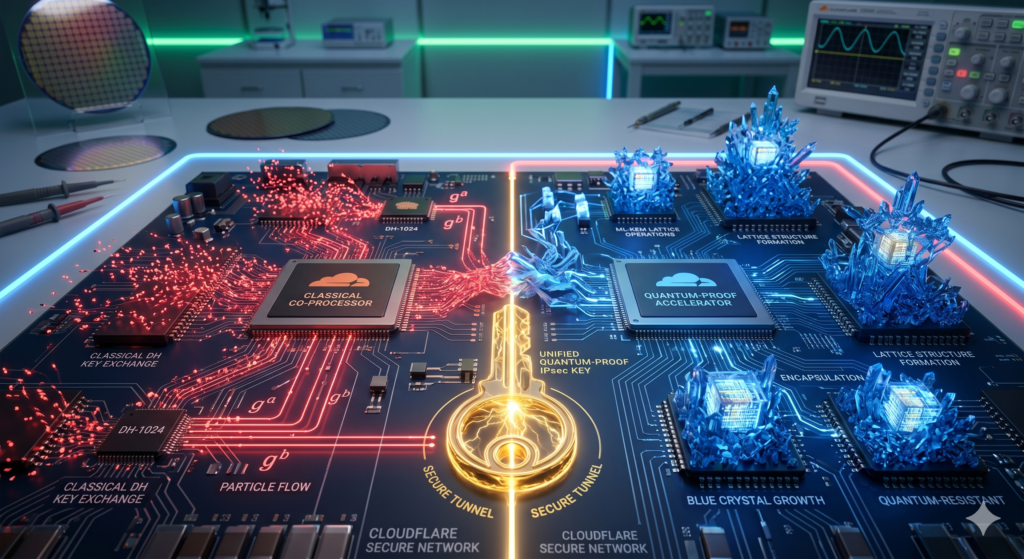
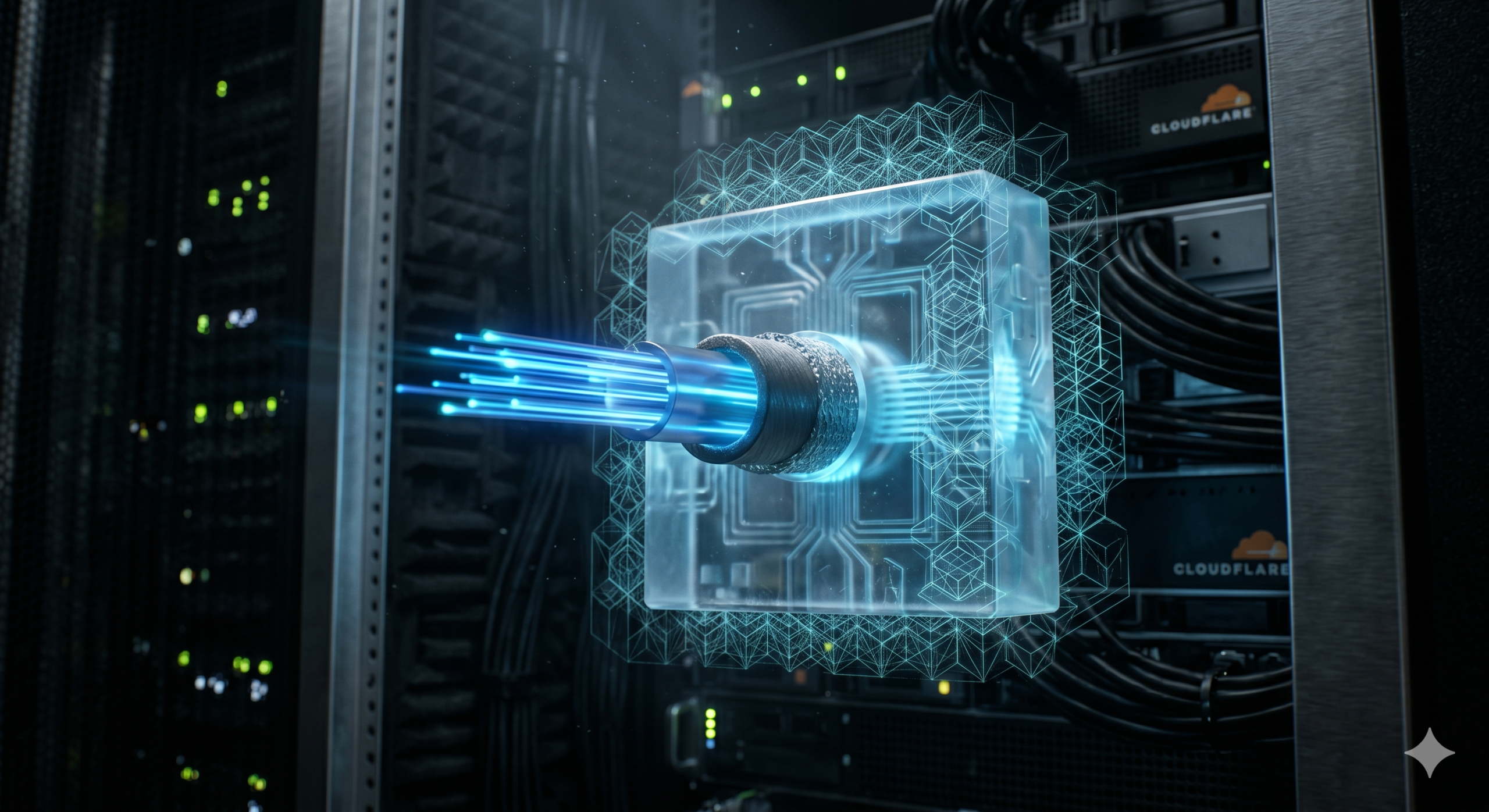
At the heart of Cloudflare’s latest security evolution lies a fundamental reengineering of how site-to-site encrypted tunnels are established—specifically, the integration of post-quantum cryptography into the IPsec protocol stack. This isn’t a bolt-on feature or a proprietary extension; it’s a standards-driven, hybrid cryptographic handshake built on draft-ietf-ipsecme-ikev2-mlkem, the emerging IETF specification that formalizes the use of ML-KEM (Module-Lattice-Based Key-Encapsulation Mechanism), now standardized as FIPS 203. The implementation is both elegant and pragmatic: during the IKEv2 (Internet Key Exchange version 2) negotiation phase, two cryptographic processes run in tandem. First, a classical Diffie-Hellman (DH) key exchange—likely using Curve25519—establishes a shared secret. This secret is then used to encrypt the second, quantum-resistant phase: the ML-KEM key encapsulation.
ML-KEM operates on the mathematical hardness of module lattice problems, a class of computations believed to be intractable even for large-scale quantum computers leveraging Shor’s algorithm. One peer generates a public key from a lattice structure, sends it to the other, who then “encapsulates” a symmetric key and returns it. The original peer “decapsulates” it using their private key, recovering the same symmetric value. This ML-KEM-derived key is never transmitted—it’s derived independently on both ends. The outputs of both the classical DH and ML-KEM exchanges are then fed into a Key Derivation Function (KDF), such as HKDF, to produce the final session keys used by the Encapsulating Security Payload (ESP) protocol to encrypt data plane traffic.
This hybrid model is critical. It ensures backward compatibility with existing IPsec infrastructure while layering in quantum resistance. Unlike pure post-quantum transitions, which risk breaking legacy systems, this approach allows gradual adoption. At the silicon level, Cloudflare’s implementation runs entirely in software—optimized C and Rust code executing on standard x86 and ARM processors across its global Anycast network. There’s no reliance on specialized cryptographic accelerators or quantum-specific hardware. Performance is maintained through constant-time algorithms to thwart side-channel attacks and kernel bypass techniques like XDP (eXpress Data Path) to minimize latency in high-throughput edge nodes. The result is a handshake that’s both quantum-resistant and Internet-scale viable—a stark contrast to earlier, fragmented attempts under RFC 9370, which allowed multiple parallel key exchanges but failed to standardize ciphersuites, leading to interoperability dead ends.
Enterprise Market Impact & TCO
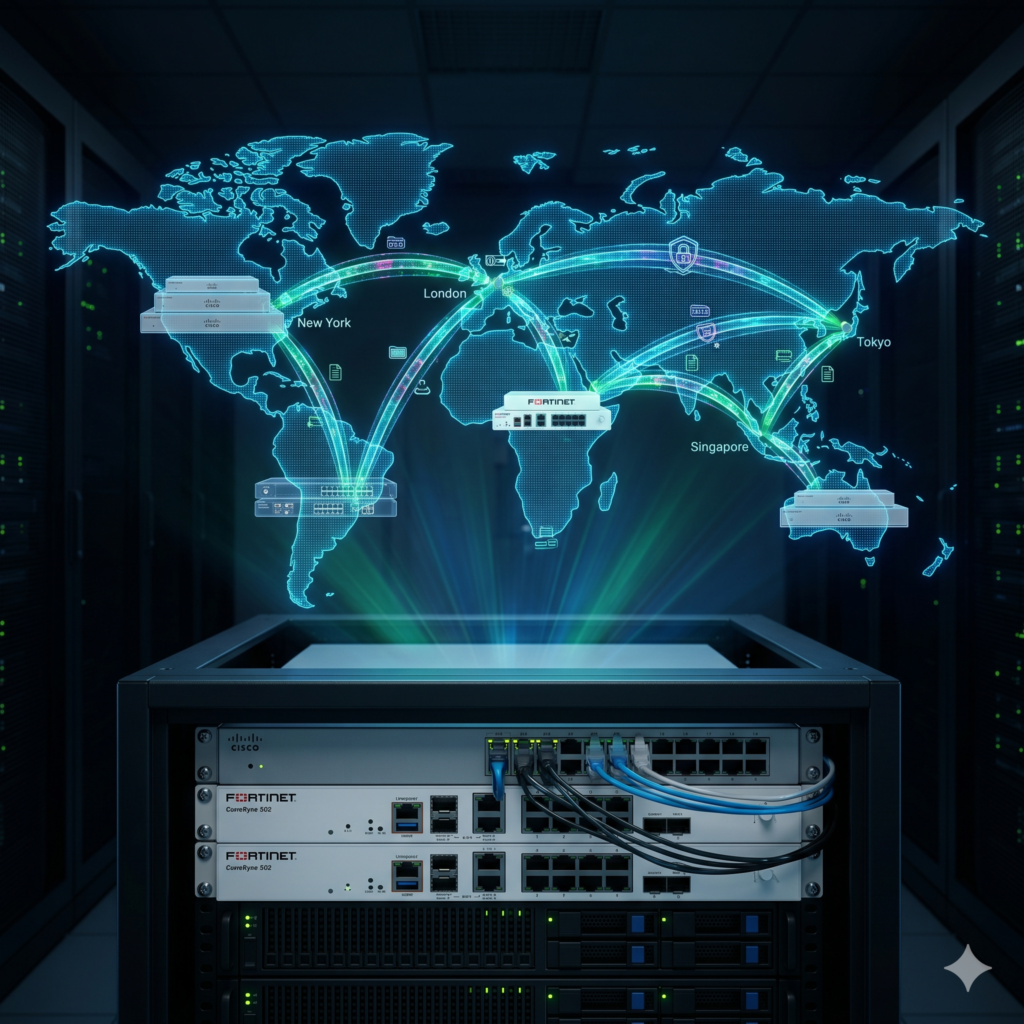
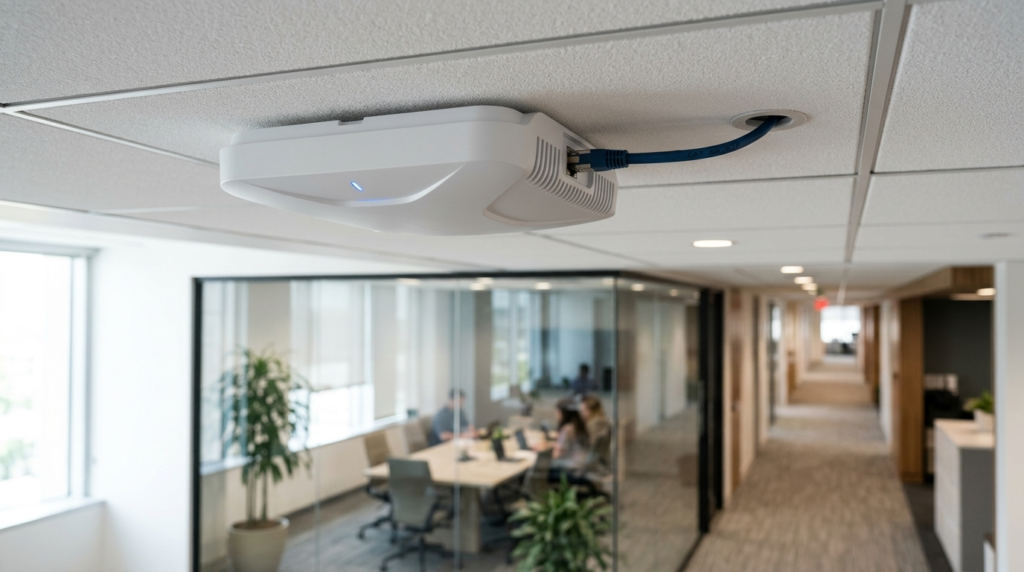
For enterprise IT leaders, Cloudflare’s move isn’t just a security upgrade—it’s a strategic recalibration of network architecture, total cost of ownership (TCO), and long-term risk management. The deployment of post-quantum IPsec within Cloudflare’s WAN-as-a-Service model eliminates the need for costly hardware refresh cycles. Unlike Quantum Key Distribution (QKD), which demands dedicated fiber links and proprietary photon detectors, ML-KEM runs on existing Cisco 8000 Series routers (v26.1.1+) and Fortinet FortiGate appliances (FortiOS 7.6.6+). This compatibility transforms what could have been a capital-intensive, multi-year migration into a firmware update and configuration toggle.
The financial implications are profound. Enterprises no longer face the dilemma of choosing between security and scalability. Cloudflare’s model—offering post-quantum encryption at no additional cost—disrupts the traditional security-as-a-premium add-on paradigm. For mid-sized organizations and distributed enterprises with dozens of branch offices, this means immediate protection against harvest-now-decrypt-later (HNDL) attacks without budget overruns. The integration with Cloudflare One’s SASE platform further consolidates network and security stacks, reducing reliance on multiple vendors and point solutions. This convergence slashes operational overhead, simplifies compliance audits, and enhances incident response times through centralized visibility.
Scalability is another cornerstone. Cloudflare’s Anycast network ensures that IPsec tunnel negotiations are routed to the nearest healthy data center, enabling automatic failover and load balancing. This is particularly valuable for global enterprises with fluctuating traffic patterns or those operating in regions prone to network instability. The hybrid handshake adds minimal latency—benchmarks suggest less than a 10% increase in negotiation time—making it viable for real-time applications like VoIP and video conferencing over encrypted WAN links. Moreover, the software-based nature of ML-KEM allows Cloudflare to push updates globally in near real-time, a capability that hardware-bound solutions like QKD simply cannot match.
However, the road to full adoption isn’t frictionless. The lack of interoperability with Palo Alto Networks’ RFC 9370 implementation—a result of early, non-standardized ciphersuites—highlights the risks of vendor fragmentation. Enterprises relying on Palo Alto firewalls may face delays or require temporary workarounds, undermining the promise of seamless transition. This underscores the importance of adhering to emerging standards like draft-ietf-ipsecme-ikev2-mlkem, which Cloudflare hopes will become the de facto baseline. For CTOs, the message is clear: prioritize vendors committed to open, interoperable post-quantum standards, not proprietary extensions masquerading as innovation.
The Consumer Reality: What This Means for You
To the average internet user, “post-quantum IPsec” might sound like abstract infrastructure jargon. But its implications ripple through every digital interaction, from online banking to telehealth appointments. The core threat it mitigates—harvest-now-decrypt-later—isn’t theoretical. Adversaries, including nation-state actors, are already intercepting and storing encrypted traffic, betting that future quantum computers will crack today’s public-key cryptography. Once that happens, decades of sensitive data could be exposed. Cloudflare’s deployment ensures that the tunnels carrying corporate data, cloud backups, and remote worker connections are now quantum-resistant, closing that window of vulnerability.
For consumers, this means stronger long-term privacy. As more companies adopt Cloudflare One and similar SASE platforms, the encryption protecting their data in transit becomes future-proofed. A small business owner using Cloudflare to connect a retail store to a cloud POS system, a remote employee accessing internal HR portals, or a hospital transmitting patient records—all benefit from this upgrade, even if they never see a single configuration screen. The fact that this protection requires no new hardware and incurs no additional cost democratizes access to cutting-edge security. Unlike previous generational shifts—such as the move to IPv6 or TLS 1.3—this transition doesn’t demand consumer-side upgrades or user intervention.
Moreover, Cloudflare’s commitment to an open, software-based model prevents a two-tier internet where only well-funded organizations can afford quantum resistance. This is a stark contrast to QKD, which remains confined to high-security government or financial backbones due to its exorbitant deployment costs. By running ML-KEM in software, Cloudflare ensures that a startup in Nairobi and a multinational in New York receive the same level of protection. This egalitarian approach aligns with the original vision of a decentralized, resilient internet. For the public, the takeaway is simple: the infrastructure beneath your digital life is getting stronger, quieter, and more equitable—without you having to lift a finger.
The Industry Ripple Effect
Cloudflare’s move sets a new benchmark for enterprise networking, forcing competitors to accelerate their own post-quantum roadmaps. With interoperability already confirmed for Cisco and Fortinet—two of the largest players in the branch networking space—the pressure is on Palo Alto Networks, Juniper, and others to align with draft-ietf-ipsecme-ikev2-mlkem. The fact that Cloudflare’s implementation doesn’t interoperate with Palo Alto’s RFC 9370-based solution is a market signal: early, non-standardized adoption carries real costs. Enterprises may begin favoring vendors with proven standards compliance, reshaping procurement strategies around cryptographic agility.
The broader networking industry is now at an inflection point. The four-year lag between post-quantum TLS and IPsec adoption—driven in part by the IPsec community’s flirtation with QKD—has finally closed. Cloudflare’s success demonstrates that software-based, standards-compliant PQC is not only viable but superior for Internet-scale deployment. This could marginalize QKD advocates, especially as agencies like the NSA, BSI, and NCSC have already warned against relying on it for general use. The focus will shift decisively toward hybrid cryptographic models that blend classical and post-quantum algorithms, ensuring both security and compatibility.
Cloudflare’s 2029 target for full post-quantum security—moved up from earlier estimates due to rapid quantum advances—adds urgency. Other cloud providers and SASE vendors will need to publish similar timelines or risk appearing complacent. The race is no longer about who can demo a quantum-safe tunnel, but who can deploy it at scale, affordably, and without disrupting existing operations. Cloudflare’s integration with its broader ecosystem—Magic WAN, Zero Trust, DDoS protection—creates a compelling bundle that competitors must now match. The ripple effect extends beyond networking: it reinforces the idea that security must be proactive, not reactive, and that open standards are the only sustainable path forward in a quantum-threatened world.
TechNode HQ Verdict: Pros, Cons & Usability
- Pro (Engineering): Hybrid ML-KEM handshake ensures backward compatibility while adding quantum resistance, running efficiently in software on standard processors.
- Pro (Consumer): No-cost, no-hardware upgrade model democratizes access to quantum-resistant encryption for businesses of all sizes.
- Con: Limited interoperability with non-compliant vendors like Palo Alto Networks creates fragmentation risk and potential deployment delays.
- Con: Absence of post-quantum authentication standards leaves a critical gap in full Q-day readiness.
Enterprise Usability: CTOs should prioritize enabling post-quantum IPsec on supported Cisco and Fortinet hardware immediately, while advocating for vendor alignment with draft-ietf-ipsecme-ikev2-mlkem in procurement contracts.
Everyday Usability: The general public does not need to take action—this is infrastructure-level protection that works silently. No consumer adoption is required.
Sources & Citations:
Original Technical Breakdown via: blog
Official Handle: @blog
Topics Explored: post-quantum cryptography, Cloudflare IPsec, ML-KEM, hybrid encryption, enterprise security