Key takeaways
- Oxide Computer secured $445 million in a Series D funding round led by Eclipse at a $6 billion valuation, bringing cumulative funding to $835 million.
- The hardware maker achieved corporate profitability in spring 2026, but accelerating enterprise demand for private cloud infrastructure outstripped production capacity.
- Each rack integrates 24 compute sleds housing up to 144-core AMD CPUs, dual network switches, custom Oxide Service Processors, and redundant flash storage.
- The new investment will provide working capital to purchase long-lead components, scale manufacturing output 20-fold, and prepare GPU-capable sled variants.
On October 9, 2026, data center hardware startup Oxide Computer announced that it raised $445 million in Series D funding to aggressively expand commercial manufacturing of its integrated server racks. Returning investor Eclipse led the financing, which valued the company at $6 billion and brought its cumulative capital raised to approximately $835 million. The round included participation from AMD Ventures, Riot Ventures, Jane Street, Atreides Management, and USIT, following an earlier $200 million investment closed in February. While Oxide achieved corporate profitability earlier in 2026 from standard commercial shipments, accelerating enterprise demand for private cloud infrastructure has outpaced factory output, necessitating substantial working capital to fulfill backlogged customer orders.
Scaling Manufacturing to Satisfy Private Cloud Backlogs
Unlike typical enterprise software startups that require outside capital to absorb operational losses, Oxide reached an unusual milestone in spring 2026 by generating taxable corporate income from commercial computer deliveries, as detailed in Oxide’s corporate disclosure. However, manufacturing dense industrial hardware introduces heavy working capital requirements. Building high-end server assemblies requires purchasing millions of dollars in processors, memory modules, circuit boards, and precision metalwork months before finished assemblies ship to buyers. As documented in a regulatory SEC Form D filing, the company completed the $445 million transaction across 15 institutional investors to fund supply chain procurement.
According to Oxide co-founder and Chief Executive Steve Tuck, enterprise interest in owning dedicated cloud hardware has surged dramatically over the past year. “The accelerating pace of on-prem cloud computing projects has required us to scale manufacturing capacity by 20x over the past 12 months, and yet demand still exceeds supply,” Tuck explained in coverage published by SiliconANGLE. The surge reflects growing corporate anxiety over escalating recurring operational costs and regulatory compliance hurdles associated with public hyperscale providers. Much like venture interest in Efficient Computer securing $97 million for dataflow chips, investors are directing substantial capital toward foundational hardware and silicon architectures capable of delivering predictable efficiency.
Integrated Compute Sleds and Custom Silicon Architecture
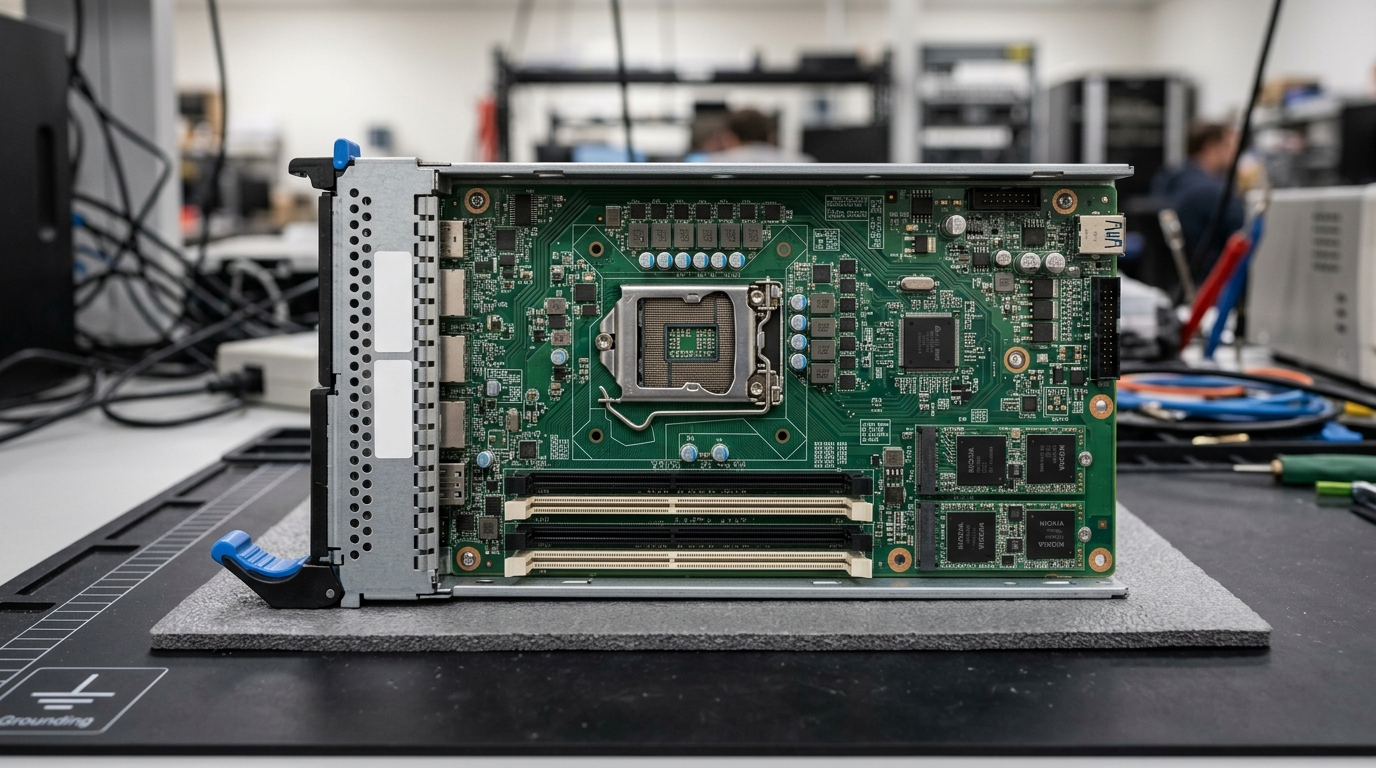
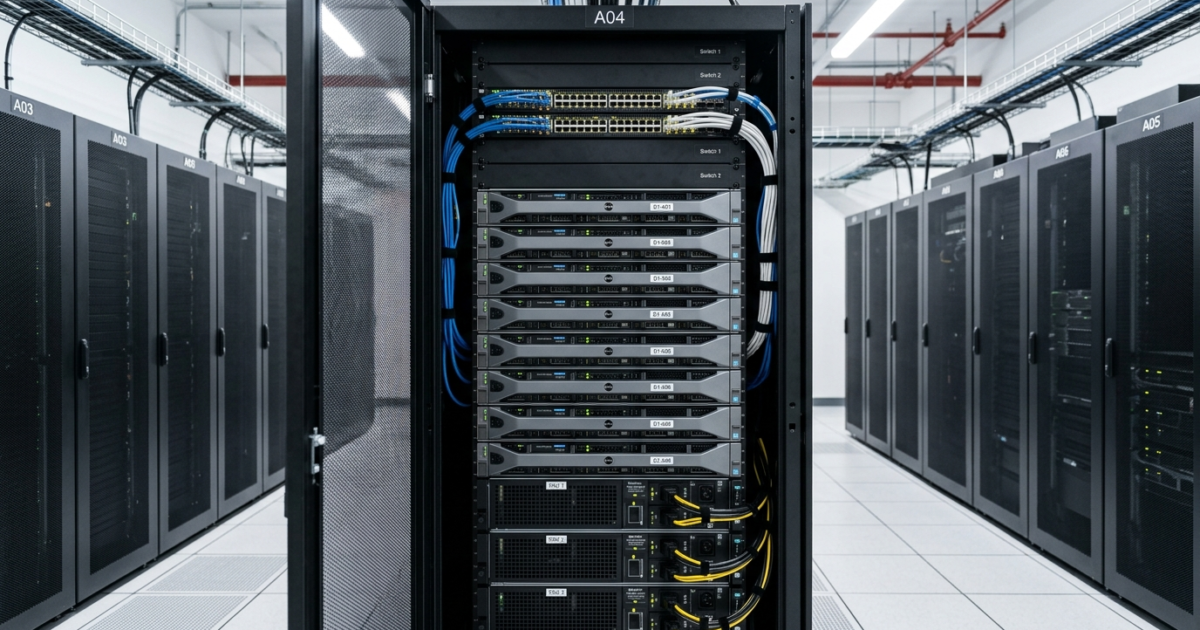
Oxide departs from conventional data center procurement models that force systems engineers to purchase separate servers, top-of-rack switches, storage arrays, and management software from competing vendors. Instead, Oxide delivers a pre-integrated, cable-free computer rack engineered as a unified appliance. The system packages 24 modular hardware units dubbed sleds, interconnected by high-speed internal backplanes rather than exposed patch cabling.
Each individual sled acts as an autonomous computing node equipped with high-density components and custom management silicon:
| Subsystem | Component Specification | Operational Capability |
|---|---|---|
| Compute Density | Up to 144-core AMD CPU per sled | Delivers dense multi-threaded x86 processing across 24 modular sled bays. |
| Memory Capacity | 1.64 TB RAM per sled | Accommodates in-memory data processing and large enterprise virtualization workloads. |
| Storage Tier | Up to 300 TB flash storage per sled | Stores three redundant data copies across modules with continuous checksum verification. |
| System Control | Custom Oxide Service Processor | Regulates module temperatures, coordinates power delivery, and applies verified firmware updates. |
| Switching Fabric | Dual integrated network switches | Maintains an active topology map of internal links to route traffic around hardware faults. |
| Power Delivery | Two power shelves with six rectifiers each | Steps incoming facility AC voltage down to chip-level direct current with dedicated telemetry. |
Operational resilience is enforced across both data storage and packet switching. The rack storage subsystem automatically writes three identical copies of every record across separate flash modules, while background processes verify data integrity via checksum mechanisms. Similarly, the dual integrated switches run a specialized routing protocol that continuously maps the health of internal communication channels, isolating failing connections without causing network downtime. Customers can segment physical hardware into distinct virtual environments protected by built-in firewalls, providing isolated sandboxes for separate software teams.
While the physical hardware provides high compute density, the commercial appeal for enterprise platform buyers lies in Oxide’s integrated software layer. As reported by Unite.AI, the platform delivers the operational ergonomics of a public cloud provider through programmatic API controls, elastic resource scheduling, and native web dashboards. This architecture enables corporate platform teams to run complex data engineering pipelines, vector search databases, and modern container orchestration platforms including Rancher, Talos Linux, and Kubernetes Cluster API directly on privately owned hardware. Enterprise demand has been further propelled by the proliferation of agentic AI workflows and private inference pipelines, according to analysis from AI Weekly, where organizations operating sensitive internal datasets seek to avoid multi-tenant cloud exposure without losing automated operational agility.
What happens next
With $445 million in fresh capital secured, Oxide plans to aggressively expand relationships with manufacturing partners, secure component inventories, and accelerate shipment schedules to work through its multi-month order backlog. Infrastructure teams considering on-premises deployments should evaluate whether their upcoming project timelines can accommodate current factory lead times while evaluating facility readiness for dense rack power distribution.
On the hardware roadmap, Oxide confirmed plans to introduce a specialized compute sled variant engineered to host dedicated graphics processing units. The company previously signaled intentions to collaborate closely with AMD to support accelerators tailored for enterprise AI training and high-throughput inference serving. If Oxide successfully brings high-density GPU acceleration into its modular rack envelope, it will significantly intensify competition with traditional original equipment manufacturers and specialized AI cloud providers alike.
Sources
- Oxide Computer raises $445M to step up data center rack production – SiliconANGLE
- Oxide Raises $445M Series D as the Company Proves Vision of Full-Stack Cloud Infrastructure Enterprises Can Own
- Our $445M Series D | Oxide Computer Company
- Oxide Computer Company Raises $445 Million to Expand Rack Production | TokenPost
- Oxide Computer Raises $445M Series D Led by Eclipse at $6B as Enterprises Flee Hyperscalers | AI Weekly
- Oxide Raises $445M Series D to Scale Enterprise-Owned Cloud Infrastructure – Unite.AI