Key takeaways
- Midjourney Medical announced an Ultrasonic CT Scanner utilizing 8,960 transducers for full-body imaging.
- The system captures 3D body composition scans in roughly 60 seconds without ionizing radiation.
- Midjourney licensed Butterfly Network’s ultrasound chips in a deal involving $15M upfront.
- The company targets 50,000 deployed scanners and 1 billion monthly scans by 2031.
- Initial deployment will focus on luxury spas, sidestepping immediate FDA diagnostic regulations.
The Architectural Reality of the Ultrasonic CT Scanner

On June 17, 2026, the AI image generation powerhouse Midjourney officially announced a massive pivot from generative synthesis to medical hardware, debuting the highly anticipated Midjourney Scanner. Far from generating conceptual art, this new endeavor focuses entirely on capturing the human body’s internal structure. Billed as a revolutionary Ultrasonic CT Scanner, the device represents a fundamental shift in how diagnostic imaging might be deployed in consumer and enterprise environments over the next decade. By merging advanced silicon with staggering computing power, Midjourney Medical is setting the stage for a dramatic disruption of traditional healthcare IT.
The core architectural reality of the Midjourney Scanner relies heavily on a departure from legacy piezoelectric ultrasound arrays. Instead, it leverages semiconductor-based transducers to scale the density of ultrasound emitters and receivers exponentially. The scanning process is both highly technical and experientially novel: users step onto a platform that lowers them into a shallow pool of water. Because sound waves propagate much more efficiently through water than air, the immersion acts as an acoustic coupling agent. Once submerged, the user passes through a ring containing 8,960 transducers.
These sensors act like a dolphin’s echolocation, sending ultrasonic sound waves through the body from every conceivable angle. By recording the ripples of these waves as they pass through various tissue densities—muscle, fat, bone, and organs—the system captures a massive dataset of the body’s internal geometry. To turn these acoustic reflections into a high-fidelity 3D image, the Midjourney Scanner employs two petaflops of local processing power. This immense computational capability allows the system to synthesize the acoustic data and generate a complete full-body scan in approximately 60 seconds, without utilizing any ionizing radiation or magnetic fields.
The Hardware & Silicon Integration
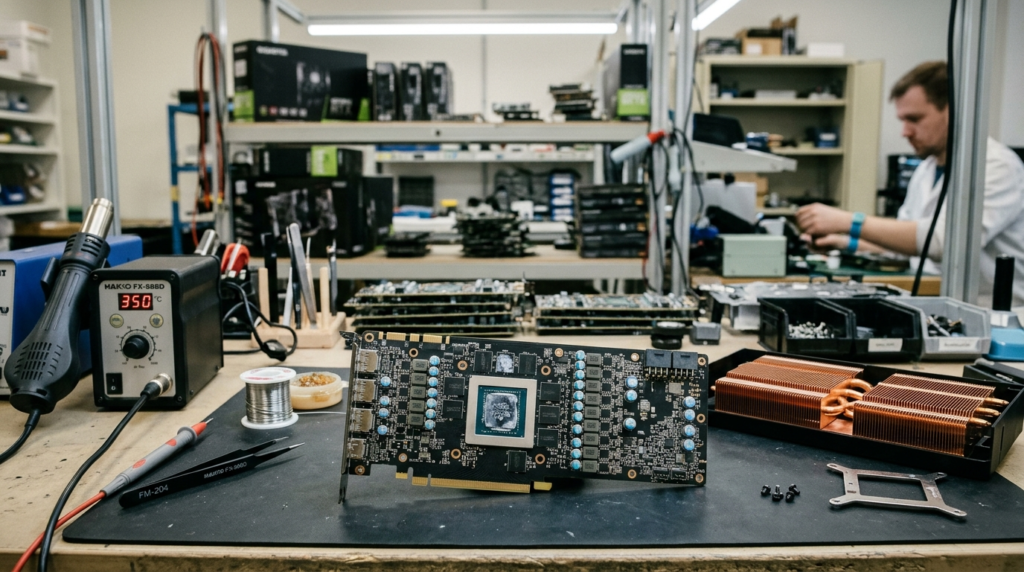
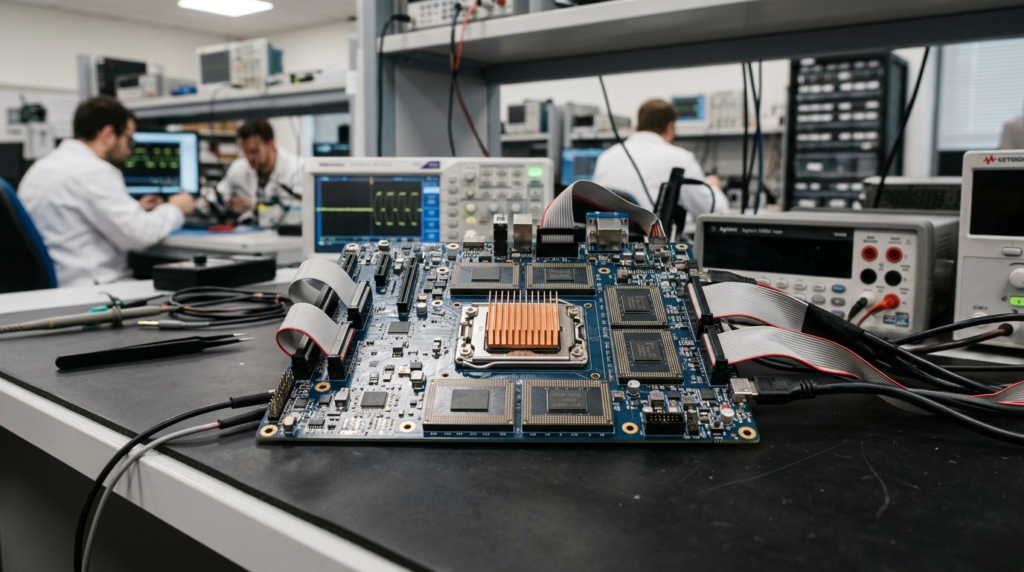
To achieve this dense array of sensors, Midjourney did not build the transducer technology from scratch. Instead, the company entered into a strategic partnership with Butterfly Network, a pioneer in semiconductor-based ultrasound technology. In November 2025, Midjourney signed a co-development and licensing agreement that secured exclusive rights to use Butterfly Network’s proprietary Ultrasound-on-Chip technology for this specific field of use. This Hardware & Silicon integration is what makes the Midjourney Scanner structurally possible and economically viable at scale.
The financial architecture of this partnership underscores Midjourney’s aggressive capitalization strategy. The deal included an initial $15 million upfront payment to Butterfly Network, along with $10 million in annual licensing fees over a five-year term. Furthermore, the agreement features potential milestone payments of up to $9 million, plus ongoing revenue sharing on the hardware incorporating the chips. Every single Midjourney Scanner utilizes 40 of Butterfly’s Ultrasound-on-Chip modules per system, creating the massive 8,960-transducer ring necessary for high-resolution volumetric imaging.
Think of this transition like moving from localized dial-up internet to a globally distributed mesh network. Instead of relying on a single, massive, expensive server (the traditional MRI machine) that takes an hour to process a single request, the Midjourney Scanner uses thousands of small, cheap, interconnected nodes working in parallel. This distributed array of semiconductor chips rapidly builds a complete picture, fundamentally altering the speed and bandwidth of human anatomical data collection.
Market Impact & Deployment

For Chief Technology Officers, hospital administrators, and enterprise investors, the Total Cost of Ownership (TCO) associated with traditional medical imaging is staggering. MRI machines cost millions of dollars to acquire, require heavily shielded rooms, rely on expensive cryogenic cooling systems, and demand highly specialized technicians to operate. Furthermore, a standard MRI scan can take between 30 and 60 minutes, severely bottlenecking patient throughput and revenue generation.
If the Midjourney Scanner can truly deliver image quality comparable to an MRI—as CEO David Holz claims—the implications for Enterprise IT and global healthcare logistics are profound. The ability to complete a full-body scan in 60 seconds means a single device could theoretically process hundreds of patients per day. Midjourney has stated an immense ambition to deploy 50,000 scanners over the next six years, with the ultimate goal of performing a billion scans per month by 2031.
Handling one billion volumetric 3D scans every month will require an unprecedented expansion of data orchestration and cloud infrastructure. Traditional DICOM image storage systems used by hospitals are not designed to ingest daily, high-fidelity full-body scans from millions of consumers. This endeavor will trigger a massive surge in demand for edge computing at the scanner level (to process the initial two petaflops of acoustic data) and deep cloud storage solutions to archive these longitudinal “library of scans.” Users will theoretically be able to share these massive datasets with doctors and emerging AI & Machine Learning health diagnostic tools.
Regulatory Hurdles & Red Team Audit
Despite the futuristic marketing and impressive silicon specs, a rigorous audit of Midjourney Medical’s claims reveals significant hurdles. The company’s assertion that this technology will be “in many ways superior to even MRI machines” remains entirely unproven in clinical literature. As of June 2026, many of the company’s technical performance claims have not been independently validated by peer-reviewed radiological studies. The clinical and regulatory pathways for the Midjourney Scanner remain to be fully documented.
Holz has acknowledged that various medical applications and diagnostic claims would require stringent FDA clearances. To sidestep this immense regulatory bottleneck for their initial launch, Midjourney Medical is strategically pivoting its marketing. For now, the company explicitly states it is working on “body composition maps.” By framing the output as wellness and fitness data—allowing users to track how their muscle and fat distribution changes in response to diet and workouts—Midjourney avoids the immediate need for the same level of FDA clearance required for diagnostic medical imaging.
This explains the company’s unconventional go-to-market strategy. Midjourney plans to open a flagship “Midjourney Spa” in San Francisco’s Union Square by the end of 2027. This location is expected to feature 10 scanners integrated alongside saunas, cold plunges, and a gym. By targeting the luxury wellness and longevity market first, Midjourney can generate early revenue, refine its hardware, and collect massive amounts of training data while slowly navigating the labyrinth of formal medical device approvals.
The Consumer Translation
For the everyday consumer, the Midjourney Scanner represents a radical democratization of physiological data. Currently, comprehensive internal imaging is reserved for when a patient is already sick or injured. It is a reactive, expensive, and often anxiety-inducing process. Midjourney aims to transform this into a proactive, preventative, and even relaxing daily routine.
By immersing the scanning hardware into a spa environment, the technology is stripped of its clinical intimidation. Consumers could walk into a wellness center, step into a warm pool of water, and receive a high-fidelity map of their internal health in the time it takes to brew a cup of coffee. This allows individuals to track subtle changes in bone density, muscle mass, and organ health over time. If adopted widely, it moves the public from relying on generalized health metrics (like BMI or heart rate) to bespoke, highly accurate anatomical tracking.
This shift has cross-industry impacts that extend far beyond Silicon Valley. The fitness industry could see luxury gyms offering daily internal scans as a premium membership perk. The health insurance sector could fundamentally restructure its actuarial models, moving away from demographic generalizations to highly specific, predictive models based on a client’s daily anatomical data. Finally, the data privacy sector will face an entirely new frontier; safeguarding biometric data of this magnitude and intimacy will require zero-trust architectures and stringent new consumer protections.
Frequently Asked Questions
Q1: What is the Midjourney Scanner?
A1: The Midjourney Scanner is an Ultrasonic CT device that uses a ring of sensors and water-immersion technology to create 3D full-body images in about 60 seconds.
Q2: How does the Midjourney Scanner compare to an MRI?
A2: While CEO David Holz claims it aims for MRI-comparable quality without the need for powerful magnets or radiation, these performance claims have not yet been independently clinically validated.
Q3: When will the Midjourney Scanner be available to the public?
A3: Midjourney plans to open a flagship “Midjourney Spa” in San Francisco featuring 10 scanners by the end of 2027.
Q4: Does the Midjourney Scanner use generative AI?
A4: Midjourney has clarified that this new medical effort is strictly focused on hardware and diagnostic imaging, not generative AI image synthesis.
Q5: Who manufactures the sensors used in the scanner?
A5: The scanner utilizes Ultrasound-on-Chip modules licensed from Butterfly Network, a company specializing in semiconductor-based ultrasound technology.
TechNode HQ Verdict: Pros, Cons & Usability
- Pro (Engineering): Replaces massive, expensive cryogenic superconducting magnets with highly scalable, cheap semiconductor-based ultrasound chips, drastically lowering hardware costs.
- Pro (Consumer): Eliminates claustrophobic, 60-minute MRI sessions in favor of a 60-second, radiation-free water bath that can track daily wellness and fitness changes.
- Con: Bypassing immediate FDA diagnostic approval by labeling the output as “body composition maps” limits its utility for serious medical triage in the short term.
- Con: Storing and processing 1 billion volumetric 3D scans per month will require an astronomical, highly expensive exabyte-scale cloud infrastructure that has yet to be proven.
Enterprise Usability: CTOs in the healthcare and wellness space should monitor the API and data export capabilities of the Midjourney Scanner. While it isn’t ready to replace diagnostic MRI machines in oncology wards, luxury fitness brands and longevity clinics should absolutely explore early adoption to attract high-net-worth clients seeking measurable wellness data.
Everyday Usability: Consumers shouldn’t expect to see this in their local doctor’s office anytime soon. However, for biohackers and fitness enthusiasts living near San Francisco in 2027, the Midjourney Spa will offer an unprecedented, albeit premium, look inside their own bodies.