Key takeaways
- Magnetic keyboard switches use frictionless Hall Effect sensors, eliminating physical metal contacts and debounce delay entirely.
- The Rapid Trigger feature dynamically resets keystrokes instantly, providing a massive advantage in fast-paced competitive shooters.
- Magnetic switches allow for highly granular actuation customization, measuring presses as shallow as 0.05 to 0.1 millimeters.
- Due to the elimination of physical friction, magnetic switches boast extreme durability, often rated for over 100 million keystrokes.
- High polling rates and continuous sensor scanning severely drain battery life, limiting wireless magnetic models to 100-200 hours.
Magnetic Keyboard Switches: The Architectural Reality
For decades, the foundation of PC input has relied on a simple mechanism: physical metal contacts closing an electrical circuit. Today, a paradigm shift is underway as magnetic keyboard switches—leveraging Hall Effect (HE) and Tunneling Magnetoresistance (TMR) technology—replace mechanical friction with electromagnetic precision. This evolution is fundamentally rewiring how both competitive gamers and enterprise professionals interact with their machines. By eliminating the mechanical constraints of springs and metal leaves, these next-generation peripherals deliver unprecedented latency reductions, limitless actuation customization, and a level of durability that traditional mechanical keyboards simply cannot match. If you are a PC gamer, it is time to upgrade, but understanding the underlying physics and market realities of these switches is critical before making the leap.
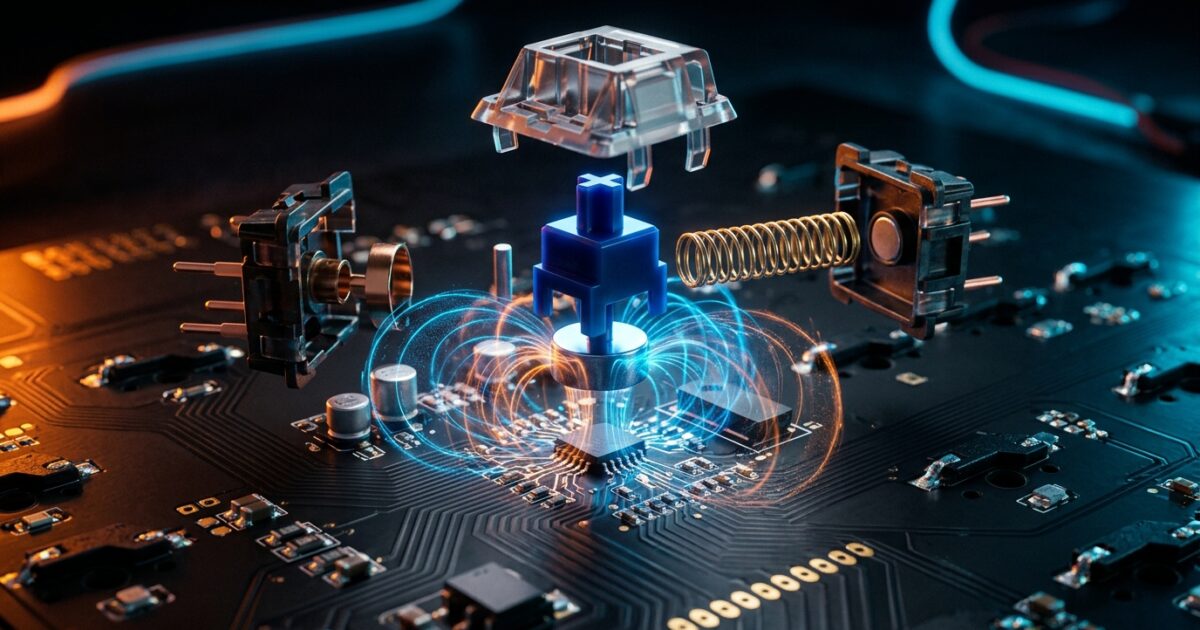
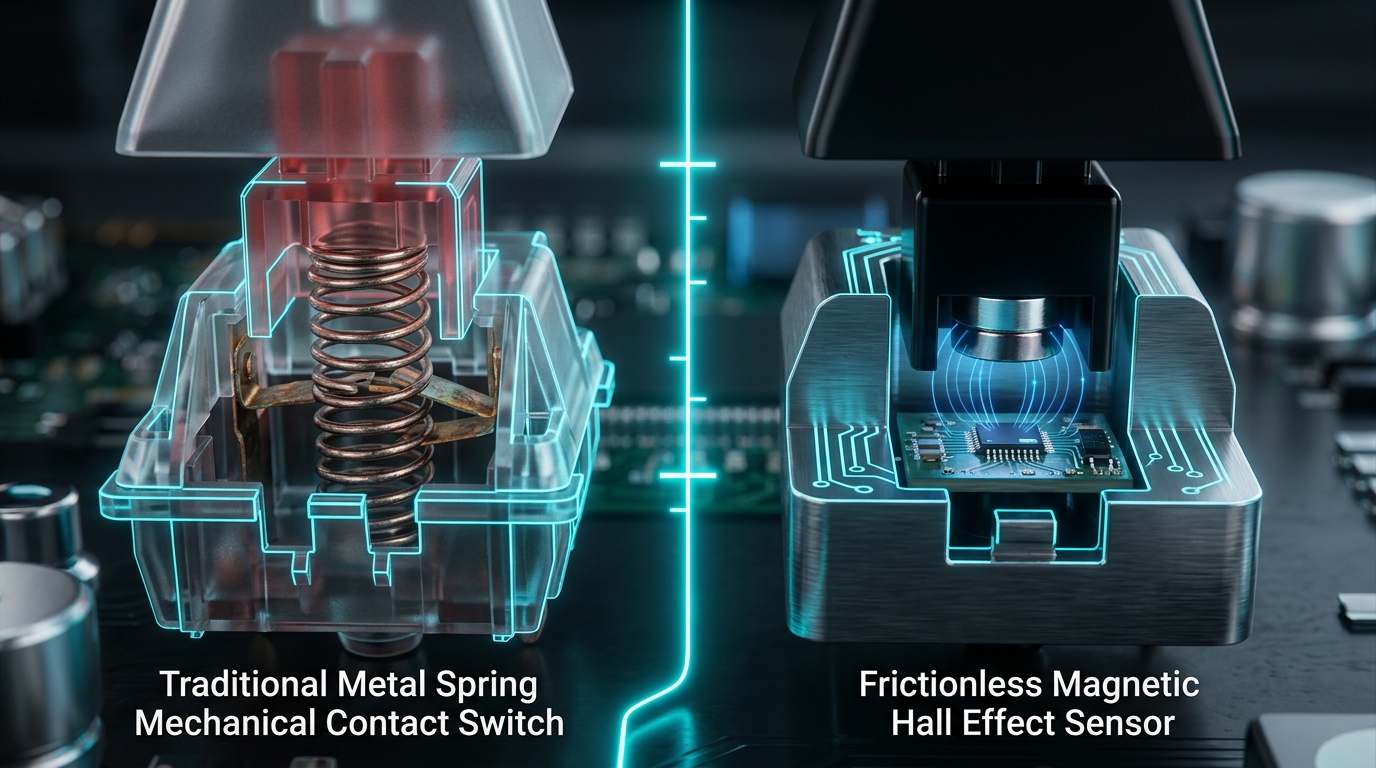
At its core, a traditional mechanical switch operates via physical actuation—a stem pushes down, causing two metal leaves to touch. This physical contact creates “switch chatter,” a microscopic bouncing effect that forces firmware engineers to implement a debounce delay to prevent a single keypress from registering multiple times. By utilizing a magnet attached to the key stem and a Hall Effect sensor on the specialized PCB beneath it, the keyboard measures the continuous changes in the magnetic field as the key descends. Because there are no physical metal contacts rubbing together, there is zero switch chatter, which completely eliminates traditional debounce delay. Furthermore, because these switches rely on a continuous reading of the magnetic field strength rather than a binary open/closed circuit, they possess the unique ability to handle true analog input—a massive leap over traditional digital magnetic switch hardware architectures.
This analog capability enables one of the most profound technological upgrades in peripheral history: completely variable actuation points. Users can utilize manufacturer-specific software to define exactly how deep a key must be pressed to register, with some high-end boards allowing actuation depth to be set as shallow as 0.05 millimeters to 0.1 millimeters for lightning-fast reactions. By contrast, a standard mechanical keyboard typically requires 1 to 2 millimeters of travel before the keystroke is registered. This level of granularity means that a single keystroke can even be mapped to perform up to four separate actions depending on the depth of the press—two actions on the downstroke and two on the release.
To understand the magnitude of this shift without delving into the physics of electromagnetism, consider this structural analogy: A traditional mechanical keyboard operates like a physical tollbooth on a highway. A car must drive up, come to a complete physical stop to press the button, wait for the gate to lift, and then accelerate again. There is an absolute, unavoidable physical bottleneck. A magnetic keyboard, conversely, operates like a modern automated toll-pass scanner combined with real-time GPS tracking. The system continuously monitors the vehicle’s exact position, velocity, and trajectory at thousands of times per second. The gate never physically exists; the transaction occurs dynamically based on pure spatial data, allowing the flow of data input to proceed with zero physical friction and absolute fluidity.
Market Impact & Deployment: Redefining Peripherals
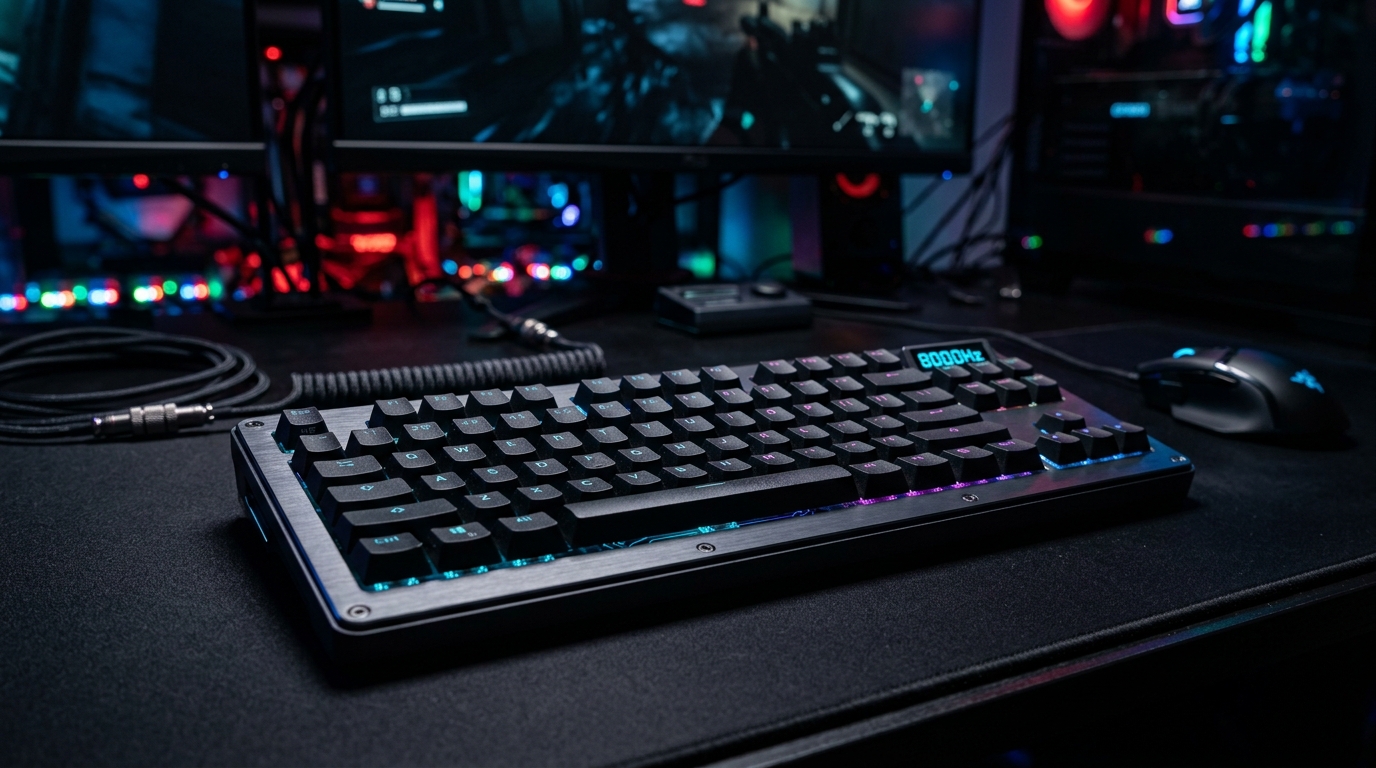
The transition to magnetic architectures is reshaping the premium peripheral market. Leading manufacturers are aggressively deploying their own proprietary implementations of Hall Effect technology to capture the lucrative enthusiast and esports demographics. The Wooting 80HE is widely considered one of the top gaming keyboards due to its flawless magnetic switch implementation and highly optimized firmware. Competitors have rapidly followed suit; the SteelSeries Apex Pro Series (Gen 3) has gained massive popularity with its HyperMagnetic switches, while the Corsair K70 Pro TKL leverages the technology alongside a blistering 8000 Hz polling rate. We are also seeing the democratization of the technology through more accessible models like the Redragon FIDD K683, which drives the entry price point down to roughly $30, and enthusiast options like the MonsGeek M1 V5 HE, which caters to users seeking magnetic performance combined with hot-swapping capabilities for custom builds.
From an enterprise and high-intensity deployment perspective, the shift to magnetic switches offers a compelling Total Cost of Ownership advantage. Because they lack the physical friction and oxidizable metal contact points of traditional mechanical switches, magnetic switches are exceptionally durable. They are frequently rated for well over 100 million keystrokes, meaning the switches will likely outlast the physical chassis of the keyboard itself. While optical switches also provide a consistent, smooth feel over a long period by lacking metal contacts, they operate by breaking a beam of light at a standard, fixed actuation point. Optical switches simply lack the granular, per-key analog customization that makes magnetic switches a generation-defining upgrade. However, it is crucial to note that this hardware represents a fundamental platform shift; magnetic switches cannot be simply swapped into a traditional mechanical keyboard, as they require a highly specialized Hall Effect PCB to interpret the magnetic field data.
The Consumer Translation: Why Gamers Are Making the Switch
For the consumer, and specifically the competitive gamer, the most visceral impact of magnetic keyboard switches is experienced through a software feature known as Rapid Trigger. Standard mechanical keyboards have fixed reset points—the key must travel back up past a specific physical threshold before it can be pressed again. Rapid Trigger dynamically resets the key the instant you release it, moving the reset point in real-time alongside your finger. This bypasses fixed reset points entirely, allowing for incredibly rapid, stutter-step inputs. In fast-paced, highly tactical FPS titles like Valorant and CS2, Rapid Trigger is widely considered a significant competitive upgrade. It allows players to execute micro-strafing, peek corners, and halt their character’s momentum with a level of precision that physical springs fundamentally cannot replicate. The analog data processing ensures that the second keypress can register the precise moment the first keypress begins to travel upward, cementing these devices as the ultimate gaming keyboards.
However, the consumer reality of magnetic switches is not without friction. Users coming from clicky or highly tactile mechanical switches may face a steep adjustment period due to the inherently smooth, linear nature of magnetic switches. The typing experience feels distinctly different, lacking the sharp tactile bump that many heavy typists rely on for physical feedback. Furthermore, while the Keychron Q3 HE 8K stands out as a glorious exception that delivers a superb daily typing experience thanks to its custom Lime Magnetic Switches and PBT keycaps, finding a magnetic board that doubles perfectly for hardcore productivity remains a challenge. Finally, the sheer computational power required to continually scan magnetic sensors and process analog inputs—often coupled with 8000 Hz polling rates—places immense strain on wireless hardware. As a result, wireless magnetic keyboards suffer from dramatically reduced battery life, typically lasting only 100 to 200 hours compared to the 1,000+ hours offered by premium mechanical wireless equivalents. For casual gaming or primarily typing, a standard mechanical keyboard may still be preferable and more cost-effective.
Cross-Industry Disruption and Future Vectors
While the current marketing narrative focuses exclusively on gaming hardware, the implications of mass-produced, highly reliable analog Hall Effect input devices extend far beyond esports. In the medical device sector, where equipment must be repeatedly sterilized, the frictionless and fully sealed nature of magnetic PCBs offers a contamination-resistant input method with infinite reliability. In industrial machinery and aviation, the complete elimination of debounce delay and physical wear means critical system inputs are registered with guaranteed, millisecond-perfect accuracy. As the technology matures and manufacturing yields improve, we expect to see magnetic switch architectures bleed into specialized enterprise hardware, high-frequency financial trading terminals, and heavy machinery interfaces, replacing traditional contact-based switches wherever latency and absolute durability are mission-critical.
Frequently Asked Questions
Q1: What are magnetic keyboard switches?
A1: Magnetic keyboard switches, or Hall Effect switches, use magnetic fields instead of physical metal contacts to detect keystrokes. This allows for frictionless operation and the ability to customize the exact actuation depth required for a keypress to register.
Q2: What is the Rapid Trigger feature?
A2: Rapid Trigger is a technology in magnetic switches that instantly resets the key upon release, bypassing standard fixed reset points. This provides a significant competitive upgrade in fast-paced FPS games by enabling lightning-fast consecutive presses and micro-strafing.
Q3: How do magnetic switches compare to optical switches?
A3: While optical switches are fast and durable because they rely on breaking a beam of light, they operate on a fixed actuation point. Magnetic switches offer true analog input, providing granular, per-key customization that optical options lack.
Q4: Do magnetic keyboards have good battery life?
A4: Generally, no. Because magnetic keyboards must continuously scan their sensors and often process data at an 8000 Hz polling rate, wireless versions suffer from short battery life, typically lasting between 100 and 200 hours.
Q5: Can I put magnetic switches in my current mechanical keyboard?
A5: No, magnetic switches cannot be simply swapped into a traditional mechanical keyboard. They require a specialized Hall Effect PCB that is specifically designed to interpret continuous magnetic field data rather than binary electrical circuits.
TechNode HQ Verdict: Pros, Cons & Usability
- Pro (Engineering): Total elimination of traditional debounce delay via frictionless analog Hall Effect sensing.
- Pro (Consumer): Rapid Trigger allows for instantaneous reset points, granting a massive latency advantage in competitive shooters.
- Con: Immense power draw from high polling rates severely limits the battery life of wireless variants.
- Con: Magnetic switches require a specialized PCB, eliminating compatibility with millions of existing hot-swappable mechanical keyboards.
Enterprise Usability: CTOs outfitting data-heavy or highly specialized high-input terminals should strongly consider HE switches. The 100-million keystroke durability dramatically lowers the Total Cost of Ownership and hardware replacement cycles.
Everyday Usability: For competitive gamers, it is a mandatory upgrade. However, pure typists or casual users should test a linear HE switch first, as the lack of tactile feedback and higher cost may make a standard mechanical keyboard the more pragmatic choice.