Key takeaways
- Intel officially designated its Crescent Island data center AI inference processor as the GPU D-Series, unveiling the flagship PCIe model named the Intel GPU D270.
- Built on the Xe3P architecture, the processor strips out legacy 3D graphics rendering and ray-tracing hardware to dedicate maximum silicon area to 256 XMX matrix engines, delivering 1.3 PFLOPS of dense FP8 compute.
- Rather than using expensive, supply-constrained High Bandwidth Memory (HBM), the card utilizes an 80-channel LPDDR5X memory subsystem offering 1.5 TB/s of bandwidth across 160GB in Intel’s reference build and up to 480GB in partner configurations.
- Operating within a 350-watt air-cooled envelope, the PCIe dual-slot accelerator is sampling to enterprise customers ahead of an expected commercial rollout in 2027.
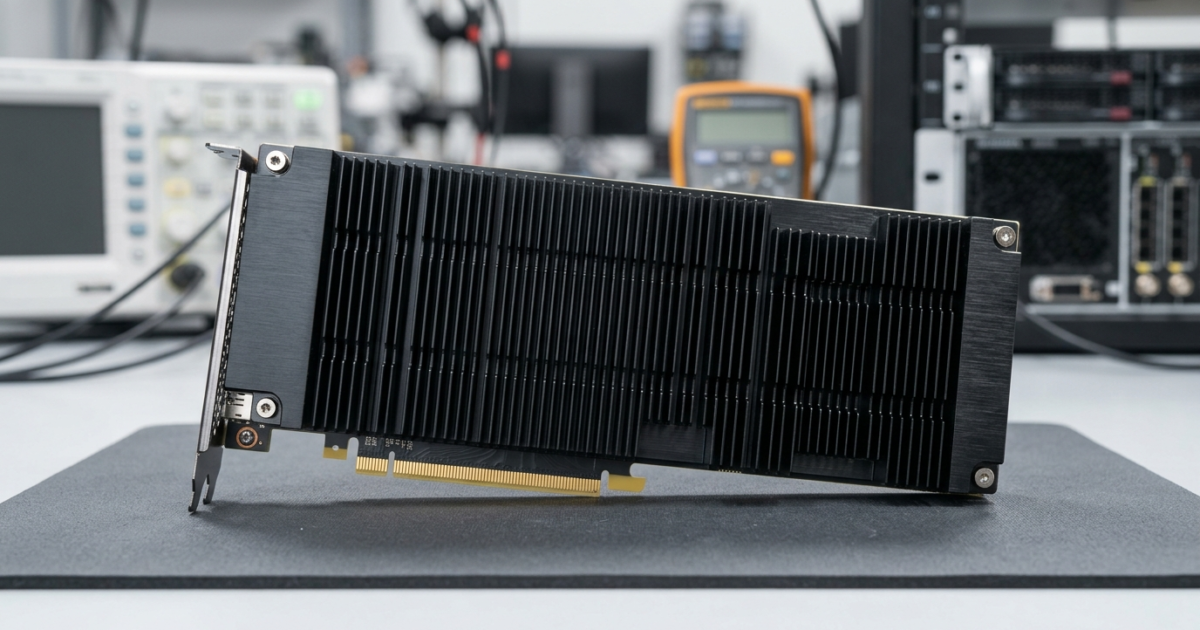
Intel has officially named its forthcoming data center AI inference accelerator, codenamed Crescent Island, the Intel GPU D-Series, revealing the inaugural dual-slot PCIe card designated as the Intel GPU D270. Announced at the Open Compute Project Global Summit, the accelerator leverages Intel’s Xe3P architecture and prioritizes cost-effective, high-capacity inference over raw training horsepower. The 350-watt air-cooled processor delivers 1.3 PFLOPS of dense FP8 matrix compute and integrates up to 480GB of LPDDR5X memory across an 80-channel interface, yielding 1.5 TB/s of memory bandwidth. By skipping 3D graphics and expensive High Bandwidth Memory, Intel targets mainstream enterprise server deployments. The company is currently sampling cards to select partners ahead of an anticipated 2027 rollout.
Xe3P Architecture and Hardware Specifications
The Intel GPU D270 marks Intel’s first commercial AI-focused data center GPU since the Ponte Vecchio architecture launched in 2021. Following the cancellation of earlier roadmap follow-ups Rialto Bridge in 2023 and Falcon Shores in 2025, Intel repositioned Crescent Island as an interim solution aimed squarely at large language model inference and dense generative model deployment. The underlying silicon relies on Xe3P, an enterprise-tailored revision of the Xe3 architecture that maximizes matrix math throughput by removing traditional 3D rasterization and ray-tracing units entirely.
By omitting display pipes, fixed-function geometric blocks, and RT cores, Intel dedicated die area directly to parallel execution units. The chip features 32 Xe Cores and 256 Xe Matrix eXtensions (XMX) engines running at approximately 2.5 GHz. This layout generates a theoretical peak of 1.3 PFLOPS of dense FP8 matrix performance alongside 10.2 TFLOPS of vector FP64 compute, supported by an on-die 32MB L2 cache.
| Specification | Value |
|---|---|
| Architecture | Xe3P (“Crescent Island”) |
| Xe Cores | 32 |
| XMX Matrix Engines | 256 |
| Clockspeed | ~2.5 GHz |
| Peak Matrix Throughput (FP8) | 1.3 PFLOPS |
| Peak Vector Throughput (FP64) | 10.2 TFLOPS |
| L2 Cache | 32MB |
| Memory Subsystem | LPDDR5X (20 chips, 80 channels, 1280-bit bus at ~9,375 MT/s) |
| Memory Bandwidth | 1.5 TB/s |
| Memory Capacity | 160GB (Intel reference) / Up to 480GB (ODM configurations) |
| Host Bus Interface | PCIe Gen 5 x16 |
| Thermal Design Power (TDP) | 350W |
| Cooling Profile | Passive chassis airflow (Air-cooled) |
LPDDR5X Memory Subsystem and Thermal Profile
Memory configuration represents the core architectural departure for the GPU D-Series. Rather than competing in the cost-heavy High Bandwidth Memory (HBM3e) supply chain, Intel elected to build an expansive LPDDR5X memory system by bypassing costly High Bandwidth Memory packaging. The GPU D270 uses 20 memory chips arranged across an 80-channel, 1280-bit interface. Operating at transfer speeds of roughly 9,375 MT/s, the card achieves 1.5 TB/s of aggregate memory bandwidth.
Intel’s reference accelerator integrates 8GB LPDDR5X packages to supply 160GB of onboard memory. Furthermore, Intel confirmed that original design manufacturer (ODM) partners can equip the accelerator with high-density 24GB packages, scaling onboard capacity up to 480GB on a single standard PCIe card. In memory-bound inference tasks, such as housing 70-billion-parameter model weights or extended context windows, a single 480GB card can run workloads locally that previously required distributing shards across multiple interconnected accelerators.
Thermal management is another key constraint factored into the card’s design. The GPU D270 is rated at 350W TDP and fits a standard dual-slot PCIe Card Electromechanical (CEM) form factor. This enables data center operators to install the card into existing air-cooled enterprise server chassis without requiring specialized liquid loops or infrastructure overhauls.
Positioning Against PCIe Inference Accelerators
The GPU D270 is not positioned to compete with flagship training platforms like NVIDIA’s liquid-cooled Blackwell Ultra or AMD’s MI455X. Instead, Intel targets density and total cost of ownership in standard dual-socket enterprise rack units. As hyperscalers and specialized providers such as CoreWeave build out dedicated AI infrastructure, PCIe form-factor accelerators provide an alternative path for local enterprise deployment.
When evaluated against AMD’s CDNA 4-based MI350P PCIe accelerator, the trade-offs become clear. AMD’s MI350P delivers up to 2.3 PFLOPS of dense FP8 compute, which is roughly 40 percent higher raw matrix throughput than the D270’s 1.3 PFLOPS. However, the MI350P tops out at a 600-watt power ceiling. Intel’s card operates at 350 watts, aiming for superior performance-per-watt metrics in workloads where prompt prefill and token generation are bounded by memory capacity rather than peak floating-point math.
What happens next
Intel is currently sampling GPU D270 silicon and reference boards to select cloud providers and hardware OEM partners. However, the company has not committed to a commercial release date in 2026, pointing instead toward 2027 for volume availability in enterprise servers.
Pricing remains undisclosed. The market reception of the GPU D-Series will largely depend on whether Intel can leverage the lower cost base of LPDDR5X to deliver an aggressive price-to-capacity advantage over competing enterprise accelerator options.
Sources
- Intel’s Crescent Island AI Server GPU Gets a Name and Specs: Meet the Intel GPU D-Series – ServeTheHome
- Intel’s Crescent Island AI accelerator officially powers new GPU D-Series products — chip delivers 1.3 peak PFLOPS of FP8 compute and 1.5 TB/s of memory bandwidth | Tom’s Hardware
- Intel’s new GPU packs up to 480GB of memory — but skips 3D graphics – Notebookcheck News