Key takeaways
- The NASA ERNEST Rover travels at 0.6 mph, 10x faster than Curiosity.
- Replaces 30-year-old passive rocker-bogie designs with active gimbal suspension.
- Four steerable wheels enable crabbing, wheel-walking, and 30-degree slope climbs.
- Operates autonomously using advanced edge reinforcement learning.
- At 4 feet long, it acts as a testbed for future high-autonomy lunar missions.
For over thirty years, the fundamental physics of extraterrestrial exploration have been constrained by a single, highly reliable piece of engineering: the passive rocker-bogie suspension system. While this mechanical linkage has successfully guided legendary machines from Sojourner to Perseverance across the Martian surface, it inherently limits how fast and how steep these multi-million-dollar scientific platforms can travel. Enter the NASA ERNEST Rover. Short for Exploration Rover for Navigating Extreme Sloped Terrain, this cutting-edge prototype built by NASA’s Jet Propulsion Laboratory (JPL) is actively rewriting the rulebook on planetary locomotion.
During a grueling 37-hour field test in the Colorado Desert in March 2026, the NASA ERNEST Rover autonomously traveled an astonishing 16 miles (25 kilometers) across rugged, uneven landscapes. But the raw distance is only part of the story. By combining highly advanced hardware mechanics with modern edge AI, NASA is unlocking access to the shadowed craters and extreme inclines of the Moon and Mars that were previously deemed totally inaccessible.
The Architectural Reality: Engineering the NASA ERNEST Rover
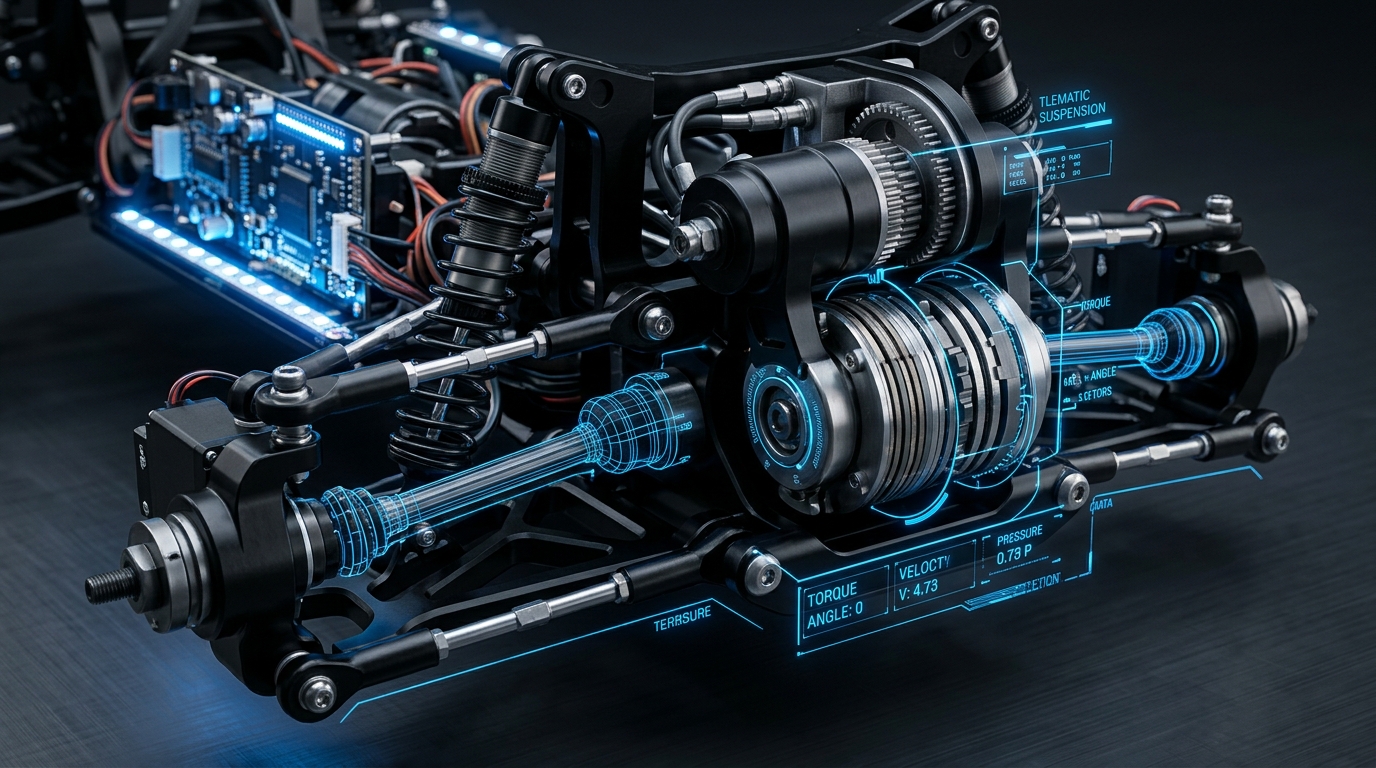
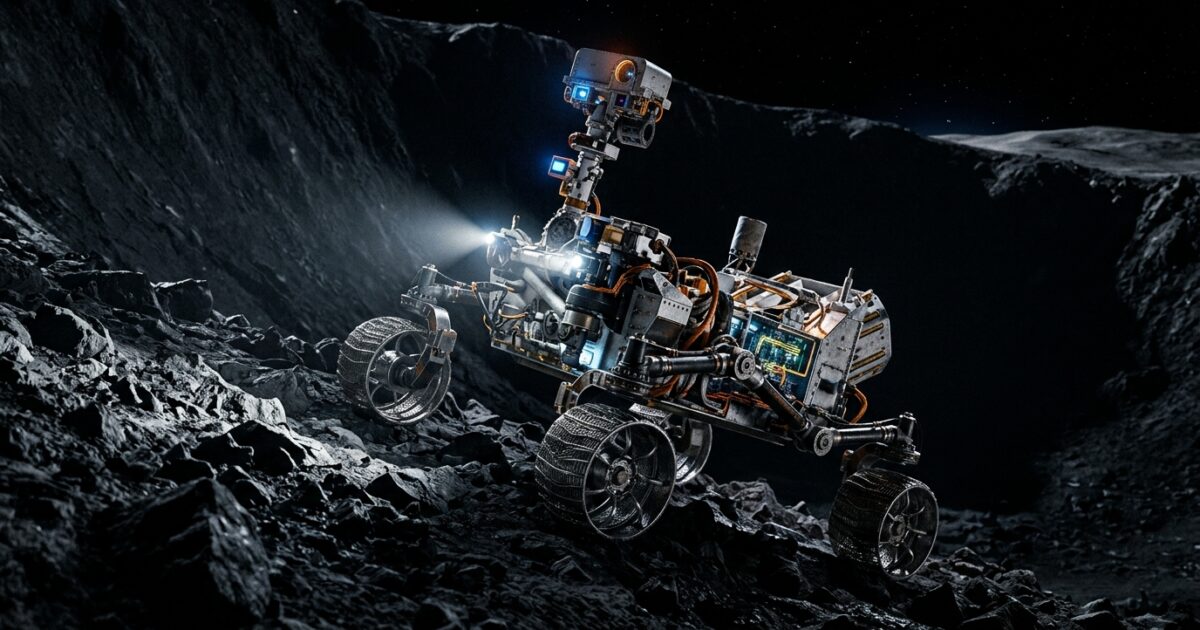
The defining breakthrough of the NASA ERNEST Rover lies in its departure from passive mechanical systems. Traditional rocker-bogie systems rely entirely on the rover’s forward momentum and mechanical leverage to climb over rocks, a design that famously limits safe operation to slopes under 15 degrees. ERNEST, however, utilizes a highly sophisticated two-degree-of-freedom Active Gimbal Suspension.
This four-wheel design incorporates a specialized clutch mechanism that allows the chassis to seamlessly switch from a standard passive mode into an active locomotion mode. Once active, two powered joints in the front of the vehicle articulate a gimbal to dynamically redistribute the vehicle’s weight across its four wheels. This is not merely a shock absorber; it is a software-defined center of gravity.
Because all four wheels are independently steerable, the rover is not restricted to linear forward-and-backward driving. It can execute lateral crabbing motions, drive sideways, and arc around a fixed center of rotation. More impressively, the active suspension enables exotic, highly adaptive gaits. When facing deep lunar-analogue regolith or extreme obstacles, ERNEST can transition into “squirming” or “wheel-walking” maneuvers, deliberately lifting and placing its wheels to conquer slopes of up to 30 degrees. In a planetary context, moving from a 15-degree constraint to a 30-degree operational envelope effectively opens up millions of square miles of unexplored, scientifically rich crater walls.
Market Impact & Deployment: The Economics of Autonomous Exploration
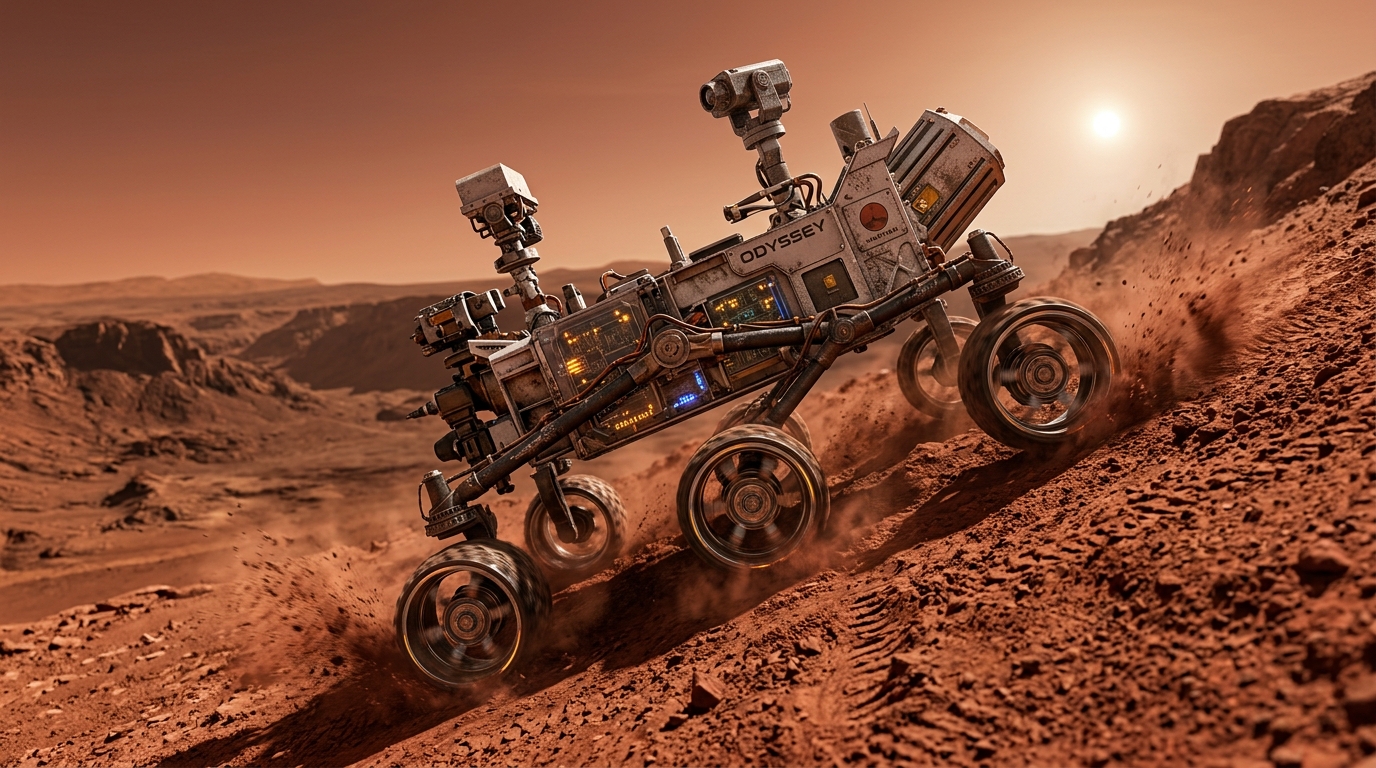
In the realm of deep-space infrastructure, time is the most expensive commodity. Every minute a rover spends navigating is a minute it cannot spend drilling, sampling, or analyzing data. Historically, planetary navigation has been crippled by teleoperation bottlenecks. Because radio signals take anywhere from 4 to 24 minutes to reach Mars, human operators on Earth must painstakingly plan and upload command sequences just to move a rover a few meters forward, waiting hours for confirmation.
ERNEST shatters this bottleneck through localized autonomy. By leveraging onboard reinforcement learning—a branch of artificial intelligence where the system learns and adapts by continuously interacting with its environment—the rover makes real-time navigational decisions without waiting for ground control. During its March 2026 desert trials, the algorithm was tested in complete darkness to simulate the long, harsh shadows of lunar dusk and dawn, proving its capability to operate without ideal visual conditions.
The economic translation of this autonomy is staggering. ERNEST reached speeds of up to 0.6 mph (1 km/h) during intermittent testing. While this may sound crawlingly slow to a terrestrial commuter, it is a full order of magnitude—10 times faster—than the top speeds of Perseverance and Curiosity. By traveling 10 times faster, space agencies dramatically lower the Total Cost of Ownership (TCO) for scientific missions, multiplying the volume of actionable data gathered per operational hour. Furthermore, at just 4 feet (1.2 meters) long, ERNEST is only half the size of the proposed Endurance mission rover, suggesting that this active gimbal architecture can be scaled up or down to optimize payload weight for commercial launch vehicles.
Hardware and Silicon: Processing at the Deep Space Edge
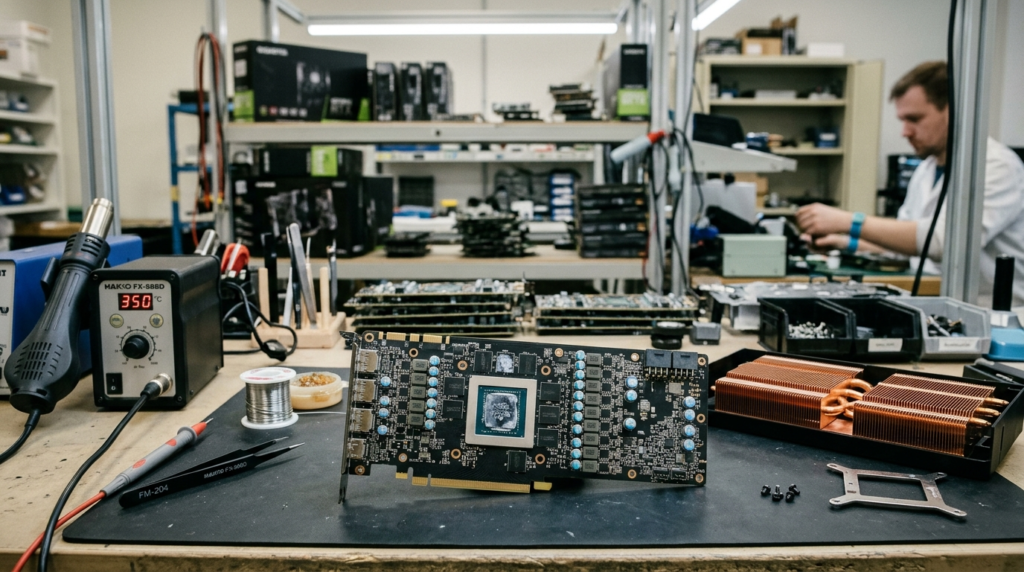
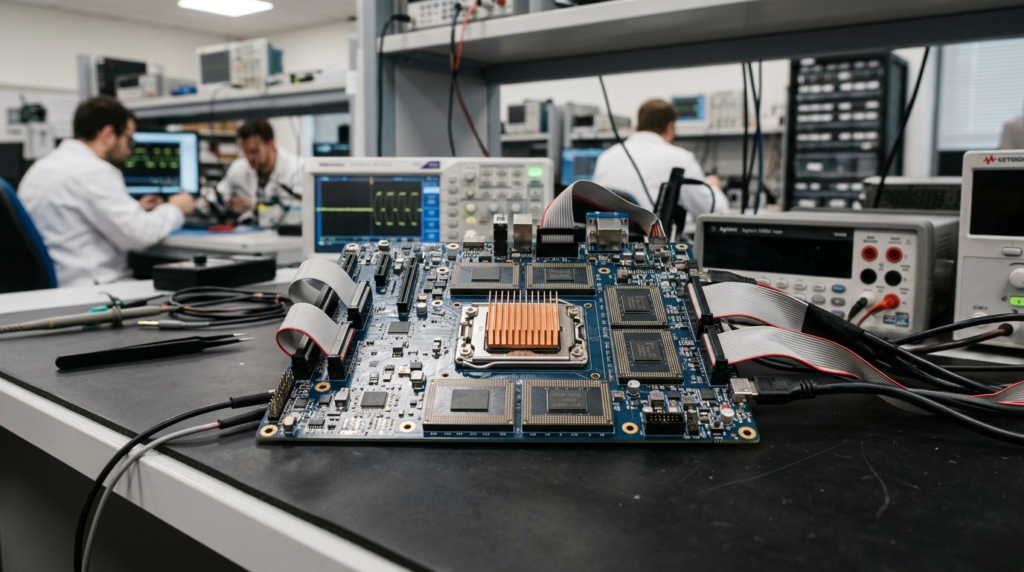
To execute dynamic wheel-walking and active weight redistribution, the physical actuators must work in perfect synchronization with the rover’s compute payload. This demands highly resilient silicon capable of processing complex spatial environments in real-time, all while operating under extreme thermal fluctuations and high radiation.
The reinforcement learning algorithms running on ERNEST act as the brain behind the active gimbal suspension. Training these models initially required a localized Mars Yard obstacle course featuring sand ripples, rubble piles, and steep steps. As the model matured, the inference was pushed to the extreme edge—the rover itself. This shift from central cloud compute to edge processing represents the bleeding edge of silicon design, where power efficiency (performance-per-watt) is prioritized above all else. Every joule of battery power spent on computing a path is a joule stolen from locomotion or thermal survival. ERNEST proves that highly complex, autonomous physical maneuvering can now be executed within the strict thermal and power envelopes of a deep-space platform.
The Consumer Translation: Terrestrial Applications for Extreme Mobility
While the NASA ERNEST Rover is purpose-built for the desolation of the Moon and Mars, the technology trickles down to Earth with massive disruptive potential. The active gimbal suspension and independent steering algorithms solve fundamental physical constraints that currently plague terrestrial industries relying on automated heavy machinery.
In the automated mining sector, extracting resources from deep, hazardous subterranean environments requires vehicles that can navigate steep, uneven rubble without human drivers risking their lives. A scaled-up variant of ERNEST’s wheel-walking chassis could drastically increase the safety and yield of these operations. Similarly, in disaster response and search-and-rescue, the ability to autonomously traverse chaotic debris fields—squirming over concrete slabs and rebar—could rapidly accelerate the deployment of emergency sensors and supplies into zones too unstable for human first responders.
Even in precision agriculture, where autonomous tractors struggle with steeply sloped vineyards or risk compacting delicate soil with heavy tracks, a lightweight, active-suspension vehicle could navigate the terrain with surgical precision, continuously redistributing its weight to avoid slip and soil damage.
Frequently Asked Questions
Q1: What is the NASA ERNEST Rover?
A1: ERNEST is a compact, four-wheeled prototype rover built by NASA’s Jet Propulsion Laboratory. It recently traversed 16 miles over 37 hours in the Colorado Desert to test next-generation mobility for the Moon and Mars.
Q2: How fast does the ERNEST rover travel?
A2: ERNEST reaches top speeds of 0.6 mph (1 km/h). While seemingly slow, this is roughly an order of magnitude (10 times) faster than legacy rovers like Perseverance and Curiosity.
Q3: Why is ERNEST’s suspension system so revolutionary?
A3: It abandons the traditional passive rocker-bogie system for a two-degree-of-freedom active gimbal suspension. This allows the rover to actively redistribute its weight, execute wheel-walking gaits, and climb steep 30-degree slopes that older rovers cannot navigate.
TechNode HQ Verdict: Pros, Cons & Usability
- Pro (Engineering): The active gimbal suspension successfully breaks the 15-degree slope limitation, allowing safe traversal of highly treacherous 30-degree inclines via complex wheel-walking gaits.
- Pro (Consumer): The underlying edge-autonomy and active weight redistribution systems are prime candidates for technology transfer into terrestrial search-and-rescue and autonomous mining robotics.
- Con: The introduction of a clutch mechanism and two powered articulating joints adds substantial mechanical complexity and multiple new potential failure points compared to the time-tested passive rocker-bogie system.
- Con: Running reinforcement learning models locally for autonomous navigation requires powerful edge compute, creating a significant drain on strict planetary power budgets.
Enterprise Usability: For aerospace and defense contractors, the ERNEST architecture serves as the new gold standard for off-world logistics. CTOs investing in ruggedized robotics should immediately begin pivoting R&D away from passive suspension models and toward software-defined, active locomotion platforms to remain competitive in autonomous heavy industry.
Everyday Usability: While the public cannot buy a deep-space rover, the reinforcement learning algorithms and robotic gaits perfected by ERNEST will likely find their way into the consumer sector within the next decade, appearing in everything from high-end automated off-road vehicles to advanced search-and-rescue drones.