Key takeaways
- The Sharge Disk Pro 2 converges a 5-in-1 hub with an NVMe SSD enclosure.
- Ice-Storm active cooling reduces thermal throttling by dropping temperatures by over 35°C.
- MagSafe integration turns smartphones into professional 4K ProRes video rigs instantly.
- Nintendo Switch 2 and Steam Deck compatibility highlights its versatile gaming application.
- Low power draw on the Ultra model enables batteryless operation from mobile devices.
The Dawn of the Sharge Disk Pro 2: Redefining Everyday Carry
The landscape of portable storage and connectivity has historically been a fragmented ecosystem. Professionals have had to juggle discrete SSD enclosures, cumbersome display adapters, and multi-port hubs, creating a tangled web of dongles in their travel bags. Enter the Sharge Disk Pro 2, a device that boldly attempts to unify these disparate peripherals into a singular, pocket-sized powerhouse. By combining a high-performance NVMe SSD enclosure with a versatile 5-in-1 USB-C hub, this device is not merely an incremental update; it represents a paradigm shift in how we approach Everyday Carry (EDC) technology.
For modern creatives, remote engineers, and mobile gamers, the sheer density of utility packed into this transparent 150g chassis is unprecedented. The Sharge Disk Pro 2 transcends the traditional definition of a storage drive. It acts as a digital Swiss Army Knife, serving as a 4K 144Hz HDMI 2.1 video output, a 5Gbps USB-A expansion slot, comprehensive SD/microSD card readers, and an 80W USB-C Power Delivery passthrough—all while housing up to 8TB of high-speed solid-state memory. This level of integration fundamentally alters the calculus of mobile productivity, allowing a single USB-C cable to transform a standard laptop, tablet, or smartphone into a fully-fledged workstation.
Hardware Engineering: Under the Transparent Hood
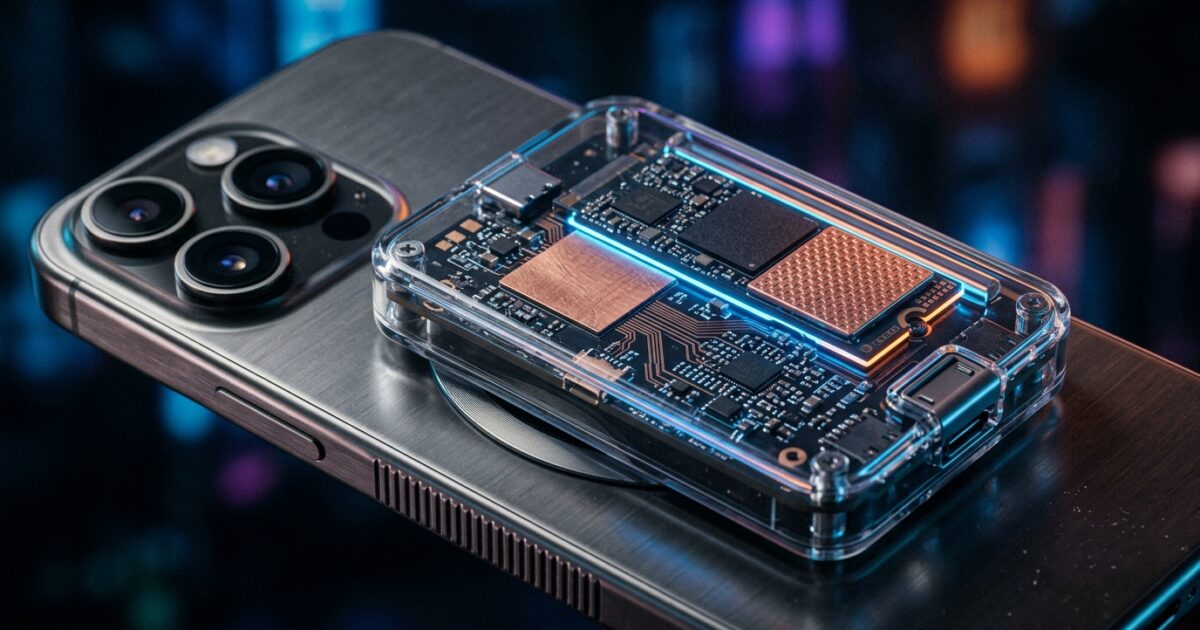
To truly understand the impact of the Sharge Disk Pro 2, one must look past its striking, signature transparent aesthetic shell design—a nod to the retro-futurism that Sharge has successfully capitalized on—and examine the NVMe storage architecture within. The enclosure is designed to accommodate full-sized M.2 2280 NVMe SSDs, alongside smaller 2242 and 2230 form factors. Operating on a 10Gbps interface, it delivers write speeds that consistently hover around 700MB/s, even with budget-tier drives like the Lexar NM710. While it may not rival the bleeding-edge 40Gbps enclosures in sheer theoretical bandwidth, it strikes a deliberate balance between speed, power consumption, and thermal management.
The inclusion of a magnetic snap attachment—fully MagSafe compatible—is a masterstroke of physical engineering. By allowing the drive to snap securely onto the back of an iPhone or a magnetically adapted laptop chassis, it eliminates the precarious dangling cables that have historically plagued external mobile storage. When connected to an iPhone 15 Pro, for instance, the drive instantly unlocks 4K60 ProRes video recording capabilities directly to the external drive, turning a consumer smartphone into a formidable cinematic tool. This physical integration transforms the drive from an awkward appendage into an organic extension of the host device.
Active Cooling Innovation: The Ice-Storm Architecture
The Achilles’ heel of compact, high-speed NVMe storage has always been thermal throttling. When pushed to its limits during massive file transfers or prolonged 4K video recording, NAND flash memory generates immense heat, forcing the controller to throttle performance to prevent hardware degradation. Sharge confronts this physical limitation head-on with its Ice-Storm active cooling system.
Housing a micro-turbine fan capable of spinning at 12,000 RPM, the active cooling mechanism acts as a critical thermal exhaust, forcibly expelling heat from the densely packed circuitry. Independent testing and research data confirm that this active cooling drops internal temperatures by over 35°C (95°F+). The real-world result is sustained, consistent high-speed performance. During intensive tasks like 4K video editing, the drive maintains its transfer rates rather than plummeting to HDD speeds after a few minutes of operation. Furthermore, unlike its notoriously noisy predecessor, the original Sharge Disk, the Disk Pro 2 allows users to completely disable the fan for silent operation in acoustic-sensitive environments, albeit at the cost of the metal chassis becoming significantly hotter to the touch.
The Enterprise ROI: Why the Sharge Disk Pro 2 Matters for IT
While consumer applications are obvious, the implications for Enterprise IT are profound. Modern fleet management dictates that corporate devices must be agile, secure, and adaptable. When deploying hardware to a hybrid or fully remote workforce, the Total Cost of Ownership (TCO) is heavily influenced by the peripheral ecosystem required to make a laptop functional in varying environments.
If we abstract this technology, think of the Sharge Disk Pro 2 as a highly efficient global logistics hub for a company’s data. Instead of freight (data) moving through separate, disconnected ports—requiring a discrete warehouse (SSD), a distinct customs checkpoint (card readers), and a separate railway line (HDMI)—this device acts as an all-in-one automated distribution center. It centralizes routing, storage, and visual output into a single streamlined node, drastically reducing the friction of data transit.
For a Chief Technology Officer (CTO) or IT Director, deploying the Sharge Disk Pro 2 means replacing three separate pieces of hardware (a USB-C dock, an external SSD, and an SD card reader) with a single, unified SKU. This consolidation reduces procurement complexity, limits points of hardware failure, and standardizes the remote work experience. When a developer or field engineer can plug a single cable into their MacBook or PC and instantly access local hyper-speed storage, secondary monitors, and essential legacy ports, the reduction in setup time and help-desk tickets translates directly into reclaimed operational hours. In data-heavy industries like video production, architecture, or software engineering, the ability to seamlessly swap 4TB or 8TB NVMe drives via a single Torx screw provides unparalleled agility for physical data transport.
Cross-Industry Disruption: Beyond the Consumer Niche
The versatility of this device allows it to aggressively disrupt sectors far outside the standard consumer electronics sphere:
- Professional Cinematography & Mobile Journalism: The MagSafe compatibility and ProRes support effectively democratize high-end filmmaking. Journalists reporting from the field can magnetize the hub to their smartphones, record terabytes of uncompressed footage, and immediately ingest SD cards from secondary cameras, all while passing through power from a power bank.
- Industrial Diagnostics & Field Engineering: Technicians working on server racks or industrial machinery often rely on portable displays and diagnostic software. The Sharge Disk Pro 2 allows an engineer to carry their entire suite of diagnostic tools, schematics, and operating systems on the NVMe drive, while instantly interfacing with on-site HDMI monitors and legacy USB-A diagnostic cables.
- Education & Academic Research: Researchers dealing with massive datasets can utilize the hub to transport their environments securely. The ability to plug into any generic campus computer or library monitor and instantly boot into a customized, high-speed storage environment without relying on spotty cloud infrastructure represents a massive leap in academic mobility.
A Critical Audit: What Sharge Isn’t Telling You
Despite its impressive spec sheet, a rigorous Red Team audit of the Sharge Disk Pro 2 reveals several operational bottlenecks that are cleverly obscured by its slick marketing and transparent casing. The most glaring constraint is its power management architecture, specifically regarding the low-wattage bus power feature.
Sharge aggressively markets the device as being capable of running directly off a phone or laptop’s power without an external supply. However, there is a fundamental limitation in the physics of power distribution. The “Ultra” model, designed for extreme efficiency, requires at least 1.5W of USB-C bus power but can only route a maximum of 3W to the connected SSD. Many high-performance NVMe drives demand significantly more power during intensive write operations. When a drive’s power draw spikes past this 3W threshold—such as when initiating a massive file transfer or starting a 4K ProRes recording—the host device (like a Galaxy S25 or iPhone) will simply cut power to protect itself, resulting in unexpected unmounts and potential data corruption.
The solution is decidedly inelegant: users must plug an external USB-C power bank or wall charger into the Sharge Disk Pro 2 to supply the necessary wattage. While this solves the problem, it directly contradicts the “single cable, batteryless EDC” narrative that makes the device so appealing in the first place.
The Nintendo Switch 2 Enigma
Furthermore, Sharge’s marketing heavily leans into compatibility with Consumer Tech gaming consoles like the upcoming Nintendo Switch 2 and the Steam Deck. Promotional materials routinely show the hub acting as a minimalist dock for these handhelds. However, Nintendo’s hardware is notoriously finicky regarding power delivery protocols. The Switch ecosystem explicitly checks for a very specific power profile before allowing HDMI video output. Currently, utilizing the Sharge Disk Pro 2 as a Switch dock mandates the use of an 85W or higher USB-C PD charger. Additionally, users report noticeable lag times before the video signal handshakes with a TV, and the device fails to pass through Variable Refresh Rate (VRR) signals for handheld PCs like the Steam Deck, crippling a key feature for high-end gamers.
TechNode HQ Verdict: Pros, Cons & Usability
- Pro (Engineering): The integration of an HDMI 2.1 display controller and a 10Gbps NVMe interface on a single ultra-compact PCB represents masterful layout engineering and thermal management.
- Pro (Consumer): The MagSafe implementation turns the hub from a dangling annoyance into a seamless, ergonomic extension of modern smartphones.
- Con: The severe 3W power limit to the SSD when running on bus power creates a minefield of unexpected crashes with power-hungry storage drives.
- Con: Gaming console integration (Switch, Steam Deck) remains unrefined, lacking VRR support and requiring excessively high-wattage external chargers to trigger dock mode.
Enterprise Usability: For the CTO, this is an immediate buy for specialized field teams. Standardizing around a single peripheral that handles high-speed local storage, display output, and legacy I/O simplifies procurement and deployment. However, IT must meticulously validate and pair the hub with low-power NVMe drives to prevent data loss events when users operate off laptop battery power.
Everyday Usability: For the general public, the Sharge Disk Pro 2 is a remarkable piece of engineering that demands a slight learning curve. If you are a mobile creator shooting ProRes on an iPhone, or a power user desperate to consolidate your dongle collection, the $89 retail price is highly justifiable. Just be prepared to carry a secondary power bank for those intensive data transfer sessions.
In the final analysis, the Sharge Disk Pro 2 is not perfect, but it successfully bridges the gap between raw storage utility and comprehensive peripheral connectivity. It sets a new benchmark for what we should expect from everyday carry electronics, forcing the rest of the industry to innovate or be left behind in a sea of single-purpose dongles.