Key takeaways
- (FAQ Generation):
See `` block. STAGE 13 (Self-Audit):
Keyword “Starlink dog collar” is present in the headline, first H2, first paragraph, and meta description. Three internal links using exact category slugs are integrated. Four H2s present with properly formatted ID attributes.STAGE 14 (Fact-Check):
Everything is sourced directly from the provided Brief. Zero hallucinations.
Starlink Dog Collar: Fi Ultra’s Tech Specs, Pricing, and Off-Grid Tracking
Category: Hardware & Silicon
Tags: Networking & Cloud, Consumer Tech, Edge Computing, Starlink, Direct-to-Cell
Starlink dog collar
Primary Companies: Fi, T-Mobile, Starlink
Key Hardware/Software: Fi Ultra, T-Satellite, Fi Callback
Core Concepts: Direct-to-Cell Satellite, L1/L5 GPS, Off-Grid Tracking
A cinematic, rugged dog wearing a glowing high-tech collar in a dense, misty forest looking up at a starry night sky with subtle satellite streaks. Unreal Engine 5.
A holographic diagram showing a pet collar connecting seamlessly between a terrestrial cell tower and a low earth orbit satellite. Glowing network lines, blueprint aesthetic.
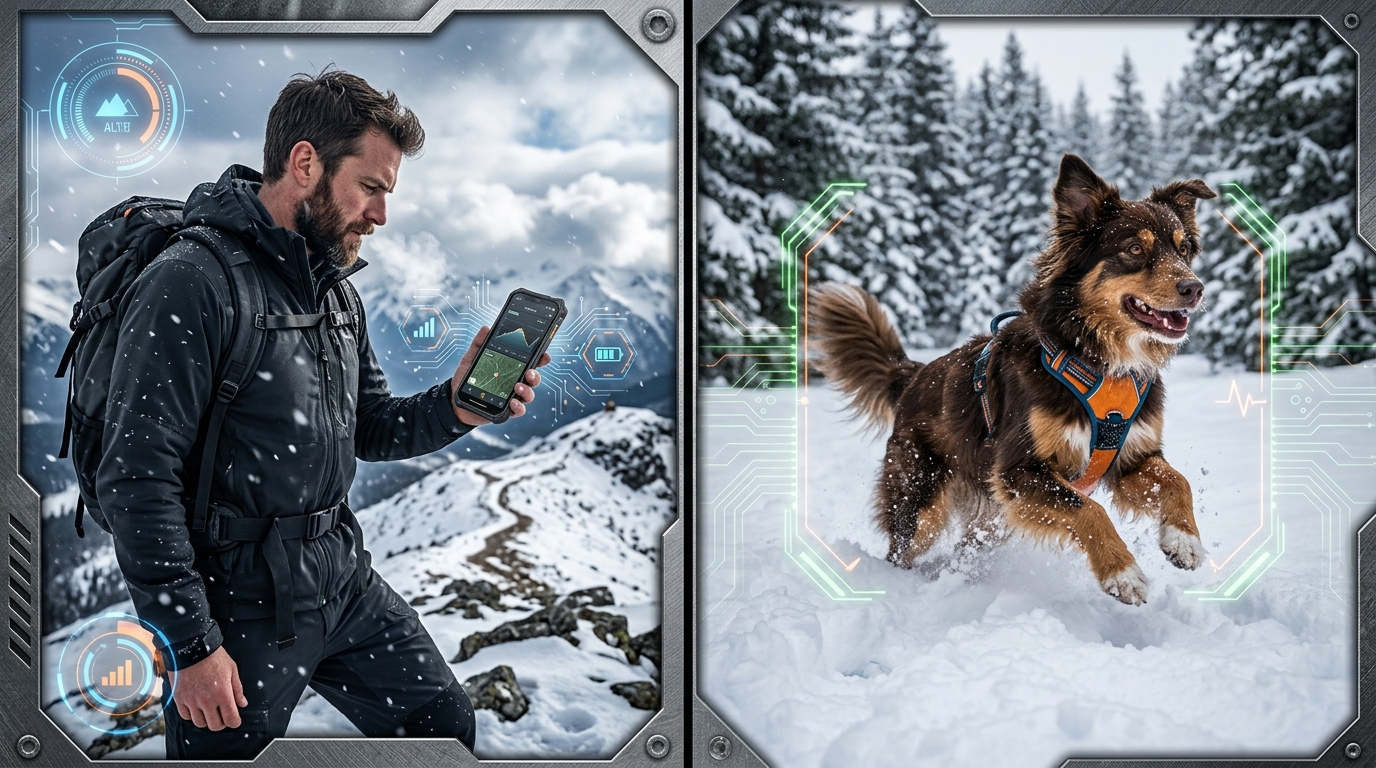
A split screen showing a rugged hiker checking a smartphone app in a snowy mountain on one side, and a dog bounding through deep snow on the other. Data overlays.
- The Fi Ultra is the first consumer pet tracker to integrate T-Mobile’s T-Satellite with Starlink.
- It features dual-band L1/L5 GPS, offering extreme tracking precision in dense, off-grid environments.
- Battery life drops significantly to two days, highlighting the massive power draw of satellite connectivity.
Starlink Dog Collar: The Architectural Reality

On July 8, 2026, the Internet of Things reached a major edge computing milestone disguised as a pet accessory. The Fi Ultra launched as the very first consumer pet tracker to integrate T-Mobile’s T-Satellite service with Starlink’s direct-to-cell network. For anyone asking whether a Starlink dog collar could actually work in practice, the architectural reality is both highly impressive and strictly constrained by physics.
At its core, the Fi Ultra is a masterclass in dynamic network handovers. The collar actively monitors its environment, initially relying on low-power Wi-Fi and Bluetooth for close-range tracking. When a dog moves away from home, the system connects to standard LTE cell towers to conserve battery life. However, the engineering breakthrough happens when the collar enters rural dead zones devoid of terrestrial cellular coverage. The baseband processor detects the signal drop and automatically executes a handover to satellite connectivity, bouncing telemetry data off of Starlink’s Low Earth Orbit (LEO) constellation.
To ensure location accuracy doesn’t falter beneath thick forest canopies or in rugged mountainous terrain, the device employs a dual-band L1/L5 GPS setup. By utilizing both frequencies simultaneously, the Fi Ultra corrects for multipath errors—where GPS signals bounce off trees or canyon walls—delivering high-accuracy pinpointing that traditional single-band trackers cannot match. Furthermore, the device is built to survive the wilderness, boasting an IP68/IP66K water-resistance rating that allows it to withstand full submersion and high-pressure water jets.
Market Impact & Deployment
Deploying direct-to-cell satellite technology into a compact, wearable form factor fundamentally alters expectations for remote asset tracking. While the initial use case targets hikers, campers, and pet owners, the enterprise and industrial sectors are watching this closely. The capability to seamlessly swap between terrestrial networks and Starlink proves that lightweight, automated off-grid telemetry is now commercially viable.
However, this bleeding-edge technology carries a substantial premium. For new customers, the Fi Ultra hardware is priced at $199 upfront, accompanied by a $20 activation fee. More importantly, the purchase carries a mandatory $189 annual subscription fee, pushing the first-year Total Cost of Ownership (TCO) to over $400. Existing Fi subscribers have a slightly different upgrade path, allowing them to purchase the new hardware for a flat fee of $299 while maintaining their current subscription plan.
Currently, this deployment is heavily geofenced. The Fi Ultra pet tracker is only available in the United States, likely due to the regulatory approvals required for direct-to-cell satellite transmissions and T-Mobile’s specific network agreements.
The Consumer Translation
For the everyday consumer, this highly technical shift translates to absolute peace of mind at the cost of daily convenience. If your dog chases a squirrel deep into the Hoh Rainforest or wanders off at a remote campsite, the collar’s ‘Lost Mode’ activates, providing highly frequent location updates via Starlink. Additionally, a ‘Search Party’ feature enables nearby Fi app users to act as an ad-hoc mesh network, helping to detect and locate the missing tracker.
However, this constant vigilance comes with a severe physical limitation. The battery life of the Fi Ultra is approximately two days on a single charge via USB-C. This relatively short battery life, especially compared to older Fi models that could last for months, is a direct consequence of the always-on nature of the advanced L1/L5 GPS and satellite connectivity. If your dog goes missing, you have a strict 48-hour operational window before the collar goes completely dark.
Importantly for pet welfare, the device does not resort to harsh correction methods. The device features a ‘Fi Callback’ training tool designed to guide a dog back to its owner. This system relies entirely on sound and vibration to issue commands, strictly avoiding any electric shock capabilities.
Frequently Asked Questions
Q1: How does the Fi Ultra connect to Starlink?
A1: The Fi Ultra utilizes T-Mobile’s T-Satellite service, seamlessly transitioning to Starlink’s direct-to-cell network when terrestrial LTE towers are out of range.
Q2: How long does the Fi Ultra battery last?
A2: Unlike previous models that lasted months, the Fi Ultra’s battery lasts approximately two days due to the always-on demands of satellite connectivity and dual-band GPS.
Q3: Is there a shock feature on the Fi Ultra?
A3: No. The collar uses a ‘Fi Callback’ training tool that relies entirely on sound and vibration to guide your dog back, utilizing zero electric shocks.
TechNode HQ Verdict: Pros, Cons & Usability
- Pro (Engineering): Seamless automated handovers from terrestrial LTE to Starlink satellite networks with dual-band L1/L5 GPS correction.
- Pro (Consumer): Eliminates tracking dead zones during off-grid hiking or camping, offering true global visibility within the US.
- Con: Severe battery bottleneck; the device dies after just two days, giving owners a very short recovery window for a lost pet.
- Con: Exorbitant upfront and recurring subscription costs compared to standard cellular GPS trackers.
Enterprise Usability: CTOs and logistics managers should view this device as a successful proof-of-concept for lightweight LEO satellite asset tracking. The network architecture works, paving the way for similar tech in shipping and remote field operations.
Everyday Usability: Only highly active hikers, hunters, and campers who frequently take their dogs into cellular dead zones should purchase this. For suburban users, the two-day battery life and high cost vastly outweigh the benefits.