Key takeaways
- The Steam Machine 2026 packs AMD Zen 4 and RDNA 3 silicon into a remarkably small 6-inch cube.
- Launching at $1,049, its price is heavily inflated by the ongoing global component shortage.
- Single-channel memory bottlenecks the APU, raising questions about its high-end 4K gaming viability.
- Valve’s recent release of official Windows drivers opens the platform beyond the native SteamOS experience.
- Supply is tightly constrained, requiring lottery-style sales to manage massive backlog demand.
When Valve officially launched the highly anticipated Steam Machine 2026 on June 29, the technology sector was watching closely. Codenamed “Fremont,” the device represents a paradigm shift in how we think about living room computing and digital entertainment. It is an engineering marvel, effectively miniaturizing desktop-grade performance into a chassis that challenges the traditional console market. Yet, despite its sophisticated design and raw capabilities, the device arrives at one of the most turbulent periods in the history of consumer electronics supply chains. With global memory and storage shortages driving prices through the roof, the device is both a triumph of design and a victim of macroeconomic circumstance.
In this comprehensive architectural deep dive, we will unpack the hardware decisions that power Valve’s latest hardware venture, analyze the operating system ecosystem, and translate these technical realities into the broader economic landscape that dictates the future of high-performance micro-computing.
Unboxing the Steam Machine 2026: Ambition Meets Reality
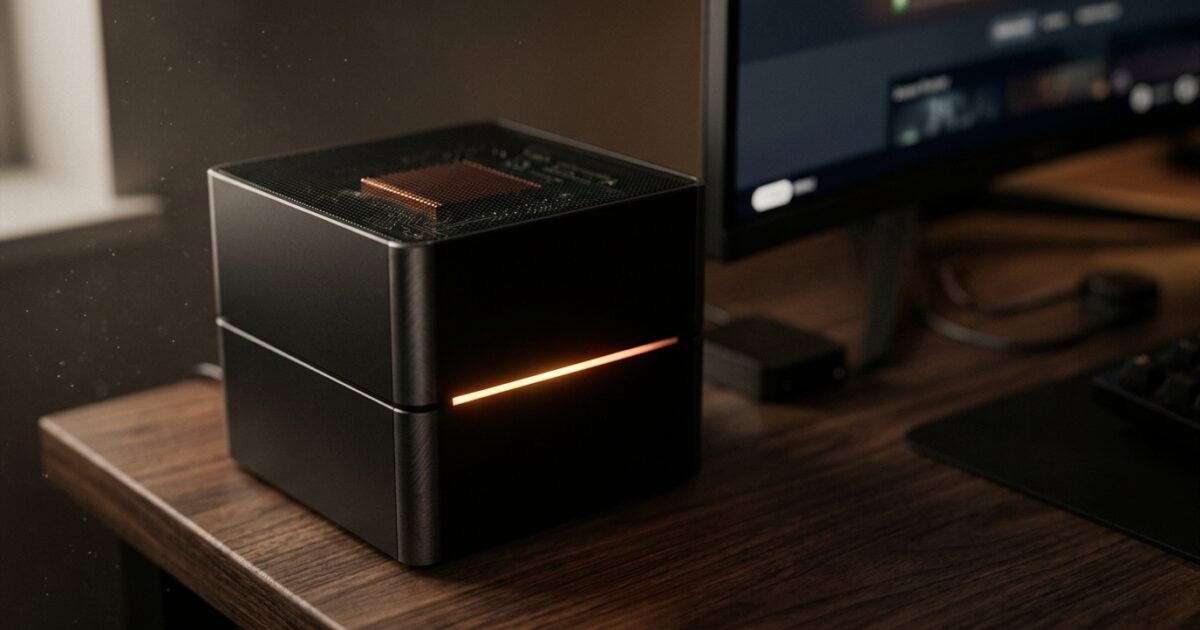
The immediate physical impression of the device is striking. Valve has managed to engineer a small, 6-inch black cube that is significantly smaller than both the PlayStation 5 and the Xbox Series X. The aesthetic is heavily customizable; it features a removable, magnetic front faceplate that allows users to swap between various finishes, including fabric and woodgrain. This level of aesthetic modularity speaks to a design philosophy that values personalization, contrasting sharply with the monolithic, unchangeable towers of traditional consoles.
Despite its diminutive stature, the machine is dense. It exudes a premium build quality that validates its high price point to some extent. However, it is crucial to temper expectations regarding its form factor: this is not a Steam Deck. It is a stationary micro-console. It requires a dedicated power outlet—mercifully utilizing a standard power cord without a cumbersome external power brick—and must be tethered to a TV or monitor. Its portability lies in the ease with which it can be tossed into a backpack for a weekend trip, rather than played during a daily commute.
The cooling apparatus is arguably the most dominant physical feature. The entire chassis essentially functions as a sophisticated wind tunnel. Intake vents on the front pull cool air over the densely packed components, while a massive rear exhaust fan aggressively expels the heat. While the system operates with impressive acoustic subtlety, the sheer volume of hot air exhausted from the rear is a testament to the thermal payload generated by the silicon inside.
Silicon Anatomy: AMD Zen 4 and the Thermal Challenge
Beneath the swappable faceplates lies a formidable processing engine. The system is powered by a semi-custom AMD Zen 4 CPU paired with an RDNA 3-based GPU architecture. This combination brings modern PC gaming architecture directly into the living room, theoretically capable of matching or exceeding the graphical fidelity of the current generation of dedicated consoles.
The base configuration, priced at an eye-watering $1,049, includes 512GB of internal storage, 16GB of DDR5 system RAM, and 8GB of GDDR6 VRAM dedicated to the graphical processor. For those willing to invest even more, a 2TB model is available for $1,349, which also bundles a specialized controller. Both models feature a microSD card slot for expandable storage, an essential inclusion given the rapidly ballooning install sizes of modern AAA software.
The Single-Channel Memory Bottleneck
Despite the cutting-edge processor, early technical audits have revealed a critical architectural compromise: the utilization of single-channel memory. In an APU (Accelerated Processing Unit) configuration where the CPU and GPU share the same silicon die and often the same memory pathways, memory bandwidth is paramount. By opting for single-channel memory, Valve has inadvertently instituted a severe bottleneck. While the device is demonstrably faster than the portable Steam Deck, this memory constraint severely limits the RDNA 3 GPU’s ability to flex its muscles at higher resolutions.
Valve explicitly warns that “Verified” software titles are optimized and tested for a 1920×1080 (1080p) resolution. While the hardware can output a 4K signal, the gaming experience at that resolution is frequently marred by framerate inconsistencies and graphical driver errors. For a device starting at over a thousand dollars, the inability to confidently drive a 4K display in an era where 4K televisions are ubiquitous is a glaring technical concession.
The OS Ecosystem: SteamOS vs. Windows
Out of the box, the hardware boots directly into SteamOS, Valve’s proprietary Linux-based operating system. SteamOS provides a heavily curated, console-like user interface that abstract away the complexities of standard PC gaming. The setup process is remarkably frictionless: plug it in, connect to Wi-Fi, log into your account, and your entire digital library is immediately available for download. This seamlessness is a monumental achievement in lowering the barrier to entry for PC gaming.
However, the closed nature of SteamOS is not mandatory. In a remarkably consumer-friendly move, Valve has released official Windows drivers for the device. This allows power users to wipe the Linux installation and install Windows 10 or Windows 11, transforming the closed console back into a fully open, versatile personal computer. This flexibility is the device’s greatest software asset, ensuring that users are never completely locked into Valve’s specific software ecosystem if they require broader application compatibility.
The Macroeconomic Headwinds: Pricing the Unpriceable
To evaluate this hardware purely on its technical merits is to miss the broader economic reality of 2026. The electronics industry is currently paralyzed by a severe global component crisis, colloquially referred to by industry analysts as “RAMageddon.” The costs for crucial materials—specifically NAND flash for SSDs and DDR memory modules—have skyrocketed.
This supply chain catastrophe is the primary driver behind the astronomical $1,049 starting price. Valve is not merely attempting to price-gouge; they are attempting to manufacture complex silicon at the peak of a historic supply drought. The launch of the console was notably restricted, employing “sales lotteries” to randomly select buyers from massive waitlists simply to manage the scarce inventory.
From an enterprise ROI perspective, this dynamic is fascinating. If we treat this console as a proxy for hyper-dense edge computing nodes, the pricing models indicate a broader chilling effect on IT infrastructure expansion. When consumer goods are priced this highly just to break even on the Bill of Materials (BOM), enterprise hardware deployments utilizing similar silicon architectures will see exponential cost increases.
Enterprise Abstraction: The Hyperconverged Console
To understand what Valve has built from an executive perspective, consider the shift in data centers from disparate, custom-built servers to standardized hyperconverged infrastructure (HCI) appliances. For decades, PC gaming was like the old data center: highly customized, frustrating to troubleshoot, and requiring dedicated “IT” knowledge to maintain.
The new Steam Machine is essentially an HCI appliance for the living room. It takes the wildly complex, fragmented ecosystem of Windows gaming hardware and abstracts it behind a unified, tightly controlled software layer (SteamOS) and standardized hardware. It delivers the theoretical power and flexibility of a custom build, but with the deployment speed and user-friendly interface of a plug-and-play appliance. It is a masterful exercise in abstraction, simplifying the complex without entirely locking down the underlying architecture.
Final Verdict: An Enthusiast’s Dream or a Supply Chain Victim?
Valve has proven, without a doubt, that they can engineer highly desirable, incredibly compact hardware. The device is a masterclass in thermal management and spatial efficiency. However, the hardware exists in a state of friction with the current market reality.
- Pro (Technical): Astounding miniaturization of Zen 4 and RDNA 3 architecture into a 6-inch chassis.
- Pro (Consumer): A completely frictionless, console-like setup experience that successfully abstracts the pain points of PC gaming.
- Con: Single-channel memory drastically bottlenecks the APU, artificially capping performance at 1080p for most modern titles.
- Con: The $1,049 starting price is prohibitively expensive, driven entirely by an inescapable global component shortage.
Enterprise Usability: For IT executives monitoring edge computing form factors, the thermal design of this cube is a phenomenal case study in passive-aggressive cooling. However, its consumer price reflects a supply chain toxicity that dictates holding off on major silicon purchases until global DRAM and NAND manufacturing stabilizes.
Everyday Usability: Should the public buy this now? Only the most dedicated enthusiasts with deep pockets should participate in the current sales lotteries. For the average consumer, the traditional console ecosystem—despite its own recent price hikes—remains a far more economically viable entry point into high-end gaming. Valve has built a fantastic machine for the future, but it has arrived in an undeniably hostile present.