
Key takeaways
- Subquadratic’s $29M funding fuels SubQ, an AI model processing up to 12 million tokens simultaneously.
- Sparse attention architecture replaces traditional dense quadratic scaling, enabling linear compute efficiency.
- SubQ claims to reduce compute requirements by nearly 1,000x compared to leading frontier models.
- Independent verification is pending, with experts questioning the reliance on self-reported benchmarks.
- Enterprise applications include SubQ Code for full-repository ingestion and a long-context search tool.
The AI industry is confronting the hard physical limits of the “transformer tax,” where compute costs scale quadratically with context length. Enter Subquadratic, a Miami-based startup that recently emerged from stealth with $29 million in seed funding (Paragraph 3). Their ambitious goal is to break this bottleneck by delivering an unprecedented 12M-token context window, fundamentally shifting how models process massive datasets.
The Architectural Reality of a 12M-token context window
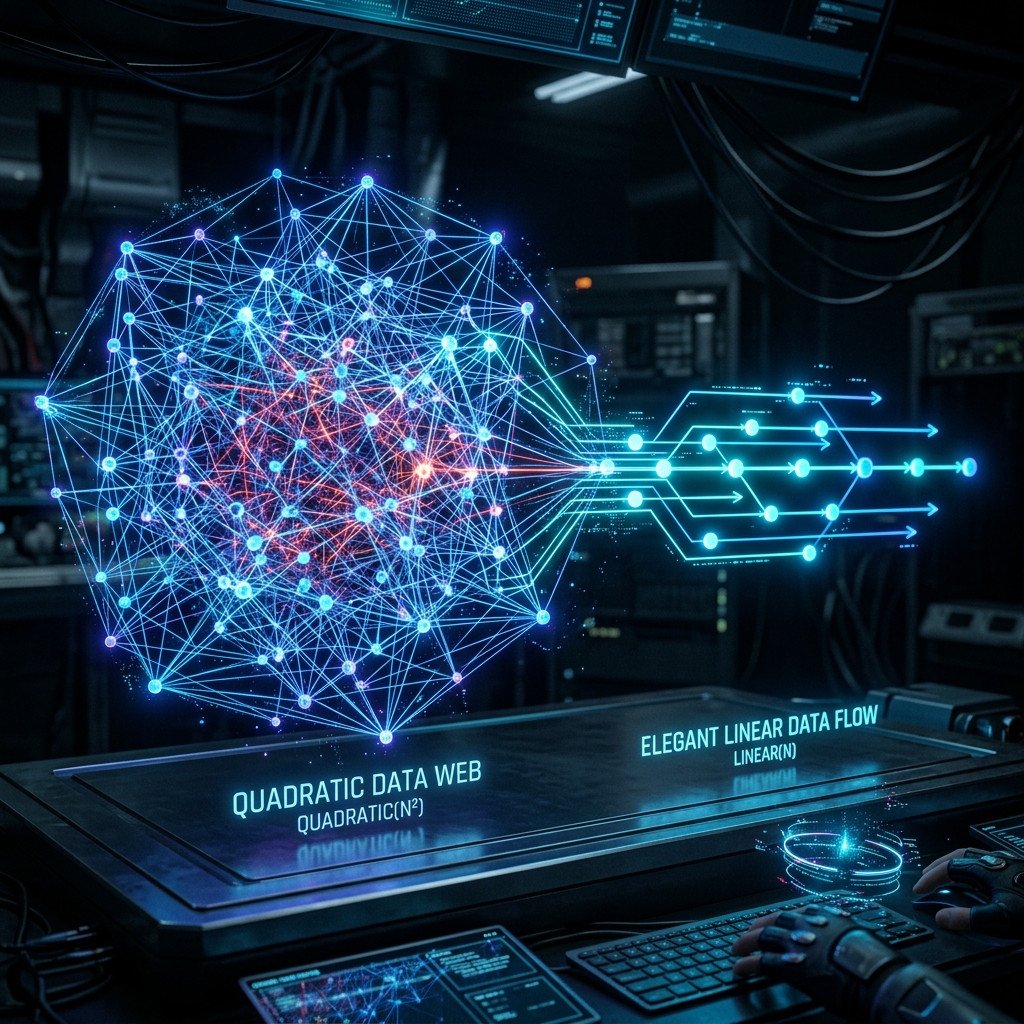
Current frontier AI models, such as Claude Sonnet 4.7 and Gemini 3.1 Pro, typically cap out at a 1-million-token limit (Paragraph 7). Scaling beyond this with traditional dense attention mechanisms demands exponentially more compute power because every token must be compared against every other token. To achieve a 12M-token context window, Subquadratic engineered a proprietary architecture dubbed Subquadratic Selective Attention (SSA) (Paragraph 11). As CEO Justin Dangel explains, this sparse attention model shifts the compute curve from quadratic scaling to linear scaling (Paragraph 9). At its theoretical peak, this innovation allows the model to analyze roughly 9 million words—the equivalent of 120 books—without exorbitant compute overhead (Paragraph 9). For deep dives into the underlying hardware required for these workloads, explore our coverage on hardware & silicon. Insufficient data available to expand further on the low-level silicon instructions utilized by the SSA architecture.
Market Impact & Deployment

If Subquadratic’s self-reported figures hold true, the market disruption could be immense. The startup claims its SubQ model is over 50 times faster and 50 times cheaper than current frontier models at the 1-million-token mark (Paragraph 17). At the full 12 million-token limit, the compute requirement is allegedly reduced by nearly 1,000x (Paragraph 18). Furthermore, on the RULER 128K long-context benchmark, SubQ reportedly scored 95% accuracy at a cost of just $8, compared to $2,600 for Claude Opus (Paragraph 19). Subquadratic is actively pushing this into production with three initial offerings: a full-context API for developers, a search tool, and SubQ Code—a command-line interface agent designed to load entire codebases into a single context (Paragraph 24). For a wider view on how this shifts corporate infrastructure, visit our enterprise IT insights.
The Consumer Translation
What does this shift mean for the average consumer? Today’s AI chatbots often “forget” earlier instructions in a long conversation, or require complex Retrieval-Augmented Generation (RAG) systems to fetch data (Paragraph 21). A linear-scaling, massive context window means a user could upload an entire year’s worth of personal financial documents, extensive legal contracts, or gigabytes of academic papers into a single prompt. The AI would retain a flawless memory of the entire dataset. This capability democratizes high-level data synthesis, freeing everyday users from the rigid data curation that currently throttles AI assistants.
Navigating Industry Skepticism
Despite the high valuation and high-profile investors like Justin Mateen and Javier Villamizar (Paragraph 26), the broader developer community remains cautious. Independent verification of SubQ’s performance is still pending. Critics point out the lack of a formal technical report and question whether the early benchmarks, which highlight “needle-in-a-haystack” retrieval accuracy, will hold up under complex reasoning tasks. Reports also indicate the model might be built upon existing open-source weights rather than trained entirely from scratch. To stay updated on how verifiable these claims prove to be in real-world testing, keep an eye on our AI & machine learning tracker.
TechNode HQ Verdict: Pros, Cons & Usability
- Pro (Engineering): The shift to linear scaling via sparse attention radically reduces the mathematical computations required per token.
- Pro (Consumer): Enables frictionless, zero-setup analysis of massive document libraries and entire codebases without piecemeal uploading.
- Con: Claims are currently self-reported and lack comprehensive, independent technical validation.
- Con: The model is entirely proprietary and closed-source, limiting community inspection of its underlying mechanics.
Enterprise Usability: CTOs and lead developers should evaluate the SubQ API beta immediately. The ability to ingest a full repository via SubQ Code without configuring complex multi-agent setups could significantly lower operational latency. However, avoid pivoting mission-critical RAG pipelines until independent benchmark validation is complete.
Everyday Usability: For the general public, SubQ Search presents an intriguing tool for heavy-duty research. If it remains free during its initial phase as promised, it is highly recommended for users handling dense, voluminous reading material.