Key takeaways
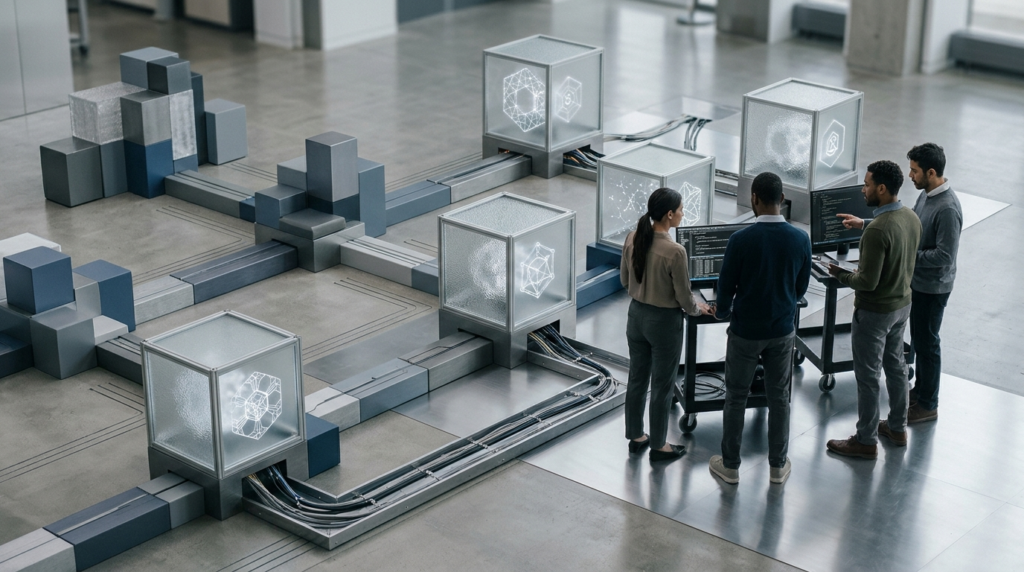
- IBM’s GIST model cuts CFD simulation time from tens of thousands of core-hours to a staggering 10 seconds.
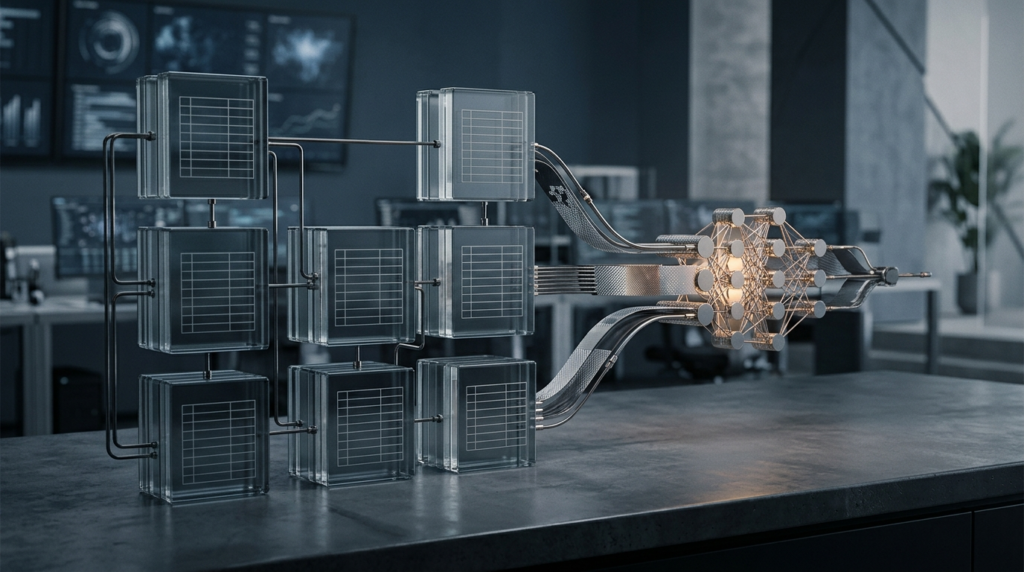
- AI CFD Surrogates rely on advanced manifold meshes rather than simple point clouds for high aerodynamic fidelity.
- Machine learning enables Formula 1 teams to algorithmically scale 1,000 CFD runs into 1 million actionable data points.
The Architectural Reality of AI CFD Surrogates
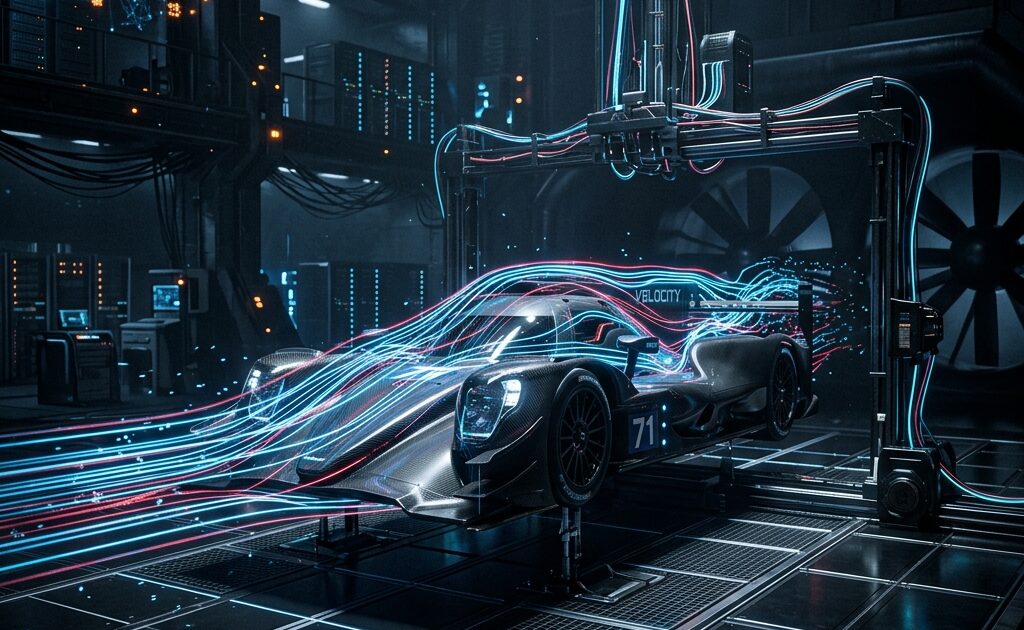
Since the introduction of inverted wings to racing cars halfway through the 1960s, airflow has been the single most critical variable in motorsport. Until that seminal era, the primary engineering objective was simply to make a chassis as slippery as possible to reduce aerodynamic drag and maximize top speed on long straights. However, legendary designers like Jim Hall at Chaparral and Colin Chapman at Lotus revolutionized the discipline by realizing they could utilize passing airflow to actively push the car downward onto the tarmac. This generated immense mechanical grip, allowing vehicles to carry unprecedented velocity through corners. The pursuit of aerodynamic downforce began as an empirical dark art, but as physical wind tunnel testing became tightly regulated, dangerous, and prohibitively expensive, teams shifted aggressively toward Computational Fluid Dynamics (CFD). For decades, CFD has reigned supreme. Yet today, this compute-heavy methodology is hitting an absolute ceiling. Simulating complex airflows over intricate vehicle geometries requires immense supercomputing power, often demanding tens of thousands of core-hours per single design iteration. The global motorsport industry is now undergoing a radical paradigm shift as highly advanced AI CFD Surrogates replace traditional physics simulations.
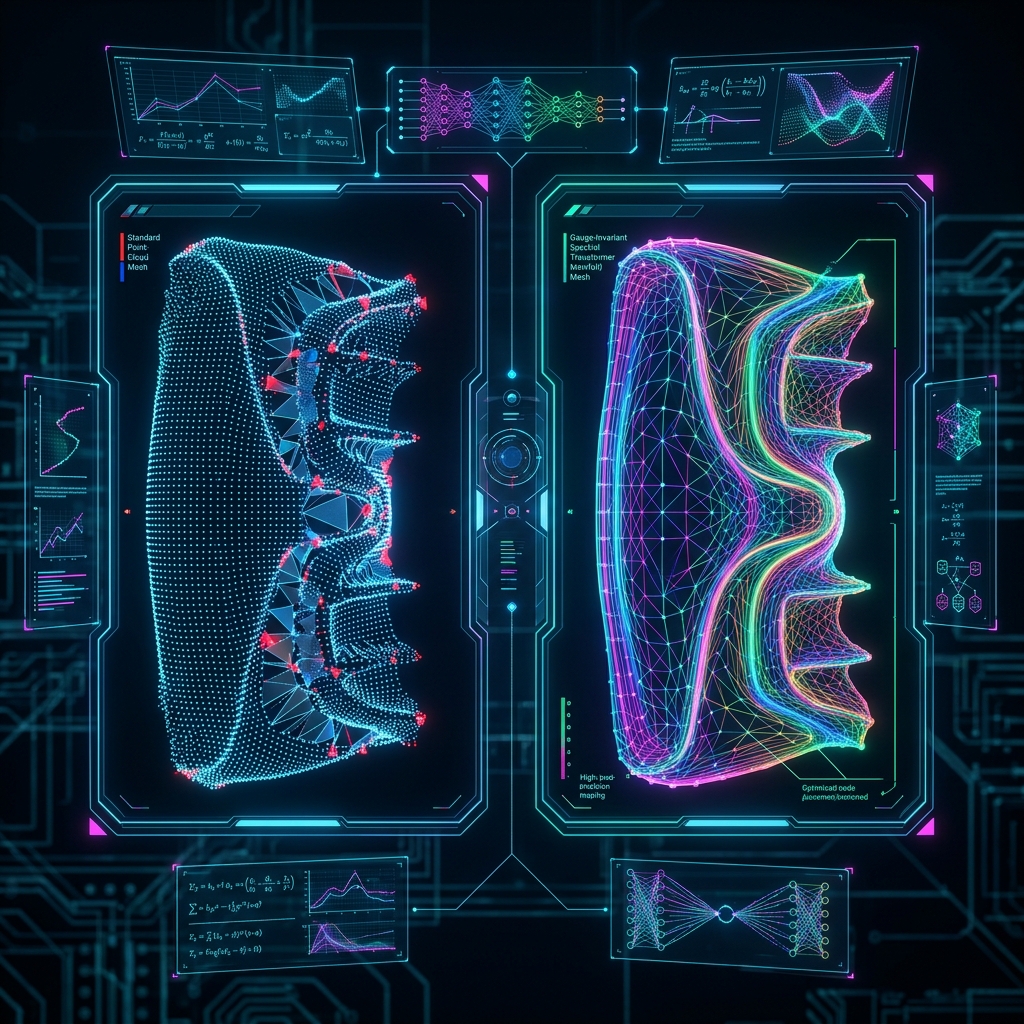
In a groundbreaking research publication that has sent shockwaves through the engineering sector, IBM and the Dallara Group recently introduced their Gauge-Invariant Spectral Transformer (GIST). Dallara—a legendary chassis manufacturer responsible for the entire IndyCar and Super Formula grids, as well as the fundamental spine of sports prototypes for Audi, Ferrari, BMW, Cadillac, and McLaren—provided an unprecedented dataset for this initiative. Unlike early AI iterations that treated vehicle meshes as primitive, disconnected point clouds, GIST operates as a highly sophisticated graph-based neural operator. It meticulously maps the exact topology of a vehicle’s surface as a continuous manifold mesh. This revolutionary mathematical approach retains the structural and geometric integrity of complex aerodynamic features, ensuring that the relationships between various physical links and surfaces are deeply understood by the algorithm.
When tested against the complex wake interactions of rotating wheels and the shaped underfloor of a Le Mans Prototype 2 (LMP2) race car, the GIST model produced aerodynamic pressure fields and downforce coefficients with an accuracy margin comparable to conventional CFD. The defining difference? The AI model executed this predictive task in a staggering 10 seconds on a single CPU. For engineers operating at the absolute bleeding edge of AI & Machine Learning, this represents a monumental leap in iteration velocity. By completely sidestepping the Navier-Stokes equations that bog down traditional fluid dynamics solvers, AI CFD Surrogates allow designers to evaluate hundreds of microscopic geometric permutations in the time it previously took to render a single CFD frame.
The Historical Compute Bottleneck: From Tunnels to Teraflops
To truly comprehend the magnitude of this artificial intelligence breakthrough, one must first examine the suffocating computational bottleneck that traditional CFD created. Historically, verifying aerodynamic downforce meant putting a scale model in a wind tunnel. While wind tunnels can run day and night without the risk of injuring a driver in a real-world track crash, they are astonishingly expensive to operate, calibrate, and maintain. As motorsport governing bodies—particularly the FIA in Formula 1—began severely restricting both on-track testing and wind tunnel hours to artificially level the playing field and cap exorbitant team budgets, engineers sought refuge in silicon. Computational Fluid Dynamics emerged as the ultimate digital wind tunnel. In racing, where teams fight for margins measured in thousandths of a second, the ability to iterate designs in a virtual environment became the ultimate competitive advantage.
However, the underlying mathematics of CFD are notoriously unforgiving. To simulate airflow over a modern race car, engineers must break the virtual environment down into millions, sometimes billions, of finite volume cells—a process known as meshing. The computer must then iteratively solve the Navier-Stokes equations across every single one of these microscopic cells to model pressure, velocity, temperature, and turbulence. This is not a linear process. Modeling complex phenomena like boundary layer separation, turbulent wakes behind spinning tires, and the precise interaction between a front wing cascade and a rear diffuser requires incredibly dense computational arrays. Utilizing advanced turbulence models like Large Eddy Simulation (LES) or even the industry-standard Reynolds-Averaged Navier-Stokes (RANS) equations demands massive High-Performance Computing (HPC) clusters.
As the fidelity of CFD software improved, so too did its insatiable appetite for processing power. It is now common for a single high-fidelity simulation evaluating pitch, yaw, and roll sensitivity to consume tens of thousands of core-hours. This computational hunger has effectively created a new bottleneck. Engineers frequently find themselves waiting days for a supercomputer to spit out the results of a minor front wing flap adjustment. The infrastructure required to run these simulations at scale is financially crippling, locking out smaller engineering firms and forcing top-tier teams to spend millions annually on cloud computing instances and private server farms. By replacing these brute-force mathematical physics solvers with highly optimized neural network inference, AI CFD Surrogates obliterate this computational roadblock, offering instantaneous feedback and democratizing aerodynamic research.
Deep Dive: IBM GIST and the Dallara LMP2 Case Study
The collaboration between IBM Research and the Dallara Group serves as the ultimate real-world validation of AI CFD Surrogates. Until this joint venture, publicly available aerodynamic AI models largely focused on smooth, generic passenger car shapes. These models completely failed to capture the chaotic, turbulent reality of a high-downforce racing machine. Dallara’s proprietary dataset changed everything. By feeding the Gauge-Invariant Spectral Transformer an enormous repository of historical CFD data based on a simulated LMP2 sports prototype, IBM was able to train the neural operator on some of the most complex aerodynamic interactions in the physical world.
The researchers specifically focused on adjusting the angle of the LMP2 car’s rear diffuser—a critical component that manages the expansion of air exiting the vehicle’s underfloor to generate massive suction and downforce. By sweeping the diffuser angle from a conservative -2 degrees to an aggressive +4 degrees, the engineers tested the AI’s ability to predict how these minor geometric tweaks would impact the overarching pressure field of the entire vehicle. Traditional AI models relying on point-cloud representations historically failed this test, as they could not comprehend how a surface change at the rear of the car cascaded through the aerodynamic wake of the front wheels and underfloor tunnels.
Because GIST rigorously treats the vehicle surface as a continuous manifold mesh, it inherently understands the topological continuity of the chassis. It acts with gauge invariance, meaning its physical predictions remain mathematically consistent regardless of how the coordinate system is arbitrarily mapped across the complex carbon fiber curves. The results published by IBM were nothing short of a watershed moment for aerodynamic engineering. The physics-based AI approach mirrored the pressure-field modeling of the traditional CFD solver with astonishing precision. But while the standard CFD campaign required tens of thousands of core-hours churning through complex fluid dynamic equations, the IBM GIST model output the exact same aerodynamic insights in seconds using only a standard, off-the-shelf desktop CPU. This orders-of-magnitude reduction in latency allows aerodynamicists to fundamentally rethink their workflow, shifting from a slow, deliberate validation process to an aggressive, high-frequency design exploration phase.
Market Impact & Deployment: F1’s Regulatory Arms Race

The financial and computational ramifications of this technological shift are profoundly visible in the rarefied, hyper-competitive world of Formula 1. In modern F1, regulatory bodies enforce strict Aerodynamic Testing Restrictions (ATR). These rules place hard caps on the number of hours a team can utilize a wind tunnel—which is already restricted to 60 percent scale models—as well as placing strict limitations on total CFD computing teraflops. The ATR operates on a sliding scale designed to equalize the grid: the higher a team finishes in the Constructors’ Championship one year, the less wind tunnel and CFD time they are permitted the following season. In this heavily restricted environment, computing efficiency is just as valuable as aerodynamic efficiency. To maximize these capped resources, F1 teams have engaged in a technological arms race, partnering with specialized AI startups to stretch their compute budgets to the absolute limit.
Enter Neural Concept, a cutting-edge startup that is currently assisting at least four major Formula 1 teams, including Racing Bulls, to deploy machine learning algorithms into their core engineering pipelines. By integrating these AI CFD Surrogates, F1 engineers can aggressively model external aerodynamics, as well as complex internal thermodynamics like cooling the high-density cells within the hybrid power unit’s battery pack. Pierre Baqué, the CEO and founder of Neural Concept, articulated the profound leverage this technology provides. “It’s really a way to go from 100 or 1,000 CFD runs to be able to have 1 million data points at the end of the day,” Baqué stated. This algorithmic scaling allows engineers to explore vast, multidimensional design spaces that would be physically impossible to evaluate under the strict FIA compute regulations.
For modern Enterprise IT leaders managing massive cloud architectures outside of motorsport, the appeal of AI surrogates extends far beyond the racetrack. The ability to shift high-fidelity simulation workloads from massive, power-hungry GPU clusters to standard CPUs fundamentally alters the Total Cost of Ownership (TCO) for hardware development and industrial design. By deploying these models on local Networking & Cloud infrastructure, engineering firms can drastically reduce their reliance on expensive third-party cloud computing instances. This transition effectively democratizes top-tier aerodynamic testing, enabling mid-sized engineering firms, aviation startups, and independent automotive manufacturers to leverage simulation capabilities previously guarded by multi-billion-dollar aerospace conglomerates.
The Bottleneck: AI’s Extrapolation Problem and Data Hygiene
Despite the sensational performance gains and the allure of near-instantaneous aerodynamic feedback, AI is not entirely displacing traditional CFD just yet. A rigorous, objective audit of the technology reveals a critical bottleneck: the fundamental mathematical difference between interpolation and extrapolation. Neural networks are exceptionally powerful at identifying patterns within the data they have already ingested. If an AI surrogate is trained on thousands of variations of an LMP2 rear diffuser ranging from -2 to +4 degrees, it will interpolate a new design at +1.5 degrees with flawless accuracy. However, if a renegade aerodynamicist introduces a radically unprecedented chassis redesign—perhaps an entirely novel front wing cascade or an extreme underfloor tunnel geometry that the model has never encountered—the AI surrogate is highly likely to hallucinate, returning physically impossible airflow data.
As Neural Concept CEO Pierre Baqué transparently notes, “The accuracy of the model is only guaranteed within a specific range of situations that are not too far from what you have already explored.” The neural network can only predict accurately within the strict boundaries of its existing CFD training distribution. It does not actually “understand” the laws of physics or the Navier-Stokes equations; it merely recognizes complex, high-dimensional statistical correlations between geometric shapes and pressure fields. Therefore, relying entirely on AI without physical validation is an engineering death sentence in a sport where miscalculating downforce can lead to catastrophic crashes at 200 miles per hour.
To combat this extrapolation limitation, motorsport teams must maintain uncompromising data hygiene. The workflow requires engineers to continuously feed the AI model fresh, high-fidelity CFD baseline runs to actively retrain the neural operator whenever design architectures shift significantly. The gap between an interesting idea and actual on-track value lies entirely in defining the right workflows, determining what specific type of ground-truth CFD data needs to be generated, and calculating exactly how often the AI model must be retrained to prevent data drift. The immediate future of motorsport engineering is not a total, outright replacement of Computational Fluid Dynamics. Instead, it is a hybrid, active-learning pipeline where limited, highly targeted traditional CFD runs act as the physical anchor for massive, AI-driven design explorations.
The Consumer Translation: Aerodynamics for the EV Era
While this computational revolution is currently heavily localized within the secretive silos of elite motorsport and enterprise supercomputing facilities, its downstream effects on the worldwide consumer market will be swift and substantial. The global automotive industry is currently navigating the most significant transition in its history: the mass adoption of electric vehicles (EVs). In the realm of internal combustion engines, aerodynamic drag was largely viewed as an impediment to fuel economy and top speed. In the EV era, aerodynamics is the primary battleground for market dominance. The drag coefficient of an electric vehicle directly dictates its battery range, and range anxiety remains the single largest psychological barrier preventing mainstream consumers from adopting battery-electric technology.
To squeeze every possible mile out of a heavy lithium-ion battery pack, commercial automakers are investing billions into aerodynamic optimization. By utilizing AI CFD Surrogates pioneered by IBM, Dallara, and Neural Concept, mainstream automotive manufacturers can iterate vehicle designs at a fraction of the historical cost and computational time. Instead of waiting weeks to validate the airflow over a new side mirror design or front fascia, automotive engineers can evaluate hundreds of microscopic tweaks in real-time during the digital drafting phase. This rapid iteration cycle directly translates to the production of highly efficient, aggressively aerodynamic road cars.
Furthermore, by drastically reducing the massive cloud computing costs associated with prolonged R&D phases, automakers can lower their overhead. Faster research and development cycles mean cheaper, longer-range EVs for the everyday consumer. The compute efficiency and aerodynamic mastery currently being forged on the harsh testing grounds of the Le Mans circuit and the Formula 1 grid are actively laying the architectural groundwork for the next generation of affordable, hyper-efficient daily drivers. The technology proves that when it comes to the future of automotive design, there truly is nowhere left to hide.
TechNode HQ Verdict: Pros, Cons & Usability
- Pro (Engineering): Deep aerodynamic computations that historically consumed tens of thousands of core-hours now execute flawlessly in 10 seconds on a single CPU, obliterating iteration bottlenecks.
- Pro (Consumer): Accelerated, cost-effective aerodynamic R&D pipelines will directly lead to the manufacturing of more efficient, longer-range consumer electric vehicles.
- Con: AI models struggle heavily with extrapolation; they are highly accurate only within the strict boundaries of their previously explored CFD training data and will hallucinate on radical new designs.
- Con: Establishing proper data hygiene, active learning loops, and hybrid workflow integration presents a remarkably steep learning curve for traditional engineering teams.
Enterprise Usability: CTOs and engineering directors operating in compute-heavy hardware sectors—such as aerospace, automotive, and thermal architecture—should immediately pilot AI surrogate models. Leveraging graph-based neural operators will drastically reduce massive cloud supercomputing expenditures and exponentially accelerate design iteration timelines.
Everyday Usability: While an AI CFD Surrogate is not a direct consumer-facing software product, its downstream impact is undeniable. The public should expect a faster time-to-market for aerodynamically optimized, highly efficient consumer vehicles, ultimately mitigating EV range anxiety and driving down automotive sticker prices.