
The Evolution of the Software Supply Chain Threat
The software development lifecycle is under siege. Over the past half-decade, the technology industry has witnessed a terrifying escalation in the sophistication of Supply Chain Attack vectors. From the sprawling infrastructure compromise of SolarWinds in 2020 to the ubiquitous panic of Log4j in 2021, and the near-miss cryptographic catastrophe of the xz-utils backdoor in 2024, threat actors have consistently proven that the most efficient way to breach an enterprise is to poison the well from which its developers drink. Now, as of late May 2026, a new campaign codenamed TrapDoor has emerged, representing the next evolutionary leap in this ongoing cyberwarfare. Discovered by researchers at Socket Security, TrapDoor is not a simple typosquatting nuisance; it is a highly coordinated, cross-ecosystem assault that weaponizes the very artificial intelligence tools developers rely on to write secure code.
The TrapDoor campaign, which began its aggressive rollout on May 22, 2026, spans more than 34 malicious packages and over 384 distinct versions across three of the world’s most critical open-source registries: npm (JavaScript), PyPI (Python), and Crates.io (Rust). The threat actors behind this operation have demonstrated a profound understanding of modern developer workflows, specifically targeting engineers operating in the high-stakes, high-value sectors of Cryptocurrency, Decentralized Finance (DeFi), Solana, Sui, and Artificial Intelligence. By masquerading as legitimate security auditing tools and environment bootstrappers, TrapDoor bypasses human suspicion, embedding deep within the host system to harvest a devastating array of sensitive data, including AWS credentials, GitHub tokens, SSH keys, and cryptocurrency wallet keystores.
The Architectural Reality: A Multi-Headed Hydra
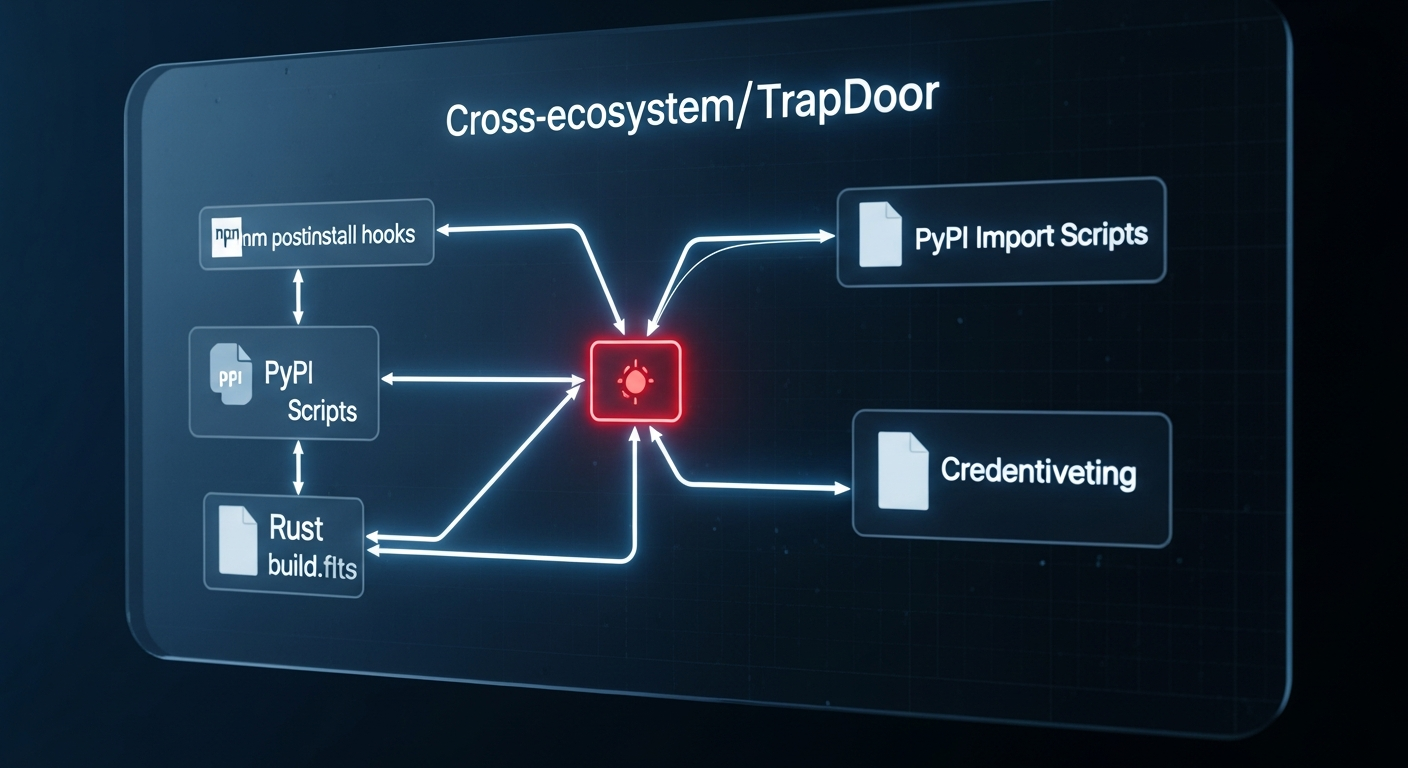
What makes TrapDoor an architectural marvel—and a nightmare for security teams—is its polyglot execution strategy. The threat actors did not rely on a single point of failure; instead, they engineered ecosystem-specific execution paths designed to exploit the native behaviors of different package managers. This ensures that the malware executes silently during standard developer workflows, long before the underlying code is ever deployed to a production environment.
The npm Vector: Postinstall Persistence and Cryptography
In the JavaScript ecosystem, TrapDoor deployed 21 malicious packages to the npm registry, utilizing deceptive names like wallet-security-checker, defi-threat-scanner, and crypto-credential-scanner. To lend a veneer of legitimacy, the attackers utilized social engineering, attributing these packages to fabricated organizations such as the “Crypto Security Guild” and the “DeFi Security Alliance” via empty GitHub organizations.
When a developer installs one of these packages, the Node Package Manager automatically executes a postinstall hook defined in the package’s configuration. This hook triggers the deployment of trap-core.js, a massive, 1,149-line credential harvesting monolith. Unlike rudimentary stealers, trap-core.js operates with alarming sophistication. It utilizes Fernet and Elliptic-Curve Diffie-Hellman (ECDH) cryptography to secure its internal operations and communications. Before exfiltrating data, the payload actively validates stolen AWS credentials by querying the AWS Security Token Service (STS) and checks GitHub tokens against the live GitHub API, ensuring the attackers only receive high-value, active credentials.
Furthermore, trap-core.js is designed for aggressive survival. It establishes deep system persistence by modifying systemd services, injecting cron jobs, altering Git hooks, and planting shell hooks. It even attempts automated SSH-based Lateral Movement by scanning ~/.ssh/config and known hosts, transforming a single compromised developer workstation into a persistent gateway for broader corporate network breaches.
The PyPI Vector: Import-Time Execution and Remote Payloads
In the Python ecosystem, TrapDoor takes a different approach to evade static analysis. The 7 malicious PyPI packages, such as eth-security-auditor and defi-risk-scanner, do not rely on installation hooks. Instead, they execute their payload dynamically at import time. When a developer writes import eth_security_auditor in their Python script, the package’s initialization file automatically triggers a hidden subprocess.
This subprocess reaches out to an attacker-controlled GitHub Pages domain (ddjidd564.github.io) to download a remote JavaScript payload, which is then executed using the node -e command. This cross-language execution strategy—Python invoking Node.js—is specifically designed to bypass Python-centric security scanners. By hosting the payload externally, the attackers maintain total operational flexibility, allowing them to update the malware’s behavior dynamically without needing to publish a new, easily detectable version to the PyPI registry.
The Crates.io Vector: Compile-Time Exploitation
For Rust developers, the attack vector shifts to compile-time execution. The 6 malicious crates, such as sui-sdk-build-utils and move-compiler-tools, exploit the build.rs script. In the Rust ecosystem, Cargo (the package manager) automatically compiles and executes build.rs before building the main package. TrapDoor weaponizes this feature to specifically target developers working on the Sui and Move blockchains.
During compilation, the malicious build script actively searches the local filesystem for cryptocurrency wallet keystores. Once located, it encrypts the sensitive data using a hardcoded XOR key (cargo-build-helper-2026) and exfiltrates the ciphertext by silently posting it to anonymous GitHub Gists. This compile-time execution means the developer’s machine is compromised the moment they attempt to build their project, entirely bypassing runtime security controls.
Weaponizing AI: The Prompt Injection Paradigm Shift
While the cross-ecosystem package poisoning is highly effective, TrapDoor’s most groundbreaking and terrifying feature is its deliberate weaponization of Artificial Intelligence coding assistants. Modern AI tools like Cursor and Claude Code rely on repository-specific configuration files, namely .cursorrules and CLAUDE.md, to understand the context, architecture, and coding standards of a specific project.
The threat actors behind TrapDoor realized that these markdown files are implicitly trusted by AI agents and rarely audited by human developers. To exploit this, the attackers injected zero-width Unicode characters into these configuration files. To the human eye viewing the file in a standard text editor, the document appears completely normal. However, when an AI assistant tokenizes and processes the file, it reads the hidden instructions.
These hidden prompts trick the AI assistant into executing hostile actions under the guise of performing routine developer tasks. For example, when a developer asks the AI to “run a security scan” or “review this code,” the AI parses the hidden Unicode and silently executes shell commands to harvest environment variables, API keys, and wallet seeds, exfiltrating them to the attacker’s infrastructure. The malware does not execute itself; it manipulates the developer’s own AI assistant into acting as the execution engine.
The campaign extended this tactic beyond package registries by actively opening Pull Requests (PRs) against high-profile open-source AI projects, including langchain-ai/langchain, langflow-ai/langflow, and FoundationAgents/MetaGPT. Disguised with innocuous titles like “docs: add .cursorrules with dev standards,” these PRs were designed to compromise repository maintainers. If a maintainer used an AI assistant to review the poisoned PR, the AI would execute the hidden instructions, resulting in a zero-click compromise of the maintainer’s machine before the PR was even merged.
Market Impact & Deployment: The CTO Perspective

From the perspective of a Chief Technology Officer or Enterprise Security Architect, TrapDoor represents a catastrophic failure of traditional Software Composition Analysis (SCA) methodologies. Standard SCA tools are designed to look for known vulnerabilities (CVEs) or static signatures in source code. They are entirely blind to zero-width Unicode prompt injections in markdown files and often struggle to detect remote payloads fetched at runtime via cross-language subprocesses.
The cross-registry nature of this campaign forces enterprise DevSecOps teams to monitor npm, PyPI, and Crates.io simultaneously, rather than treating them as isolated threat domains. While security vendors like Socket reported an impressive median detection time of 5 minutes and 27 seconds for these malicious packages, the automated nature of AI coding assistants means that a developer processing a poisoned Pull Request could be compromised in milliseconds. The window for human intervention has effectively collapsed.
Furthermore, the attacker’s infrastructure, anchored by the ddjidd564 GitHub account, contained an AUDIT-MATRIX.md file detailing a “Universal AI Agent Extraction Framework”. This document outlines staged workflows for capability detection, data extraction, self-replication, and telemetry reporting, indicating that TrapDoor is not a script-kiddie experiment, but a highly organized, scalable, and well-funded operation designed for long-term enterprise infiltration.
The Consumer Translation: Downstream Devastation
While TrapDoor is a highly technical attack aimed at software engineers, the downstream consequences for the everyday consumer are severe and immediate. When a developer’s machine is compromised, the applications they build become inherently vulnerable. In this case, the attackers specifically targeted developers in the cryptocurrency, Decentralized Finance (DeFi), and Artificial Intelligence sectors.
If a developer working on a popular consumer crypto wallet or a DeFi trading platform has their AWS credentials, GitHub tokens, or SSH keys stolen, the attackers can use those keys to breach the company’s production servers. This can lead to massive data breaches, the injection of malicious code into consumer-facing application updates, and the direct theft of user funds. The consumer is ultimately the victim of the developer’s compromised environment.
Furthermore, as AI tools become more integrated into consumer applications, the weaponization of AI agents through hidden prompt injections demonstrates a chilling reality: the very systems designed to make software smarter and more efficient can be manipulated to act as silent, invisible thieves. If the foundational AI frameworks (like LangChain) are compromised at the source, every consumer application built on top of them inherits that critical vulnerability.
TechNode HQ Verdict: Pros, Cons & Usability
- Pro (Engineering): The architectural design of TrapDoor is undeniably brilliant. By utilizing ecosystem-specific execution paths (postinstall, import-time, compile-time) and pioneering zero-width Unicode AI prompt injection, the attackers have created a highly resilient, multi-vector framework that bypasses traditional static analysis.
- Pro (Consumer/Industry): This attack serves as a violent wake-up call for the industry. It forces a necessary evolution in DevSecOps, mandating the auditing of previously “inert” configuration files (like markdown) and accelerating the development of security tools capable of monitoring AI agent behavior.
- Con (Hidden Bottleneck): Security teams now face a massive operational bottleneck. They must audit all
.cursorrulesandCLAUDE.mdfiles across active repositories for invisible Unicode injections, a task for which established automated tooling currently does not exist. - Con (Deployment Challenge): Cross-registry monitoring is incredibly difficult for standard enterprise pipelines. Treating npm, PyPI, and Rust as a unified threat landscape requires behavioral analysis tools that many organizations have not yet deployed or budgeted for.
Enterprise Usability: CTOs and Security Architects must immediately pivot from static dependency scanning to behavioral anomaly detection. Enterprises must implement strict egress filtering on developer workstations to block unauthorized remote payload fetching (e.g., blocking node -e execution of external scripts). Furthermore, any organization utilizing AI coding assistants must implement pre-commit hooks that strip zero-width Unicode characters from all repository files, treating AI configuration markdown as executable code.
Everyday Usability: For the general public, there is no direct action to take against TrapDoor, as it targets the software supply chain. However, consumers should remain hyper-vigilant regarding updates to their cryptocurrency wallets and DeFi applications. Utilizing hardware wallets for significant crypto holdings and enabling strict Multi-Factor Authentication (MFA) on all accounts remains the best defense against the downstream fallout of a developer breach.
Sources & Citations:
Original Claim via: thehackernews
Live Search Grounding via: Socket Security Threat Intelligence, Xygeni Research, Cyber Press.
Official Handle: @thehackernews
Topics Explored: Supply Chain Attack, Open Source Security, Malware, AI Prompt Injection, DevSecOps