The Architectural Reality: Why AI Data Compounds
For the better part of the last four years, the artificial intelligence narrative has been monopolized by a single piece of silicon: the GPU. The industry’s obsession with compute—faster accelerators, larger clusters, and staggering power densities—made perfect sense during the initial gold rush of Large Language Model (LLM) training. But as we navigate through 2026, the AI landscape has fundamentally shifted from episodic experimentation to continuous, production-scale deployment. And with this shift, a harsh architectural reality has emerged: AI is no longer just a compute challenge. It is a massive, unrelenting data systems challenge.
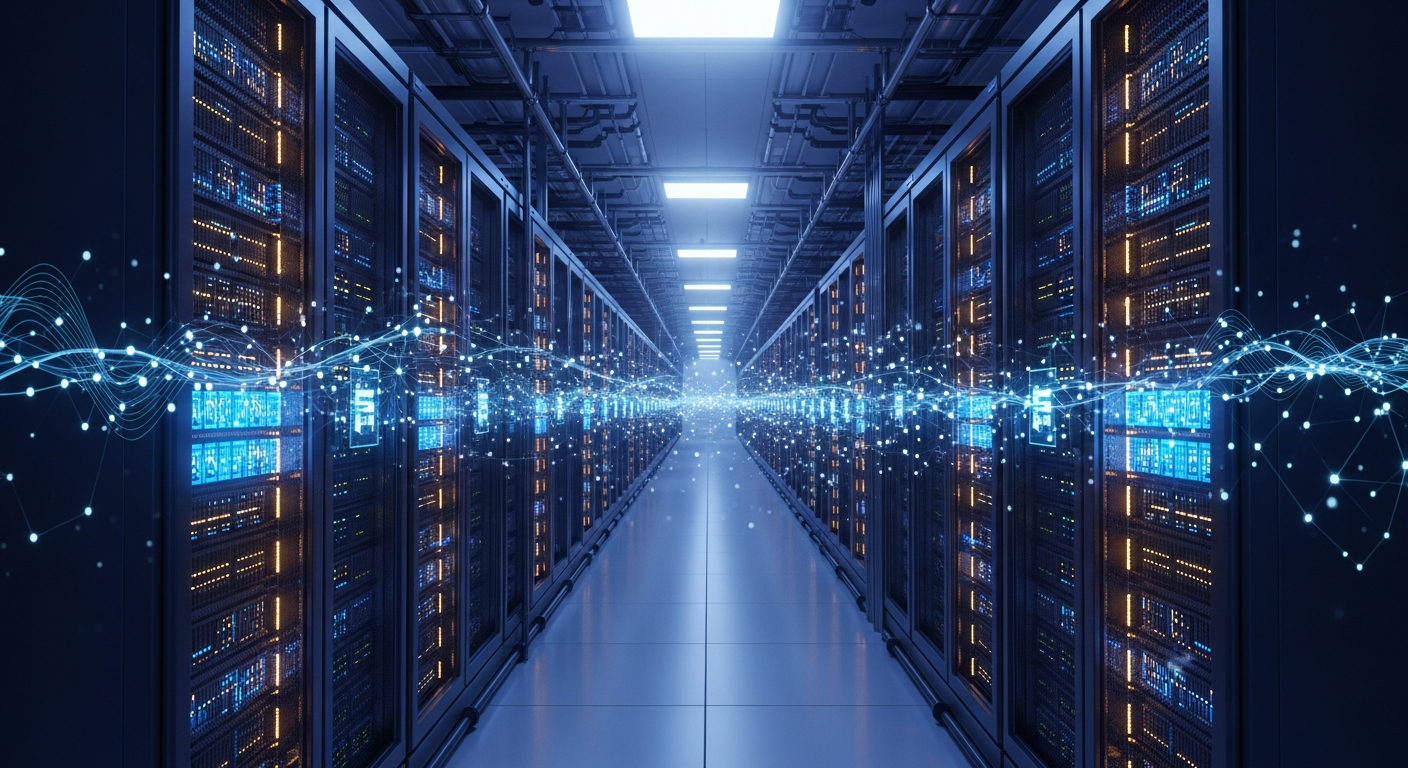
The core issue lies in the physics of how AI workloads operate in production. Compute is inherently episodic and reusable. A cluster of GPUs might spend three months training a frontier model, but once that model is compiled, those same GPUs are wiped clean and repurposed for the next workload. The compute cycles fluctuate, but the hardware remains static. Data, on the other hand, behaves entirely differently. Data persists. More importantly, data compounds.
Every single AI workflow continuously generates new information. We are no longer just feeding static text into a model; modern AI ecosystems rely heavily on Retrieval-Augmented Generation (RAG), agentic loops, and multi-modal outputs. Every inference run, user interaction, synthetic dataset generation, vector embedding, and system checkpoint creates a permanent digital footprint. As AI scales to billions of daily active users globally, this data must be retained, governed, audited, and fed back into the system for future optimization. You can reuse a GPU, but you cannot delete the exabytes of context required to make that GPU useful.
As Western Digital’s Chief Product Officer, Ahmed Shihab, recently articulated: “AI is fundamentally a data systems challenge, not just a compute challenge. While compute is reused, data persists and grows.” This compounding effect is forcing infrastructure architects to completely rethink how they build the data centers of the future.
The 2026 Storage Crisis: NAND Shortages and the HDD Resurgence
To understand why this architectural shift is causing panic in Silicon Valley, one must look at the current state of the semiconductor supply chain. For years, enterprise IT leaders comfortably transitioned their infrastructure toward Solid State Drives (SSDs), taking advantage of steadily falling NAND flash prices to boost performance across all workloads. The assumption was that the “death of the hard drive” was imminent, and the future of AI would be entirely flash-based.
The reality of 2026 has violently shattered that assumption. The explosive growth of AI accelerators has fundamentally fractured the memory market. Major silicon fabricators have aggressively reallocated their wafer capacity away from traditional NAND flash (used in SSDs) and pivoted almost entirely toward highly lucrative High-Bandwidth Memory (HBM) and high-capacity DDR5 required to feed Nvidia and AMD GPUs. This strategic reallocation has created a massive supply deficit in the broader storage market, causing enterprise SSD prices to surge dramatically.
Faced with punishing flash hardware costs and rapidly inflating cloud storage bills, Hyperscale Data Centers are being forced to rethink their economics. You cannot store exabytes of compounding AI logs and vector embeddings on premium NVMe SSDs when the cost per terabyte has skyrocketed. The natural, mathematically necessary response to this silicon squeeze has been a rapid, aggressive pivot back to traditional Hard Disk Drives (HDDs).
The situation has reached such an extreme that major storage manufacturers are seeing their high-capacity HDD production lines completely sold out. Hyperscalers are locking in firm purchase orders for hard drives extending well into 2027 and 2028. They are not buying legacy technology; they are buying advanced Heat-Assisted Magnetic Recording (HAMR) drives that push capacities beyond 30TB per drive, offering a vastly superior cost-per-terabyte ratio that makes exabyte-scale AI retention financially viable.
Engineering the Tiered AI Data Center
The AI data center of the future is not a monolithic, single-tier storage layer optimized entirely for speed. What works at a small scale—like an all-flash array for a localized database—spectacularly breaks at exabyte scale due to both financial constraints and power grid limitations. Today’s AI infrastructure requires a highly sophisticated, tiered systems architecture.
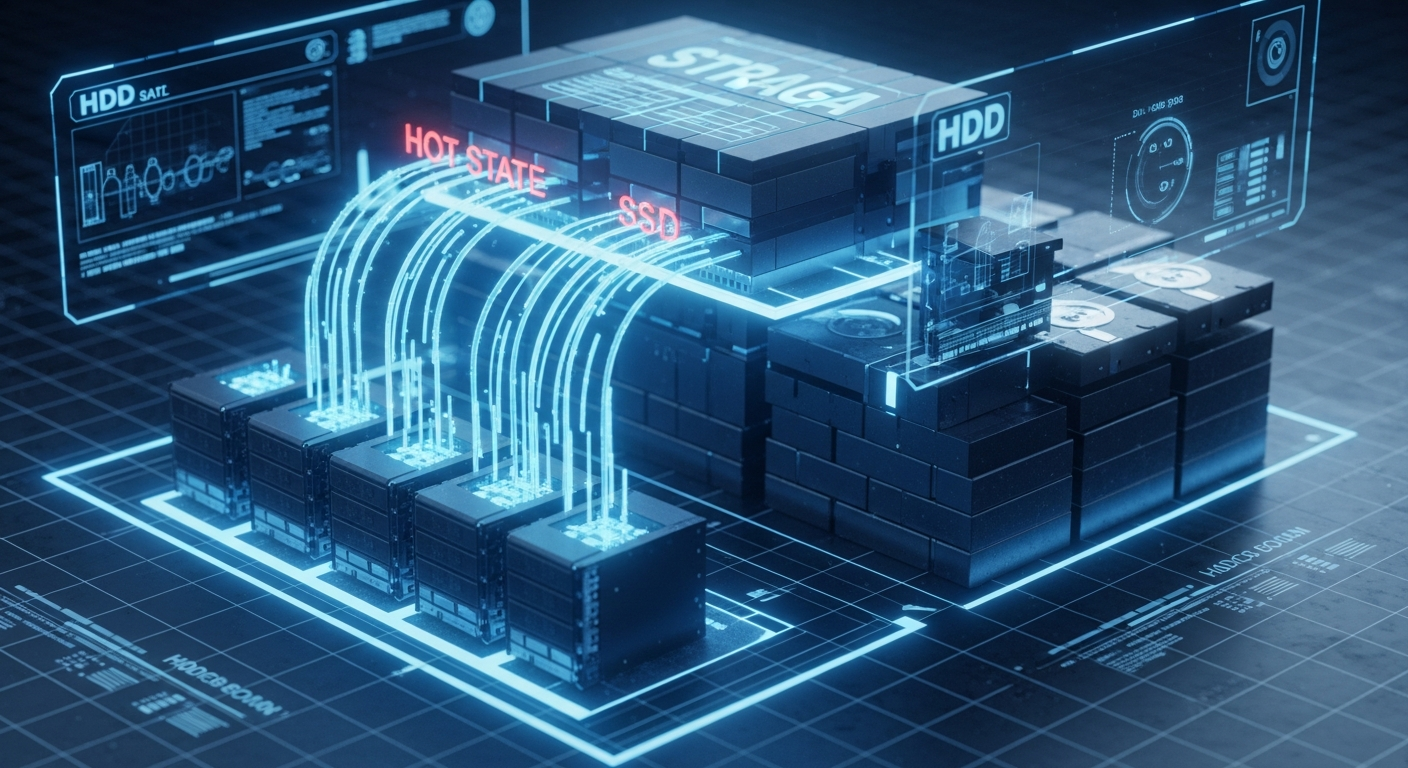
In this tiered model, it is not a battle of HDD versus SSD; it is the mandatory synergy of HDD and SSD. The “hot” tier of data—the immediate weights, active context windows, and real-time inference pipelines—requires ultra-fast access sitting as close to the compute resources as possible. This is where PCIe Gen 5 and Gen 6 NVMe SSDs shine, ensuring that multi-million-dollar GPU clusters are never starved for data (a bottleneck known as the “von Neumann bottleneck”).
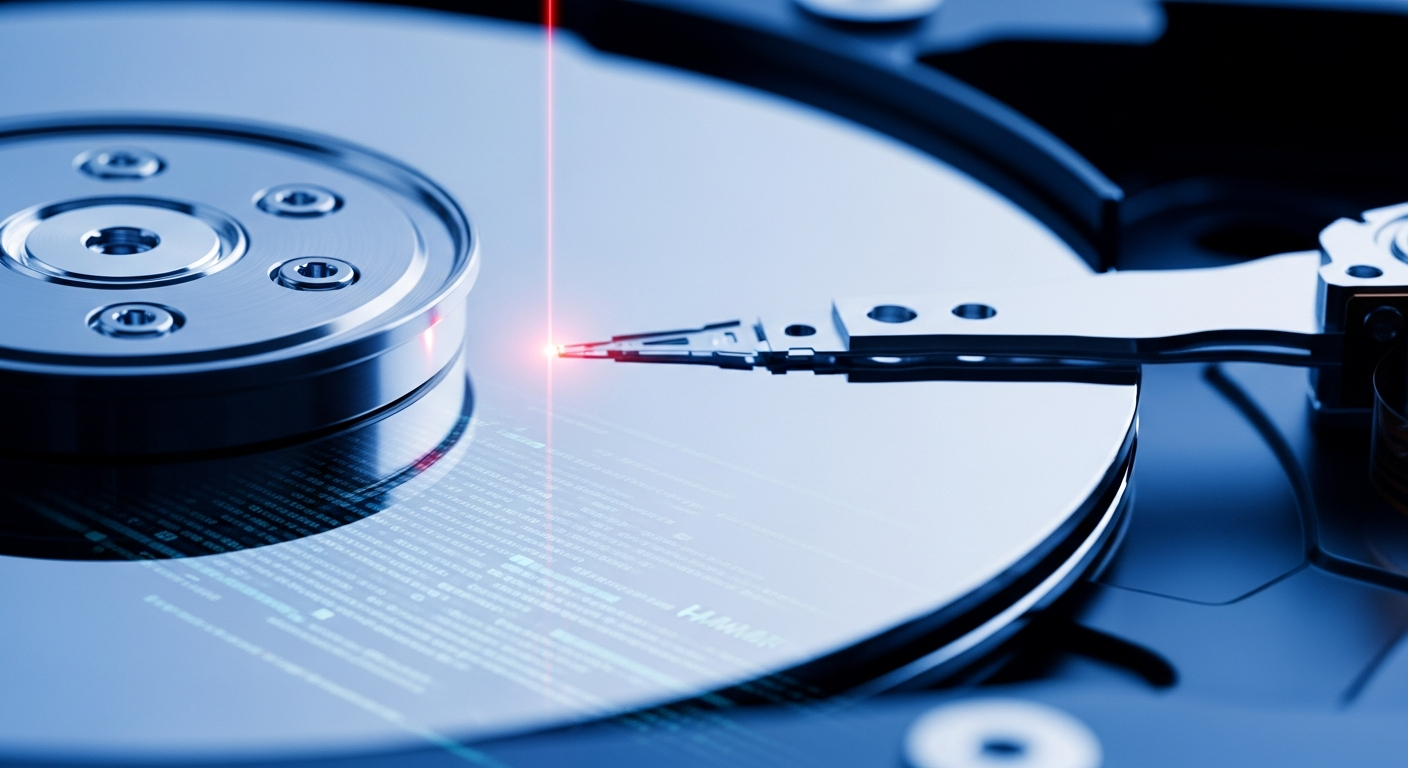
However, this hot tier represents only a fraction of the total data volume. The vast majority of AI data—historical logs, massive embedding libraries, synthetic training data, and compliance archives—shifts toward a capacity-optimized “warm/cold” tier. This is where HDDs dominate. By utilizing HAMR technology, which uses a microscopic laser to heat the disk surface to temporarily change its magnetic coercivity, manufacturers can pack unprecedented amounts of data onto spinning platters. This allows data centers to store massive volumes of persistent data economically, reliably, and sustainably over time.
Furthermore, power consumption is a critical engineering constraint. With AI data centers now pushing past 500 megawatts of power draw, operators must ruthlessly optimize their energy budgets. High-capacity HDDs consume significantly less power per terabyte at rest compared to maintaining massive arrays of active flash storage. By offloading cold data to spinning disks, data center operators can route precious megawattage back to the GPUs where it is needed most.
Market Impact & Deployment: The TCO Equation
The market is already speaking, and the message is clear: operational sustainability is trumping bleeding-edge novelty. A comprehensive May 2026 survey conducted by Western Digital among global hyperscalers, cloud providers, and enterprise infrastructure leaders paints a stark picture of this new reality.
According to the data, a staggering 66% of respondents stated they have deprioritized, or are actively considering deprioritizing, newer experimental technologies in favor of infrastructure that delivers consistent reliability and predictable performance at scale. When asked about their primary objectives, 69% prioritized supporting AI training and inference workloads, while an equal 69% prioritized improving overall reliability and availability.
Perhaps the most telling statistic from the WD survey is the shift in performance metrics. Latency optimization—long considered the holy grail of storage—ranked surprisingly low at just 7%, falling far behind scalability, operational efficiency, and reliability. This perfectly illustrates the architectural shift: at the capacity tier, sheer volume and cost matter more than microsecond response times.
The economics of this shift are undeniable. 87% of infrastructure leaders cited capacity expansion and Total Cost of Ownership (TCO) optimization as their key priorities. To achieve this, 74% explicitly cited the TCO, capacity, and scalability advantages of HDD-based infrastructure. The deployment reality reflects this sentiment: 70% of respondents reported operating HDD-majority environments, and 35% reported extreme environments where HDDs represented more than 75% of their total storage capacity.
As one anonymous survey respondent succinctly noted: “HDDs stay in a long-term strategy because they solve a problem that newer technologies still don’t beat on economics and scale. The future is not HDD vs SSD, but HDD and SSD.”
The Consumer Translation: What This Means for Everyday AI
For the average consumer, the intricacies of NAND wafer reallocation and HAMR laser physics might seem like abstract enterprise problems. However, this invisible infrastructure shift directly dictates the capabilities, speed, and cost of the AI tools the public uses every day.
Consider the evolution of AI assistants like ChatGPT, Claude, or Google Gemini. In 2023, these models had “amnesia”—they forgot who you were the moment you started a new chat. Today, consumer AI is highly agentic. It remembers your coding preferences, your writing style, your past projects, and can process context windows spanning millions of words. This “memory” is not magic; it is raw data that must be stored permanently on a server.
If cloud providers were forced to store all of this personalized, compounding user data exclusively on expensive SSDs, the economics of consumer AI would collapse. The standard $20-per-month subscription fee for premium AI access would likely triple to cover the exorbitant hardware and power costs. By leveraging high-capacity HDDs for the vast majority of this retained context, hyperscalers can keep AI affordable for the masses.
The trade-off, however, is architectural complexity. If a cloud provider poorly optimizes their storage tiers, consumers will experience noticeable lag. If an AI agent has to retrieve a piece of your personal context from a “cold” hard drive rather than a “hot” SSD, the time-to-first-token (the delay before the AI starts typing) will increase. The seamless magic of everyday AI now relies entirely on how well these companies can juggle your data between spinning disks and flash memory in real-time.
TechNode HQ Verdict: Pros, Cons & Usability
- Pro (Engineering): Tiered HDD/SSD architectures drastically lower the Total Cost of Ownership (TCO) at exabyte scale, freeing up critical power grid capacity and capital expenditure for GPU acquisition.
- Pro (Consumer): High-capacity, low-cost storage allows AI companies to offer massive context windows, personalized memory, and agentic capabilities without drastically raising monthly subscription fees.
- Con: The ongoing NAND flash shortage and reallocation of silicon to HBM means that the “hot tier” of SSD storage will remain painfully expensive and supply-constrained through at least 2027.
- Con: Tiering complexity introduces severe deployment challenges. Poorly optimized data pipelines between HDDs and SSDs will result in severe latency bottlenecks during RAG (Retrieval-Augmented Generation) workloads.
Enterprise Usability: For CTOs and infrastructure architects, the mandate is clear: abandon the dream of the all-flash AI data center. You must immediately audit your data lifecycle. Deploy PCIe Gen 5 NVMe SSDs strictly for active GPU feeding and real-time inference, and aggressively scale your capacity tier using the latest 30TB+ HAMR HDDs. Lock in your supply chain contracts now, as HDD inventory is rapidly being consumed by hyperscalers.
Everyday Usability: For the general public, this enterprise shift is a net positive. It ensures that the AI tools you rely on will continue to get smarter, remember more, and process larger documents without pricing you out of the ecosystem. However, power users should be aware that as AI “memory” grows, retrieval times for older, archived chats may slightly increase as that data is pulled from mechanical storage.
Sources & Citations:
Original Claim via: Western Digital Blog
Official Handle: @westerndigital
Topics Explored: AI Infrastructure, Data Storage, HDD vs SSD, Total Cost of Ownership, Cloud Computing