The End of the Blank-Check AI Era
For the past three years, the enterprise technology sector has operated under a singular, financially reckless mandate: deploy artificial intelligence at any cost. Chief Information Officers and IT departments have gleefully signed blank checks to public cloud providers, treating massive inference token bills as the unavoidable cost of doing business in the generative AI era. But as the industry shifts from simple conversational chatbots to autonomous, multi-step Agentic AI, the underlying economics of cloud-based inference have fundamentally broken down.
At the Dell Technologies World 2026 conference in Las Vegas, Dell Technologies officially declared war on the “AI Cloud Tax.” The company’s sweeping announcements—spanning from localized deskside workstations to turnkey data center racks—target what Dell executives are calling the “enterprise AI execution gap.” Organizations are no longer struggling with a lack of AI ambition; they are drowning in the operational complexities of data management, energy consumption, data sovereignty, and catastrophic cloud costs.
The centerpiece of Dell’s aggressive new strategy is the Dell Deskside Agentic AI system. Built in deep collaboration with Nvidia, this localized hardware and software stack is designed to repatriate AI workloads from the public cloud back to on-premises environments. By combining Dell’s high-performance workstations with Nvidia’s NemoClaw software stack and OpenShell runtime, Dell is offering a secure, localized sandbox for developing and running AI agents. The financial implications are staggering: Dell claims organizations can reduce their AI spending by up to 87% over a two-year period compared to relying on public cloud APIs, with a break-even point arriving in as little as three months.
The Architectural Reality: Deskside Supercomputing and the NemoClaw Sandbox
To understand the magnitude of Dell’s announcement, one must look past the marketing terminology and examine the raw engineering required to run autonomous AI agents locally. Unlike traditional generative AI models that wait for a user prompt, generate a response, and go dormant, agentic systems are “always-on.” They autonomously execute multi-step workflows, continuously looping through reasoning, tool usage, observation, and action phases. This continuous loop consumes inference tokens at an exponential rate.
Jon Siegal, Senior Vice President of Dell’s Client Solutions Group, highlighted the severity of this issue during the event: “We had a single developer burn through 1 billion tokens in 24 hours. That was a $3,400 cloud bill”. Multiply that single developer by an enterprise team of hundreds, and the financial toxicity of cloud-based agentic AI becomes immediately apparent. The solution is local inference using open-weight models, but deploying these models securely has historically been an IT nightmare.
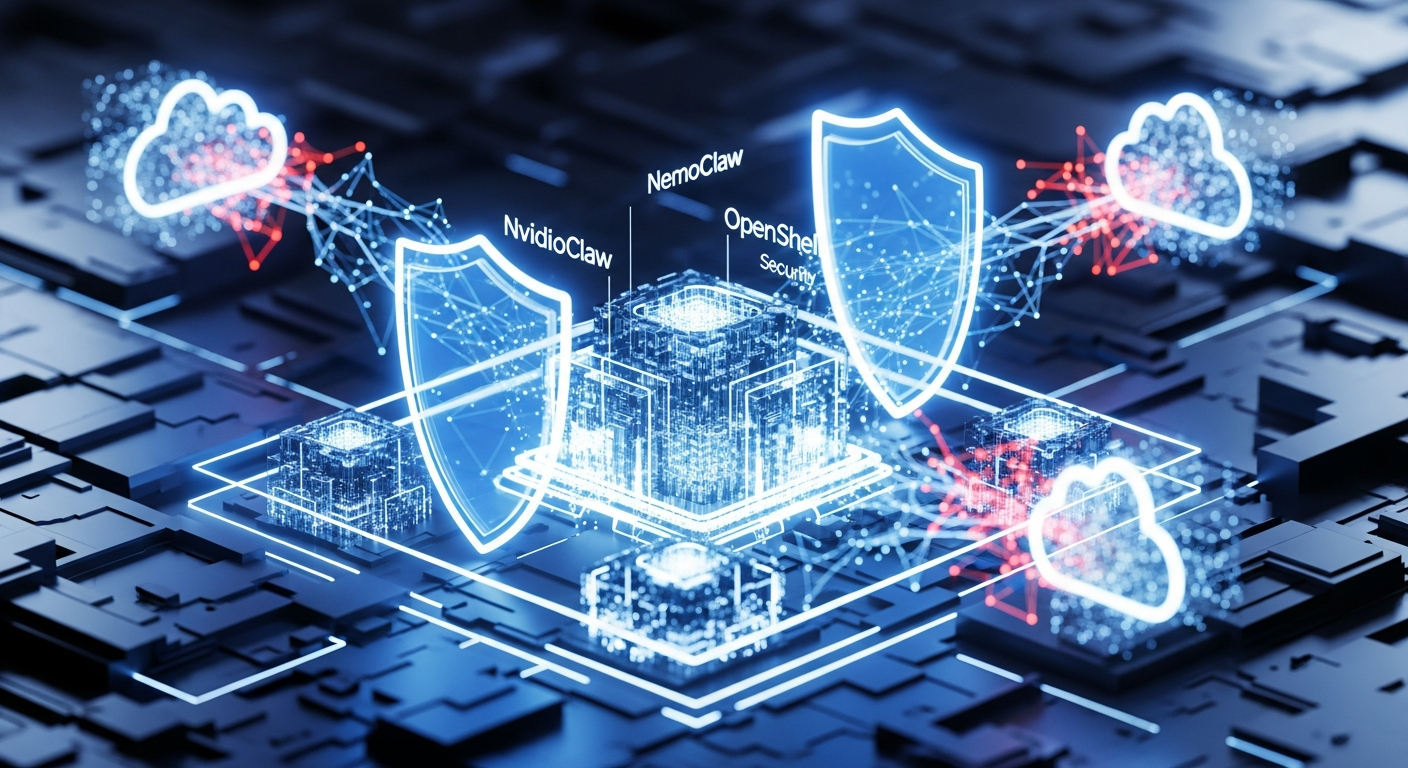
Enter Nvidia NemoClaw and OpenShell. OpenClaw has rapidly become the open-source operating system for AI agents, but running raw, open-source agents with arbitrary network and filesystem access is a massive security risk for enterprises. NemoClaw acts as an enterprise-grade reference stack that wraps OpenClaw in Nvidia’s OpenShell runtime. OpenShell utilizes deep Linux kernel security features—specifically Landlock for unprivileged access control, seccomp (secure computing mode) for system call filtering, and strict network namespace isolation. This creates a hardened, policy-driven sandbox where agents can operate autonomously without the risk of exfiltrating sensitive corporate data or executing malicious code.
On the hardware front, Dell’s Deskside Agentic AI portfolio ranges from compact Dell Pro Max systems for smaller, quantized models, all the way up to high-end workstation towers capable of supporting models with up to 1 trillion parameters. From an engineering perspective, running a 1-trillion parameter model locally is a staggering achievement. Even utilizing aggressive 4-bit quantization (INT4), a model of that size requires roughly 500GB to 600GB of VRAM just to load the weights and maintain a functional context window. This implies that Dell’s top-tier “deskside” towers are essentially localized supercomputers, packed with multiple high-end Ada Generation or Blackwell GPUs interconnected via NVLink, disguised within a workstation chassis.
Furthermore, AI is functionally useless without structured, accessible data. Dell addressed this bottleneck by announcing massive updates to the Dell AI Data Platform. By integrating GPU-accelerated SQL analytics developed alongside Nvidia and Starburst Data, Dell promises up to 6x faster query performance on Nvidia Blackwell processors. Additionally, the platform now boasts 12x faster vector indexing, a critical enhancement for Retrieval-Augmented Generation (RAG) workflows that rely on rapidly searching billions of unstructured files.
Market Impact & Deployment: Rack-Scale Reality and Liquid Cooling
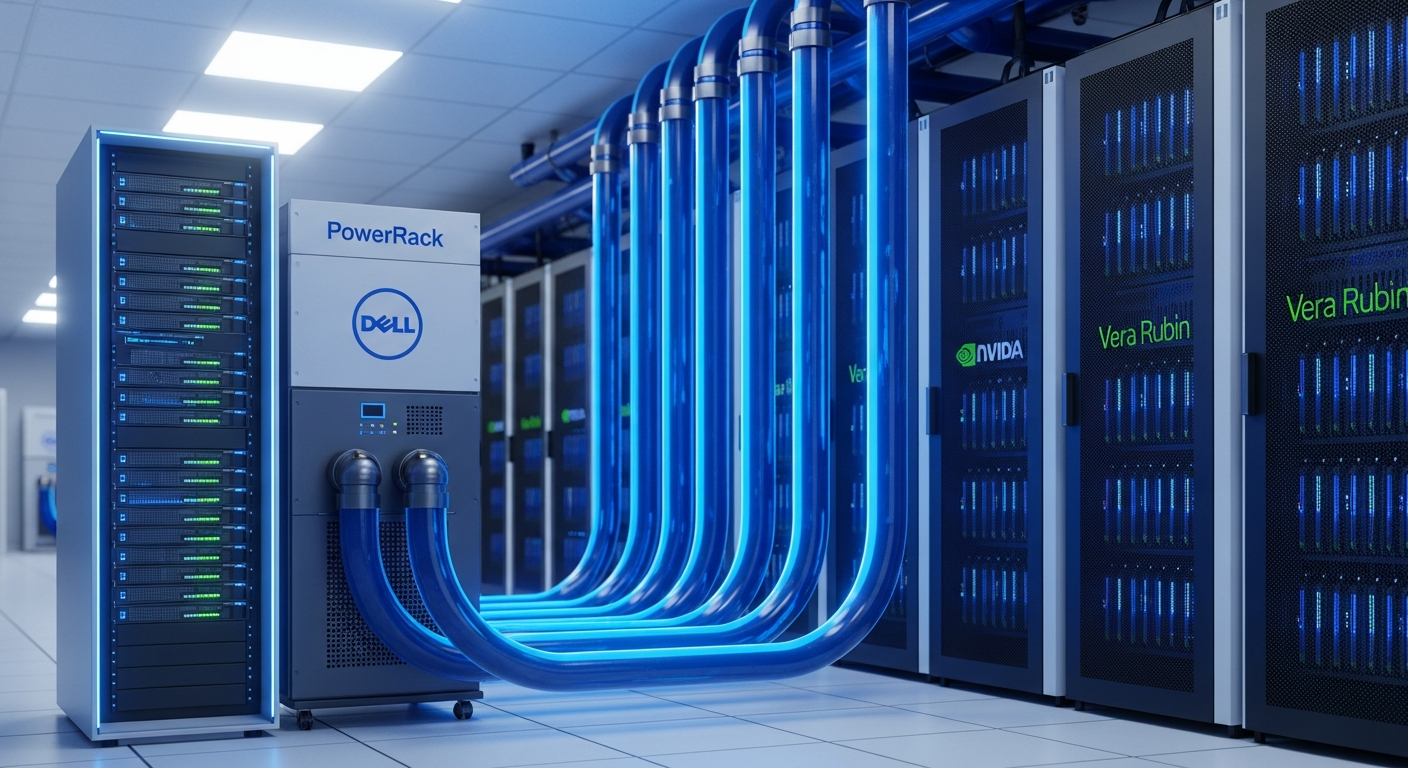
While the deskside workstations handle localized development and departmental deployment, Dell’s announcements extended deep into the enterprise data center. The broader macroeconomic trend of Cloud Repatriation is accelerating, driven not just by cost, but by the physical limitations of power and cooling in legacy facilities.
To address the data center execution gap, Dell introduced PowerRack, a turnkey, rack-scale system that pre-integrates computing, networking, storage, cooling, and management into a single engineered unit. Varun Chhabra, Senior Vice President of Infrastructure and Telecom Marketing, noted that enterprises are exhausted by the “Frankenstein” approach of assembling AI infrastructure from disparate vendors. PowerRack is designed to be deployed as a cohesive, factory-tested unit, drastically reducing time-to-value for high-performance computing (HPC) deployments.
However, the most critical infrastructure announcement may be the most easily overlooked: the Dell PowerCool CDU C7000. As the industry prepares for the arrival of the Nvidia Vera Rubin NVL72 platform, the thermal design power (TDP) of AI racks is pushing past the physical limits of traditional air cooling. The Vera Rubin NVL72, which connects 72 GPUs in a single rack via NVLink, will draw tens of kilowatts of power, necessitating direct-to-chip liquid cooling.
The PowerCool CDU C7000 is a rack-mount cooling distribution unit that fits into a compact 4U form factor and is specifically engineered to meet the thermal demands of the NVL72 platform. Crucially, it supports facility water temperatures up to 40°C (104°F). This is a massive operational advantage for data center operators. Traditional liquid cooling requires energy-intensive chillers to cool the facility water before it reaches the racks. By supporting 40°C water, Dell allows data centers to utilize free-cooling or warm-water cooling techniques, drastically reducing the facility’s Power Usage Effectiveness (PUE) and overall carbon footprint.
Dell is also aggressively expanding its ecosystem to ensure these hardware investments are immediately useful. New partnerships include bringing Palantir’s Foundry and Artificial Intelligence Platforms on-premises to Dell infrastructure, integrating OpenAI’s Codex coding agent into the Dell AI Data Platform, and offering Google Gemini models via Google Distributed Cloud on Dell hardware. This ecosystem approach ensures that enterprises don’t have to sacrifice frontier model capabilities when they move their workloads on-premises.
The Consumer Translation: What Localized AI Means for the Public
While Dell Technologies World is strictly an enterprise affair, the trickle-down effects of localized, agentic AI will fundamentally reshape the consumer experience. For the past few years, the public has grown accustomed to the latency, privacy concerns, and generic responses associated with cloud-based AI models.
When an enterprise—be it a major healthcare provider, a global financial institution, or a retail giant—deploys Dell Deskside Agentic AI, the immediate consumer benefit is absolute data sovereignty. Currently, when you interact with an AI-powered customer service bot, your personal data is often packaged, encrypted, and sent across the internet to a public cloud API (like OpenAI, Anthropic, or Google) for processing. With Dell’s local infrastructure and Nvidia’s NemoClaw sandbox, your sensitive data never leaves the company’s internal network. The AI agent processes your medical history or financial records locally, ensuring a zero-trust environment where data leaks to third-party cloud providers are physically impossible.
Furthermore, the economics of local AI directly impact consumer access. If a company is burning $3,400 a day on cloud tokens just to run a single AI agent, they are forced to limit consumer access to that agent, often hiding it behind premium subscription paywalls or severely restricting its capabilities. By slashing AI compute costs by up to 87%, enterprises can afford to deploy thousands of autonomous agents to handle customer support, personalize shopping experiences, and expedite bureaucratic processes without passing exorbitant cloud costs onto the consumer. Localized AI democratizes the power of agentic workflows, making them a standard feature of everyday digital life rather than a premium luxury.
TechNode HQ Verdict: Pros, Cons & Usability
- Pro (Engineering): The integration of Nvidia NemoClaw and OpenShell provides a desperately needed, cryptographically secure sandbox for open-source AI agents, utilizing kernel-level isolation (Landlock/seccomp) to prevent rogue autonomous actions.
- Pro (Consumer): Localized inference guarantees strict data sovereignty. Consumers can interact with highly capable AI agents in healthcare and finance without their personal data ever being transmitted to a public cloud provider.
- Con: The “87% savings” metric is highly dependent on maximum hardware utilization. If a $50,000+ localized workstation sits idle for 14 hours a day, the upfront CapEx will struggle to beat the pay-as-you-go OpEx of cloud APIs.
- Con: A “deskside” tower capable of running a 1-trillion parameter model will generate significant acoustic noise and thermal exhaust, challenging its viability in a standard open-office environment without dedicated cooling infrastructure.
Enterprise Usability: For CTOs and IT Directors, the Dell Deskside Agentic AI and PowerRack systems represent an immediate, highly viable off-ramp from escalating cloud costs. If your development teams are experimenting with always-on agentic workflows, the token burn rate will quickly eclipse the CapEx of Dell’s local hardware. Enterprises should immediately audit their cloud AI spend; if the break-even point is under six months, transitioning to Dell’s localized NemoClaw environment is a financial imperative.
Everyday Usability: While consumers cannot buy these enterprise-grade workstations, the public should actively demand that the services they use (banks, hospitals, legal firms) transition to localized AI infrastructure. The era of blindly sending personal data to public cloud LLMs is ending, and consumers should prioritize doing business with organizations that utilize on-premises, sandboxed AI agents.
Sources & Citations:
Original Claim via: siliconangle
Official Handle: @siliconangle
Topics Explored: Agentic AI, Dell Technologies, Nvidia NemoClaw, Cloud Repatriation, AI Infrastructure