The Macroeconomic Bloodbath of 2026 and Ford’s Existential Bet
The year 2026 has proven to be a uniquely hostile environment for the electric vehicle industry in the United States. The macroeconomic tailwinds that once propelled the EV transition—generous federal tax credits, aggressive environmental mandates, and cheap capital—have violently reversed course. The current administration has effectively dismantled the incentive structures that subsidized early adoption, while simultaneously erecting massive tariff walls that have crippled the global supply chain for critical battery components. The result is a market where affordability has evaporated. We have already seen the casualties: major players like Honda recently executed a brutal, unceremonious culling of three nearly production-ready EV models, determining that the math simply no longer works. The industry is facing a bleak, highly contracted reality.
Yet, in the face of this sector-wide retreat, Ford is doubling down with a project that borders on the audacious: a $30,000 electric midsize pickup truck built on a highly modular “Universal Electric Vehicle” (UEV) platform. To understand how a legacy automaker burdened by over a century of bureaucratic inertia plans to achieve a price point that has eluded even the most agile Silicon Valley startups, we must look past Dearborn, Michigan. The answer lies inside a nondescript, tilt-up concrete building in a business park near the Long Beach Airport in California. This is Ford’s Electric Vehicle Development Center (EVDC)—a ruthless, highly autonomous skunkworks operation designed to strip the vehicle manufacturing process down to its barest, most cost-effective essentials.
Led by Alan Clarke, Vice President of Advanced Development Projects and a notable defector from Tesla, the EVDC operates under a philosophy directly lifted from Clarence “Kelly” Johnson, the legendary aeronautical engineer who founded Lockheed Martin’s original Skunk Works. Johnson’s 14 rules of management—which birthed the SR-71 Blackbird—are predicated on absolute autonomy, viciously restricted team sizes, and the elimination of middle-management reporting. By capping the EVDC team at roughly 350 on-site engineers and isolating them from the “big blue mothership” in Michigan, Ford is attempting to replicate the agility of a tech startup while wielding the manufacturing scale of a global titan. But the true story isn’t just the management structure; it is the radical, enterprise-grade architectural shift happening beneath the sheet metal.
The Architectural Shift: Zonal Compute and the 48-Volt Revolution

To build a $30,000 electric vehicle in a high-tariff environment, you cannot simply optimize existing legacy architectures; you must burn them to the ground. For decades, the automotive industry has relied on a decentralized, chaotic network of Electronic Control Units (ECUs) communicating over a sluggish CAN bus network. A modern luxury vehicle might have over 100 distinct ECUs—one for the windows, one for the seats, one for the wipers—each requiring its own dedicated wiring back to a central hub. This legacy approach results in wiring harnesses that weigh hundreds of pounds, require massive amounts of expensive copper, and demand thousands of hours of manual labor to install on the assembly line.
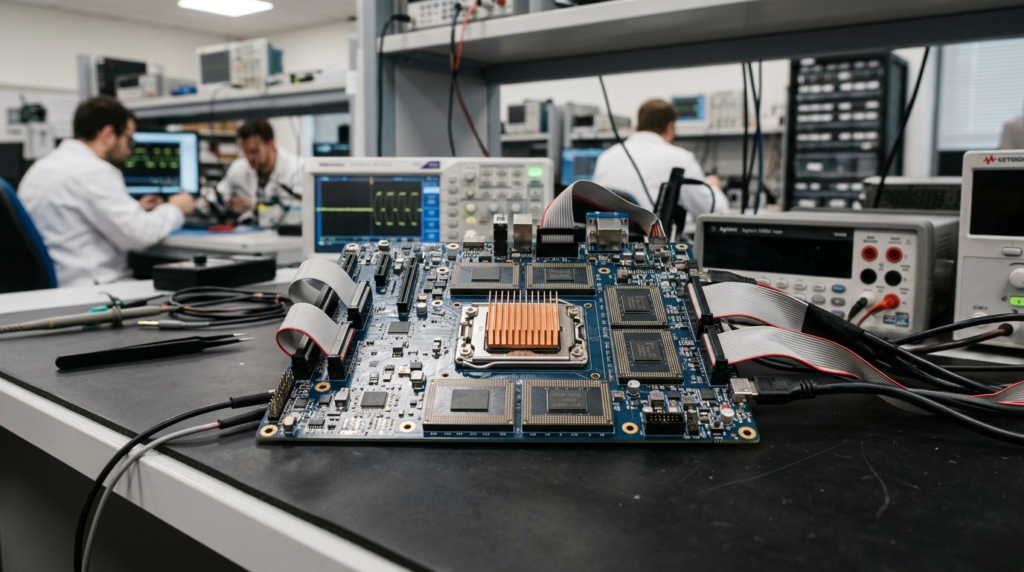
Ford’s EVDC is aggressively pivoting to Zonal Architecture, a concept deeply familiar to enterprise IT infrastructure architects. Instead of dozens of disparate micro-controllers, the UEV platform utilizes a handful of centralized, high-compute nodes that manage specific physical “zones” of the vehicle. This is the automotive equivalent of moving from a sprawling, inefficient on-premise server room to a hyperconverged, cloud-native edge computing model. By consolidating compute power, Ford drastically reduces the number of physical modules required. To validate this, the EVDC team utilizes an 80/20 aluminum extrusion mock-car—a skeletal testbed where engineers lay out the entire zonal wiring harness and software stack, allowing for rapid, iterative hardware-in-the-loop testing without waiting for physical chassis prototypes.
But the true multiplier effect of zonal architecture is unlocked by Ford’s transition to a 48-volt electrical architecture. Legacy vehicles operate on a 12-volt standard, a relic of the mid-20th century. As modern EVs demand exponentially more electrical power for infotainment, advanced driver-assistance systems (ADAS), and thermal management, a 12-volt system requires incredibly thick, heavy copper wires to handle the necessary amperage without melting. By quadrupling the voltage to 48V, Ohm’s law dictates that the current (amperage) required to deliver the same amount of power is slashed by a factor of four.
This simple physics equation yields massive dividends on the manufacturing floor. Lower amperage means Ford can use significantly thinner wires. Thinner wires mean a drastic reduction in the total mass of copper required per vehicle. Copper is expensive, heavy, and subject to volatile global commodity pricing. By thinning the wiring loom, Ford cuts raw material costs, reduces the overall weight of the vehicle (which directly translates to better battery range), and makes the wiring harness flexible enough to be installed by automated robotics rather than human hands. This is how you shave thousands of dollars off the Bill of Materials (BOM).
Hardware Consolidation: Gigacasting and Structural Batteries
The cost-cutting engineering extends far beyond the digital and electrical layers; it fundamentally alters the physical metallurgy of the truck. Traditional automotive manufacturing relies on stamping hundreds of individual pieces of sheet metal and welding them together to form a chassis. This requires massive factory footprints, hundreds of specialized stamping dies, and armies of welding robots. Ford’s UEV platform is abandoning this in favor of large-scale monolithic castings—often referred to in the industry as “gigacasting.”
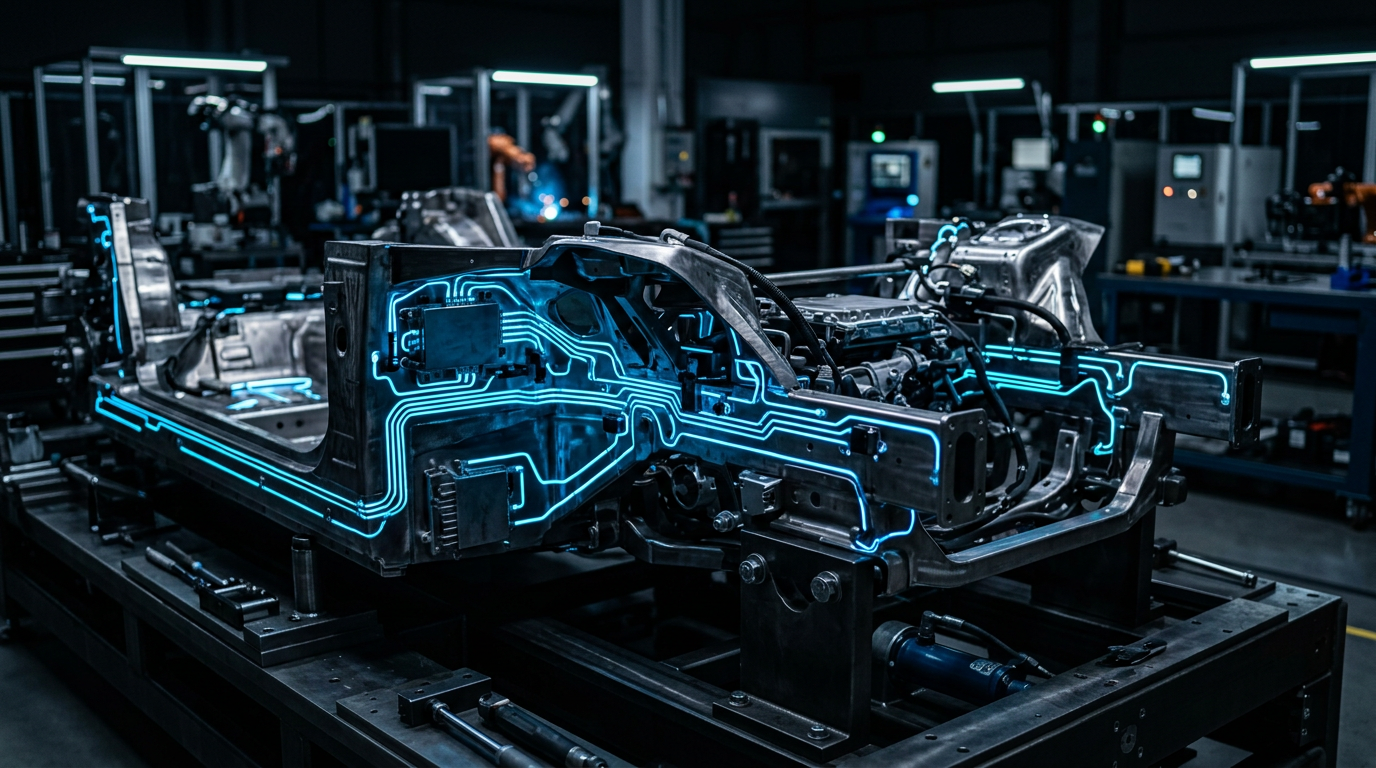
By using massive high-pressure die-casting machines, Ford can form the entire front and rear clips of the vehicle as single, unified pieces of aluminum. This eliminates hundreds of individual parts, removes the need for countless welds, and significantly increases the torsional rigidity of the vehicle. The EVDC is so committed to this rapid iteration that they house a CNC mill large enough to shape full-size clay models, alongside three types of industrial 3D printers, allowing engineers to design, print, cast, and test structural components entirely in-house without waiting on external vendors.
Furthermore, Ford is adopting a structural battery pack design. In legacy EVs, battery cells are placed inside modules, which are placed inside a heavy steel pack, which is then bolted into the vehicle’s frame. It is essentially carrying dead weight to protect the batteries. The UEV platform utilizes the battery pack itself as a stressed member of the chassis. The pack provides the structural backbone of the truck—to the point where the passenger seats are bolted directly to the battery enclosure. This approach, similar to the aerospace engineering used in modern fighter jets (and mirrored by BMW’s upcoming Neue Klasse platform), maximizes volumetric efficiency. Every ounce of metal serves a dual purpose, stripping out redundant weight and labor.
The Supply Chain Gamble: LiFePO4 Chemistry
Perhaps the most critical, and risky, decision made by the EVDC is the choice of battery chemistry. To hit the $30,000 price target, Ford has opted for Lithium Iron Phosphate (LiFePO4 or LFP) cells, moving away from the industry-standard Nickel Manganese Cobalt (NMC) chemistry. LFP batteries are significantly cheaper to produce because they entirely eliminate the need for cobalt and nickel—two rare-earth minerals plagued by volatile pricing, geopolitical supply chain bottlenecks, and severe ethical concerns regarding mining practices.
LFP batteries are also inherently safer, boasting a much higher thermal runaway threshold, meaning they are far less likely to catch fire in the event of a catastrophic puncture. They also degrade much slower, allowing owners to charge them to 100% daily without damaging the cell’s lifespan. However, LFP has a major drawback: lower energy density. An LFP pack is heavier and larger than an NMC pack of the same kilowatt-hour capacity.
To achieve the “gold standard” 300-mile (482 km) range required to convince American consumers to abandon internal combustion, Ford’s engineers are relying entirely on the weight savings generated by the 48V architecture, the gigacastings, and extreme aerodynamic optimization. It is a delicate balancing act of physics: saving weight in the wiring and chassis to afford the weight penalty of a cheaper, cobalt-free battery. The geopolitical risk, however, remains high. The LFP supply chain is currently dominated by Chinese battery giants like CATL and BYD. Navigating the 2026 tariff landscape to source these cells cheaply will require masterful supply chain gymnastics from Ford’s procurement teams.
Enterprise Market Impact & TCO

While the consumer market fixates on the $30,000 price tag, the true target demographic for this midsize electric truck is the enterprise fleet sector. For commercial operators—plumbers, electricians, municipal governments, and last-mile delivery logistics companies—Total Cost of Ownership (TCO) is the only metric that matters. The UEV platform is engineered from the ground up to dominate the fleet spreadsheet.
At $30,000, the capital expenditure (CapEx) of acquiring this vehicle undercuts almost every internal combustion engine (ICE) equivalent on the market today. But the operational expenditure (OpEx) is where the enterprise value truly compounds. The structural simplicity of the UEV—fewer moving parts, no oil changes, no transmission maintenance, and the use of highly durable LFP batteries that can withstand daily 100% charge cycles—drastically reduces scheduled downtime. In the fleet world, vehicle uptime is directly correlated to revenue generation.
Furthermore, the zonal architecture and 48V system allow for seamless over-the-air (OTA) software updates and deep telematics integration. Fleet managers will have granular, real-time data on vehicle health, driver behavior, and energy consumption, allowing for predictive maintenance rather than reactive repairs. If Ford can successfully deliver this vehicle at scale, it will not just be a consumer novelty; it will become the default infrastructure asset for commercial logistics across North America, forcing competitors to either match the TCO or abandon the commercial fleet market entirely.
The Consumer Reality: What This Means for You
For the everyday consumer, the promise of a $30,000 electric truck is a beacon of hope in an automotive market that has become increasingly hostile to the middle class. With the average new car price hovering near $50,000, the UEV represents a return to accessible utility. A 300-mile range midsize truck is the perfect form factor for the American suburbs—capable of handling weekend hardware store runs, daily commutes, and moderate towing without the bloated footprint of an F-150.
However, consumers must be acutely aware of the hidden costs associated with this new manufacturing paradigm, specifically regarding repairability and insurance. The use of large-scale gigacastings reduces manufacturing costs, but it complicates post-collision repairs. If you get into a fender bender in a traditional truck, a body shop unbolts the crumpled steel fender and bolts on a new one. If you crack a monolithic aluminum casting, the repair process is vastly different.
Ford’s Chief Engineer of Advanced Vehicle Structure, Vlad Bogachuk, has outlined a process where collision repair centers will cut through the damaged casting at designated “cut lines” and replace the damaged portion with a new repair casting. Crucially, this new piece is not welded; it is bonded to the original casting using structural adhesive—essentially, aerospace-grade panel glue. While Ford correctly notes that supercars and hypercars have used structural adhesives for years without compromising integrity, the reality of deploying this repair method to thousands of independent, blue-collar body shops across the country is daunting. If insurance companies determine that gluing cast aluminum is too labor-intensive or risky, they may simply choose to “total” the vehicle after minor accidents. This could lead to skyrocketing insurance premiums for the consumer, effectively neutralizing the $30,000 upfront savings.
The Industry Ripple Effect
Ford’s skunkworks project is a direct threat to the established order of legacy auto manufacturing. If the EVDC successfully launches the UEV platform at the targeted price point and margin, it will instantly render the manufacturing lines of General Motors, Stellantis, and Toyota obsolete. Competitors will be forced to accelerate their own transitions to 48V zonal architectures and gigacasting, requiring billions of dollars in factory retooling at a time when capital is expensive.
Even Tesla, the pioneer of many of these manufacturing techniques, will be forced to react. While Tesla dominates the sedan and crossover EV space, their foray into trucks with the Cybertruck has been polarizing, expensive, and plagued by production bottlenecks. A utilitarian, highly affordable midsize truck from a brand with Ford’s historical truck pedigree could capture a massive demographic that Tesla currently ignores. The UEV is not just a new product; it is a weaponized platform designed to trigger a pricing war that legacy automakers are ill-equipped to survive.
TechNode HQ Verdict: Pros, Cons & Usability
- Pro (Engineering): The transition to a 48-volt zonal architecture drastically reduces copper weight, wiring complexity, and compute redundancy, representing a masterclass in hardware consolidation.
- Pro (Consumer): A true $30,000 price point combined with a 300-mile range and the extreme longevity of LFP battery chemistry democratizes EV ownership for the middle class.
- Con: Geopolitical supply chain risks surrounding LFP batteries could subject the vehicle to crippling tariffs, threatening the $30,000 price target.
- Con: The reliance on structural adhesives (“panel bond”) to repair cut gigacastings post-collision may lead to a massive spike in insurance premiums and vehicle write-offs.
Enterprise Usability: For CTOs and Fleet Managers, the UEV should be viewed as a highly optimized edge-compute node on wheels. If the $30k price holds, the TCO math makes this an immediate, aggressive buy for commercial logistics, municipal fleets, and service industries. Prepare charging infrastructure now to capitalize on the OpEx savings.
Everyday Usability: For the general public, this is the exact vehicle the market has been begging for. However, buyers should wait for the first wave of real-world insurance data to emerge post-launch. If premiums remain stable and body shops prove capable of executing the adhesive repairs, this truck will be the most logical automotive purchase of the decade.
Sources & Citations:
Original Technical Breakdown via: arstechnica
Official Handle: @arstechnica
Topics Explored: Zonal Architecture, Gigacasting, EV Supply Chain, 48V Systems, LiFePO4 Batteries