The Architectural Shift
At the heart of this revival lies a quiet but profound architectural truth: GPUs are not just graphics processors—they are massively parallel compute engines. When Nvidia acquired Ageia in 2008 and folded PhysX into its CUDA ecosystem, it didn’t just kill the Physics Processing Unit (PPU); it redefined the GPU’s role in gaming. PhysX, originally designed to run on dedicated silicon, was rearchitected to exploit the thousands of CUDA cores in GeForce cards. This shift transformed physics simulation from a CPU-strangling burden into a parallelizable workload that could scale with GPU compute power.
Fast forward to 2025, and the RTX 50-series represents the apex of this evolution. With the RTX 5090, we’re looking at a die that likely exceeds 20,000 CUDA cores, built on a 3nm process, with dedicated tensor and RT cores for AI and ray tracing. Yet, when PhysX is enabled in legacy 32-bit titles, performance still plummets—by as much as 70% in some cases. Why? Because even a GPU of this magnitude cannot infinitely parallelize workloads when they’re competing for the same execution units. Rendering, shading, ray tracing, and physics all draw from the same pool of compute resources. When PhysX is enabled, it doesn’t just add load—it fragments the GPU’s attention.
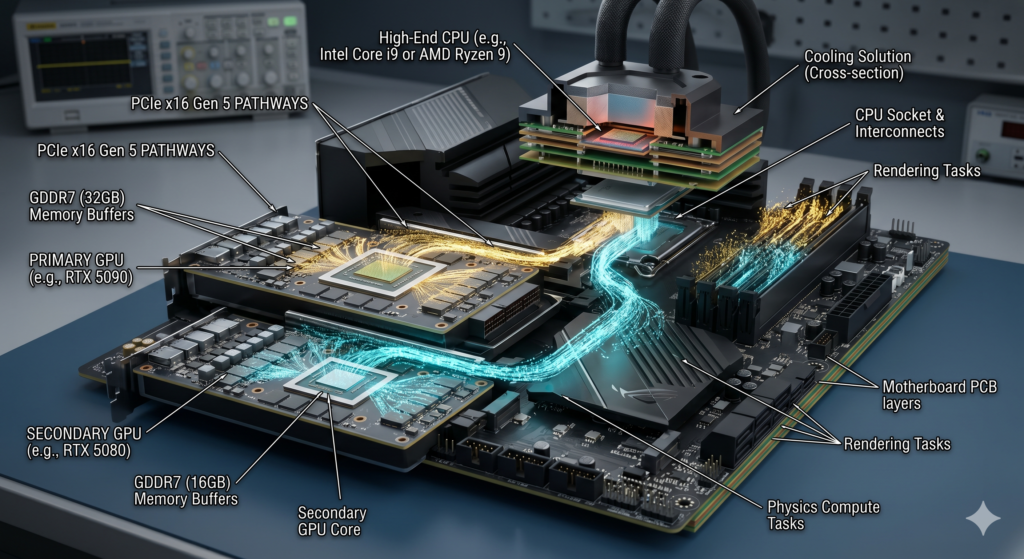
The solution, as Tom’s Hardware’s testing reveals, is not better hardware, but smarter workload partitioning. By designating an RTX 5060 as the dedicated PhysX processor via the NVIDIA Control Panel, the driver creates a clean separation of concerns. The primary GPU handles rasterization, ray tracing, and post-processing, while the secondary GPU takes over all PhysX API calls. This is not SLI—it’s not frame alternation or split-frame rendering. It’s compute offload, a concept more akin to how data centers distribute AI inference or video transcoding across specialized accelerators.
Under the hood, this works through Nvidia’s CUDA runtime, which allows multiple GPUs to coexist in a single system with distinct roles. When the game calls a PhysX function—say, simulating the flutter of a torn poster in the wind—the driver intercepts that call and routes it to the PhysX-dedicated GPU. That GPU executes the simulation, stores the results in its VRAM, and signals completion. The primary GPU then reads those physics states and renders them as part of the scene. This decoupling eliminates the contention that occurs when both rendering and physics fight for the same SMs (Streaming Multiprocessors).
The December 2025 driver update that restored 32-bit PhysX support for the RTX 50-series was likely a critical enabler. With 32-bit CUDA deprecated, older games could no longer launch PhysX kernels directly. The fix probably involved a compatibility layer that translates 32-bit kernel calls into 64-bit equivalents, or a thunking mechanism that wraps legacy APIs in modern runtime calls. This isn’t just backward compatibility—it’s a lifeline for a generation of games that defined immersive physics.
Enterprise Market Impact & TCO
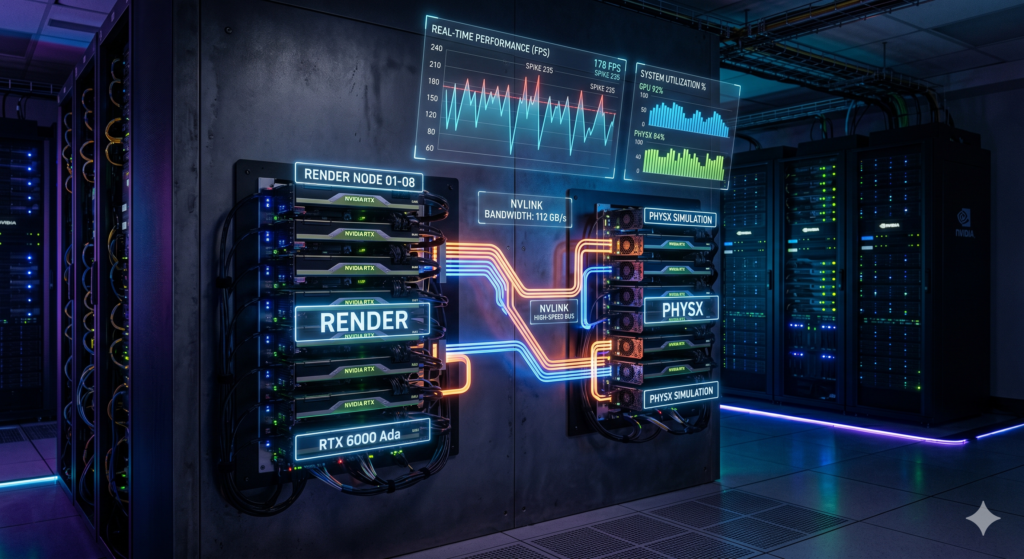
While this setup may seem like a niche enthusiast experiment, it carries surprising relevance for enterprise IT and data center operations. The principle of compute offload is not new—AI inference farms use dedicated accelerators like TensorRT or T4 GPUs to handle model execution while primary servers manage orchestration. Similarly, video transcoding farms offload encoding to NVENC-enabled cards. The dual-GPU PhysX model is a microcosm of this broader trend: specialized workloads should not compete with primary compute tasks.
For enterprises running simulation-heavy applications—engineering CFD, financial modeling, or even virtual training environments—this test underscores the value of workload segregation. Imagine a workstation running a real-time structural simulation where physics calculations are offloaded to a secondary GPU. The primary GPU remains free for high-fidelity visualization, reducing latency and improving interactivity. This isn’t hypothetical; industries like automotive design already use multi-GPU setups for precisely this reason.
However, the Total Cost of Ownership (TCO) equation is complex. Adding a second GPU increases power draw, cooling requirements, and physical footprint. The RTX 5060, while mid-tier, still requires a 600W+ PSU when paired with a 5090. In a data center, that translates to higher rack density costs, increased HVAC load, and greater failure points. Moreover, driver and software support for such configurations is not standardized outside of Nvidia’s consumer stack. Enterprise environments rely on stability, not experimental setups.
Yet, the scalability lesson is clear: as workloads become more heterogeneous, the “one GPU does all” model is reaching its limits. The future may not be dual-GPU gaming, but rather specialized silicon for specific tasks—just as we now have DPUs for networking and NPUs for AI. Nvidia’s own Grace CPU + Hopper GPU architecture is a step in this direction. The PhysX experiment, then, is a canary in the coal mine: general-purpose GPUs are hitting diminishing returns, and the next leap will come from specialization.
For CTOs, the takeaway isn’t to deploy dual-GPUs in workstations, but to evaluate how workloads can be partitioned across available hardware. If a $300 RTX 5060 can boost performance by 76% in a legacy title by handling a single task, what gains could be realized by offloading AI denoising, physics, or even audio processing in professional pipelines? The answer lies in rethinking the GPU not as a monolithic renderer, but as a modular compute fabric.
The Consumer Reality: What This Means for You
Let’s be clear: for 99% of gamers, this setup is overkill. The RTX 5090 alone delivers over 200 FPS in 4K with PhysX enabled in most of these titles. Adding a second GPU for a 25–76% boost is like installing a twin-turbo V12 in a grocery-getter. The performance is glorious, but the cost, power, and complexity are hard to justify. The RTX 5060 isn’t cheap—retailing around $300 at launch—and you’ll need a 1200W PSU, ample case space, and excellent airflow to run both cards without throttling.
But for a specific subset of users—retro gaming enthusiasts, content creators, and simulation purists—this is a revelation. The Batman: Arkham series, particularly Asylum and City, were designed with PhysX as a core immersion tool. Without it, debris is static, cloth is stiff, and fog is just a texture. With it, the world feels alive. Paper flutters in the wind, smoke billows with mass, and every shattered window rains down particles that react to airflow. These aren’t gimmicks; they’re environmental storytelling. For YouTubers and streamers revisiting these classics, the visual fidelity boost is worth the hassle.
And here’s the irony: the RTX 5060 is overqualified. Historically, users ran PhysX on cards like the GT 730 or GTX 1050—GPUs that cost under $100. The fact that a 5060 averages only 14–42% utilization in these tests proves that even modest hardware can handle legacy PhysX workloads. This opens the door for budget-conscious users to repurpose old GPUs. Got a spare GTX 1650? Drop it in, set it to PhysX, and breathe new life into Mafia II or Mirror’s Edge.
Yet, the broader consumer impact is more philosophical. PhysX remains a Nvidia-exclusive technology. AMD GPUs cannot run it, and game developers have largely abandoned it due to limited reach. As one forum user noted, if PhysX were open-sourced or ported to Vulkan/DX12 Compute, it could have become a universal standard. Instead, it’s a walled garden—a premium feature that only benefits one ecosystem. This exclusivity stifles innovation. We could have had a generation of games with rich, systemic physics, but instead, we got optional eye candy.
For the average user, the lesson is this: hardware advances only matter if software embraces them. The RTX 5090 is a marvel, but it can’t resurrect a dead ecosystem. Until developers prioritize physics as a core gameplay element—not just a visual toggle—this dual-GPU trick will remain a curiosity, not a revolution.
The Industry Ripple Effect
This test isn’t just about two GPUs—it’s a referendum on Nvidia’s ecosystem strategy. By keeping PhysX proprietary, Nvidia ensured loyalty among GeForce users, but at the cost of industry-wide adoption. Contrast this with AMD’s approach to FSR or Intel’s XeSS: open, cross-vendor upscaling technologies that gained rapid developer support. PhysX, by remaining closed, became a niche feature rather than a standard.
The results here could force a reckoning. If dual-GPU PhysX delivers 76% gains in flagship titles, what could be possible in modern games with more advanced physics? Imagine Cyberpunk 2077 with every piece of debris, every fabric, every raindrop simulated in real time. Or Starfield with fully dynamic ship destruction. The tech exists—but without developer buy-in, it’s inert.
Competitors are watching. AMD has dabbled in physics with Radeon Rays, but never pushed it as a core feature. Intel’s Xe architecture includes strong compute capabilities, but lacks a unified physics SDK. If Nvidia opens PhysX—or if a third party creates an open alternative—the landscape could shift overnight. Epic Games could integrate it into Unreal Engine 5, and suddenly, every dev has access to robust physics.
But until then, Nvidia holds the keys. And while they’ve shown willingness to support legacy use cases (witness the 32-bit driver fix), they’ve done little to push PhysX into the future. The rise of AI-driven physics—using neural networks to predict particle behavior—could render traditional PhysX obsolete. Nvidia’s own DLSS and Broadcast technologies show they’re investing in AI, not legacy APIs.
The ripple effect, then, is cautionary. Proprietary tech can create short-term advantages, but long-term stagnation. The dual-GPU PhysX revival is a victory for enthusiasts, but a reminder that innovation dies without openness.
TechNode HQ Verdict: Pros, Cons & Usability
- Pro (Engineering): Demonstrates the viability of compute offload for specialized workloads, validating a core principle in high-performance computing.
- Pro (Consumer): Revives immersive physics in classic games, offering tangible visual and gameplay enhancements for retro gaming enthusiasts.
- Con: High power draw and thermal output from dual-GPU setups increase TCO and require premium PSUs and cooling.
- Con: Limited to Nvidia GPUs and a shrinking pool of PhysX-enabled games, reducing real-world applicability.
Enterprise Usability: Not recommended for deployment, but the concept of workload partitioning should inform future infrastructure design, especially in simulation-heavy environments.
Everyday Usability: Only viable for hardcore enthusiasts with spare GPUs; general consumers should wait for broader software support or AI-driven physics alternatives.
Sources & Citations:
Original Technical Breakdown via: tomshardware
Official Handle: @tomshardware
Topics Explored: RTX 5090, PhysX, dual GPU, NVIDIA, legacy gaming