
The Architectural Shift
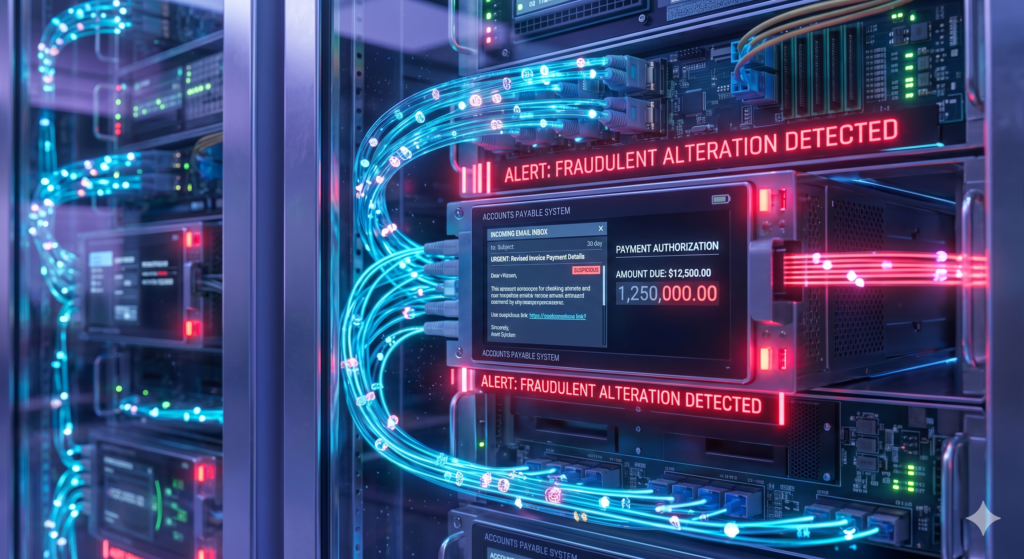
At the silicon level, the Sri Lankan cyber heist wasn’t a brute-force intrusion or a zero-day exploit—it was a surgical manipulation of trust. The attackers didn’t need to crack encryption or bypass firewalls. Instead, they exploited the most vulnerable layer in any financial system: human workflow. Business Email Compromise (BEC) attacks like this one rely on social engineering to infiltrate email ecosystems—typically Microsoft 365 or Google Workspace—where credentials are harvested via phishing, credential stuffing, or session hijacking. Once inside, attackers deploy low-footprint surveillance: reading emails, mapping vendor relationships, and identifying payment cycles. This reconnaissance phase can last weeks, during which no malicious code is executed, making detection by traditional antivirus or EDR tools nearly impossible.
The real engineering breach occurs at the point of transaction. When a finance officer prepares to pay an invoice—say, to the U.S. Postal Service—the attacker, now embedded in the email chain, subtly alters the bank account and routing numbers. This isn’t done through malware but via direct email manipulation: a reply from a spoofed address that appears legitimate, or a compromised vendor account sending updated banking details. In legacy financial systems, especially in government agencies, payment approvals often rely on email confirmation rather than authenticated, API-driven payment platforms. The absence of multi-factor authentication (MFA) on email accounts, combined with decentralized payment authorization—where different departments manage their own disbursements—creates a perfect storm for exploitation.
At the network layer, attackers may use DNS spoofing to redirect traffic to fake banking portals, or deploy browser-in-the-browser (BitB) attacks to overlay legitimate banking sites with fraudulent forms. In some advanced BEC campaigns, attackers install lightweight browser extensions that intercept and modify SWIFT or SEPA transaction data before submission. The Sri Lankan case suggests a lack of real-time transaction monitoring: no anomaly detection flagged the $2.5 million transfer to an unauthorized account, nor the missing $625,000 payment. This indicates the absence of AI-driven behavioral analytics that could detect deviations from normal payment patterns—such as a sudden change in beneficiary bank details or an unusually large disbursement to a foreign entity.
Underpinning this vulnerability is the reliance on outdated financial infrastructure. Many government treasuries still operate on monolithic ERP systems like SAP or Oracle Financials, where payment workflows are siloed and audit trails are fragmented. Without blockchain-style immutable ledgers or real-time reconciliation engines, discrepancies only surface when external parties—like the USPS or Australian officials—report non-payment. The lack of end-to-end encryption in inter-agency communication, combined with weak identity governance, allows attackers to persist undetected for weeks, silently rerouting funds.
Enterprise Market Impact & TCO

The Sri Lankan breach isn’t an outlier—it’s a blueprint for how cybercriminals are targeting financial infrastructure globally. For enterprise IT leaders, the implications are profound. The Total Cost of Ownership (TCO) of financial operations is no longer just about software licenses and personnel. It now includes the cost of fraud mitigation, incident response, regulatory fines, and reputational damage. A single BEC attack can erase millions in profit, as seen in the $3.125 million lost by Sri Lanka in under a week. For multinational corporations, the risk is amplified: decentralized subsidiaries with independent payment authority become attack vectors, especially in regions with weaker cybersecurity oversight.
The economic model of BEC is brutally efficient. According to the FBI’s 2025 Internet Crime Report, BEC scams accounted for $2.7 billion in losses—more than ransomware and crypto theft combined. The average BEC attack yields $120,000 per incident, but high-value targets like government ministries or Fortune 500 suppliers can net millions. Cybercriminals operate with near-zero marginal cost: a phishing kit costs less than $50 on dark web forums, and a single compromised email account can generate millions in illicit transfers. This asymmetry forces enterprises to invest heavily in prevention, not just detection.
From a data center perspective, the solution lies in zero-trust architecture. Legacy “castle-and-moat” security models, where internal networks are trusted by default, are obsolete. Modern financial systems must assume breach and enforce strict identity verification at every transaction point. This means implementing MFA on all email and financial systems, deploying AI-driven anomaly detection that monitors payment patterns in real time, and integrating payment gateways with blockchain-based verification layers. Companies like Ripple and Circle are already piloting real-time cross-border payment systems with embedded cryptographic validation, reducing reliance on email-based confirmations.
Scalability is another challenge. For governments and large enterprises, migrating from legacy ERP systems to modern, API-first financial platforms is a multi-year, multi-million-dollar endeavor. Sri Lanka’s finance ministry likely uses a decades-old system with limited integration capabilities, making it difficult to deploy modern security controls. The cost of upgrading isn’t just financial—it’s operational. Finance teams must be retrained, workflows redesigned, and third-party vendors brought into compliance. Yet the alternative—continued exposure to BEC—is far costlier. Insurance premiums for cyber liability are rising, with some policies now excluding BEC-related losses unless MFA and multi-person approval protocols are in place.
The breach also exposes the fragility of global financial interdependence. When Sri Lanka fails to pay the USPS, it disrupts mail services, customs processing, and e-commerce logistics. Australia’s reported irregularities suggest a cascading effect: delayed payments trigger audits, increase transaction friction, and erode trust in international trade. For enterprises, this means higher due diligence costs, longer payment cycles, and the need for redundant verification channels. The TCO of global operations is rising—not from tariffs or shipping, but from the hidden tax of cyber insecurity.
The Consumer Reality: What This Means for You
You don’t need to be a finance minister to fall victim to a BEC attack. The same tactics used to steal $3 million from Sri Lanka are deployed daily against small businesses, freelancers, and homeowners. Imagine you’re renovating your kitchen and receive an invoice from your contractor. A hacker, having compromised their email, sends a “updated payment details” message with a new bank account. You pay, the money vanishes, and the contractor never receives it. This isn’t hypothetical—thousands of such cases occur annually, with the FBI reporting that small businesses lost over $2.4 billion to BEC in 2025 alone.
The Sri Lankan case reveals a disturbing truth: the global financial system runs on trust, not technology. When you pay a bill online, you assume the bank details are correct. But if the sender’s email is compromised, that assumption collapses. Consumers are increasingly vulnerable as digital payments replace checks and cash. Zelle, Venmo, and bank transfers offer speed but lack fraud protection—once money is sent, it’s often unrecoverable. Unlike credit cards, which have chargeback mechanisms, peer-to-peer payments are final. This creates a perfect environment for BEC-style fraud.
For everyday users, the lesson is clear: never trust an email with payment instructions. Always verify changes in banking details through a secondary channel—call the vendor, use a verified app, or meet in person. But this places the burden on individuals, not institutions. Banks and payment platforms could implement AI-driven verification: flagging sudden changes in recipient accounts, requiring multi-step approval for large transfers, or using biometric authentication. Yet most don’t, prioritizing convenience over security.
The broader impact is a slow erosion of trust in digital finance. If governments can’t secure their payments, why should individuals? This skepticism could slow the adoption of digital currencies, open banking, and automated bill pay. Consumers may revert to slower, more secure methods—like paper checks or in-person payments—reversing decades of financial digitization. The cost isn’t just monetary; it’s societal. Every extra verification step, every delayed transaction, every lost dollar chips away at the efficiency that digital finance promises.
The Industry Ripple Effect
The Sri Lankan breach is a wake-up call for the global cybersecurity industry. It confirms that BEC is no longer a nuisance crime but a systemic threat to financial stability. Competitors are already reacting. Microsoft has accelerated its rollout of AI-powered email protection in Microsoft 365, using machine learning to detect anomalous sender behavior and flag suspicious payment requests. Google is integrating its Chronicle security analytics with Gmail to provide real-time BEC alerts. Meanwhile, fintech firms like Stripe and Adyen are building “smart invoicing” platforms that cryptographically verify vendor bank details, eliminating the need for email-based updates.
Insurance companies are also shifting. Cyber insurers like Lloyd’s of London and AIG now require proof of MFA, multi-person payment approval, and regular employee training as conditions for coverage. Some are excluding BEC claims entirely unless these controls are in place. This forces enterprises to adopt better security or face uninsurable risk. The regulatory landscape is following suit: the U.S. SEC’s 2025 cybersecurity disclosure rules now mandate public companies to report material BEC incidents, increasing transparency and accountability.
For emerging markets, the implications are dire. Countries like Sri Lanka, already grappling with economic instability, cannot afford repeated cyber heists. The breach could trigger downgrades from credit rating agencies, increase borrowing costs, and deter foreign investment. Other developing nations are taking notice: India, Indonesia, and Nigeria are now auditing their government payment systems for BEC vulnerabilities. The global standard is shifting—financial integrity now includes cybersecurity resilience.
The long-term ripple effect may be the decoupling of communication and payment. The era of “send me the details via email” is ending. Instead, we’ll see the rise of verified payment networks—platforms where vendor identities and banking details are cryptographically anchored, and transactions are executed through secure APIs. This mirrors the shift from HTTP to HTTPS: a recognition that trust must be engineered, not assumed.
TechNode HQ Verdict: Pros, Cons & Usability
- Pro (Engineering): Exposes the critical need for zero-trust financial workflows and real-time anomaly detection in payment systems.
- Pro (Consumer): Raises public awareness of BEC risks, empowering individuals to verify payment details through secondary channels.
- Con: Highlights the massive cost and complexity of upgrading legacy government financial infrastructure.
- Con: Demonstrates that current email and payment ecosystems are fundamentally insecure by design.
Enterprise Usability: CTOs must enforce MFA on all financial systems, implement AI-driven transaction monitoring, and phase out email-based payment approvals in favor of API-integrated platforms.
Everyday Usability: The general public should never trust payment instructions sent via email; always verify through a known, secure channel. Wait for widespread adoption of verified payment networks before assuming digital transactions are safe.
Sources & Citations:
Original Technical Breakdown via: techcrunch
Official Handle: @TechCrunch
Topics Explored: Business Email Compromise, Cybersecurity Breach, Government Cyberattack, Financial Infrastructure, BEC Scams