Key takeaways
- Mach Industries manages six concurrent weapons programs to avoid single-point failure.
- A $300M Series C led by Infinite Capital values Mach at $1.8 billion.
- The company focuses on out-creating adversaries through rapid, in-house component manufacturing.
- Mach Energetics was formed after acquiring Exquadrum for $50M to secure rocket motors.
- By starting with hardware, Mach contrasts sharply with top-down, software-first competitors.
The global defense industrial base is undergoing a radical paradigm shift. At the epicenter of this transformation is Mach Industries manufacturing, a strategic blueprint that eschews the traditional, slow-moving procurement pipelines in favor of hyper-agile, vertically integrated production. Led by 22-year-old founder and CEO Ethan Thornton—a Thiel Fellowship recipient who dropped out of MIT after just one semester in 2023—the Huntington Beach, California-based startup is attempting what many legacy primes consider structurally impossible: scaling six highly complex weapons programs simultaneously. Thornton, who grew up on a farm in Burnet, Texas, and has been prototyping weapons since high school, recognized early on that the true bottleneck in modern geopolitical conflict is not merely software algorithms, but the sheer physical output of the supply chain.
Armed with a recent $300 million Series C funding round led by Infinite Capital and Ribbit Capital, which catapulted its valuation to $1.8 billion, the company is rapidly expanding its footprint. With total capital raised now sitting at roughly $485 million, Mach Industries is heavily capitalizing on its vision to out-create global adversaries by mastering the hardware innovation layer from the ground up. The strategic implications of this resurgence in American hard-tech engineering cannot be overstated. For decades, the defense industrial base has trended towards massive consolidation, leaving a handful of giant prime contractors producing exquisitely expensive, slowly iterating platforms. Thornton’s vision directly assaults this status quo, betting that the future of global security belongs to decentralized swarms of asymmetric platforms driven by extreme manufacturing velocity.
Mach Industries Manufacturing: The Architectural Reality

The contrast between Mach’s strategy and the broader defense technology ecosystem is exceptionally stark. While heavily funded competitors like Anduril—which recently commanded a massive $61 billion valuation—focus heavily on a top-down, software-first ecosystem that wraps digital layers around existing platforms, Mach is aggressively bottom-up. The company is actively managing a diverse and wildly ambitious portfolio of six distinct weapons programs: a vertical take-off cruise missile/attack aircraft, a long-range anti-ship missile, two separate stratospheric systems, a low-cost surface-to-air drone defense interceptor, and a recently announced 40-foot Navy logistics-attack aircraft capable of hauling a 1,000-pound payload over 1,000 miles.
This massive diffusion of focus initially raises eyebrows among defense analysts accustomed to the discipline of single-platform scaling seen in successful unicorns like Shield AI (valued at $12.7B) or Saronic ($9.25B). However, Thornton’s fundamental thesis asserts that adversarial combat is a highly dynamic chess game requiring hundreds of different interlocking products. To bet on a single platform is to court systemic failure. When evaluating the underlying engineering and architectural mechanics of the company, it becomes evident that the core product is not just the munitions, but the supply chain itself. Mach Industries relies on a doctrine of relentless vertical integration, aiming to bypass the fragile external vendor networks that paralyze the modern defense industry. A prime example of this engineering velocity is their internal propulsion development: Mach engineers designed, built, and successfully fired two custom jet engines from scratch in just eight months—a timeline that traditionally consumes up to four years within standard Department of Defense contracting environments.
To further solidify its hardware stack, the company executed a strategic acquisition in April 2026, purchasing the 24-year-old solid rocket motor manufacturer Exquadrum for $50 million. Beating out approximately eight other bidders, this acquisition brought crucial energetic and propulsion IP directly in-house. Exquadrum, originally founded in 2002 by former Air Force Research Lab engineers Kevin Mahaffy and Eric Schmidt, has since been rebranded and integrated as Mach Energetics. By securing its own supply of solid rocket motors and jet propulsion units, the startup insulates itself from severe bottlenecks. Interestingly, this rapid verticalization means that selling base components to other defense contractors now accounts for approximately 50% of the company’s total revenue, establishing a dual-pronged business model that effectively funds their advanced research and development.
The technological journey has not been without its major pivots. The company initially centered its early research and development on hydrogen-powered weaponry and propulsion systems. After extensive prototyping—some of which Thornton famously conducted with materials sourced from commercial hardware stores during his teenage years—the team concluded that hydrogen was fundamentally a bad bet for robust, field-deployable combat systems. This rapid invalidation of a core technological premise highlights the startup’s willingness to fail fast and pivot, a hallmark of agile enterprise procurement frameworks but an absolute rarity in the world of heavy kinetic weaponry.
Market Impact & Deployment
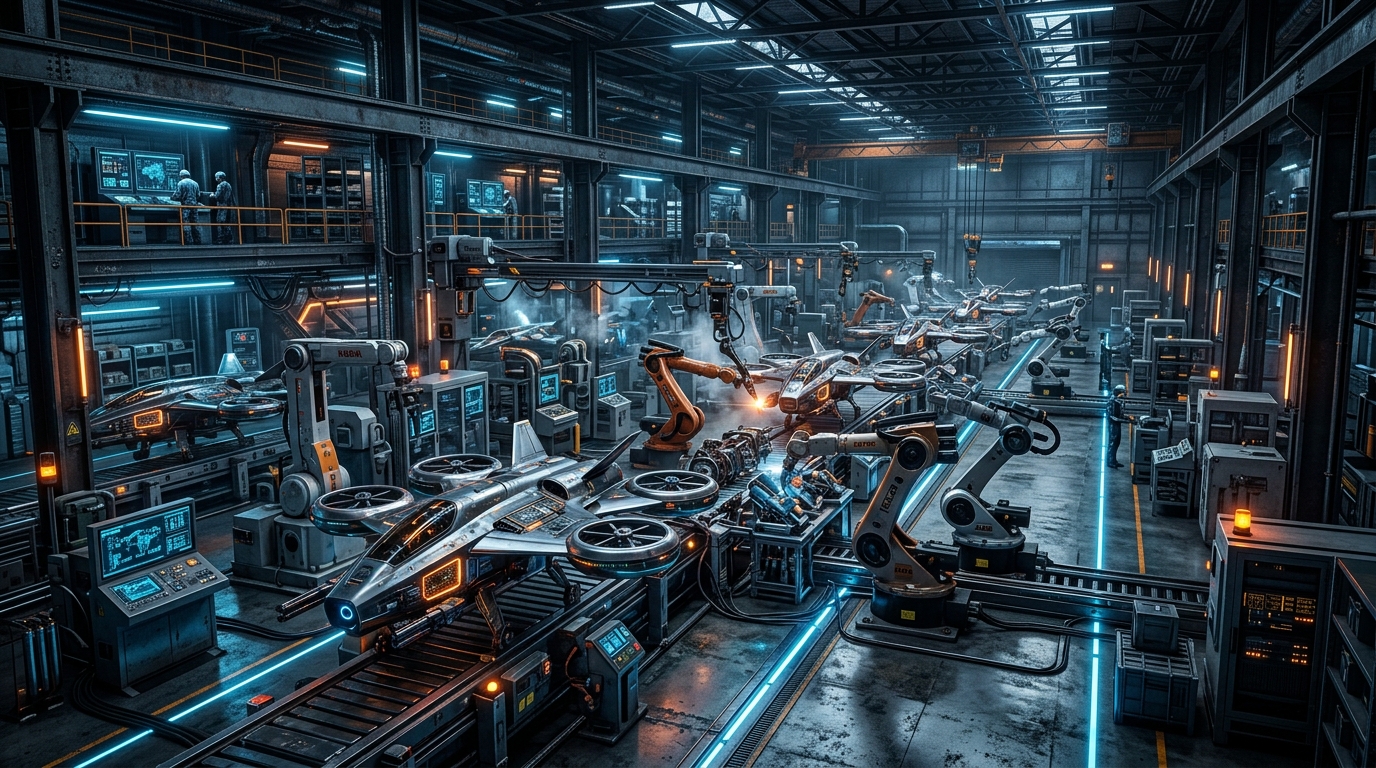
From a business and executive standpoint, the Total Cost of Ownership (TCO) and return on investment (ROI) metrics associated with Mach’s methodology are profoundly compelling. By owning the component manufacturing layer natively, the company drastically reduces the lead times and inflated costs driven by multi-tier subcontractor markups. This directly translates to lower per-unit costs for the Pentagon, allowing the U.S. military to procure the higher volumes of interceptors and strike platforms required for highly distributed maritime operations or contested airspace scenarios. Currently, the company holds roughly 13 government contracts, positioning its portfolio directly in the crucial middle stages of defense procurement—past initial blueprints and into active government range testing.
The ultimate litmus test for the company, however, will be traversing the notorious “valley of death”—the treacherous transition from successful prototypes to full-rate manufacturing. Less than ten defense-tech startup programs industry-wide have successfully achieved rate manufacturing at scale. Thornton has set an exceptionally aggressive target: pushing three of the six active systems into full-scale production by the end of 2026. Transitioning from churning out hundreds of units a month to hundreds of thousands requires not just brilliant initial engineering, but a world-class manufacturing logistics network akin to what the automotive industry mastered in the 20th century. By establishing a dedicated factory infrastructure, the startup aims to practically demonstrate that American ingenuity and deep productization can overcome the raw industrial scale of foreign adversaries.
A structural analogy clarifies this approach for non-engineering stakeholders: Imagine legacy defense procurement as traditional, on-premise monolithic data centers—highly secure, extremely rigid, and agonizingly slow to provision, upgrade, or scale. Mach is aggressively applying the cloud-native, microservices methodology to physical munitions. By building the fundamental, interchangeable “compute nodes” (jet engines, autonomous flight controllers, solid rocket motors) entirely in-house, they can rapidly snap together and scale an entire fleet of diverse applications (missiles, interceptors, stratospheric drones) without waiting years for external hardware provisioning. This modular, heavily verticalized stack is essentially the physical embodiment of modern cloud-native logistics networks.
However, a rigorous red-team audit reveals significant execution risks hidden beneath the impressive funding rounds and aggressive timelines. The startup is simultaneously managing extreme complexities across vastly different aerospace domains: a 40-foot Navy strike aircraft requires entirely different aerodynamic profiles, material sciences, and payload integrations than a high-altitude stratospheric drone or a cheap, mass-produced surface-to-air interceptor. The dispersion of elite engineering talent across six demanding fronts could potentially dilute their technical edge, resulting in multiple projects that are ‘good enough’ rather than best-in-class. While selling sub-components provides a robust revenue floor, transitioning a massive 4,000-pound aircraft from a prototype into full-rate production involves strict Department of Defense safety, reliability, and software certifications that cannot simply be “hacked” or bypassed.
Cross-Industry Disruption & Future Horizons
Beyond immediate military applications, the vertical integration of energetic materials and rapid propulsion systems fundamentally disrupts three adjacent industries. First, the commercial space sector stands to benefit immensely from the commoditization of solid rocket motors. Currently, the massive bottleneck for micro-satellite deployment is the availability and prohibitive cost of secondary payload launch vehicles. By driving the cost of raw thrust down to a fraction of traditional aerospace levels through in-house mass production, civilian space exploration and orbital infrastructure development can scale exponentially.
Second, the advanced manufacturing and robotics sectors will likely adopt the aggressive, rapid prototyping techniques championed by Mach’s engineering teams. The ability to iterate, cast, and fire a physical jet engine in just eight months requires an extensive reliance on industrial additive manufacturing (3D printing), automated precision tooling, and AI-driven thermal fluid dynamics simulations. As these specific tools and methodologies are proven in the unforgiving crucible of defense tech, they will inevitably permeate commercial manufacturing, allowing automotive, marine, and consumer electronics companies to shorten their own product development cycles dramatically.
Third, the global supply chain and logistics industry is watching the deployment of the 40-foot vertical-takeoff aircraft very closely. While currently slated strictly for Navy logistics-and-strike missions, a platform capable of autonomously hauling a half-ton of heavy cargo over a thousand miles without requiring a traditional paved runway could revolutionize global disaster relief, remote medical supply delivery, and trans-continental overnight shipping networks. The underlying thermal architecture, composite materials, and hybrid fuel efficiency models being perfected under defense budgets will eventually yield commercial variants, reshaping how physical goods move across challenging terrestrial environments across the globe.
The Consumer Translation
While Mach Industries operates strictly within the classified and sovereign defense domains, the trickle-down impact of its manufacturing breakthroughs will inevitably alter the consumer and commercial landscapes in profound ways. History repeatedly shows that military aerospace innovation consistently catalyzes commercial technology. The intense pressure to mass-produce cheap, highly reliable jet engines and solid rocket motors will ultimately drive down the fundamental cost curve for commercial launch providers, satellite deployment networks, and potentially even high-speed autonomous drone delivery networks for civilian consumer use.
Furthermore, the software-hardware integration techniques required to safely launch, coordinate, and recover cheap, expendable drones will inevitably push the boundaries of edge computing and autonomous spatial navigation. As these systems become commoditized through massive scale, the lightweight composite materials, dense battery architectures, and resilient sensors developed for the defense sector will find their way into everyday consumer electronics, commercial autonomous vehicles, and civilian aviation infrastructure. By forcing the United States industrial base to remember how to manufacture complex, heavy hardware at warp speed, companies like Mach are fundamentally revitalizing the nation’s broader technological infrastructure for decades to come.
Frequently Asked Questions
Q1: What is Mach Industries building?
A1: Mach Industries is developing six simultaneous weapons programs, including a vertical-takeoff strike aircraft, a long-range anti-ship missile, stratospheric systems, and a drone defense interceptor. They recently announced a 40-foot Navy logistics aircraft capable of carrying a 1,000-pound payload over 1,000 miles.
Q2: How much funding has Mach Industries raised?
A2: Mach Industries recently closed a $300 million Series C round led by Infinite Capital and Ribbit Capital. This brings their total funding to approximately $485 million at a $1.8 billion valuation.
Q3: How does Mach Industries’ approach differ from competitors like Anduril?
A3: Unlike Anduril, which employs a top-down, software-first playbook, Mach operates bottom-up by starting with the hardware stack. They focus on securing the supply chain, such as acquiring Exquadrum to build rocket motors internally.
Q4: Who is the founder of Mach Industries?
A4: Ethan Thornton is the 22-year-old founder and CEO. He received the Thiel Fellowship and dropped out of MIT at 19 after prototyping hydrogen-powered weaponry.
Q5: What is Mach Energetics?
A5: Mach Energetics is the new operational name for Exquadrum, a 24-year-old solid rocket motor company that Mach Industries acquired for $50 million in April 2026 to bring critical propulsion manufacturing in-house.
TechNode HQ Verdict: Pros, Cons & Usability
- Pro (Engineering): Total ownership of the propulsion and energetics supply chain allows for unprecedented hardware iteration speed and massively reduced unit costs.
- Pro (Consumer): Innovations in rapid aerospace manufacturing and automated material sciences will trickle down to revolutionize commercial logistics and civilian drone markets.
- Con: Scaling six disparate, highly complex aerospace programs simultaneously risks catastrophic engineering dilution and severe capital burn rates.
- Con: Navigating the rigid Department of Defense procurement pipeline to achieve full-rate production remains a monumental, unproven hurdle for a startup of this age.
Enterprise Usability: For aerospace primes and defense procurement officers, Mach represents a critical hedge against supply chain fragility; integrating their base components (engines, motors) offers immediate cycle-time reductions and strategic sourcing resilience.
Everyday Usability: While not a direct-to-consumer product, the massive investments in deep-tech manufacturing infrastructure will accelerate the availability and lower the costs of next-generation commercial logistics networks and satellite-enabled services over the coming decade.