Key takeaways
- Apple’s stock dropped nearly 10%, erasing nearly $500 billion in market value amid supply warnings.
- The “RAMmageddon” memory shortage is driven by manufacturing capacity shifts toward AI infrastructure.
- Apple’s profit margins face compression despite reporting a record $109.4 billion June quarter.
- Apple broke its minimal inventory strategy, building component reserves to secure supply lines.
- Incoming CEO John Ternus faces immediate supply chain and political hurdles before his September start.
The Architectural Reality of the Apple Memory Shortage
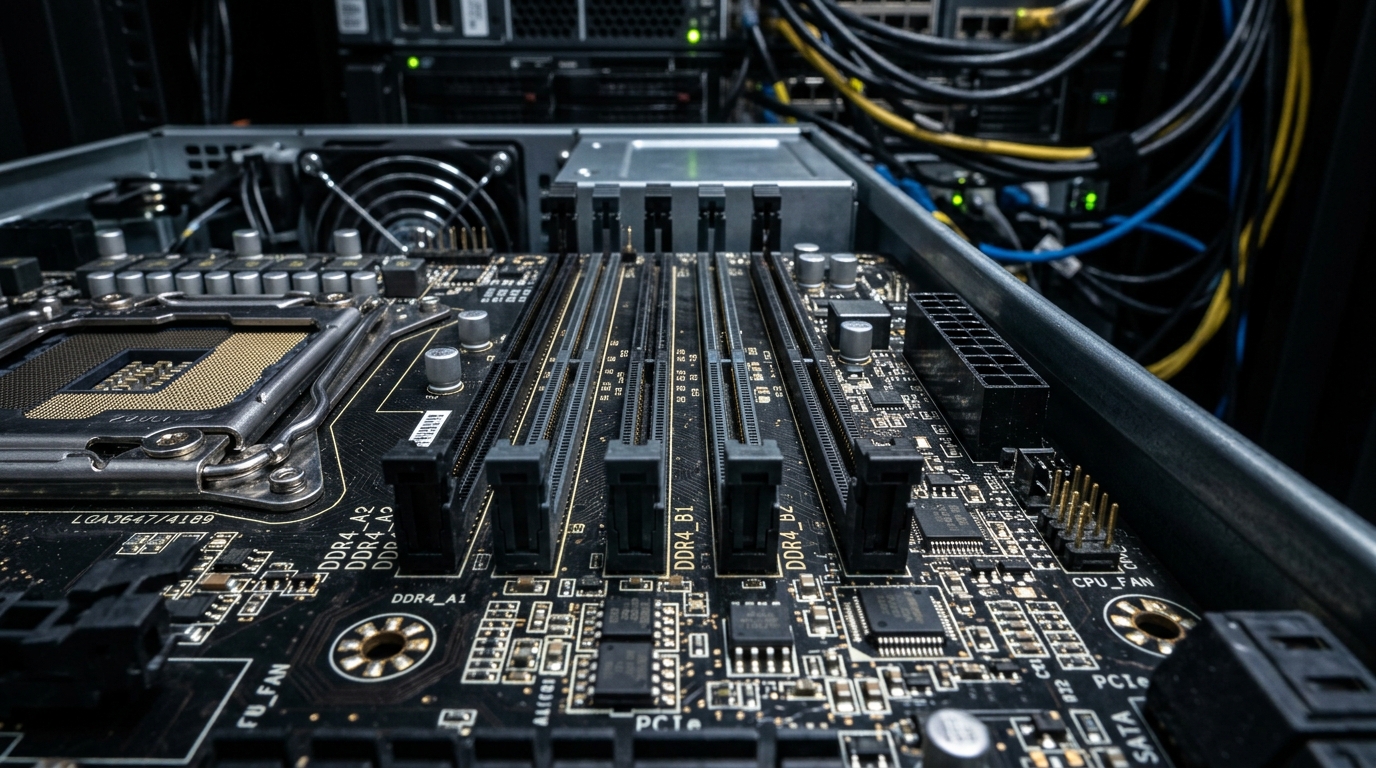
The global semiconductor ecosystem is currently experiencing a seismic reallocation of resources, culminating in what industry insiders have dubbed “RAMmageddon.” At the center of this storm is the severe Apple memory shortage, a crisis that has fundamentally disrupted the predictable cadence of consumer technology manufacturing. While Apple recently reported its strongest June quarter ever, with revenue surging 16% year-over-year to a staggering $109.4 billion and iPhone sales climbing by 22%, the underlying architectural reality of their supply chain is fraught with unprecedented friction. Outgoing CEO Tim Cook warned of “very significant” component shortages, explicitly highlighting a severe lack of DRAM and NAND flash memory chips. This is not a mere logistical hiccup; it is a structural realignment of global silicon fabrication.
The root cause of this memory drought is the explosive, insatiable demand for AI data center infrastructure. Semiconductor foundries are actively pivoting their manufacturing capacity away from the standardized, high-volume memory modules traditionally used in consumer electronics, reallocating those precise fabrication lines to produce the specialized, high-bandwidth memory (HBM) required by enterprise AI accelerators. As a result, the silicon components necessary for laptops, tablets, and smartphones are being aggressively sidelined. Apple, a company famous for its supply chain mastery and leverage, is finding that even its immense purchasing power cannot simply conjure fabrication capacity out of thin air when the entire industry is pivoting toward artificial intelligence infrastructure.
Apple has historically operated on a “just-in-time” inventory model, a masterpiece of operational efficiency designed to minimize overhead and maximize flexibility. However, the current macro-environment has forced a radical departure from this strategy. Apple has broken its long-standing approach by actively building up component reserves to secure supply lines. While they have utilized this stockpiled inventory to cushion against the initial wave of rising component costs, Tim Cook has indicated that this critical buffer is now depleting. The architectural reality is that the safety nets are unraveling, exposing the company directly to the volatile spot market for memory pricing, which Cook characterized as a “100-year flood” of exponential increases.
The Supply Chain Red Team Audit: Fluff vs. Reality
When dissecting the corporate narrative, a red team audit reveals critical vulnerabilities beneath the polished earnings calls. Apple’s leadership emphasized that current supply issues are primarily driven by unexpectedly high product demand rather than supplier failures. While it is true that a 22% surge in iPhone sales outpaced their own internal forecasts, attributing the friction solely to consumer enthusiasm masks the systemic rigidity of their supply chain. The reality is a severe lack of flexibility. Apple is facing significant constraints on advanced semiconductor nodes for its custom chips, a bottleneck that cannot be resolved quickly regardless of how much capital is deployed.
Furthermore, the strategy to offset memory price hikes by reducing costs on non-memory components is mathematically limited. Memory constitutes a massive percentage of the Bill of Materials (BOM) for modern computing devices. You cannot endlessly squeeze the cost of chassis aluminum or standard logic boards to compensate for a 50% spike in DRAM prices. This discrepancy is precisely why analysts project overall gross margins for the iPhone could face compression, dropping from a healthy 38% down to 34.5%. For a company valued on its ability to maintain premium margins at massive scale, this represents a structural threat.
To combat this, Apple is actively evaluating its supply sources to improve stability, including the highly controversial exploration of memory chips from Chinese manufacturers like ChangXin Memory Technologies (CXMT) and Yangtze Memory Technologies Corp (YMTC). This is a geopolitical minefield. While Apple is not legally required to obtain U.S. government approval to purchase these chips, doing so without the administration’s support exposes the company to severe political ramifications. U.S. lawmakers from both sides of the aisle are heavily pressuring Apple, warning that adopting Chinese memory could undermine domestic production and jeopardize planned investments in states like Indiana, Idaho, New York, and Virginia. The audit reveals that Apple is trapped between the absolute necessity of securing memory components and the immense political pressure to decouple from Chinese technology.
Market Impact & Deployment

The financial markets reacted to these underlying vulnerabilities with brutal efficiency. Following the earnings report and the stark warnings regarding the memory shortage, Apple’s stock plummeted by nearly 10%, a massive selloff that erased nearly $500 billion from the company’s total market capitalization. To put that into perspective, the value lost in a single day exceeds the total market cap of most Fortune 500 companies. This financial shockwave also marked a symbolic changing of the guard, as Apple subsequently lost its position as the world’s most valuable company to Nvidia, the primary beneficiary of the AI infrastructure boom causing the very shortage Apple is battling.
For enterprise deployment and IT infrastructure planning, this shift signals a prolonged era of increased Total Cost of Ownership (TCO) for endpoint devices. CTOs and fleet managers must recalibrate their procurement budgets. If Apple, the gold standard of supply chain management, is unable to shield itself from these price shocks, the downstream effect will inevitably be passed on to enterprise buyers. Apple has already reluctantly raised prices on certain Mac and iPad models in response to the current shortages. As organizations plan their hardware refresh cycles for the next 24 months, they must factor in the reality that the baseline cost of high-performance computing endpoints is structurally inflating.
The executive abstraction of this crisis is akin to a global shipping network suddenly deciding that 80% of its cargo ships will now exclusively transport heavy industrial equipment, leaving standard consumer goods stranded at the docks. The infrastructure exists, but it has been unilaterally reallocated to a higher-margin, higher-priority sector. For Apple, the challenge is not just finding a new ship; it is convincing the shipyard to build consumer vessels when the real money is in industrial freighters. This delicate balancing act falls squarely on the shoulders of John Ternus, the incoming CEO who will officially succeed Tim Cook on September 1, 2026. Ternus has been actively participating in high-level supply discussions, aiming for continuity, while Cook prepares to transition to the role of executive chairman.
The Consumer Translation
For the everyday consumer, this highly technical shift in global fabrication capacity translates directly into financial strain at the checkout counter. The era of predictable, incremental upgrades at stable price points is temporarily suspended. When Tim Cook refers to a “100-year flood” on memory pricing, he is signaling to the market—and to buyers—that the absorption capacity of the company has reached its limit. While Cook declined to comment specifically on pricing for the upcoming iPhone 18 Pro models and Apple’s highly anticipated first foldable device launching this September, the writing is on the wall. Multiple industry analysts believe that price increases for flagship consumer electronics are now unavoidable.
This dynamic introduces a complex friction point for Apple’s consumer ecosystem. If Apple raises iPhone prices, the fundamental economic law of demand dictates that unit growth will likely slow. As hardware unit growth slows, the subsequent expansion of Apple’s highly lucrative Services sector—which relies entirely on an ever-growing installed base of active devices—will also face headwinds. To mitigate consumer sticker shock, Apple will likely heavily promote financing options, such as their new leasing programs, effectively shifting the business model from a massive upfront capital expenditure to a predictable monthly operational expense for the consumer. It is a financial engineering solution to a silicon manufacturing problem.
Cross-Industry Impact: Beyond the Smartphone
The ramifications of RAMmageddon extend far beyond Apple’s walled garden, violently disrupting multiple tangential industries that rely on baseline computing components. First, the automotive industry, currently undergoing a massive transition toward software-defined vehicles and autonomous driving capabilities, requires immense amounts of robust memory. As fabrication lines prioritize AI data centers, automakers are finding themselves at the back of the queue, potentially delaying the rollout of advanced driver-assistance systems (ADAS) and next-generation infotainment hubs.
Secondly, the Internet of Things (IoT) and smart home sectors face an existential pricing crisis. These industries operate on razor-thin margins, relying on the commoditization of older, cheaper memory chips to make smart lightbulbs, thermostats, and sensors economically viable. The rising tide of memory costs threatens to completely wipe out the profitability of low-end IoT devices, forcing manufacturers to either abandon product lines or pass significant price hikes onto consumers, thereby stunting the adoption curve of smart home technology. Finally, the broader cloud computing ecosystem, outside of the specialized AI accelerators, is feeling the pinch. Standard cloud storage and general-purpose compute instances rely heavily on traditional NAND and DRAM. As these components become scarce and expensive, cloud providers are forced to reconsider their capital expenditure strategies, which could eventually lead to higher baseline hosting costs for SaaS companies and startups worldwide.
Frequently Asked Questions
Q1: Why did Apple’s stock drop recently?
A1: Apple’s stock dropped nearly 10%, erasing nearly $500 billion in market value, following warnings from CEO Tim Cook about a severe global memory shortage impacting profit margins.
Q2: What is causing the global memory shortage?
A2: Dubbed “RAMmageddon,” the shortage is primarily driven by semiconductor manufacturers massively reallocating their fabrication capacity toward AI data center infrastructure.
Q3: Will the price of iPhones increase?
A3: Analysts predict price increases for upcoming models like the iPhone 18 Pro, as Apple has already reluctantly raised prices on certain Mac and iPad models due to component costs.
Q4: Who is the new CEO of Apple?
A4: John Ternus will officially succeed Tim Cook as CEO of Apple on September 1, 2026, while Cook transitions to the role of executive chairman.
Q5: How is Apple mitigating the supply chain constraints?
A5: Apple has actively built up component reserves, breaking its traditional minimal inventory strategy, and is evaluating memory from Chinese manufacturers like CXMT and YMTC.
TechNode HQ Verdict: Pros, Cons & Usability
- Pro (Engineering): Apple’s aggressive buildup of component reserves demonstrates agile supply chain pivoting in the face of macro-economic fabrication constraints.
- Pro (Consumer): The expansion of leasing and financing programs will help obscure hardware price hikes, maintaining accessibility for ecosystem-locked users.
- Con (Audit Discovery): The mathematical impossibility of indefinitely offsetting exponential memory cost spikes via non-memory component savings points to inevitable, structural margin compression.
- Con (Deployment Challenge): Exploring Chinese memory suppliers (CXMT, YMTC) to solve hardware bottlenecks introduces massive, potentially volatile geopolitical risk from U.S. lawmakers.
Enterprise Usability: CTOs must immediately audit their endpoint hardware lifecycle management. With baseline costs for high-performance computing devices inflating due to the memory crunch, organizations should accelerate necessary procurement now or plan to extend device lifespans by 12-18 months to weather the pricing anomaly.
Everyday Usability: Consumers should anticipate higher upfront costs for the upcoming iPhone 18 Pro and M-series Macs. If you require a device upgrade, purchasing current-generation hardware before the September refresh may shield you from the impending “100-year flood” pricing adjustments.