Key takeaways
- Operational obsolescence occurs when static ITIL change processes and semi-annual maintenance fail to match the agility of hybrid clouds and machine-speed AI cyber threats.
- Frontier AI vulnerability analysis and nation-state campaigns like Salt Typhoon and Volt Typhoon have converted physical and virtual network infrastructure into primary attack surfaces.
- Modernizing infrastructure operations requires evolving ITIL through three pillars: Services as Code, machine-speed AIOps automation, and AI-assisted DevOps governance.
- Deploying autonomous AI agents safely demands four foundational baselines: standardization, deterministic automation guardrails with human-in-the-loop gates, unified cross-domain observability, and agentic enablement.
- The shift to autonomous architecture moves through a six-level maturity curve, elevating IT operators from manual task executors to strategic intent architects.
Autonomous IT operations represent the strategic convergence of declarative infrastructure code, machine-speed telemetry, and agentic artificial intelligence to govern complex enterprise environments with minimal manual intervention. As enterprise networks expand across multi-cloud and on-premises fabrics, traditional manual operations face operational obsolescence—a failure state where legacy maintenance cadences cannot protect infrastructure against rapid configuration drift and automated vulnerability discovery. By replacing static semi-annual change freezes with closed-loop validation, policy-as-code guardrails, and continuous observability, autonomous operations enable IT teams to remediate faults, enforce security baselines, and manage infrastructure at machine speed while preserving human oversight for high-consequence governance decisions.
The Anatomy of Operational Obsolescence
For decades, enterprise IT management functioned on a philosophy of change minimization. Engineering teams staged hardware, validated configurations, deployed services, and subsequently locked down environments through rigid change windows. Routine maintenance, patch management, and firmware upgrades were scheduled annually or semi-annually. This cautious cadence worked when networks were homogeneous, perimeter firewalls defined security boundaries, and application release cycles took months.
The enterprise infrastructure footprint is no longer static. Modern architectures encompass multi-tenant hybrid clouds, distributed edge compute, container fabrics, and software-defined wide area networks. In this distributed environment, operational obsolescence emerges as a structural risk. It is the condition that manifests when operation and maintenance (O&M) processes—originally engineered for manual, periodic intervention—fail to absorb the velocity, scale, and operational risk profile of modern systems. Static documentation and manual runbooks drift from reality within weeks of deployment, turning routine maintenance into an unpredictable risk to business continuity.
The Shifting Attack Surface: Critical Infrastructure Under Siege
Two concurrent pressures have converted operational obsolescence from a workflow bottleneck into a catastrophic security liability. First, core infrastructure devices—switches, routers, firewalls, hypervisors, and load balancers—have become the preferred target of sophisticated threat actors. Campaigns attributed to Chinese state-sponsored actors, documented by the Cybersecurity and Infrastructure Security Agency (CISA Advisory AA25-239A), demonstrate how groups like Salt Typhoon systematically compromise network carriers and edge devices to establish persistent access and intercept communications. Similarly, CISA Advisory AA24-038A highlights how Volt Typhoon compromises critical operational technology by leveraging living-off-the-land techniques that evade legacy perimeter detection.
Second, the maturation of frontier AI models has dramatically shortened the window between vulnerability existence and adversary exploitation. Unlike first-generation code completion tools, contemporary frontier models can analyze multi-million-line legacy codebases across entire software distributions, identifying obscure memory-safety flaws and race conditions in hours rather than months. When adversaries can discover zero-day vulnerabilities programmatically, an enterprise operating on semi-annual patching cycles remains exposed for months at a time. Defending multi-domain infrastructure requires enterprises to accelerate automating security risk management across all layers of operations.
Evolving ITIL for Machine-Speed Governance
Faced with machine-speed threats, some engineering organizations argue for discarding traditional frameworks like the Information Technology Infrastructure Library (ITIL). That response misunderstands the challenge. ITIL’s fundamental objectives—governance, auditability, risk assessment, and change traceability—remain indispensable for regulatory compliance and operational stability. However, the manual mechanisms historically associated with ITIL, such as lengthy Change Advisory Board (CAB) review meetings and manual spreadsheet change logs, are incompatible with modern operational tempos.
The solution is an evolution of ITIL powered by software engineering principles. By digitalizing administrative intent, automating verification, and continuously enforcing desired state, organizations transform ITIL from an administrative roadblock into an automated pipeline:
- Services as Code: Infrastructure configurations, network policies, routing tables, and security postures are defined as version-controlled data models. Following practices outlined in Cisco DevNet Infrastructure as Code methodologies, network devices are treated as software entities provisioned and validated via tools like Terraform, Ansible, and network orchestration engines.
- Machine-Speed Automation via AIOps: Artificial Intelligence for IT Operations analyzes high-volume telemetry, correlates anomalies, and executes configuration remediation with consistency that manual operations cannot achieve.
- AI-Powered DevOps Integration: Approval workflows, policy checks, and regulatory compliance rules are integrated directly into automated deployment pipelines. Every infrastructure modification is validated against security policies before applying state changes.
As detailed in IBM’s analysis of autonomous operations, moving beyond declarative infrastructure code toward autonomous operations enables continuous closed-loop reconciliation without manual ticket creation for routine events.
Four Foundations for Scaling Autonomous Operations
Deploying autonomous agents into an undocumented, fragmented network leads to operational failure. Unconstrained agents acting on partial data can misdiagnose network partitions and trigger cascading configuration changes. To establish operational resilience, organizations must construct four foundational pillars:
- Standardization (The Baseline): Establishing a single Source of Truth (SoT) is mandatory. IT organizations must define golden configurations, version-controlled data models (such as OpenConfig or YANG schemas), and standardized Method of Procedures (MOPs). Without clean baselines, automation accelerates configuration drift instead of eliminating it.
- Automation & Guardrails (The Boundaries): Autonomous systems require deterministic boundaries. Teams must implement policy-as-code engines, pre-change synthetic validation, and strict Human-in-the-Loop (HITL) gates for high-blast-radius operations. These guardrails should be reinforced with rigorous identity and access management frameworks for AI agents and, where applicable, hardware-level security controls to guarantee that autonomous actors operate only within designated privilege boundaries.
- Unified Observability (The Context): Autonomous decision-making requires high-fidelity telemetry rather than isolated alert streams. Unified observability correlates streaming telemetry across campus access networks, data center spines, and public cloud transit gateways, isolating root causes before application performance degrades.
- Agentic Enablement (The Execution): Deploying specialized AI agents capable of closed-loop triage and automated root-cause analysis (RCA). Working inside collaborative interfaces, these agents assist human operators by synthesizing telemetry, drafting configuration diffs, and executing approved remediations deterministically.
The Six-Level Autonomous Architecture Maturity Model
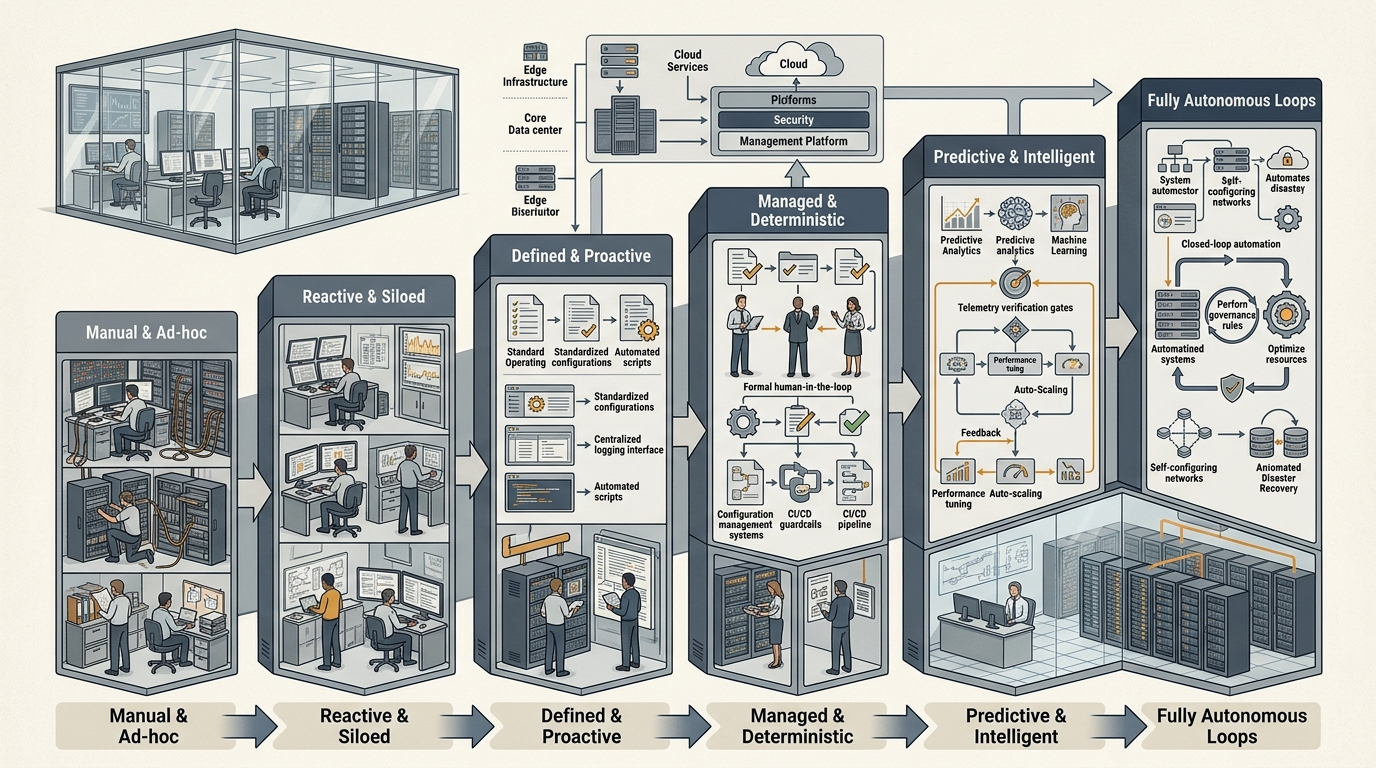
Transitioning from manual infrastructure maintenance to an autonomous operating model is an incremental engineering journey. Presented during Cisco Live 2026 EMEA (session PSOCX-2092), the autonomous architecture maturity framework outlines six distinct stages across six operational disciplines: Fault, Capacity, Configuration, Observability and Assurance, Security, and Availability Management.
| Maturity Level | Operational Model | Decision Authority | Core Capabilities |
|---|---|---|---|
| Level 0: Manual | Static, reactive operations | Human manual execution | Manual CLI troubleshooting, static spreadsheets, ticket-driven change requests. |
| Level 1: Assisted | Scripted execution | Human-initiated automation | Isolated Python or Ansible scripts, basic monitoring alerts, manual root cause analysis. |
| Level 2: Partial Autonomous | Declarative orchestration | System proposes, human executes | Infrastructure as Code (IaC), centralized golden configs, automated compliance scanning. |
| Level 3: Conditional Autonomous | AIOps-assisted triage | System acts within narrow boundaries | Closed-loop remediation for known fault signatures, synthetic pre-change verification, automated rollback. |
| Level 4: Highly Autonomous | Cross-domain agentic orchestration | Autonomous execution with HITL oversight | Autonomous AI agent triage, cross-domain root-cause correlation, dynamic traffic shaping during anomalies. |
| Level 5: Fully Autonomous | Self-healing, self-optimizing fabric | Continuous machine governance | Zero-touch operational lifecycle, predictive capacity planning, self-defending security posture against zero-day threats. |
This maturity progression mirrors the manufacturing sector’s historical shift toward Computer Numerical Control (CNC). Rather than physically turning handwheels, the machinist transitioned to writing, optimizing, and overseeing the G-code that governed the cutting tool. In modern enterprise IT, the operator’s role undergoes an identical metamorphosis. Infrastructure engineers step away from repetitive manual CLI entries and become architects of intent, policy designers, and strategic supervisors of autonomous agents.
Bottom line
Operational obsolescence is no longer an internal efficiency metric; it is an active vulnerability that sophisticated cyber adversaries exploit. Legacy maintenance schedules cannot match the discovery speed of frontier AI models, nor can manual Change Advisory Boards safeguard sprawling multi-cloud topologies. Enterprise technology leaders must approach autonomous operations as a fundamental architectural evolution rather than a simple tooling upgrade.
Organizations should avoid attempting an overnight transition to Level 5 autonomy. The path to operational resilience requires mastering Level 1 and Level 2 baselines: establishing a rigorous single Source of Truth, standardizing data models across all network domains, and implementing deterministic policy-as-code guardrails. By combining machine-speed telemetry with human-governed automation gates, enterprise IT teams can protect critical infrastructure, eliminate systemic operational drift, and ensure continuous business resilience.
Sources
- Beyond Operational Obsolescence: The New Paradigm of IT Management in the AI Era – Cisco Blogs
- From infrastructure as code to autonomous infrastructure operations | IBM
- Infrastructure as Code – Cisco DevNet
- Countering Chinese State-Sponsored Actors Compromise of Networks Worldwide to Feed Global Espionage System | CISA
- PRC State-Sponsored Actors Compromise and Maintain Persistent Access to U.S. Critical Infrastructure | CISA
- Salt Typhoon – Wikipedia