
Key takeaways
- Automated scanners detect unpatched CMS components and exposed endpoints within minutes, requiring strict 72-hour patching SLAs and continuous inventory tracking.
- Broken access control remains the primary attack vector; deploying phishing-resistant FIDO2/WebAuthn multi-factor authentication and automated same-day offboarding closes credential gaps.
- Client-side third-party scripts and tag managers introduce major supply chain risks, requiring Subresource Integrity (SRI) hashes and strict Content Security Policies aligned with PCI DSS v4.0.1.
- Transport encryption requires TLS 1.3 coupled with RFC 6797 HSTS preloading, while perimeter Web Application Firewalls (WAF) provide threat filtering rather than code remediation substitutes.
- Resilience requires isolated, immutable offsite backups with verified semiannual restoration drills and centralized SIEM logging to minimize incident dwell times.
Effective website security best practices in 2026 require strict access controls, rapid dependency patching, modern transport encryption, and automated perimeter defenses to defeat automated scanning and credential abuse. Rather than sophisticated zero-day exploits, most enterprise web compromises stem from preventable operational failures: stolen administrative credentials, abandoned third-party plugins, unsanitized user inputs, and unmonitored scripts. Securing an enterprise web footprint demands proactive governance: enforcing phishing-resistant multi-factor authentication, pruning redundant software supply chain dependencies, deploying a Web Application Firewall with rate limiting, validating all server inputs, and regularly testing offsite backup restorations.
Automated scanning bots inspect thousands of web properties per hour, identifying unpatched content management systems, exposed configuration files, and weak endpoints within minutes of discovery. The proliferation of third-party JavaScript—ranging from analytics tags and payment widgets to embedded AI chat interfaces—has drastically expanded the potential attack surface. At the same time, threat actors leverage automated tooling to conduct credential stuffing campaigns and test known Common Vulnerabilities and Exposures (CVEs) across entire network ranges. A robust defense combines continuous hygiene with defense-in-depth principles.
Enforcing Access Governance and Identity Hardening
Broken access control remains a pervasive vulnerability across corporate websites and web applications. When user privileges are loosely defined or inadequately checked on the server, unauthorized visitors can view restricted data, manipulate customer records, or take administrative control of the CMS. Hardening identity and access management serves as the primary barrier against site-wide compromise.
Modern authentication strategies must transition away from static passwords and SMS-based verification toward phishing-resistant standards. Enterprise security policies must enforce:
- Phishing-resistant multi-factor authentication (MFA): Mandate hardware security keys or cryptographic passkeys conforming to the FIDO Alliance and W3C Web Authentication (WebAuthn) specifications for all administrative, developer, and hosting infrastructure accounts. Legacy two-factor mechanisms relying on SMS or push notifications remain vulnerable to SIM swapping and adversary-in-the-middle proxy attacks.
- Principle of least privilege and strict RBAC: Segment administrative privileges using granular role-based access control. Marketing contributors and copy editors should never hold publishing privileges on themes, plugins, or server settings. Audit privileged roles quarterly to ensure administrative status reflects active job duties.
- Same-day account offboarding: Integrate website CMS and hosting access with central identity providers (IdPs) via Single Sign-On (SSO) and SCIM provisioning. When employees, contractors, or external marketing agencies conclude their engagements, their accounts must be revoked automatically on the same day. Orphaned agency accounts left active indefinitely represent one of the most common pathways for unauthorized entry.
- Endpoint obfuscation and lockout thresholds: Restrict default administrative paths, such as standard WordPress or Drupal login URLs, by placing them behind VPNs or Zero Trust Network Access (ZTNA) gateways. Implement aggressive lockout policies that freeze accounts or challenge connections after repeated unsuccessful attempts, mitigating automated credential stuffing.
Managing the Software Supply Chain and Third-Party Dependencies
Enterprise websites are rarely monolithic; they function as distributed composites of open-source frameworks, database connectors, frontend libraries, analytics beacons, and third-party widgets. The OWASP Top 10 categorizes software supply chain failures as one of the most critical threats facing modern web applications. A single compromised package or malicious registry update can undermine an otherwise well-architected infrastructure.
Unpatched CMS cores and server runtimes present immediate vectors for compromise, as demonstrated when critical remote code execution vulnerabilities in server runtimes require emergency out-of-cycle patching across production environments. Maintaining software integrity requires a formal operational routine:
- Comprehensive component inventory: Maintain an automated Software Bill of Materials (SBOM) tracking every plugin, theme, server-side library, and client-side JavaScript snippet deployed across the digital estate. Automated dependency scanners should cross-reference this inventory against National Vulnerability Database (NVD) entries continuously.
- Rapid patching service level agreements: Establish strict operational windows for security updates. High-severity and critical security patches must be evaluated and deployed within 72 hours, rather than deferred to monthly release cycles. Attackers automate exploitation of disclosed vulnerabilities within hours of public disclosure.
- Eradication of inactive and abandoned software: Deactivated plugins and themes must be permanently uninstalled from production web servers. Merely deactivating an extension leaves vulnerable PHP or JavaScript files directly accessible within the public directory structure, enabling remote execution even while the plugin is dormant inside the CMS dashboard.
- Staging validation and automated regression testing: Never apply security patches directly to production environments. Execute automated regression suites in isolated staging replicas that mirror production server configurations, database structures, and caching layers to ensure stability before final promotion.
Hardening Transport Security and Browser Policies
Transport Layer Security (TLS) forms the baseline of web communication, yet basic HTTPS implementation is insufficient on its own. Attackers exploit missing response directives to execute man-in-the-middle downgrades, clickjacking, and cross-site scripting (XSS). Engineering teams must configure modern TLS alongside strict browser security headers.
Web servers and content delivery networks (CDNs) must enforce TLS 1.3 exclusively, deprecating TLS 1.0 and 1.1 alongside weak legacy cipher suites. In addition, HTTP response headers must be configured to dictate browser security boundaries directly to connecting clients:
| Header Name | Targeted Threat Vector | Recommended Policy Directive | Operational Validation Method |
|---|---|---|---|
| Strict-Transport-Security | SSL stripping, protocol downgrade, and cookie interception | max-age=63072000; includeSubDomains; preload |
Verify via RFC 6797 compliance and submit domain to the HSTS preload list. |
| Content-Security-Policy | Cross-site scripting (XSS), data exfiltration, and code injection | default-src 'self'; script-src 'nonce-{RANDOM}' 'strict-dynamic'; object-src 'none' |
Validate with W3C CSP Level 3 evaluators and monitor violation reports via the Reporting API. |
| X-Frame-Options | Clickjacking, UI redressing, and unauthorized iframe embedding | DENY (or CSP frame-ancestors 'none') |
Inspect HTTP response headers via automated browser testing suites. |
| Referrer-Policy | Sensitive URL parameter leakage to external third-party origins | strict-origin-when-cross-origin |
Verify referrer string truncation across external outbound links. |
| Permissions-Policy | Unauthorized access to browser hardware and privileged APIs | camera=(), microphone=(), geolocation=(), payment=() |
Test browser API feature gating using automated integration tests. |
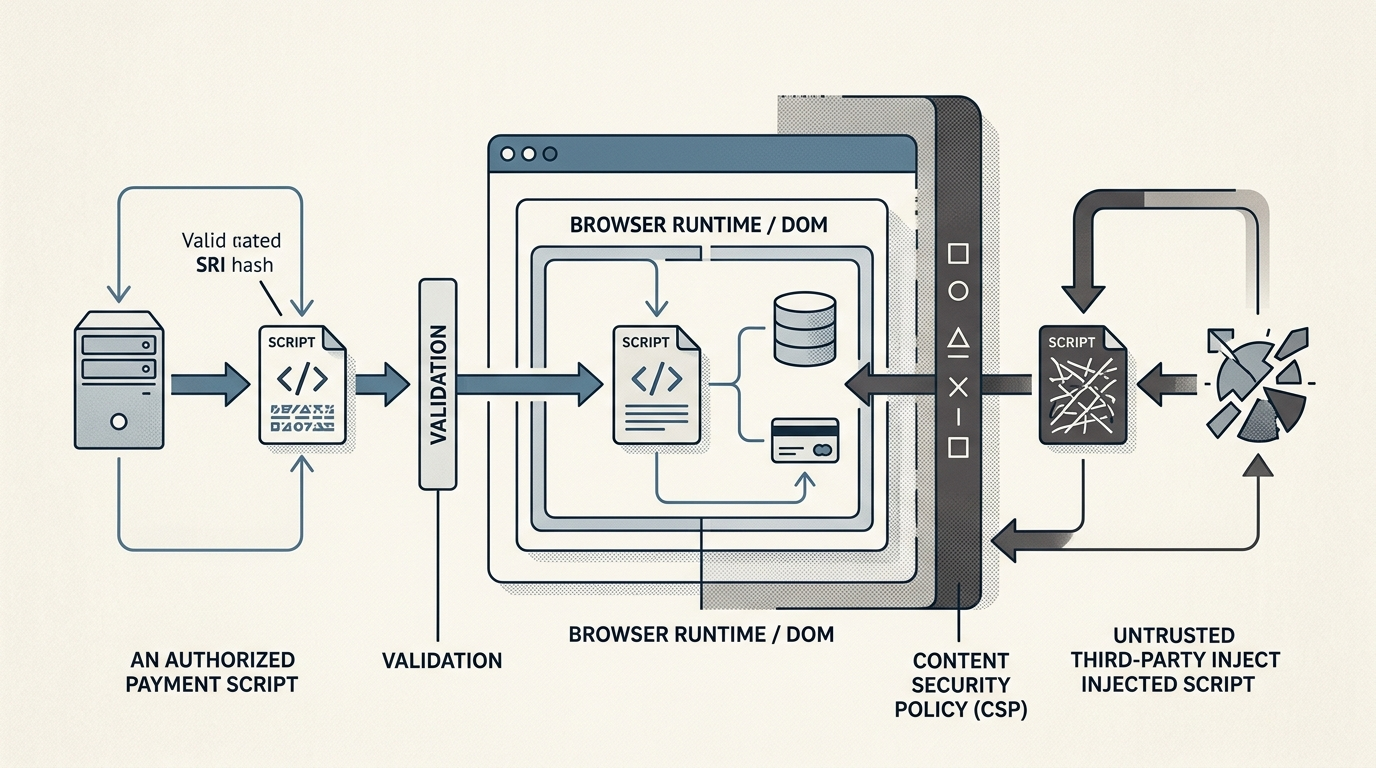
Implementing a strict Content Security Policy requires particular attention to script management. Moving from brittle domain allowlists to cryptographic nonces or hashes prevents malicious scripts from executing even if an attacker successfully injects HTML into a database-backed field.
Deploying Perimeter Defenses and Validating Inputs
Perimeter defenses filter malicious inbound traffic before it interacts with application business logic. Deploying an enterprise Web Application Firewall (WAF) coupled with rate limiting blunts automated reconnaissance, SQL injection probes, and distributed denial-of-service (DDoS) floods.
However, a WAF represents a tactical defensive layer rather than a substitute for code-level remediation. While a firewall suppresses malicious traffic patterns and buys critical response time during an active disclosure, underlying vulnerabilities in application code must still be patched. In conjunction with perimeter filtering, robust input validation must be enforced at the application tier:
- Server-side data validation and sanitization: Client-side JavaScript validation serves usability but offers zero security protection, as any attacker can bypass frontend controls using direct HTTP clients. All inbound payloads must be strictly validated against rigid schemas and sanitized on the server before processing.
- Parameterized queries and prepared statements: Eliminate SQL injection by decoupling SQL code from user-supplied data. Utilize Object-Relational Mapping (ORM) frameworks correctly or execute parameterized queries through prepared statements across every database interaction.
- Hardened file upload architecture: File uploads represent severe risk if mismanaged. Restrict uploads strictly to necessary MIME types, re-encode images to strip embedded script tags, randomize stored filenames, and store uploaded assets in isolated cloud object storage containers detached from the application execution root.
- API authentication and authorization controls: Validate authentication tokens and cryptographic signatures on every API request. Enforce strict object-level authorization checks to verify that the authenticated user possesses explicit permissions to access the requested data record, preventing Broken Object Level Authorization (BOLA).
- Granular rate limiting: Restrict request velocity on authentication routes, password reset endpoints, and computationally intensive search queries. Enforcing progressive delays and CAPTCHA challenges neutralizes automated brute-force attempts and resource exhaustion attacks.
Architecting High-Assurance Websites for Regulated Platforms
Financial institutions, healthcare organizations, and regulated enterprises operate under stringent regulatory mandates and elevated threat profiles. In these environments, security architecture cannot be retrofitted post-launch; it must be incorporated into initial wireframes, data flows, and system designs.
Regulated organizations must navigate strict governance frameworks that dictate explicit technical controls across their web properties:
- Client-side script integrity and monitoring: Under the PCI Security Standards Council PCI DSS v4.0.1 standard, Requirements 6.4.3 and 11.6.1 enforce rigorous management of payment pages. Organizations must maintain an authorized inventory of all scripts executing within consumer browsers, establish business justifications for each script, verify cryptographic integrity via Subresource Integrity (SRI) hashes, and run continuous tamper-detection checks at least weekly to prevent digital skimming and formjacking.
- Session management and re-authentication: Implement conservative session timeout thresholds and invalidate session tokens on logout across both client and server state. Sensitive operations—such as adding funds recipients, modifying profile email addresses, or changing security settings—must mandate explicit step-up authentication using biometric passkeys or hardware tokens.
- Data minimization and cryptographic masking: Enforce data privacy principles aligned with GDPR and CCPA. Restrict data collection to mandatory transaction fields, tokenize payment details immediately, and mask sensitive values (such as account numbers and tax identifiers) on rendered screens to mitigate shoulder surfing and credential leakage.
- Independent verification and penetration testing: Augment internal automated tooling with regular third-party security audits. Conduct comprehensive manual penetration tests at least annually and immediately following major architectural redesigns, cloud migrations, or third-party service integrations.
Resilience Through Isolated Backups and Active Auditing
Preventative controls drastically decrease breach probability, but enterprise security programs must plan for eventual compromise. Rapid operational recovery depends entirely on the availability of untampered data backups and actionable audit logs.
A reliable disaster recovery posture requires isolating backups outside the primary server and cloud provider environment. Offsite, immutable backups protected by Write Once, Read Many (WORM) storage policies prevent ransomware or rogue credentials from deleting recovery points. Furthermore, organizations must test backup restoration at least twice per year. A backup routine that has never undergone practical restoration testing represents an unverified assumption that frequently fails during an active crisis.
Simultaneously, comprehensive logging must track administrative logins, privilege elevations, configuration modifications, and repeated failed requests. Centralizing web logs into a Security Information and Event Management (SIEM) platform enables automated anomaly detection, alerting security teams to anomalous geographic logins or mass database export operations. Because malicious actors frequently dwell inside compromised environments for weeks before initiating ransomware or data exfiltration, centralized telemetry significantly reduces discovery dwell times.
Implementation checklist
This operational checklist outlines prioritized implementation actions for IT leaders, enterprise architects, and engineering teams to establish a resilient website security baseline:
- Identity & Access Controls:
- Mandate FIDO2/WebAuthn passkeys or hardware tokens on all CMS, hosting, and DNS control portals.
- Implement automated same-day offboarding integrated with enterprise Single Sign-On and SCIM directory sync.
- Audit administrative privileges across all web properties and restrict access using least-privilege RBAC.
- Software Supply Chain Governance:
- Generate and maintain an active Software Bill of Materials (SBOM) for all CMS plugins, core frameworks, and dependencies.
- Permanently delete inactive plugins, themes, and obsolete server scripts from file systems.
- Establish a strict 72-hour deployment SLA for high-severity security patches, validated on isolated staging environments.
- Transport & Browser Policy Enforcement:
- Enforce TLS 1.3 exclusively across all endpoints and deprecate legacy cryptographic ciphers.
- Deploy HSTS with the
includeSubDomainsdirective and enroll the root domain in the HSTS preload registry. - Implement a strict Content Security Policy (CSP Level 3) utilizing nonces or hashes to block unauthorized inline script execution.
- Edge & Application Defense:
- Route traffic through an enterprise Web Application Firewall configured with automated bot mitigation.
- Enforce granular rate limiting on login portals, search interfaces, and public API endpoints.
- Verify that all user inputs undergo rigid server-side schema validation and database interactions use parameterized queries.
- Client-Side Governance (Regulated & E-Commerce Sites):
- Audit all third-party tags and scripts on checkout and sensitive pages, verifying Subresource Integrity (SRI) hashes.
- Deploy continuous client-side tamper monitoring to fulfill PCI DSS v4.0.1 Requirements 6.4.3 and 11.6.1.
- Enforce step-up re-authentication for sensitive transactions and account profile changes.
- Operational Resilience & Telemetry:
- Configure automated, encrypted, and immutable offsite backups, conducting restoration drills semiannually.
- Forward web server and CMS audit logs to a centralized SIEM with real-time alerting for privilege anomalies.
- Schedule annual third-party penetration tests and post-redesign security assessments.